From Surf Wiki (app.surf) — the open knowledge base
Leominster
Town in Herefordshire, England

Town in Herefordshire, England
| Field | Value |
|---|---|
| country | England |
| coordinates | |
| static_image_name | Leominster Priory.jpg |
| static_image_caption | Leominster Priory |
| population | 11,959 |
| population_ref | (2021 Census) |
| official_name | Leominster |
| civil_parish | Leominster |
| unitary_england | Herefordshire |
| region | West Midlands |
| lieutenancy_england | Herefordshire |
| constituency_westminster | North Herefordshire |
| post_town | LEOMINSTER |
| postcode_area | HR |
| postcode_district | HR6 |
| dial_code | 01568 |
| os_grid_reference | SO496591 |
Leominster ( ) is a market town in Herefordshire, England; it is located at the confluence of the River Lugg and its tributary the River Kenwater. The town is 12 mi north of Hereford and 7 mi south of Ludlow in Shropshire. With a population of almost 12,000, Leominster is the largest of the five towns in the county; the others being Ross-on-Wye, Ledbury, Bromyard and Kington.
From 1974 to 1996, Leominster was the administrative centre for the former local government district of Leominster.
Toponymy
The town, previously spelled 'Lemster', takes its name from the English word minster, meaning a community of clergy and the original Celtic name for the district Leon or Lene, probably in turn from an Old Welsh root lei to flow. The Welsh name for Leominster is Llanllieni, with Llan suggesting a possible Celtic origin to the town's religious community.
Contrary to certain reports, the name has nothing to do with Leofric, an 11th-century Earl of Mercia (most famous for being the legendarily miserly husband of Lady Godiva).
History
During the Early Middle Ages, Leominster was home to Æthelmod of Leominster, an English saint known to history mainly through the hagiography of the Secgan Manuscript. He is reputedly buried in Leominster.
During the 8th and 9th Century, Danes (or Vikings) frequently raided the area. In 2015, two individuals (operating without landowner permission), using metal detectors, found a large hoard near Leominster (the Herefordshire hoard) consisting primarily of Saxon jewellery and silver ingots but also coins; the latter date to around 879 AD. According to a news report, "experts believe it was buried by a Viking during a series of raids", while Wessex was ruled by Alfred the Great and Mercia by Ceolwulf II of Mercia.
According to the Anglo-Saxon Chronicle, a raid by Gruffudd ap Llywelyn on Leominster in 1052 resulted in the Battle of Llanllieni, between the Welsh and a combined force of Normans (mercenaries) and English Saxons.
Henry I bestowed the minster and its estates on Reading Abbey, which founded a priory at Leominster in 1121, although there was one here from Saxon times. Its Priory Church of St. Peter and St. Paul, which now serves as the parish church, is the remaining part of this 12th-century Benedictine monastery. Quatrefoil piers were inserted between 1872–79 by Sir George Gilbert Scott.
The priory was ransacked by the Welsh forces of Owain Glyndŵr after their victory at the Battle of Bryn Glas near Pilleth in 1402, along with several local manor houses.
Investigations to the north of the priory in 2005 located the position of the cloister, although most of the stone had been stolen following the Dissolution. Discarded animal bones found on the site when submitted to carbon dating showed that the area was occupied in the 7th century. This agrees with the date of 660 AD associated with the founding myth, which suggests a Christian community was established here by a monk, St. Eadfrith, originally from Lindisfarne in Northumbria.
Leominster is also the historical home of Ryeland sheep, a breed once famed for its wool, known as 'Lemster ore'. This wool was prized above all other English wool in trade with the continent of Europe in the Middle Ages. It was the income and prosperity from this wool trade that established the town and the minster and attracted the envy of the Welsh and other regions.
From approximately 1748 to 1754, Pinsley Mill in Leominster was home to one of the Paul-Wyatt cotton mills, the first four cotton mills in the world, employing the spinning machines of Lewis Paul and John Wyatt. The mill was financed by Lancashire native Daniel Bourn, and was partly owned by other men from Lancashire. Bourn introduced his own version of the carding engine to work at this mill, and of the four Paul-Wyatt mills, it may have been the most successful, as shortly after the fire that destroyed the mill, it was reported that the cotton works "had been viewed with great pleasure and admiration by travellers and all who had seen them."
One of the last ordeals by ducking stool took place in Leominster in 1809, with Jenny Pipes as the final incumbent. The ducking stool is on public display in Leominster Priory; a mechanised depiction of it is featured on the town clock.
Climate
The town has a maritime climate, with mild winters and summers. The data below is from a weather station in Shobdon.
|Jan record high C = 14.9 |Feb record high C = 17.2 |Mar record high C = 22.3 |Apr record high C = 24.6 |May record high C = 26.6 |Jun record high C = 30.8 |Jul record high C = 35.0 |Aug record high C = 33.1 |Sep record high C = 29.5 |Oct record high C = 27.2 |Nov record high C = 18.0 |Dec record high C = 15.2 |Jan record low C = -12.2 |Feb record low C = -9.5 |Mar record low C = -7.8 |Apr record low C = -4.9 |May record low C = -2.3 |Jun record low C = 0.2 |Jul record low C = 2.6 |Aug record low C = 2.4 |Sep record low C = -0.7 |Oct record low C = -5.6 |Nov record low C = -9.5 |Dec record low C = -16.9 |access-date = 15 December 2024}} |access-date= 16 December 2024 |archive-date= 1 February 2023 |archive-url= https://web.archive.org/web/20230201173843/http://starlingsroost.ddns.net/weather/ukobs/temp_month_record_tmax_map.php |url-status= dead
Transport
Leominster railway station is managed by Transport for Wales, who operate services on the Welsh Marches Line between South Wales and North West England. Direct services run to Cardiff, Hereford, Ludlow, Shrewsbury, Crewe and Manchester.
The town has a bus station which is the focal point for its bus services. Routes are operated by Lugg Valley Travel and First Worcester, which link Leominster with Hereford, Ludlow and Ledbury.
Leominster is a primary destination on Great Britain's road network, being where the north-south A49 and east-west A44 roads meet. At Leominster, roads are signed towards Rhayader (A44 westbound), Worcester (A44 eastbound), Shrewsbury (A49 northbound) and Hereford (A49 southbound).
Schools
Earl Mortimer College, is a state comprehensive school providing secondary education for about 650 pupils. It was formerly known as the Minster School. There is also Leominster Primary School and Westfield's Special School. Primary schools in the villages around the town include Ivington, Kimbolton, Kingsland, Luston and Stoke Prior.
Media
In print, Leominster is served by the Hereford Times, The Leominster News and the Teme Valley Times. Local TV coverage are provided by BBC West Midlands and ITV Central. Television signals are received from the Ridge Hill TV transmitter. Local radio stations are Sunshine Radio, Sunshine 855, BBC Hereford & Worcester, Hits Radio Herefordshire & Worcestershire and Greatest Hits Radio Herefordshire & Worcestershire.
Notable people
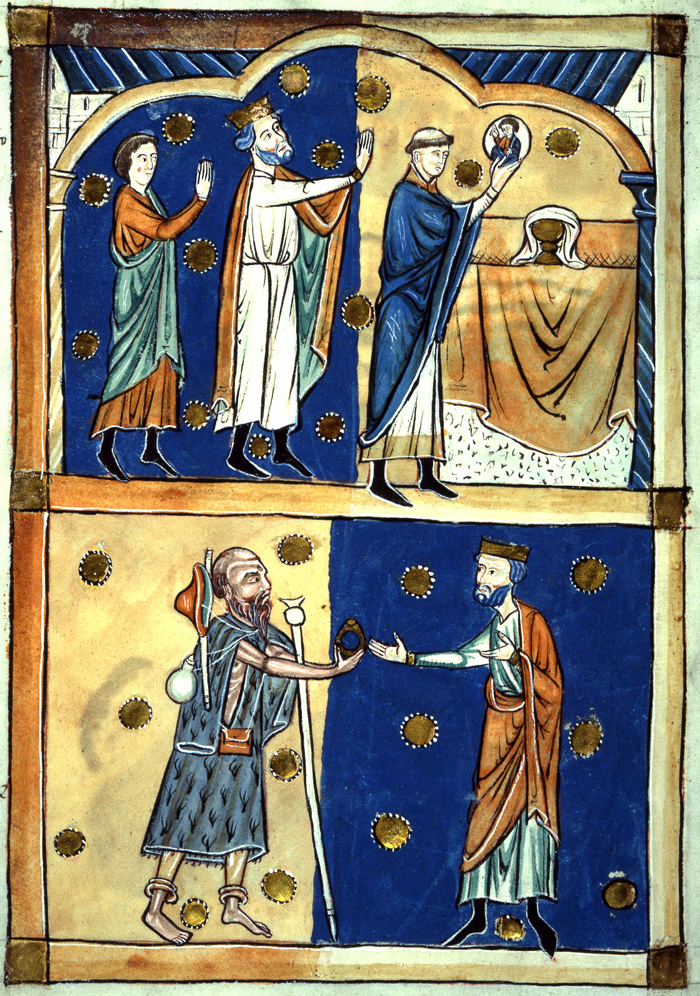


- Saint Cuthfleda was the abbess of Leominster nunnery and the patroness of the region. She was known for her holiness and her chaste life.
- Æthelmod of Leominster an Anglo-Saxon Saint
- Leofric, Earl of Mercia (died 1057) and his wife Godgifu Lady Godiva – are commemorated as benefactors of the monastery at Leominster
- Sir Philip Hoby (1505–1558), English Ambassador to the Holy Roman Empire and Flanders.
- Sir Thomas Hoby (1530–1566), English diplomat and translator.
- Nicholas Woodfen (1550-1586), Roman Catholic priest who was hanged, drawn and quartered at Tyburn, London in 1586.
- John Abel (1578/9–1675), carpenter and mason, entitled King's Carpenter, who was responsible for several notable ornamented half-timbered buildings, like, Grange Court (1633).
- Sir George Caswall (died 1742), banker, politician and MP for Leominster, 1717/1741.
- John Ward (1704–1773) an English actor and theatre manager.
- John Scarlett Davis (1804–1845), painter and lithographer, several of his works are in Leominster Museum.
- Frederick William Evans (1808–1893), a Shaker writer, elder in the Mount Lebanon Shaker Society.
- Richard Arkwright (1835–1918), barrister, politician and MP for Leominster, 1866-1876
- Henry Stanley Newman (1837–1912), grocer, Quaker philanthropist and author.
- Sir George Newman (1870–1948), public health physician, Quaker, the first Chief Medical Officer
- Arthur Peppercorn (1889–1951), locomotive designer
- Dorothy Bowers (1902–1948), mystery novelist and crossword puzzle compiler.
- Paddie O'Neil (1926-2010), actress and singer, was born at Leominster while her parents were appearing in a fairground there.
- Sir John Craven (1940–2022), financier, chairman of Deutsche Morgan Grenfell Group plc
Sport
- Mary Rudge (1842–1919), an English chess master.
- Harry Gill (1881–1968), gymnast, competed at the 1908 Summer Olympics
- Jarrod Bowen (born 1996), footballer played over 340 games including 210 for West Ham United and 20 for England.
Twin towns
Leominster is twinned with Saverne in eastern France and Tengeru in Tanzania.
Local attractions
- Croft Castle
- Berrington Hall
- Grange Court
- Priory Church, Leominster
- Queen's Wood Country Park
Notes
References
References
- "Leominster".
- (2011). "Neighbourhood Statistics – Area: Leominster (Parish) – Sex, 2021 (QS104EW)". [[Office for National Statistics]].
- J. & C. Hillaby, ''Leominster Minster, Priory, and Borough c.660–1539'' (Logaston Press, Almeley, Herefs. 2006), 4–5.
- link. (3 January 2014 , British Library)
- (22 November 2019). "MILLIONS OF DOLLARS OF VIKING TREASURE THAT COULD REWRITE HISTORY STOLEN, METAL DETECTORISTS CONVICTED". Newsweek.
- Evans, Gwynfor. (1974). "Land of My Fathers: 2000 Years of Welsh History". Y Lolfa.
- Hillaby, 53-7
- ''The Buildings of England: Herefordshire'', Nikolaus Pevsner, (1963) p226 {{ISBN. 0-14-071025-6
- "Our History". Leominster Priory.
- (1931). "The Cotton Trade and Industrial Lancashire, 1600–1780". Manchester University Press.
- Manchester Mercury, reported on 5 November 1754
- Rejali, Darius. (2009). "Torture and democracy". Princeton University Press.
- (5 August 2009). "Herefordshire clock on go slow". [[Hereford Times]].
- (May 2023). "Timetables". Transport for Wales.
- (2023). "Leominster Bus Services". Bus Times.
- (21 June 2017). "At school in the 90s or 00s? Check out our photo archive from the Minster College in Leominster". Hereford Times.
- (1 May 2004). "Full Freeview on the Ridge Hill (County of Herefordshire, England) transmitter".
- [http://oxfordindex.oup.com/view/10.1093/acref/9780199596607.013.0406 Cuthfleda], ''Oxford Dictionary of Saints'', 5th ed, 2011. Accessed 5 January 2014.
- The Chronicle of John of Worcester ed. and trans. R.R. Darlington, P. McGurk and J. Bray (Clarendon Press: Oxford 1995), pp.582–3.
- {{cite DNB. Goodwin. Gordon. ()
- {{cite DNB. Goodwin. Gordon. ()
- {{CathEncy. Pollen. John Hungerford
- "[http://www.grangecourt.org/history-and-heritage/history-page-1-john-abel/ John Abel, King's carpenter]", Grange Court website. Accessed 5 January 2014.
- Hobbs, Tony. (2004). "John Scarlett Davis: A Biography". Logaston Press.
- {{cite DNB. Radford. Ernest. ()
- {{Cite AmCyc. .
- link. (6 January 2014 ", A1 Steam Locomotive Trust. Accessed 5 January 2014.)
- [https://www.theguardian.com/stage/2010/mar/25/paddie-oneil-obituary Obituary ''The Guardian'', 26 March 2010]
- Fisher, Ben. (16 January 2019). "Jarrod Bowen: from playing without pay to scoring for fun at Hull".
This article was imported from Wikipedia and is available under the Creative Commons Attribution-ShareAlike 4.0 License. Content has been adapted to SurfDoc format. Original contributors can be found on the article history page.
Ask Mako anything about Leominster — get instant answers, deeper analysis, and related topics.
Research with MakoFree with your Surf account
Create a free account to save articles, ask Mako questions, and organize your research.
Sign up freeThis content may have been generated or modified by AI. CloudSurf Software LLC is not responsible for the accuracy, completeness, or reliability of AI-generated content. Always verify important information from primary sources.
Report