From Surf Wiki (app.surf) — the open knowledge base
Lemniscate of Bernoulli
Plane algebraic curve
Plane algebraic curve
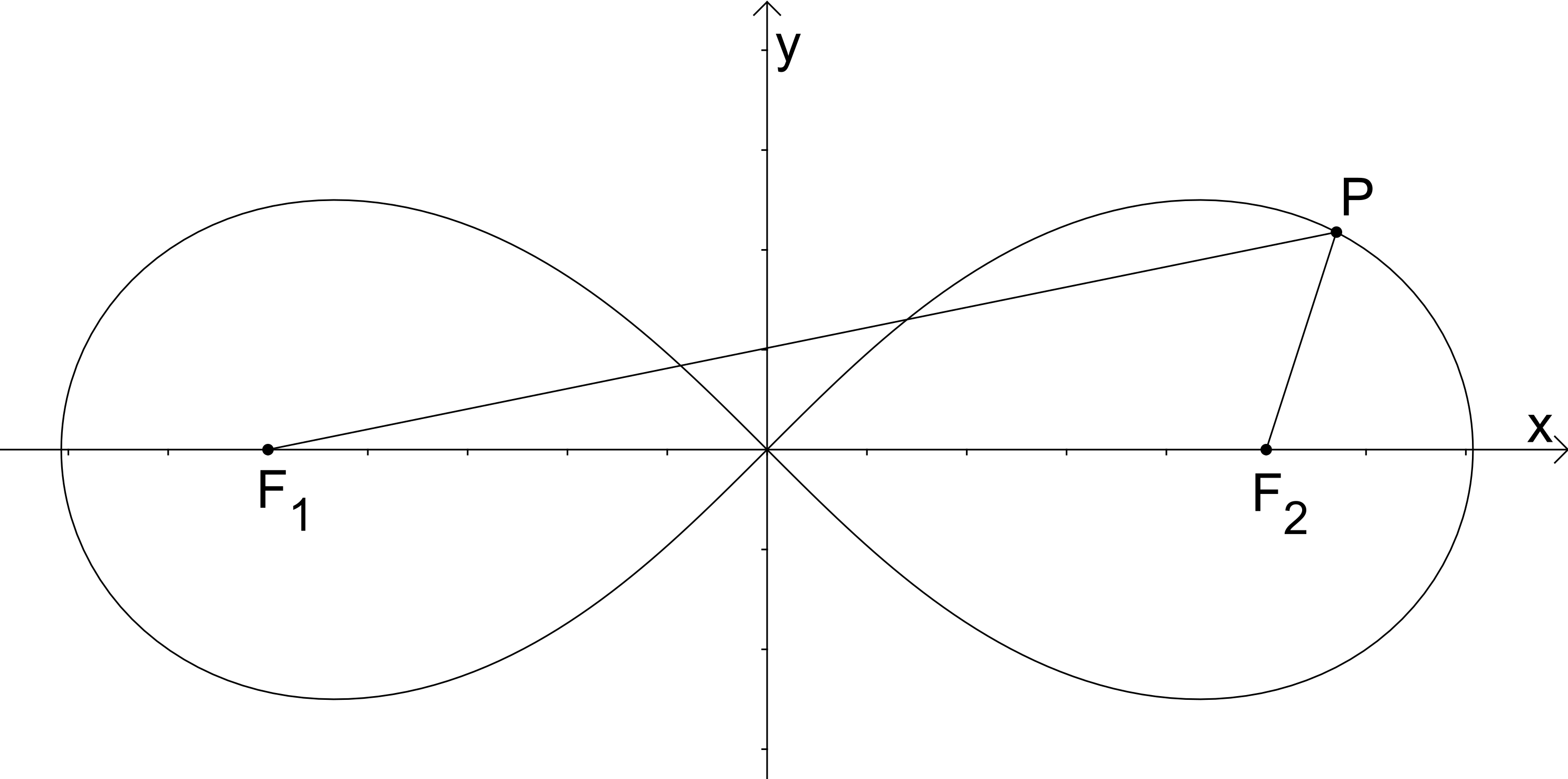
In geometry, the lemniscate of Bernoulli is a plane curve whose shape resembles the numeral 8 or the ∞ symbol. It can be defined from two given points and , called the foci, as the locus of points satisfying the relation |PF_1|\cdot|PF_2| = c^2, where the notation |AB| means the distance between two points and , and c = \tfrac12|F_1F_2| is half the distance between foci. The name lemniscate derives from the Latin word , meaning "decorated with hanging ribbons". The lemniscate of Bernoulli is a special case of the Cassini oval and is a rational algebraic curve of degree four.
The curve was first studied in 1694 by Jakob Bernoulli, who introduced it as a modification of an ellipse. An ellipse is defined as the locus of points for which the sum of the distances to two fixed focal points is constant, whereas a Cassini oval is defined as the locus of points for which the product of these distances is constant. The lemniscate of Bernoulli is the special case of a Cassini oval which passes through the midpoint between its foci.
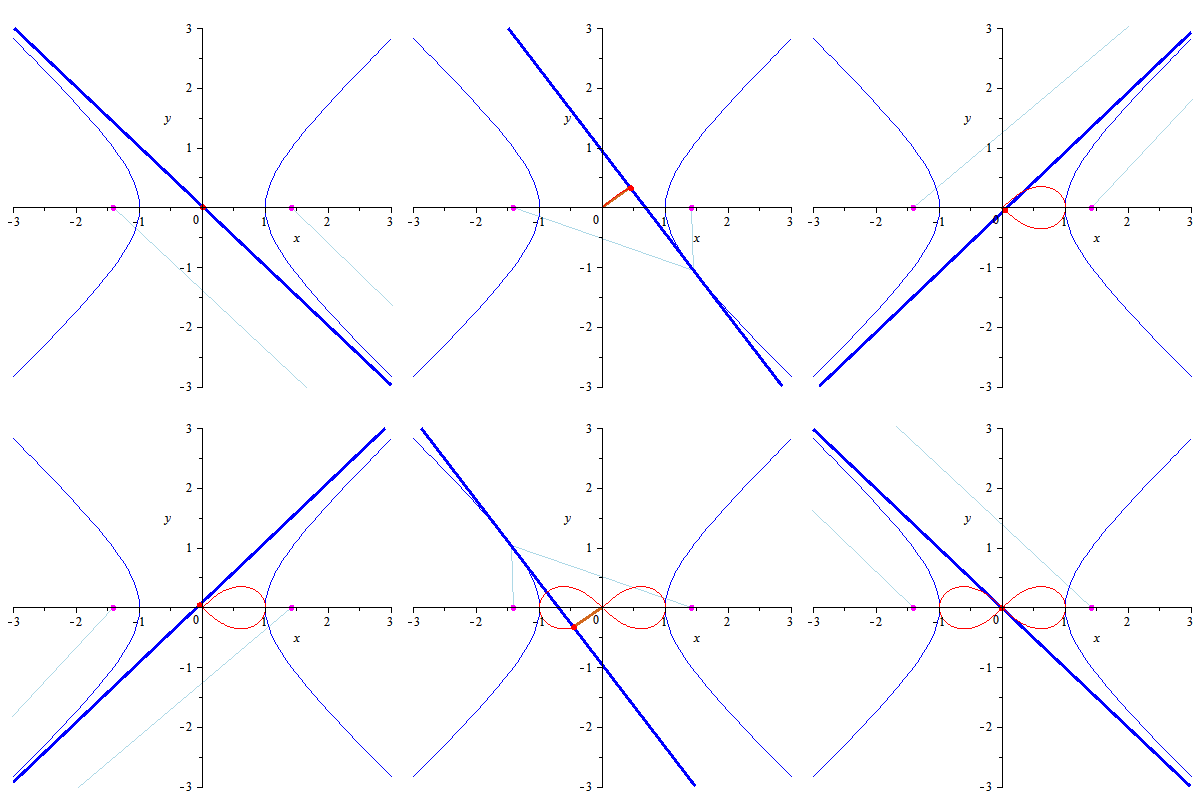
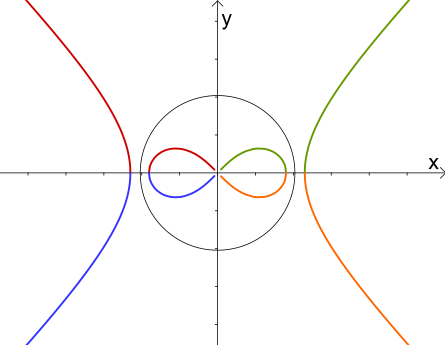
The lemniscate of Bernoulli results from applying a circle inversion transformation to a hyperbola, where the center of inversion is the midpoint of the hyperbola's foci. It can also be drawn mechanically using a mechanical linkage known as Watt's linkage, provided that the lengths of the three bars and the distance between the fixed endpoints are chosen to form an crossed parallelogram.
Equations
The lemniscate of Bernoulli may be described using either the focal parameter or the half-width . These parameters are related by .
- In Cartesian coordinates (up to translation and rotation): \begin{align} \left(x^2 + y^2\right)^2 &= a^2\left(x^2 - y^2\right) \ &= 2c^2\left(x^2 - y^2\right) \end{align}
- Solved for as a function of : y^2 = \left(\sqrt{8x^2 + a^2} - a\right)\frac{a}{2} - x^2
- As a parametric equation: x = \frac{a\cos t}{1 + \sin^2 t}, \qquad y = \frac{a\sin t\cos t}{1 + \sin^2 t}
- A rational parametrization:x = a\frac{t + t^3}{1 + t^4}, \qquad y = a\frac{t - t^3}{1 + t^4}
- In polar coordinates: r^2 = a^2\cos 2\theta
- In the complex plane: |z - c|\cdot|z + c| = c^2
- In two-center bipolar coordinates:rr' = c^2
Arc length and elliptic functions
Main article: Lemniscate elliptic functions

The determination of the arc length of arcs of the lemniscate leads to elliptic integrals, as was discovered in the eighteenth century. Around 1800, the elliptic functions inverting those integrals were studied by C. F. Gauss (largely unpublished at the time, but allusions in the notes to his Disquisitiones Arithmeticae). The period lattices are of a very special form, being proportional to the Gaussian integers. For this reason the case of elliptic functions with complex multiplication by is called the lemniscatic case in some sources.
Using the elliptic integral :\operatorname{arcsl}x \stackrel{\text{def}} \int_0^x\frac{dt}{\sqrt{1-t^4}} the formula of the arc length L can be given as :\begin{align} L &= 4a \int_{0}^1\frac{dt}{\sqrt{1-t^4}} = 4a,\operatorname{arcsl}1 = 2\varpi a \[6pt] &= \frac{\Gamma (1/4)^2}{\sqrt\pi},c =\frac{2\pi}{\operatorname{M}(1,1/\sqrt{2})}c\approx 7{.}416 \cdot c \end{align} where c and a = \sqrt{2}c are defined as above, \varpi = 2 \operatorname{arcsl}{1} is the lemniscate constant, \Gamma is the gamma function and \operatorname{M} is the arithmetic–geometric mean.
Angles
Given two distinct points \rm A and \rm B, let \rm M be the midpoint of \rm AB. Then the lemniscate of diameter \rm AB can also be defined as the set of points \rm A, \rm B, \rm M, together with the locus of the points \rm P such that |\widehat{\rm APM}-\widehat{\rm BPM}| is a right angle (cf. Thales' theorem and its converse).

The following theorem about angles occurring in the lemniscate is due to German mathematician Gerhard Christoph Hermann Vechtmann, who described it 1843 in his dissertation on lemniscates.
:F1 and F2 are the foci of the lemniscate, O is the midpoint of the line segment F1F2 and P is any point on the lemniscate outside the line connecting F1 and F2. The normal n of the lemniscate in P intersects the line connecting F1 and F2 in R. Now the interior angle of the triangle OPR at O is one third of the triangle's exterior angle at R (see also angle trisection). In addition the interior angle at P is twice the interior angle at O.
Further properties
- The lemniscate is symmetric to the line connecting its foci F1 and F2 and as well to the perpendicular bisector of the line segment F1F2.
- The lemniscate is symmetric to the midpoint of the line segment F1F2.
- The area enclosed by the lemniscate is .
- The lemniscate is the circle inversion of a hyperbola and vice versa.
- The two tangents at the midpoint O are perpendicular, and each of them forms an angle of with the line connecting F1 and F2.
- The planar cross-section of a standard torus tangent to its inner equator is a lemniscate.
- The curvature at (x,y) is {3\over a^2}\sqrt{x^2+y^2}. The maximum curvature, which occurs at (\pm a,0), is therefore 3/a.
Notes
References
References
- (2008). "How round is your circle? Where Engineering and Mathematics Meet". Princeton University Press.
- Lemmermeyer, Franz. (2011). "Parametrizing Algebraic Curves".
- (2004). "The Number Pi". American Mathematical Society.
- Alexander Ostermann, Gerhard Wanner: ''Geometry by Its History.'' Springer, 2012, pp. [https://books.google.com/books?id=eOSqPHwWJX8C&pg=PA207 207-208]
This article was imported from Wikipedia and is available under the Creative Commons Attribution-ShareAlike 4.0 License. Content has been adapted to SurfDoc format. Original contributors can be found on the article history page.
Ask Mako anything about Lemniscate of Bernoulli — get instant answers, deeper analysis, and related topics.
Research with MakoFree with your Surf account
Create a free account to save articles, ask Mako questions, and organize your research.
Sign up freeThis content may have been generated or modified by AI. CloudSurf Software LLC is not responsible for the accuracy, completeness, or reliability of AI-generated content. Always verify important information from primary sources.
Report