From Surf Wiki (app.surf) — the open knowledge base
Leland Stanford
Governor of California from 1862 to 1863

Governor of California from 1862 to 1863
| Field | Value |
|---|---|
| name | Leland Stanford |
| image | Leland Stanford, photographed in 1890 (cropped).jpg |
| caption | Stanford in 1890 |
| jr/sr | United States Senator |
| state | California |
| term_start | March 4, 1885 |
| term_end | June 21, 1893 |
| predecessor | James T. Farley |
| successor | George Clement Perkins |
| order1 | 8th |
| office1 | Governor of California |
| term_start1 | January 10, 1862 |
| term_end1 | December 10, 1863 |
| lieutenant1 | John F. Chellis |
| predecessor1 | John Gately Downey |
| successor1 | Frederick Ferdinand Low |
| birth_name | Amasa Leland Stanford |
| birth_date | |
| birth_place | Watervliet, New York, U.S. |
| death_date | |
| death_place | Palo Alto, California, U.S. |
| party | Republican (from 1856) |
| otherparty | Whig (until 1856) |
| spouse | |
| children | Leland Jr. |
| alma_mater | Cazenovia Seminary |
| occupation | |
| signature | Leland Stanford Signature.svg |
|jr/sr = United States Senator
Amasa Leland Stanford (March 9, 1824June 21, 1893) was an American attorney, industrialist, philanthropist, and Republican Party politician from Watervliet, New York. He served as the eighth governor of California from 1862 to 1863 and represented the state in the United States Senate from 1885 until his death in 1893. Stanford and his wife Jane founded Stanford University, named after their late son.
Stanford became a successful merchant and wholesaler after migrating to California in 1852 during the gold rush; he built a business empire. Stanford was an influential executive of the Central Pacific Railroad and later of the Southern Pacific railroads from 1861 to 1890; these positions gave him tremendous power in the Western United States which left a lasting impact on California. | editor-last1=Goethals | editor-first1=George R. | display-authors=et al. | title=Encyclopedia of Leadership, Volume 2| date = 29 February 2004 | publisher=Sage Publications | url = https://books.google.com/books?id=v3uiCQAAQBAJ | page=897 | chapter = Legacy |isbn = 978-1-4522-6530-8 Stanford also played a significant role as a shareholder and executive in the early history of Pacific Life and Wells Fargo. He was the first Republican governor of California. Stanford is widely considered a robber baron.
Early life and career
Leland Stanford was born on March 9, 1824, in what was then Watervliet, New York (now the Town of Colonie). He was one of eight children of Josiah and Elizabeth Phillips Stanford. Among his siblings were New York State Senator Charles Stanford (1819–1885) and Australian businessman and spiritualist Thomas Welton Stanford (1832–1918). His ancestor, Thomas Stanford, settled in Charlestown, Massachusetts, in the 17th century. Later ancestors settled in the eastern Mohawk Valley of central New York about 1720.
Stanford's father was a farmer of some means. Stanford was raised on family farms in the Lisha Kill and Roessleville (after 1836) areas of Watervliet. The family home in Roessleville was called Elm Grove. The Elm Grove home was razed in the 1940s. Stanford attended the common school until 1836 and was tutored at home until 1839. He attended Clinton Liberal Institute, in Clinton, New York, and studied law at Cazenovia Seminary in Cazenovia, New York, in 1841 to 1845. In 1845, Stanford entered the law office of Wheaton, Doolittle, and Hadley in Albany.
After being admitted to the bar in 1848, Stanford moved with many other settlers to Port Washington, Wisconsin, where he began a law practice with Wesley Pierce. His father presented him with a law library said to be the finest north of Milwaukee. In 1850, Stanford was nominated by the Whig Party as Washington County, Wisconsin, district attorney.
Businesses
In 1852, having lost his law library and other property to a fire, Stanford followed his five brothers to California during the California gold rush. His wife, Jane, returned (temporarily) to Albany and her family. Stanford went into business with his brothers and became the keeper of a general store for miners in Michigan City, California, later the name changed to Michigan Bluff in Placer County; later, he had a wholesale house. Stanford served as a justice of the peace and helped organize the Sacramento Library Association, which later became the Sacramento Public Library. In 1855, he returned to Albany to join his wife, but found the pace too slow after the excitement of developing California.
Central Pacific and Southern Pacific railroads
The Central Pacific's first locomotive, named Gov. Stanford in his honor, is preserved on static display at the California State Railroad Museum, in Sacramento.
Stanford ran unsuccessfully for governor of California in 1859. He was nominated again in 1861 and won the election. Due to the Great Flood of 1862, Stanford had to row to his inauguration in a rowboat. He served one term, then limited to two years.
While the Central Pacific was under construction, Stanford and his associates in 1868 acquired control of the Southern Pacific Railroad. Stanford was elected president of the Southern Pacific, a post he held until 1890 (except for a brief period in 1869–1870 when Tevis was acting president) when Stanford was ousted by Collis Huntington.

Stanford moved with his family from Sacramento to San Francisco in 1874, where he assumed presidency of the Occidental and Oriental Steamship Company, the steamship line to Japan and China associated with the Central Pacific.
The Southern Pacific Company was organized in 1884 as a holding company for the Central Pacific-Southern Pacific system. Stanford was president of the Southern Pacific Company from 1885 until 1890 when he was forced out of that post (as well as the presidency of the Southern Pacific Railroad) by Collis Huntington, the company's ranking vice president and the corporate directorate. That was thought to be retaliation for Stanford's election to the US Senate in 1885 over Huntington's friend, Aaron A. Sargent.
Stanford was elected chairman of the Southern Pacific Railroad's executive committee in 1890, and he held this post and the presidency of the Central Pacific Railroad until his death.
Other interests
In May 1868, Stanford joined Lloyd Tevis, Darius Ogden Mills, H.D. Bacon, Hopkins, and Crocker in forming the Pacific Union Express Company. It merged in 1870 with Wells Fargo and Company. Stanford was a director of Wells Fargo and Company from 1870 to January 1884. After a brief retirement from the board, he served again from February 1884 to his death in June 1893. Also in May 1868, Stanford started the Pacific Mutual Life Insurance Company (now Pacific Life) and served as its first president from 1868 to 1876.
Stanford owned two wineries, the Leland Stanford Winery in Alameda County founded in 1869, and run and later inherited by his brother Josiah, and the 55000 acre Great Vina Ranch in Tehama County, containing what was then the largest vineyard in the world at 3575 acre and given to Stanford University.
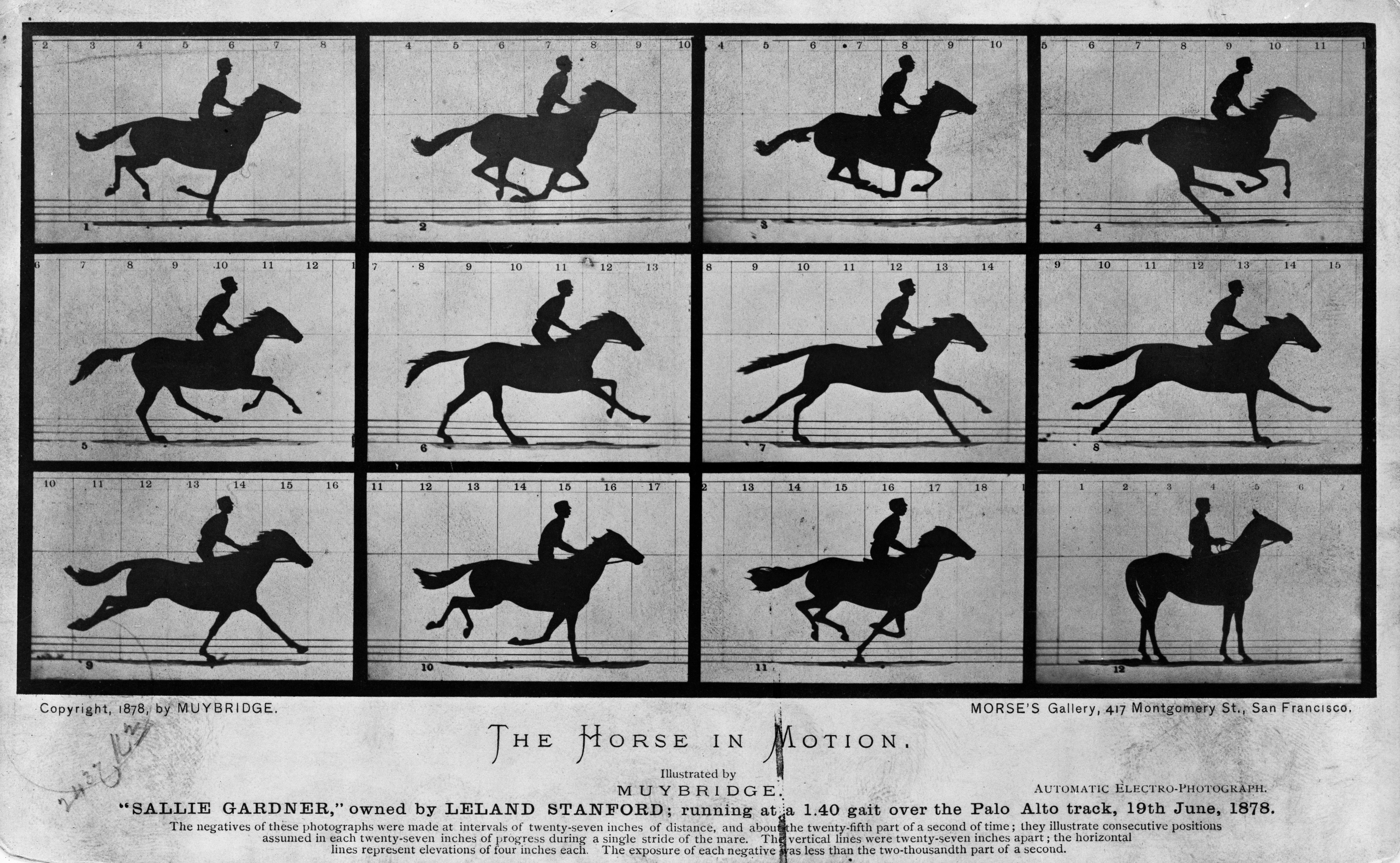
Stanford was also interested in horses and owned the Gridley tract of 17800 acre in Butte County. In Santa Clara County, he founded his Palo Alto Stock Farm. Stanford bred Standardbred horses to be raced as trotters, including his chief sire, Electioneer (sired by Hambletonian) and his winning offspring: Arion, Sunol, Palo Alto, and Chimes (out of Stanford's best known dam Beautiful Bells); and Thoroughbreds for flat racing. In 1872, Stanford commissioned the photographer Eadweard Muybridge to undertake scientific studies of the gaits of horses at a trot and gallop at the Agricultural Park racetrack in Sacramento. Images of the horses' feet were captured there, later moving to his Palo Alto Stock Farm. Stanford wanted to determine if the horses ever had all four feet off the ground at the same time. The result was the proto-film Sallie Gardner at a Gallop (1878). As the Palo Alto breeding farm was later developed into the Stanford University, the university was nicknamed "The Farm."
Politics
Stanford was politically active and became a leading member of the Republican Party. In 1856, he met with other Whig politicians in Sacramento on April 30 to organize the California Republican Party at its first state convention. Stanford was chosen as a delegate to the Republican Party convention that selected US presidential electors in both 1856 and 1860. He was defeated in his 1857 bid for California state treasurer, and his 1859 bid for the office of governor of California. In 1860, Stanford was named a delegate to the Republican National Convention in Chicago, but did not attend. He was elected governor in a second campaign in 1861.
Governor of California

Stanford was elected the eighth Governor of California, serving from January 1862 to December 1863, and the first Republican governor. Due to the Great Flood of 1862, the governor was said to have needed to row in a boat to his own inauguration. A large, slow-speaking man who always read from a prepared text, he impressed his listeners as being more sincere than a glib, extemporaneous speaker.
During his gubernatorial tenure, Stanford cut the state's debt in half and advocated for the conservation of forests. He also oversaw the establishment of California's first state normal school in San Jose, later to become San Jose State University. Following Stanford's governorship, the term of office changed from two years to four years, in line with legislation passed during his time in office.
Native Americans
The ongoing eradication of the Native Americans living in California continued under Stanford's administration. He did sign into law an act reversing part of the 1850 Act for the Government and Protection of Indians that allowed the enslavement of Native Americans. However, Stanford also continued the prosecution of the Bald Hills War in Northern California.
Chinese immigrants
The gold strike in California had brought a large influx of newcomers into the territory, including Chinese immigrants, who faced persecution. Anti-Chinese sentiment became a political issue over time. In a message to the legislature in January 1862, Governor Stanford said:
Stanford was initially acclaimed for such statements, but lost support when it was revealed that his Central Pacific Railroad was also importing Chinese workers to construct the railroad.
United States Senator

Later, Stanford served in the United States Senate from 1885 until his death in 1893. Stanford served for four years as chairman of the U.S. Senate Committee on Public Buildings and Grounds and on the Naval Committee. He was president and director of the Central Pacific Railroad the entire time he sat in the Senate. Stanford authored several Senate bills that advanced ideas advocated by the People's Party: a bill to foster the creation of worker-owned cooperatives, and a bill to allow the issuance of currency backed by land value instead of only the gold standard. Neither bill made it out of committee. In Washington, D.C., he had a residence on Farragut Square near the home of Baron Karl von Struve, Russian minister to the United States.
Stanford University
Main article: Stanford University
With his wife Jane, Stanford founded Leland Stanford Junior University as a memorial for their only child, Leland Stanford Jr., who died at age 15 of typhoid fever in Florence, Italy, in 1884 while on a trip to Europe. The university was established by the Endowment Act of the California Assembly and Senate of March 9, 1885, and the Grant of Endowment from Leland and Jane Stanford signed at the first meeting of the board of trustees on November 14, 1885.
The Stanfords donated approximately $40 million (equivalent to approximately $ today) to develop the university, which held its opening exercises on October 1, 1891, and was intended for agricultural studies. Its first student, admitted to Encina Hall that day, was Herbert Hoover, who went on to become the 31st US president. The wealth of the Stanford family during the late 19th century is estimated at $50 million (equivalent to approximately $ today).
Stanford had ideas of Stanford University employee ownership for more than 30 years before giving them expression in his plans for the university, proposals as a senator, and in interviews with the news media.
Personal life and death

On September 30, 1850, Stanford married Jane Elizabeth Lathrop in Albany, New York. She was the daughter of Dyer Lathrop, a merchant of that city, and Jane Anne (Shields) Lathrop. The couple did not have any children for 18 years, until their only child, a son, Leland DeWitt Stanford, was born in 1868 when his father was 44.
Stanford was an active Freemason from 1850 to 1855, joining the Prometheus Lodge No. 17 in Port Washington, Wisconsin. After moving west, he became a member of the Michigan City Lodge No. 47 in Michigan Bluff, California. Stanford was also a member of the Independent Order of Odd Fellows in California.[[File:Residence of Governor Stanford, Palo Alto, California, 1888 (LAROCHE 12).jpeg|thumb|The Stanford residence in Palo Alto, 1888|left]] The Stanfords retained ownership of their mansion in Sacramento, where their only son was born in 1868. Now the Leland Stanford Mansion State Historic Park, the house museum is also used for California state social occasions. The Stanfords' home in San Francisco's Nob Hill district was destroyed in the 1906 San Francisco earthquake; the site is now occupied by the Stanford Court Hotel. The Stanford residence at the Palo Alto Stock Farm became a convalescent home for children in 1919 (the forerunner of the Lucille Packard Children's Hospital) and was torn down in 1965.
Long-suffering from locomotor ataxia, Stanford died of heart failure at home in Palo Alto, California, on June 21, 1893; he was 69 years old. Stanford was buried in the family mausoleum on the Stanford campus. Jane Stanford died in 1905 after being poisoned with strychnine.
Legacy and honors
In 1862, California volunteer troops re-building a military post at the confluence of the San Pedro River and Aravaipa Creek in Arizona Territory named the post Fort Stanford after the governor. However, the post later reverted to its former name, Fort Breckenridge, and in 1866 became Camp Grant. In 2008, Stanford was inducted into The California Museum for History, Women and the Arts, California Hall of Fame. A relative, Tom Stanford, accepted the honors on his behalf.
The Stanford Memorial Church on the university campus is dedicated to Stanford's memory. Mount Stanford, located in California's Sierra Nevada, is named in his honor. Central Pacific locomotives named for Stanford were:
- Gov. Stanford, a 4-4-0 locomotive built in 1863 by the Norris Locomotive Works in Philadelphia and brought to San Francisco by sailing vessel. This engine is preserved at the California State Railroad Museum in Sacramento
- El Gobernador, a 4-10-0 locomotive built in the Central Pacific shops in Sacramento in 1884. Found to be disappointing in its performance as a freight hauler, it was scrapped in July 1894.
Mount Stanford in California's John Muir Wilderness is named for Stanford. This mountain, found in Pioneer Basin, is located near other mountains named for robber barons, including Mount Huntington, Mount Hopkins, and Mount Crocker.
References
References
- Burlingame, Dwight. (August 19, 2004). "Philanthropy in America: A Comprehensive Historical Encyclopedia". ABC-CLIO.
- Tuterow, Norman E.. (2004). "The governor: the life and legacy of Leland Stanford, a California colossus, Volume 2". Arthur H. Clark Co..
- (April 2009). "Handbook to Life in America, Vol. 4". Facts on File.
- Cummings, Bruce. (2009). "Dominion from Sea to Sea: Pacific Ascendancy and American Power". Yale University Press.
- Lindsay, David. (2005). "Madness in the Making". Universe.
- (1935). "Dictionary of American Biography". Charles Scribner's Sons.
- "Port Washington Downtown Historic District".
- (1929). "Dictionary of American Biography". Science.
- Wheeler, Keith. (1973). "The Railroaders". Time-Life Books.
- (1987). "Southern Pacific Company Steam Locomotive Compendium". Shade Tree Books.
- Zhong, Raymond. (2022-08-15). "Why the 'Big One' Could Be Something Other Than an Earthquake". The New York Times.
- (1899). "The National Cyclopaedia of American Biography". James T. White & Company.
- (1929). "Dictionary of American Biography". Science.
- Loomis, Noel M.. (1968). "Wells Fargo". Clarkson N. Potter, Inc..
- Pinney, Thomas. (1989). "A History of Wine in America from the Beginnings to Prohibition". University of California Press.
- (1929). "Dictionary of American Biography". Science.
- "ELECTIONEER".
- "ARION".
- "SUNOL".
- "CHIMES".
- "BEAUTIFUL BELLS".
- Amory, Cleveland. (1960). "Who Killed Society?". Harper & Brothers.
- (2016). "An American genocide : the United States and the California Indian catastrophe, 1846-1873". Yale University Press.
- (July 11, 2023). "California's little known genocide".
- Magliari, Michael F.. (2012-05-01). "Free State Slavery: Bound Indian Labor and Slave Trafficking in California's Sacramento Valley, 1850–1864". Pacific Historical Review.
- Asbury, Herbert. (2008). "The Barbary Coast". Basic Books.
- Sandmeyer, Elmer Clarence. (1991). "The Anti-Chinese Movement in California". University of Illinois Press.
- Stanford, Leland. (May 4, 1887). "Co-operation of Labor". [[New York Tribune]].
- Congressional Record, 49 Congress, 2 Sess.: 1804–1805; 51 Congress, 1 Sess.: 2068–2069, 5169–5170, 2 Sess.: 667–668; 52 Congress, 1 Sess.: 468–479, 2684–2686.
- (August 2019). "The Land Loan Project: Senator Stanford Explains His New Money Scheme". The New York Times.
- "The great question: an interview with Senator Leland Stanford on money".
- (1885). "The Leland Stanford, Junior, University".
- (April 5, 1905). "Stanford Estate Worth Seven Millions". The Evening News.
- Altenberg, Lee. (Winter 1990). "Beyond Capitalism: Leland Stanford's Forgotten Vision". Stanford Historical Society.
- "Jane Stanford: The woman behind Stanford University". Stanford University.
- "Famous men members of Masonic Lodges".
- (June 15, 2007). "10,000 Famous Freemasons". Cornerstone Book Publishers.
- "History, Mission and Values".
- "Jane L. Stanford: Timeline". Stanford University.
- (June 28, 1893). "Leland Stanford".
- Dancis, Bruce. (May 28, 2008). "New California Hall of Fame class includes Fonda, Nicholson". Sacramento Bee.
- 9780520266193, page 373.
- Ambrose, Stephen E.. (2000). "Nothing Like It in the World. The Men Who Built the Transcontinental Railroad 1863–1869". Simon & Schuster.
- Hollingsworth, Brian. (1984). "The Illustrated Encyclopedia of North American Locomotives". Crescent Books.
This article was imported from Wikipedia and is available under the Creative Commons Attribution-ShareAlike 4.0 License. Content has been adapted to SurfDoc format. Original contributors can be found on the article history page.
Ask Mako anything about Leland Stanford — get instant answers, deeper analysis, and related topics.
Research with MakoFree with your Surf account
Create a free account to save articles, ask Mako questions, and organize your research.
Sign up freeThis content may have been generated or modified by AI. CloudSurf Software LLC is not responsible for the accuracy, completeness, or reliability of AI-generated content. Always verify important information from primary sources.
Report