From Surf Wiki (app.surf) — the open knowledge base
Leflunomide
Chemical compound
Chemical compound
| Field | Value | ||||
|---|---|---|---|---|---|
| verifiedrevid | 462089809 | ||||
| image | Leflunomide.svg | ||||
| image_class | skin-invert-image | ||||
| image2 | Leflunomide ball-and-stick model.png | ||||
| image_class2 | bg-transparent | ||||
| tradename | Arava, Lefumide, Arabloc, others | ||||
| Drugs.com | |||||
| MedlinePlus | a600032 | ||||
| licence_EU | yes | ||||
| DailyMedID | Leflunomide | ||||
| pregnancy_AU | X | ||||
| routes_of_administration | By mouth | ||||
| ATC_prefix | L04 | ||||
| ATC_suffix | AK01 | ||||
| legal_AU | S4 | ||||
| legal_AU_comment | |||||
| legal_BR | C1 | ||||
| legal_BR_comment | |||||
| legal_CA | Rx-only | ||||
| legal_DE | |||||
| legal_NZ | |||||
| legal_UK | POM | ||||
| legal_UK_comment | |||||
| legal_US | Rx-only | ||||
| legal_US_comment | |||||
| legal_EU | Rx-only | ||||
| legal_EU_comment | |||||
| legal_UN | |||||
| legal_status | |||||
| bioavailability | 80% | ||||
| protein_bound | 99% | ||||
| metabolism | GI mucosa and liver | ||||
| metabolites | Teriflunomide | ||||
| elimination_half-life | 14–18 days | ||||
| excretion | Faeces (48%), urine (43%) | ||||
| CAS_number_Ref | |||||
| CAS_number | 75706-12-6 | ||||
| PubChem | 3899 | ||||
| IUPHAR_ligand | 6825 | ||||
| DrugBank_Ref | |||||
| DrugBank | DB01097 | ||||
| ChemSpiderID_Ref | |||||
| ChemSpiderID | 3762 | ||||
| UNII_Ref | |||||
| UNII | G162GK9U4W | ||||
| KEGG_Ref | |||||
| KEGG | D00749 | ||||
| ChEBI_Ref | |||||
| ChEBI | 6402 | ||||
| ChEMBL_Ref | |||||
| ChEMBL | 960 | ||||
| IUPAC_name | 5-methyl-N-[4-(trifluoromethyl) phenyl]-isoxazole-4-carboxamide | ||||
| C | 12 | H=9 | F=3 | N=2 | O=2 |
| SMILES | O=C(Nc1ccc(cc1)C(F)(F)F)c2c(onc2)C | ||||
| StdInChI_Ref | |||||
| StdInChI | 1S/C12H9F3N2O2/c1-7-10(6-16-19-7)11(18)17-9-4-2-8(3-5-9)12(13,14)15/h2-6H,1H3,(H,17,18) | ||||
| StdInChIKey_Ref | |||||
| StdInChIKey | VHOGYURTWQBHIL-UHFFFAOYSA-N |
| Drugs.com =
| elimination_half-life = 14–18 days
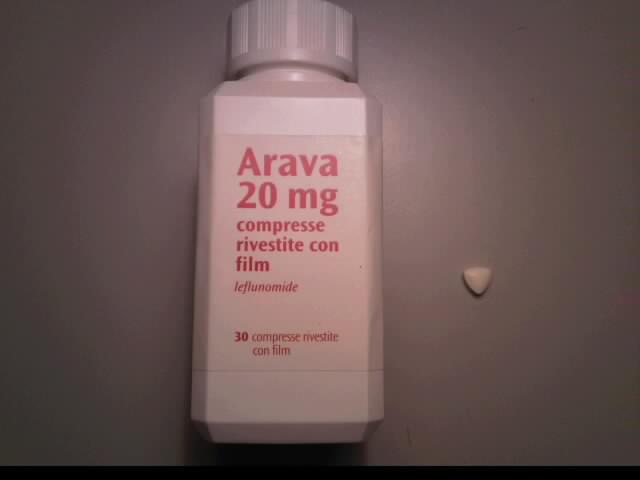
Leflunomide, sold under the brand name Arava among others, is an immunosuppressive disease-modifying antirheumatic drug (DMARD), used in active moderate-to-severe rheumatoid arthritis and psoriatic arthritis. It is a pyrimidine synthesis inhibitor that works by inhibiting dihydroorotate dehydrogenase.
Medical use
Rheumatoid arthritis and psoriatic arthritis are the only indications that have received regulatory approval. Arava was developed by Sanofi Aventis and approved by the U.S. Food and Drug Administration in 1998. Clinical studies regarding the following diseases have been conducted: There have been reports on potential re-purposing of leflunomide for treatment of solid tumors with tumor suppressor, PTEN, loss. In PTEN negative tumors, leflunomide causes synthetic lethality potentially due to increased demand on pyrimidines in these faster growing cells.
- Polyoma BK virus nephropathy
- Kimura's disease
- Systemic lupus erythematosus
- Felty's syndrome
- Takayasu arteritis
- Granulomatosis with polyangiitis
- Ankylosing spondylitis
- Crohn's disease
- Sarcoidosis
- Uveitis
- Still's disease
- Prostate cancer
- Pemphigoid
- Prevention of organ transplant rejection
Contraindications
Contraindications include:
- Pregnancy, women of childbearing potential (unless contraception used)
- Liver disease, hepatitis B/C seropositive
- Active serious infections
- Hypersensitivity
Adverse effects
The dose-limiting side effects are liver damage, lung disease and immunosuppression. diarrhea, respiratory tract infections, hair loss, high blood pressure, rash, nausea, bronchitis, headache, abdominal pain, abnormal liver function tests, back pain, indigestion, urinary tract infection, dizziness, infection, joint disorder, itchiness, weight loss, loss of appetite, cough, gastroenteritis, pharyngitis, stomatitis, tenosynovitis, vomiting, weakness, allergic reaction, chest pain, dry skin, eczema, paraesthesia, pneumonia, rhinitis, synovitis, cholelithiasis and shortness of breath. Whereas uncommon side effects (occurring in 0.1–1% of those treated with the drug) include: constipation, oral thrush, stomatitis, taste disturbance, thrombocytopenia and hives. Rarely (in 0.1% of those treated with it) it can cause: anaphylaxis, angiooedema, anaemia, agranulocytosis, eosinophilia, leucopenia, pancytopenia, vasculitis, toxic epidermal necrolysis, Stevens–Johnson syndrome, cutaneous lupus erythematosus, severe infection, interstitial lung disease, cirrhosis and liver failure.
Interactions
Other immunomodulatory treatments should be avoided due to the potential for additive immunosuppressant effects, or in the case of immunostimulants like echinacea or astragalus, reduced therapeutic effects. Likewise live vaccines (like the MMR vaccine (measles, mumps, rubella) and yellow fever vaccines) should be avoided due to the potential for severe infection due to the immunosuppressive nature of the treatment.
The concomitant use of methotrexate, in particular, may lead to severe or even fatal liver-damage or hepatotoxicity. Seventy-five percent of all cases of severe liver damage reported until early 2001 were seen under combined drug therapy leflunomide plus methotrexate.
Pharmacology
Mechanism of action
Leflunomide is an immunomodulatory drug that achieves its effects by inhibiting the mitochondrial enzyme dihydroorotate dehydrogenase (DHODH), which plays a key role in the de novo synthesis of uridine monophosphate (rUMP), which is required for the synthesis of DNA and RNA. Hence, leflunomide inhibits the reproduction of rapidly dividing cells, especially lymphocytes.
The inhibition of human DHODH by teriflunomide, the active metabolite of leflunomide, occurs at levels (approximately 600 nM) that are achieved during treatment of rheumatoid arthritis (RA). Teriflunomide also has antiviral effects against numerous viruses including CMV, HSV1 and the BK virus, which it achieves by inhibiting viral replication by interfering with nucleocapsid tegumentation and hence virion assembly.
Pharmacokinetics
It has an oral bioavailability of 80%, protein binding of 99%, metabolism sites of the GI mucosa and liver, volume of distribution (Vd) of 0.13 L/kg, elimination half-life of 14–18 days and excretion routes of faeces (48%) and urine (43%).
Leflunomide metabolism
Teriflunomide is the main active in vivo metabolite of leflunomide. Upon administration of leflunomide, 70% of the drug administered converts into teriflunomide. The only difference between the molecules is the opening of the isoxazole ring. Upon oral administration of leflunomide in vivo, the isoxazole ring of leflunomide is opened and teriflunomide is formed.

"Regardless of the substance administered (leflunomide or teriflunomide), it is the same molecule (teriflunomide)—the one exerting the pharmacological, immunological or metabolic action in view of restoring, correcting or modifying physiological functions, and does not present, in clinical use, a new chemical entity to patients." Because of this, the European Medicines Agency (EMA) initially had not considered teriflunomide to be a new active substance.
References
References
- Anvisa. (31 March 2023). "RDC Nº 784 - Listas de Substâncias Entorpecentes, Psicotrópicas, Precursoras e Outras sob Controle Especial". [[Diário Oficial da União]].
- (25 August 2023). "Arava EPAR".
- "Arava (leflunomide) dosing, indications, interactions, adverse effects, and more". WebMD.
- (January 2005). "When a DMARD fails, should patients switch to sulfasalazine or add sulfasalazine to continuing leflunomide?". Annals of the Rheumatic Diseases.
- (2006). "Leflunomide in clinical practice". Acta Reumatologica Portuguesa.
- (December 2020). "Australian Medicines Handbook". The Australian Medicines Handbook Unit Trust.
- "Leflunomide Search". U.S. National Library of Medicine.
- (December 2020). "Leflunomide triggers synthetic lethality in PTEN-deficient prostate cancer". Prostate Cancer and Prostatic Diseases.
- (April 2017). "PTEN Regulates Glutamine Flux to Pyrimidine Synthesis and Sensitivity to Dihydroorotate Dehydrogenase Inhibition". Cancer Discovery.
- (December 2006). "Current recommendations for diagnosis and management of polyoma BK virus nephropathy in renal transplant recipients". Nephrology, Dialysis, Transplantation.
- (June 2011). "Effective treatment of Kimura's disease with leflunomide in combination with glucocorticoids". Clinical Rheumatology.
- (February 2013). "Leflunomide: friend or foe for systemic lupus erythematosus?". Rheumatology International.
- (April 2002). "Leflunomide for the treatment of rheumatoid arthritis and autoimmunity". The American Journal of the Medical Sciences.
- (January 2013). "New treatment strategies in large-vessel vasculitis". Current Opinion in Rheumatology.
- (January 2005). "Six months open label trial of leflunomide in active ankylosing spondylitis". Annals of the Rheumatic Diseases.
- (August 2003). "Leflunomide treatment of Crohn's disease patients intolerant to standard immunomodulator therapy". Journal of Clinical Gastroenterology.
- (April 2008). "Treatment of Crohn's disease with leflunomide as second-line immunosuppression : a phase 1 open-label trial on efficacy, tolerability and safety". Digestive Diseases and Sciences.
- (October 2012). "Acute pulmonary exacerbations of sarcoidosis". Chest.
- (August 2007). "Early clinical experience with leflunomide in uveitis". Canadian Journal of Ophthalmology.
- (May 2003). "Treatment of adult-onset Still's disease with leflunomide and chloroquine combination in two patients". Clinical Rheumatology.
- {{ClinicalTrialsGov. NCT00004071. Mitoxantrone and Prednisone With or Without Leflunomide in Treating Patients With Stage IV Prostate Cancer
- {{ClinicalTrialsGov. NCT00802243. Leflunomide Associated With Topical Corticosteroids for Bullous Pemphigoid (ARABUL)
- (September 2010). "Leflunomide: a drug with a potential beyond rheumatology". Immunotherapy.
- (7 August 2012). "Arava Product Information". sanofi-aventis australia pty ltd.
- (21 November 2013). "Arava : EPAR - Product Information". Sanofi-Aventis Deutschland GmbH.
- (29 June 2012). "Data Sheet Arava". sanofi-aventis new zealand limited.
- (November 2012). "Arava (leflunomide) tablet, film coated [sanofi-aventis U.S. LLC]". sanofi-aventis U.S. LLC.
- (21 February 2014). "Arava 10mg Tablets - Summary of Product Characteristic". Sanofi.
- (2009). "Combination treatment with leflunomide and methotrexate for patients with active rheumatoid arthritis". Scandinavian Journal of Rheumatology.
- (December 1999). "Mechanism of action for leflunomide in rheumatoid arthritis". Clinical Immunology.
- "Assessment report. AUBAGIO (international non-proprietary name: teriflunomide). Procedure No. EMEA/H/C/002514/0000".
- (2002). "Clinical pharmacokinetics of leflunomide". Clinical Pharmacokinetics.
- "Clinical Pharmacology/Biopharmaceutics Review. Product: ARAVA (leflunomide tablets). Application Number: NDA 20905". Center for Drug Evaluation and Research.
- "Summary of Opinion (Initial Authorisation): Aubagio (teriflunomide)". European Medicines Agency.
This article was imported from Wikipedia and is available under the Creative Commons Attribution-ShareAlike 4.0 License. Content has been adapted to SurfDoc format. Original contributors can be found on the article history page.
Ask Mako anything about Leflunomide — get instant answers, deeper analysis, and related topics.
Research with MakoFree with your Surf account
Create a free account to save articles, ask Mako questions, and organize your research.
Sign up freeThis content may have been generated or modified by AI. CloudSurf Software LLC is not responsible for the accuracy, completeness, or reliability of AI-generated content. Always verify important information from primary sources.
Report