From Surf Wiki (app.surf) — the open knowledge base
Lecture hall
Large instruction room in a college or university
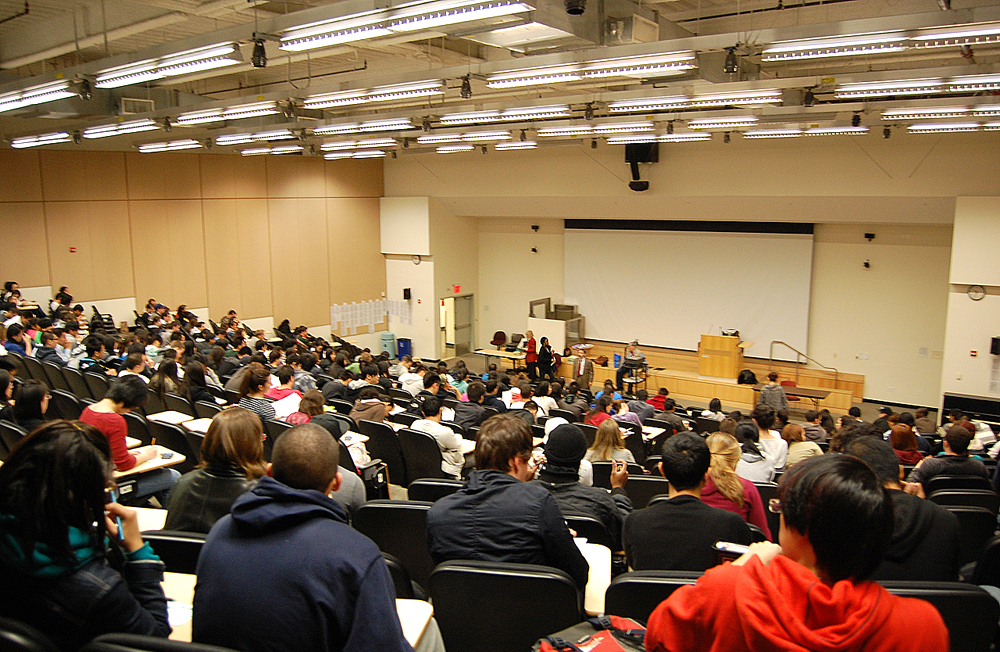
Large instruction room in a college or university


A lecture hall or lecture theatre is a large room used for lectures, typically at a college or university. Unlike flexible lecture rooms and classrooms with capacities normally below one hundred, the capacity of lecture halls can sometimes be measured in the hundreds. Lecture halls frequently have tiered seating, with those in the rear sat higher than those at the front.
Lecture halls differ from other types of learning spaces, seminar rooms in particular, in that they allow for little versatility in use, although they are no less flexible than, for example, chemistry laboratories. Experimentation, group work, and other contemporary educational methods are not practicable in a lecture hall. On the other hand, lecture halls are excellent for focusing the attention of a large group on a single point, either an instructor or an audio-visual presentation, and modern lecture halls often feature audio-visual equipment. A microphone and loudspeakers are common to help the lecturer be heard, and projection screens may be used for large displays.
Studies into the use of the lecture theatre teaching space have found that students sit in specific locations due to a range of factors; these include being noticed, addressing anxiety or an ability to focus. Personal and social factors are also thought to determine students' lecture theatre seating choice and the resulting effects on attainment. Studies into the way students use the space indicate that peer group formation exerts a strong impact on attainment and engagement, with groups of similar ability sitting together.
History
.jpg)
The use of lectures at universities dates back to the middle ages. A variety of different rooms and halls may have been used for lectures – one of the earliest images of a lecture shows Henry of Germany giving a law lecture at the University of Bologna in 1233, speaking from what appears to be a pulpit.
.jpg)
Lecture theatres may go back further than this, however, with archaeological excavations at Kom El Deka, near Alexandria, having uncovered a complex of U-shaped auditoria that have been interpreted as lecture theatres from the classical period.

Tiered lecture theatres developed in Renaissance Italy, where they were used for teaching anatomy. The earliest purpose-built lecture theatre of the modern era was in Padua in 1594, but the idea spread quickly with a lecture theatre being built in Leiden in 1597 and at the Barber-Surgeons Hall in London in 1636, designed by Inigo Jones. The steep rake of these lecture theatres enabled students to see the dissection table and was copied by scientific lecture theatres to ensure the demonstration bench could be seen.
The "Harvard-style" lecture theatre developed in the late 19th century at Harvard Law School. These had a shallower rake than traditional lectures theatres and placed the seating in a U-shape rather than in arced or semi-circular rows, promoting exchanges between lecturers and students. Upholstered seating also became common in the 19th century, and desks became standard by the mid 20th century.
The 21st century saw the development of "collaborative lecture theatres", originally at the University of Queensland in 2009, with shallower-raked tiers and seating that could be turned to form small groups of student for collaborative work or to face the front for traditional lectures. These collaborative lecture theatres typically have between 100 and 200 seats.
Types
Lecture theatres come in various types, suiting different pedagogies and space restrictions. These include:
-
Tiered lecture theatre: the traditional lecture theatre, with rows of tiered seats enabling the speaker and screens or boards to be seen by large numbers of people.
-
Anatomical theatre or demonstration theatre: steep-tiered and designed to allow views of the dissection table or demonstration bench. Example: the Royal Institution Lecture Theatre.
-
Flat lecture theatre: a flat room with a fixed lecture arrangement, distinguishing it from reconfigurable teaching rooms. Generally smaller than tiered lecture theatres; below a capacity of 50 such rooms are not normally called lecture theatres although they can be at some institutions. Example: the Gillis lecture theatre at Balliol College, Oxford.
-
Harvard-style or horseshoe lecture theatre: U-shaped arrangement of seats on shallow tiers, designed to promote interaction between students and the lecturer.
-
Retractable lecture theatre: a flat room that can be converted to a tiered lecture theatre by deploying retractable seating, allowing for a variety of uses. Example: the Fonteyn Ballroom in Dunelm House at Durham University.
-
Collaborative lecture theatre: a lecture theatre with a shallow tiers designed so that seats can be turned to form collaborative booths for group work or forwards for use as a normal lecture theatre. Example: three lecture theatres in the Roger Stevens building at the University of Leeds.
Technology
The original conception of lecture theatres was as spaces for listening to a speaker talk or for viewing a scientific demonstration. The first introduction of technology was writing boards – originally chalk boards but now normally whiteboards. This was supplemented with projectors – originally slide projectors and now normally digital projectors attached to a computer. Computer systems control the audio-visual technology and may also give control of the lighting level in the room. Microphones and speakers are commonly used in larger lecture theatres to ensure the speaker can be heard.{{cite web|url=https://ats-techdocs.rutgers.edu/m/LectureHall/l/1451835-lecture-hall-technology|title= Lecture Hall Technology |website=Rutgers University|access-date=7 March 2025}}
Lecture capture technology allows for lectures to be recorded and watched later, or to be attended virtually when linked with a video conferencing system. Networking of lecture theatres can allow a lecture to be shown in multiple rooms.
References
References
- "Inside the TLC". 22nd Biennial [[New Chaucer Society]] Congress, Durham 2022.
- "Large Lecture Hall Design". Center for Research on Learning and Teaching.
- Smith, David P.. (2018-08-21). "Who goes where? The importance of peer groups on attainment and the student use of the lecture theatre teaching space". FEBS Open Bio.
- Norma Martin Clement. (16 November 2018). "Is the large lecture theatre really dead? History tells us no...".
- Grzegorz Majcherek. (2007). "The Auditoria on Kom el-Dikka: A Glimpse of Late Antique Education in Alexandria". Proceedings of the 25th International Congress of Papyrology.
- "History of the Hall".
- "Thomas Webster (1773-1844)".
- "Section 1: Types of space". UCL.
- (24 June 2024). "Unveiling the new Gillis Lecture Theatre and Warburg Music Suite".
- Lydia Blundell. (3 October 2018). "Lectures to be held in Durham Students’ Union". [[Palatinate (newspaper).
- "Audio Visual Guide - large lecture theatres".
- "Landmark innovation at Durham".
This article was imported from Wikipedia and is available under the Creative Commons Attribution-ShareAlike 4.0 License. Content has been adapted to SurfDoc format. Original contributors can be found on the article history page.
Ask Mako anything about Lecture hall — get instant answers, deeper analysis, and related topics.
Research with MakoFree with your Surf account
Create a free account to save articles, ask Mako questions, and organize your research.
Sign up freeThis content may have been generated or modified by AI. CloudSurf Software LLC is not responsible for the accuracy, completeness, or reliability of AI-generated content. Always verify important information from primary sources.
Report