From Surf Wiki (app.surf) — the open knowledge base
Lebanese Arabic
Levantine Arabic dialect
Levantine Arabic dialect
| Field | Value |
|---|---|
| name | Lebanese Arabic |
| nativename | اللهجة اللبنانية |
| pronunciation | |
| states | Lebanon |
| speakers | million |
| date | 2024 |
| ref | |
| familycolor | Afroasiatic |
| fam2 | Semitic |
| fam3 | West |
| fam4 | Central |
| fam5 | Arabic |
| fam6 | Levantine |
| listclass | hlist |
| dia1 | Beqaa Arabic |
| dia2 | Iqlim-Al-Kharrub Sunni Arabic |
| dia3 | Jdaideh Arabic |
| dia4 | North-Central Lebanese Arabic |
| dia5 | North Lebanese Arabic |
| dia6 | Saida Sunni Arabic |
| dia7 | South-Central Lebanese Arabic |
| dia8 | South Lebanese Arabic |
| dia9 | Sunni Beiruti Arabic |
| script | Arabic alphabet |
| Arabic chat alphabet | |
| iso3comment | (covered by `apc`) |
| iso3 | none |
| isoexception | dialect |
| ietf | apc-LB |
| glotto | stan1323 |
| glottorefname | Standard Lebanese Arabic |
| notice | IPA |
| map | Levantine Arabic 2023.svg |
| mapcaption | Modern distribution of Levantine Arabic |
Arabic chat alphabet Lebanese Arabic ( ar; autonym: apc ), or simply Lebanese ( ar; autonym: apc ), is a variety of Levantine Arabic, indigenous to and primarily spoken in Lebanon, with significant linguistic influences borrowed from other Middle Eastern and European languages. Due to multilingualism and pervasive diglossia among Lebanese people (a majority of the Lebanese people are bilingual or trilingual), it is not uncommon for Lebanese people to code-switch between or mix Lebanese Arabic, French, and English in their daily speech. It is also spoken among the Lebanese diaspora.
Lebanese Arabic is a descendant of the Arabic dialects introduced to the Levant and other Arabic dialects that were already spoken in other parts of the Levant in the 7th century AD, which gradually supplanted various indigenous Northwest Semitic languages to become the regional lingua franca. As a result of this prolonged process of language shift, Lebanese Arabic possesses a significant Aramaic substratum, along with later non-Semitic adstrate influences from Ottoman Turkish, French, and English. As a variety of Levantine Arabic, Lebanese Arabic is most closely related to Syrian Arabic and shares many innovations with Palestinian and Jordanian Arabic.
Differences from Standard Arabic
Lebanese Arabic shares many features with other modern varieties of Arabic. Lebanese Arabic, like many other spoken Levantine Arabic varieties, has a syllable structure very different from that of Modern Standard Arabic. While Standard Arabic can have only one consonant at the beginning of a syllable, after which a vowel must follow, Lebanese Arabic commonly has two consonants in the onset.
- Morphology: no mood or grammatical case markings.
- Number: verbal agreement regarding number and gender is required for all subjects, whether already mentioned or not.
- Vocabulary: many borrowings from other languages; most prominently Syriac-Aramaic, Western-Aramaic, Persian, Phoenician, Ottoman Turkish, French, Coptic, as well as, less significantly, from English.
- Some authors, such as the Lebanese statistician Nassim Nicholas Taleb, believe that a significant part of the Lebanese grammatical structure is due to Aramaic influences.
Examples
- The following example demonstrates two differences between Standard Arabic (Literary Arabic) and Spoken Lebanese Arabic: coffee (قهوة), Literary Arabic: ; Lebanese Arabic: . The voiceless uvular plosive corresponds to a glottal stop , and the final vowel () commonly written with ar (ة) is raised to .
- As a general rule, the voiceless uvular plosive is replaced with glottal stop , e.g. دقيقة 'minute' becomes . This debuccalization of is a feature shared with Syrian Arabic, Palestinian Arabic, Egyptian Arabic, and Maltese.
- The exception for this general rule is the Druze of Lebanon who, like the Druze of Syria and Israel, have retained the pronunciation of in the centre of direct neighbours who have replaced with (for example 'heart', which is in Literary Arabic, becomes or . The use of by Druze is particularly prominent in the mountains and less so in urban areas.
- Unlike most other varieties of Arabic, a few dialects of Lebanese Arabic have retained the classical diphthongs and (pronounced in Lebanese Arabic as and ), which were monophthongised into and elsewhere, although the majority of Lebanese Arabic dialects realize them as and . In urban dialects (i.e. Beiruti) has replaced and sometimes medial , and has replaced final making it indistinguishable with tāʾ marbūtah (ة). Also, has replaced ; replacing some short s. In singing, the , and medial are usually maintained for artistic values.
- The sound from Modern Standard Arabic is sometimes replaced with in words from MSA like , (second as in the number) when it becomes . Other times, it may be replaced with in words like (second as in the time measurement) when it becomes . It is assumed that this is to maintain an audible difference between the two words which were originally homophones. In some dialects, the sound is replaced with for both words.
Contentions regarding descent from Arabic
Lebanese literary figure Said Akl led a movement to recognize the "Lebanese language" as a distinct prestigious language and oppose it to Standard Arabic, which he considered a "dead language". Akl's idea was relatively successful among the Lebanese diaspora.
Historian and linguist Ahmad Al-Jallad has argued that modern dialects are not descendants of Classical Arabic, forms of Arabic existing before the formation of Classical Arabic being the historical foundation for the various dialects. Thus he states that, "most of the familiar modern dialects (i.e. Rabat, Cairo, Damascus, etc.) are sedimentary structures, containing layers of Arabics that must be teased out on a case-by-case basis." In essence, the linguistic consensus is that Lebanese too is a variety of Arabic.
Several non-linguist commentators, most notably the statistician and essayist Nassim Nicholas Taleb, have said that the Lebanese vernacular is not in fact a variety of Arabic at all, but rather a separate Central Semitic language descended from older languages including Aramaic; those who espouse this viewpoint suggest that a large percentage of its vocabulary consists of Arabic loanwords, and that this compounds with the use of the Arabic alphabet to disguise the language's true nature. Taleb has recommended that the language be called Northwestern Levantine or neo-Canaanite. However, this classification is at odds with the comparative method of historical linguistics; the lexicon of Lebanese, including basic lexicon, exhibits sound changes and other features that are unique to the Arabic branch of the Semitic language family, making it difficult to categorize it under any other branch, and observations of its morphology also suggest a substantial Arabic makeup. However, this is disputable as Arabic and Aramaic share many cognates, so only words proper to the Arabic language and cognates with Arabic-specific sound changes can certainly only be from Arabic. It is plausible that many words used in Lebanese Arabic today may have been influenced by their respective Aramaic and Canaanite cognates.
Phonology
Consonants
| Labial | Alveolar | Palatal | Velar | Uvular | Pharyngeal | Glottal | plain | emphatic | Nasal | Stop | voiceless | voiced | Fricative | voiceless | voiced | Tap/trill | Approximant |
|---|---|---|---|---|---|---|---|---|---|---|---|---|---|---|---|---|---|
| () | () | () | |||||||||||||||
| () | |||||||||||||||||
| () |
- The phonemes and are not native to Lebanese Arabic and are only found in loanwords. They are sometimes realized as and respectively.
- The velar stop occurs in native Lebanese Arabic words but is generally restricted to loanwords, especially from Turkish (e.g. جمرك gumrok, 'customs'), Persian (e.g. أرجيلة argīle, 'narghile'), Romance languages (e.g. from French سيجارة sigāra, 'cigarette'), and Cairene Arabic (e.g. جلابية jallābiyya, 'galabia'). It is realized as by some speakers.
- can be heard among Druze speech, alternating with a glottal .
Vowels and diphthongs
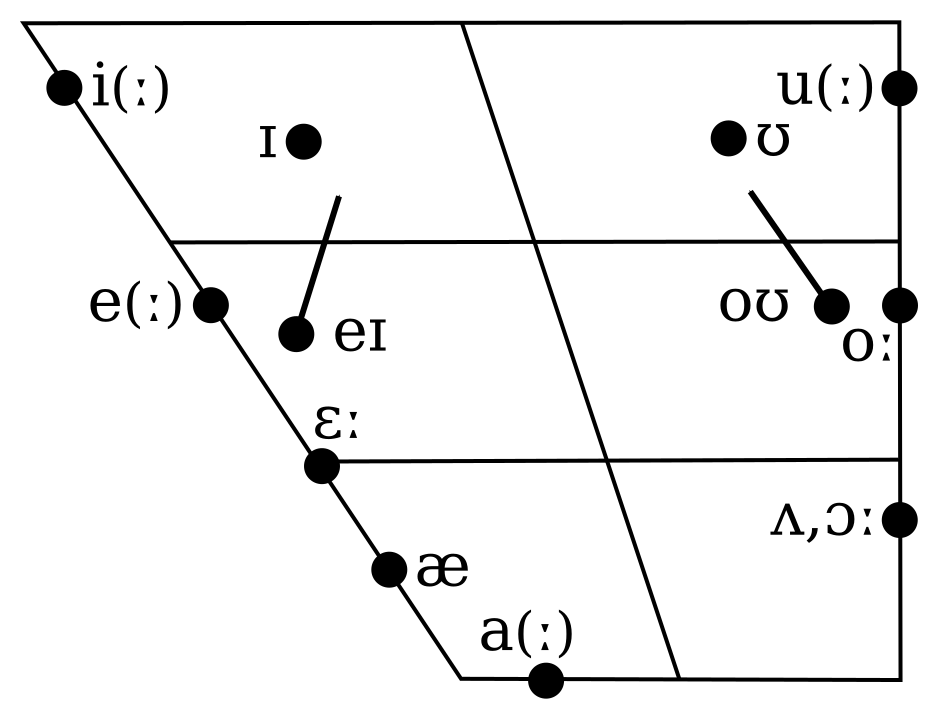
Compared to Modern Standard Arabic, Lebanese Arabic shows notable differences in its vowel system. It has a five‑vowel inventory , each with short and long counterparts which comprise , and the diphthongs and , realized in most dialects as and .
Short vowels show allophonic variation. becomes or after emphatic/back consonants (), and , , or in fronting environments. tends toward unstressed, while surfaces as , and both are often reduced to a central schwa in fast speech.
Long vowels remain relatively stable, though the long is frequently fronted and raised to unless adjacent to emphatic or guttural consonants. In traditional northern dialects, is often realized as , while in traditional southern dialects, may be diphthongized to . As an illustration, Lebanon (لبنان) is pronounced , with the final vowel raised to , reflecting the imāla pattern. This pronunciation serves as a recognizable shibboleth of Lebanese speech across the region.
A distinctive Lebanese feature is word‑final imāla. The vowel of tā’ marbūṭah (ـة)— in MSA—is consistently raised to . Final long is likewise pronounced . In addition, final short and long are both realized as .
Another feature is the insertion of a parasitic but phonemic schwa after the second consonant in many triliteral nouns to break up the cluster. For example: baḥr (بحر, “sea”) → baḥer , šams (شمس, “sun”) → shames , ʔakl (أكل, “food”) → akel and kalb (كلب, “dog”) → kaleb
Comparison
This table shows the correspondence between general Lebanese Arabic vowel phonemes and their counterpart realizations in Modern Standard Arabic (MSA) and other Levantine Arabic varieties.
| Lebanese Arabic | MSA | Southern | Central | Northern |
|---|---|---|---|---|
| or | or | |||
| ~ | or | or | ||
| ~ | or | |||
| ~ | ||||
| ~ | ||||
| ~ |
After back consonants this is pronounced in Lebanese Arabic, Central and Northern Levantine varieties, and as in Southern Levantine varieties.
Regional varieties
Although there is a modern Lebanese Arabic dialect mutually understood by Lebanese people, there are regionally distinct variations with, at times, unique pronunciation, grammar, and vocabulary.
Widely used regional varieties include:
- Beiruti varieties, further distributed according to neighbourhoods, the notable ones being Achrafieh variety, Basta variety, Ras Beirut variety, etc.
- Northern varieties, further distributed regionally, the most notable ones being Tripoli variety, Zgharta variety, Bsharri variety, Koura variety, Akkar variety.
- Southern varieties, with notable ones being the Tyre and Bint Jbeil varieties.
- Beqaa varieties, further divided into varieties, the notable ones being Zahlé and Baalbek-Hermel varieties.
- Mount Lebanon varieties, further divided into regional varieties like the Keserwan variety, the Matin dialect, Shouf variety, etc.
Even in the medieval era, the geographer Yaqut al-Hamawi wrote that: "They say that in the Lebanon district there are spoken seventy dialects, and no one people understands the language of the other, except through an interpreter."
Writing system
Lebanese Arabic is rarely written, except in novels where a dialect is implied or in some types of poetry that do not use classical Arabic at all. Lebanese Arabic is also utilized in many Lebanese songs, theatrical pieces, local television and radio productions, and very prominently in zajal.
Formal publications in Lebanon, such as newspapers, are typically written in Modern Standard Arabic, French, or English.
While Arabic script is usually employed, informal usage such as online chat may mix and match Latin letter transliterations. The Lebanese poet Said Akl proposed the use of the Latin alphabet but did not gain wide acceptance. Whereas some works, such as Romeo and Juliet and Plato's Dialogues have been transliterated using such systems, they have not gained widespread acceptance. Yet, now, most Arabic web users, when short of an Arabic keyboard, transliterate the Lebanese Arabic words in the Latin alphabet in a pattern similar to the Said Akl alphabet, the only difference being the use of digits to render the Arabic letters with no obvious equivalent in the Latin alphabet.
There is still today no generally accepted agreement on how to use the Latin alphabet to transliterate Lebanese Arabic words. However, Lebanese people are now using Latin numbers while communicating online to make up for sounds not directly associable to Latin letters. This is especially popular over text messages and apps such as WhatsApp. Examples:
- 2 for ء or ق (qaf is often pronounced as a glottal stop)
- 3 for ع
- 5 or kh for خ
- 7 for ح
- 8 or gh for غ
In 2010, The Lebanese Language Institute released a Lebanese Arabic keyboard layout and made it easier to write Lebanese Arabic in a Latin script, using unicode-compatible symbols to substitute for missing sounds.
Said Akl's orthography

Said Akl, the poet, philosopher, writer, playwright and language reformer, designed an alphabet for the Lebanese language using the Latin alphabet in addition to a few newly designed letters and some accented Latin letters to suit the Lebanese phonology in the following pattern:
- Capitalization and punctuation are used normally the same way they are used in French and English
- Some written consonant-letters, depending on their position, inherited a preceding vowel. As L and T.
- Emphatic consonants are not distinguished in spelling by Said Akl's method, with the exception of represented by ƶ. Probably Said Akl did not acknowledge any other emphatic consonant.
- Stress is not marked.
- Long vowels and geminated consonants are represented by double letters.
- ꞓ which represents (Arabic hamza) was written even initially.
- All of the basic Latin alphabet are used, in addition to other diacriticized ones. Most of the letters loosely represent their IPA counterparts, with some exceptions:
| Letter | Corresponding | |
|---|---|---|
| phoneme(s) | Notes | |
| a | , | |
| aa | , | |
| c | ||
| ꞓ | The actual diacritic is a diagonal stroke crossing the bottom left of the letter | |
| g | ||
| i | , | Represents word-finally |
| ii | ||
| j | ||
| k | ||
| q | ||
| u | , | Represents word-finally |
| uu | ||
| x | ||
| y | ||
| ý | The actual diacritic is a horizontal stroke going from the top of the upper-left spoke of the letter towards the top-center of the letter-space | |
| ƶ |
Roger Makhlouf largely uses Akl's alphabet in his Lebanese-English Lexicon.
References
Bibliography
- Elie Kallas, Atabi Lebnaaniyyi. Un livello soglia per l'apprendimento del neoarabo libanese, Cafoscarina, Venice, 1995.
- Angela Daiana Langone, Btesem ente lebneni. Commedia in dialetto libanese di Yahya Jaber, Università degli Studi La Sapienza, Rome, 2004.
- Jérome Lentin, "Classification et typologie des dialectes du Bilad al-Sham", in Matériaux Arabes et Sudarabiques n. 6, 1994, 11–43.
- Franck Salameh, "Language, Memory, and Identity in the Middle East", Lexington Books, 2010.
- Abdul-Karim, K. 1979. Aspects of the Phonology of Lebanese Arabic. University of Illinois at Urbana-Champaign Doctoral Dissertation.
- Bishr, Kemal Mohamed Aly. 1956. A grammatical study of Lebanese Arabic. (Doctoral dissertation, University of London; 470pp.)
- Choueiri, Lina. 2002. Issues in the syntax of resumption: restrictive relatives in Lebanese Arabic. Ann Arbor: UMI. (Doctoral dissertation, University of Los Angeles; xi+376pp.)
- Makki, Elrabih Massoud. 1983. The Lebanese dialect of Arabic: Southern Region. (Doctoral dissertation, Georgetown University; 155pp.)
References
- "Arabic, Levantine". Ethnologue.
- "Languages".
- Bishai, Wilson B.. (1964-01-01). "Coptic Lexical Influence on Egyptian Arabic". Journal of Near Eastern Studies.
- (2008-11-25). "You may think you're speaking Lebanese, but some of your words are really Syriac". The Daily Star Newspaper - Lebanon.
- Taleb, Nassim Nicholas. (2018-01-02). "No, Lebanese is not a "dialect of" Arabic".
- {{harvnb. Płonka. 2006
- Al-Jallad, Ahmad. "A Manual of the Historical Grammar of Arabic".
- Brustad, Kristen; Zuniga, Emilie (6 March 2019). "Chapter 16: Levantine Arabic". In Huehnergard, John; Pat-El, Na'ama (eds.). The Semitic languages (2nd ed.). London & New York: Routledge Taylor & Francis Group. pp. 403–432. {{doi. 10.4324/9780429025563. {{ISBN. 978-0-429-02556-3. {{S2CID. 166512720.
- Huehnergard, John; Pat-El, Na'ama (eds.). The Semitic languages (2nd ed.). London & New York: Routledge Taylor & Francis Group. pp. 3–6. {{ISBN. 978-0-429-02556-3. {{S2CID. 166512720.
- "Lebanese Language - MARONITE HERITAGE".
- "Phoenicia: The Lebanese Language: What is the difference between the Arabic Language and the Lebanese language?".
- "Lebanese Language Institute » History".
- Souag, Lameen. (4 January 2018). "Jabal al-Lughat: Taleb unintentionally proves Lebanese comes from Arabic". }}{{better source needed.
- Souag, Lameen. (9 September 2014}}{{better source needed). "Jabal al-Lughat: Why "Levantine" is Arabic, not Aramaic: Part 2".
- (2006). "Encyclopedia of Arabic Language and Linguistics: Lat-pu". Brill.
- (2009). "Phonetic Cues to Gemination in Lebanese Arabic". Newcastle University.
- Holes, Clive. (2004). "Modern Arabic: Structures, Functions, and Varieties". Georgetown University Press.
- Watson, Janet C. E.. (2002). "The Phonology and Morphology of Arabic". Oxford University Press.
- Cowan, David. (1960). "The Sounds of Arabic". SOAS Publications.
- Ferguson, Charles A.. (1996). "Studies in Arabic Dialectology". American Oriental Society.
- Ferguson, Charles A.. (1996). "Studies in Arabic Dialectology". American Oriental Society.
- Holes, Clive. (2001). "Dialect, Culture, and Society in Eastern Arabia". Brill.
- Abdul-Karim, K. 1979. Aspects of the Phonology of Lebanese Arabic. University of Illinois at Urbana-Champaign Doctoral Dissertation.
- "Lebanese Language - MARONITE HERITAGE".
- Makki, Elrabih Massoud. 1983. The Lebanese dialect of Arabic: Southern Region. (Doctoral dissertation, Georgetown University; 155pp.)
- Le Strange, Guy. (1890). "Palestine Under the Moslems: A Description of Syria and the Holy Land from A.D. 650 to 1500". Committee of the [[Palestine Exploration Fund]].
- Lebanese Language Institute: [http://www.lebaneselanguage.org/lll-system/lebanese-latin-letters/ Lebanese Latin Letters The Lebanese Latin Letters]
- Makhlouf, Roger. (2018). "Lebanese-English Lexicon". Amazon Digital Services LLC - KDP Print US.
This article was imported from Wikipedia and is available under the Creative Commons Attribution-ShareAlike 4.0 License. Content has been adapted to SurfDoc format. Original contributors can be found on the article history page.
Ask Mako anything about Lebanese Arabic — get instant answers, deeper analysis, and related topics.
Research with MakoFree with your Surf account
Create a free account to save articles, ask Mako questions, and organize your research.
Sign up freeThis content may have been generated or modified by AI. CloudSurf Software LLC is not responsible for the accuracy, completeness, or reliability of AI-generated content. Always verify important information from primary sources.
Report