From Surf Wiki (app.surf) — the open knowledge base
Leaving group
Atom(s) that detach from the substrate during a chemical reaction
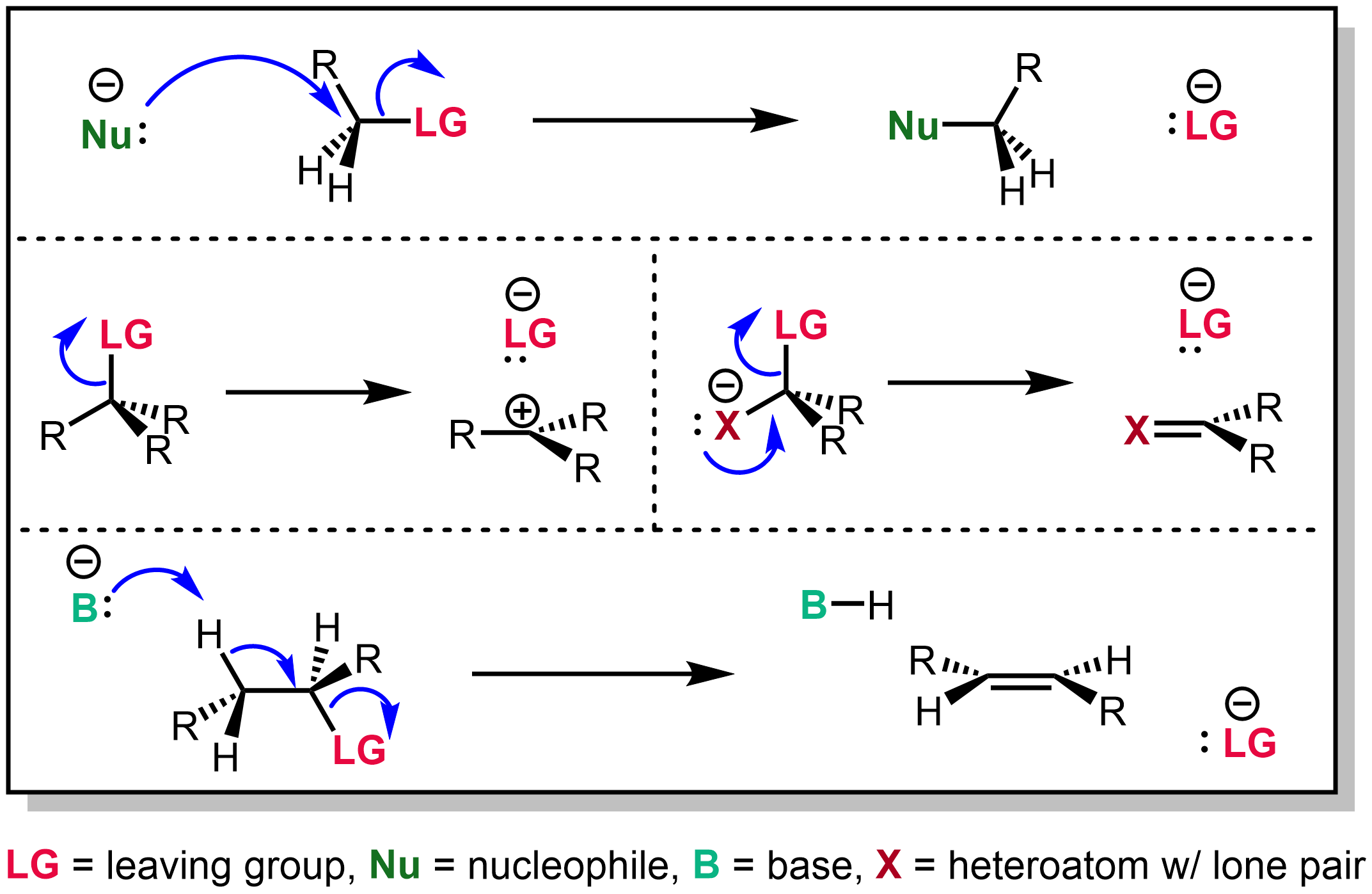
Atom(s) that detach from the substrate during a chemical reaction
A species' ability to serve as a leaving group can affect whether a reaction is viable, as well as what mechanism the reaction takes.
Leaving group ability depends strongly on context, but often correlates with ability to stabilize additional electron density from bond heterolysis. Common anionic leaving groups are , and halides and sulfonate esters such as tosylate (). Water (), alcohols (), and amines () are common neutral leaving groups, although they often require activating catalysts. Some moieties, such as hydride (H−) serve as leaving groups only extremely rarely.
Nomenclature
IUPAC defines a leaving group to be any group of atoms that detaches from the main substrate during a reaction step. The term thus includes groups that depart without an electron pair in a heterolytic cleavage (electrofuges), like or , which commonly depart in electrophilic aromatic substitution reactions. Similarly, species of high thermodynamic stability like nitrogen () or carbon dioxide () commonly act as leaving groups in homolytic bond cleavage reactions of radical species.
In organic chemistry, the term leaving group is rarely used for such species, being restricted only to nucleofugal leaving groups. Leaving groups are generally anions or neutral species, departing from neutral or cationic substrates, respectively, though in rare cases, cations leaving from a dicationic substrate are also known.
This article follows the organic chemistry convention.
Overview
Leaving group ability manifests physically in a fast reaction rate. Equivalently, reactions involving good leaving groups have low activation barriers and relatively stable transition states. Because different reaction mechanisms have different transition states, leaving group ability depends on the reaction in question.
For example, consider the first step of an SN1 or E1 reaction in neutral media: ionization, with an anionic leaving group.

Context-dependence
The correlation in SN1 and E1 reactions between leaving group ability and pKaH is not perfect. Leaving group ability reflects the energy difference (ΔG‡) between neutral starting materials and the partially-charged, partially-bonded transition state. The pKaH, however, represents net energy difference (ΔG°) for the (possibly multi-step) adduction equilibrium between the leaving group and a solvated proton. Hammond's postulate explains conceptually when and why the two energy differences correlate.
For reactions with a different transition state, other aspects of the leaving group may govern. In acid-catalyzed reactions' rate-determining step, only adducts between the formal leaving group and the acid catalyst depart. In those cases, leaving group ability correlates with bond strength to the catalyst (see ). Even more dramatically, benzoate anions decarboxylate when heated with a copper salt catalyst, in principle expulsing an aryl anion from . The true leaving group is most likely an arylcopper compound rather than the aryl anion salt.
Even for the same reaction mechanism in the same media, relative lability may depend on the other reagents. In the substitutions tabulated below, ethoxide displaces tosylate before any halide, but para-thiocresolate prefers to displace iodide and even bromide before tosylate.
| Leaving group (X) | [[File:Propyl halide toluene thiolate reaction.png | center | 332px]] | [[File:Ethyl halide ethoxide reaction.png | center | 291px]] |
|---|---|---|---|---|---|---|
| Cl | 0.0074 | 0.0024 (at 40 °C) | ||||
| Br | 1 | 1 | ||||
| I | 3.5 | 1.9 | ||||
| OTs | 0.44 | 3.6 |
Table
Many organic chemistry textbooks offer a table comparing typical leaving groups' ability across common reactions:
| Leaving groups ordered approximately in decreasing ability to leave |
|---|
| R–I |
| R–OTs, R–OMs, etc. |
| R–Br |
| , |
| R–Cl |
| , |
| , |
| R–F |
| R–OCOR |
| R–OAr |
| R–OH, R–OR |
| R–NR2 |
| R–H |
| R–R' |
It is exceedingly rare for groups such as (hydrides), (alkyl anions, R = alkyl or H), or (aryl anions, Ar = aryl) to depart with a pair of electrons because of the high energy of these species. The Chichibabin reaction provides an example of hydride as a leaving group, while the Wolff-Kishner reaction and Haller-Bauer reaction feature unstabilized carbanion leaving groups.
SN2 reactions
For SN2 reactions, typical synthetically-useful leaving groups include , , and . Phosphate and carboxylate substrates are more likely to react by competitive addition-elimination, while sulfonium and ammonium salts generally form ylides or undergo E2 elimination. Phenoxides () constitute the lower limit for feasible SN2 leaving groups: very strong nucleophiles like or demethylate anisole derivatives through SN2 displacement at the methyl group. Hydroxide, alkoxides, amides, hydride, and alkyl anions do not serve as leaving groups in SN2 reactions.
Base eliminations
When anionic or dianionic tetrahedral intermediates collapse, the high electron density of the neighboring heteroatom facilitates the expulsion of even a very poor leaving group. This dramatic departure occurs because forming a very strong C=O double-bond can drive an otherwise unfavorable reaction forward. For example, even amides expulse R2N−, an extremely poor leaving group, in nucleophilic acyl substitution.
This elimination of poor leaving groups also extends vinylogously to conjugate base eliminations. Many E1cb reactions (e.g. the aldol condensation) commonly involve a hydroxide leaving group from an enolate β position.
Likewise, in SNAr reactions, the rate is generally increased when the leaving group is fluoride relative to the other halogens. This effect is due to the fact that the highest energy transition state for this two step addition-elimination process occurs in the first step, where fluoride's greater electron withdrawing capability relative to the other halides stabilizes the developing negative charge on the aromatic ring. The departure of the leaving group takes place quickly from this high energy Meisenheimer complex, and since the departure is not involved in the rate limiting step, it does not affect the overall rate of the reaction.
E1cb reactions
E1cb reactions proceed with poor leaving groups, but because the C=C double bond is weaker than a C=O bond, the leaving group affects the elimination mechanism.


Poor leaving groups favor the E1cB mechanism, but as the leaving group improves, transition state BC‡ becomes lower in energy. First, the rate-determining step shifts: initially leaving-group elimination from intermediate B; it becomes deprotonation via transition state AB‡ (not pictured). Eventually, BC‡ is no longer stationary on the potential energy surface, and the reaction becomes a concerted E2 elimination (albeit very asynchronous in the diagrammed case).
Activation
In SN1 and E1 reactions, protonation or complexation with a Lewis acid commonly transform a poor leaving group into a good one. Then the reaction proceeds with (respectively) nucleophilic attack or elimination. For example, protonation before departure allows a molecule to formally lose such poor leaving groups as hydroxide.
The same principle applies in Friedel-Crafts reactions. There, a strong Lewis acid is required to generate a carbocation from an alkyl halide or an acylium ion from an acyl halide.

In Friedel-Crafts alkylations, the normal halogen leaving group order is reversed, and the reaction rate follows RF RCl RBr RI. This effect is due to their greater ability to complex the Lewis acid catalyst. The actual group that leaves is an "ate" complex between the Lewis acid and the formal leaving group.
Spontaneous departure
Any leaving group comparable to triflate is called a super leaving group; such compounds generally autoionize if the electrofuge can form a stable carbocation. Thus, the most commonly encountered organic triflates are alkenyl, aryl, and methyl triflates, of which none can form stable carbocations. Conversely, mixed acyl-triflyl anhydrides smoothly acylate arenes, where the corresponding acyl halides would require a strong Lewis acid catalyst.
Even more reactive are the hyper leaving groups, which are stronger than triflate and react with reductive elimination. Prominent hyper leaving groups include various halonium ions, such as diaryl iodonium salts; and other λ3-iodanes.
Hyper leaving groups can be displaced by extraordinarily weak nucleophiles, in part because entropy favors splitting one molecule into three:

Heating neat samples of under reduced pressure methylates the very poorly nucleophilic carborane anion, with concomitant expulsion of the leaving group. Likewise, dialkylhalonium hexafluoroantimonate salts alkylate other alkyl halides to give exchanged products.
In one study, reactivities increased in the order chloride (krel = 1), iodide (krel = 91), tosylate (krel = 3.7), triflate (krel = 1.4), phenyliodonium tetrafluoroborate (, krel = 1.2). In general, leaving groups from dialkylhalonium ions increase in lability as {{chem2|RI
References
References
- (2009). "Gold Book: leaving group". IUPAC.
- "Gold Book: electrofuge". IUPAC.
- For example, leaving groups are defined this way in ''Organic Chemistry: Structure and Function'' (8th ed.) by P. Vollhardt and N. Schore (p. 231).
- (February 1992). "Electrostatic Activation of Nucleofuges: Cationic Leaving Groups". Angewandte Chemie International Edition in English.
- Hoffmann, H. M. R.. (1965). "1252. The rate of displacement of toluene-p-sulphonate relative to bromide ion. A new mechanistic criterion". Journal of the Chemical Society (Resumed).
- Smith, March. ''Advanced Organic Chemistry'' 6th ed. (501-502)
- Warren, S.; Wyatt, P. ''Organic Synthesis: The Disconnection Approach'', 2nd ed.; Wiley: Chichester, U.K., 2008.
- Brown, Herbert C.. (1955). "The Reaction of Benzene and Toluene with Methyl Bromide and Iodide in the Presence of Aluminum Bromide; Evidence for a Displacement Mechanism in the Methylation of Aromatic Compounds". Journal of the American Chemical Society.
- Martínez, A. Garcia. (1993). "A New Easy One-Step Synthesis of Isoquinoline Derivatives from Substituted Phenylacetic Esters". Synlett.
- (1969). "Friedel-Crafts chemistry. IV. Dialkylhalonium ions and their possible role in Friedel-Crafts reactions". Journal of the American Chemical Society.
- Stoyanov, Evgenii S.. (2010). "Dialkyl Chloronium Ions". Journal of the American Chemical Society.
- Olah, George A.. (1970). "Friedel-Crafts chemistry. V. Isolation, carbon-13 nuclear magnetic resonance, and laser Raman spectroscopic study of dimethylhalonium fluoroantimonates". Journal of the American Chemical Society.
This article was imported from Wikipedia and is available under the Creative Commons Attribution-ShareAlike 4.0 License. Content has been adapted to SurfDoc format. Original contributors can be found on the article history page.
Ask Mako anything about Leaving group — get instant answers, deeper analysis, and related topics.
Research with MakoFree with your Surf account
Create a free account to save articles, ask Mako questions, and organize your research.
Sign up freeThis content may have been generated or modified by AI. CloudSurf Software LLC is not responsible for the accuracy, completeness, or reliability of AI-generated content. Always verify important information from primary sources.
Report