From Surf Wiki (app.surf) — the open knowledge base
Least weasel
Species of mammal

Species of mammal
The least weasel (Mustela nivalis), little weasel, common weasel, or simply weasel is the smallest member of the genus Mustela, family Mustelidae and order Carnivora. It is native to Eurasia, North America and North Africa, and has been introduced to New Zealand, Malta, Crete, the Azores, and São Tomé. It is classified as least concern by the IUCN, due to its wide distribution and large population throughout the Northern Hemisphere. Eighteen subspecies are recognised.
The least weasel varies greatly in size over its range. The body is slender and elongated, and the legs and tail are relatively short. The colour varies geographically, as does the pelage type and length of tail. The dorsal surface, flanks, limbs and tail of the animal are usually some shade of brown while the underparts are white. The line delineating the boundary between the two colours is usually straight. At high altitudes and in the northern part of its range, the coat becomes pure white in winter.
Small rodents form the largest part of the least weasel's diet, but it also kills and eats rabbits, other mammals, and occasionally birds, birds' eggs, fish and frogs. Males mark their territories with olfactory signals and have exclusive home ranges which may intersect with or include several female ranges. Least weasels use pre-existing holes to sleep, store food and raise their young. Breeding takes place in the spring and summer, and there is a single litter of about six kits which are reared exclusively by the female. Due to its small size and fierce nature, the least weasel plays an important part in the mythology and legend of various cultures.
Taxonomy and evolution
The least weasel was given its scientific name Mustela nivalis by Carl Linnaeus in his 12th edition of Systema Naturae in 1766; its epithet nivalis comes from the Latin word nix meaning "snow" because it grows a white coat during the winter season. The type locality was Västerbotten in Sweden. However, Rodrigues et al. (2016) recognized M. subpalmata as a distinct population of nivalis rather than a distinct species.
Within the genus Mustela, the least weasel is a relatively unspecialised form, as evidenced by its pedomorphic skull, which occurs even in large subspecies. Its direct ancestor was Mustela praenivalis, which lived in Europe during the Middle Pleistocene and Villafranchian. M. praenivalis itself was probably preceded by M. pliocaenica of the Pliocene. The modern species probably arose during the Late Pleistocene. The least weasel is the product of a process begun 5–7 million years ago, when northern forests were replaced by open grassland, thus prompting an explosive evolution of small, burrowing rodents. The weasel's ancestors were larger than the current form, and underwent a reduction in size to exploit the new food source. The least weasel thrived during the Ice Age, as its small size and long body allowed it to easily operate beneath snow, as well as hunt in burrows. It probably crossed to North America through the Bering land bridge 200,000 years ago.
Subspecies
The least weasel has a high geographic variation, a fact which has historically led to numerous disagreements among biologists studying its systematics. The least weasel's subspecies are divided into three categories:
- The pygmaea–rixosa group (small least weasels): Tiny weasels with short tails, pedomorphic skulls, and pelts that turn pure white in winter. They inhabit northern European Russia, Siberia, the Russian Far East, Finland, the northern Scandinavian Peninsula, Mongolia, northeastern China, Japan and North America.
- The boccamela group (large least weasels): Very large weasels with large skulls, relatively long tails and lighter coloured pelts. Locally, they either do not turn white or only partially change colour in winter. They inhabit Transcaucasia, from western Kazakhstan to Semirechye and in the flat deserts of Middle Asia. They are also found in Morocco, Algeria, and Tunisia.
- The nivalis group (medium-sized least weasels): Medium-sized weasels, with tails of moderate length, representing a transitional form between the former two groups. They inhabit the middle and southern regions of European Russia, Crimea, the Ciscaucasus, western Kazakhstan, the southern and middle Urals and the montane parts of Middle Asia, except the Kopet Dag.
| Subspecies | Trinomial authority | Description | Range | Synonyms | |||
|---|---|---|---|---|---|---|---|
| Common least weasel | |||||||
| M. n. nivalis | Linnaeus, 1766 | Heptner | Sludskii | 2002 | p=982}} | The middle regions of European Russia, from the Baltic states to the middle and southern Urals, northward approximately to the latitude of Saint Petersburg and Perm, and south to the Kursk and Voronezh Oblasts. Outside the former Soviet Union, its range includes Northern Europe (except for Ireland, Iceland, Finland and parts of the Scandinavian Peninsula) and Hokkaidō. | caraftensis (Kishida, 1936) |
| Allegheny least weasel | |||||||
| M. n. allegheniensis | Rhoads, 1901 | Similar to M. n. rixosa, but is larger, has a broad skull and darker coat, and is more adapted to live in deciduous forests | The northeastern United States (Michigan, Pennsylvania, New York, Virginia, North Carolina, Ohio, Illinois, Wisconsin, West Virginia, and Indiana) | ||||
| Transcaucasian least weasel | |||||||
| M. n. boccamela | Bechstein, 1800 | Heptner | Sludskii | 2002 | p=980}} | Transcaucasia, southern Europe, Asia Minor and probably western Iran | italicus (Barrett-Hamilton, 1900) |
| Plains least weasel | |||||||
| M. n. campestris | Jackson, 1913 | The Great Plains of the United States (South Dakota, Iowa, Nebraska, and Kansas) | |||||
| Caucasian least weasel | |||||||
| M. n. caucasica | Barrett-Hamilton, 1900 | dinniki (Satunin, 1907) | |||||
| Alaskan least weasel | |||||||
| M. n. eskimo | Stone, 1900 | A small subspecies. Resembles M. n. rixosa, but has a duller colour, a larger skull and a shorter tail. | Alaska, the Yukon, and the Northwest Territories | ||||
| Turkmenian least weasel | |||||||
| M. n. heptneri | Morozova-Turova, 1953 | Heptner | Sludskii | 2002 | p=981}} | The deserts and semi-deserts of southern Kazakhstan and Middle Asia from the Caspian Sea to Semirechye, southern Tajikistan, Koppet Dag, Afghanistan and northeastern Iran | |
| Japanese least weasel | |||||||
| M. n. namiyei | Kuroda, 1921 | Smaller than M. n. rixosa and paler than M. n. eskimo. Resembles M. n. pygmaea, but the head and body are longer and the tail considerably longer. | Northern Honshū (Aomori, Akita and Iwate Prefectures) | ||||
| Mediterranean least weasel | |||||||
| M. n. numidica | Pucheran, 1855 | The largest subspecies | Morocco, Algeria, Egypt (formerly thought to be a distinct species, the Egyptian weasel), Malta, the Azores Islands and Corsica | albipes (Mina Palumbo, 1868) | |||
| Montane Turkestan least weasel | |||||||
| M. n. pallida | Barrett-Hamilton, 1900 | Heptner | Sludskii | 2002 | p=984}} | The montane parts of Turkmenistan, Uzbekistan, Tajikistan, Kazakhstan and Kirgizia, as well as the Chinese parts of the same mountain systems and perhaps in the extreme eastern parts of Hindukush | |
| Siberian least weasel | |||||||
| M. n. pygmaea | J. A. Allen, 1903 | Heptner | Sludskii | 2002 | p=978}} | All of Siberia (except for southern and southeastern Transbaikalia); the northern and middle Urals, northern Kazakhstan and the Russian Far East, including Sakhalin, the Kuril Islands and the Korean Peninsula; all of Mongolia (except for the eastern part), and probably northeastern China | kamtschatica (Dybowksi, 1922) |
| Bangs' least weasel | |||||||
| M. n. rixosa | Bangs, 1896 | Merriam | 1896 | pp=14–15}} | Nunavut, Labrador, Quebec, Minnesota, North Dakota, Montana, Saskatchewan, Alberta, and British Columbia | ||
| Middle European least weasel | |||||||
| M. n. vulgaris | Erxleben, 1777 | Heptner | Sludskii | 2002 | p=983}} | 9780643099166}} | dumbrowskii (Matschie, 1901) |
Description


The least weasel has a thin, greatly elongated and extremely flexible body with a small, yet elongated, blunt-muzzled head which is no thicker than the neck. The eyes are small in relation to their head size and are bulging and dark colored. The legs and tail are relatively short, the latter constituting less than half the body length. The feet have sharp, dark-coloured claws, and the soles are heavily haired. The skull, especially that of the small rixosa group, has an infantile appearance when compared with that of other members of the genus Mustela (in particular, the stoat and kolonok). This is expressed in the relatively large size of the cranium and shortened facial region. The skull is, overall, similar to that of the stoat, but smaller, though the skulls of large male weasels tend to overlap in size with those of small female stoats. There are usually four pairs of nipples but these are only visible in females.
The baculum is short, 16 to, with a thick, straight shaft. Fat is deposited along the spine, kidneys, gut mesentries and around the limbs. The least weasel has muscular anal glands under the tail, which measure 7 by, and contain sulphurous volatiles, including thietanes and dithiacyclopentanes. The smell and chemical composition of these chemicals are distinct from those of the stoat. The least weasel moves by jumping, the distance between the tracks of the fore and hind limbs being 18 to.

Dimensions vary geographically, to an extent rarely found among other mammals. Least weasels of the boccamela group, for example, may outweigh the smaller races by almost four times. In some large subspecies, the male may be 1.5 times longer than the female. The tail lengths are also variable, constituting 13 to 30 percent of the length of the body. Average body length in males is 130 to, while females average 114 to. The tail measures 12 to in males and 17 to in females. Males weigh 36 to, while females weigh 29 to.
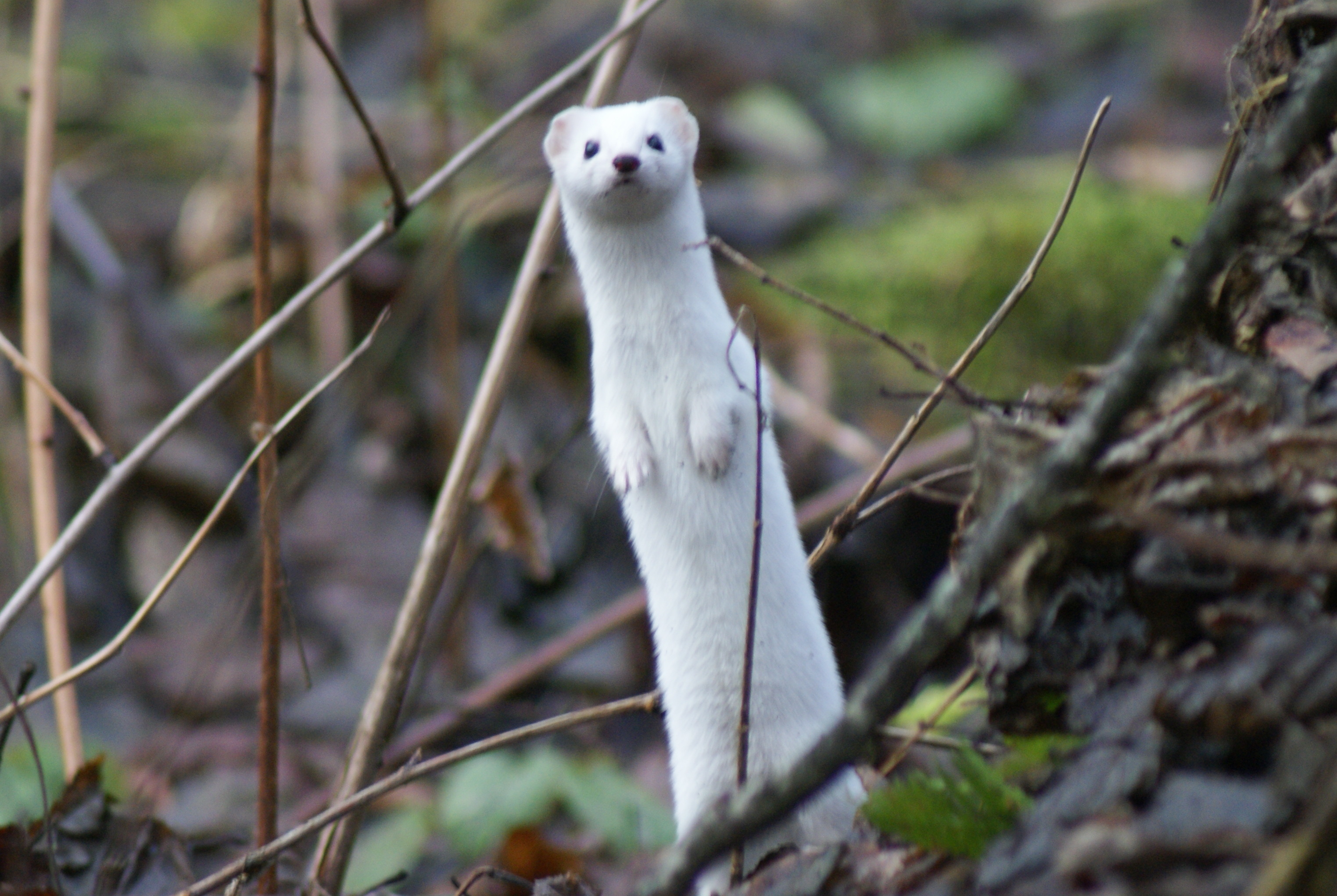
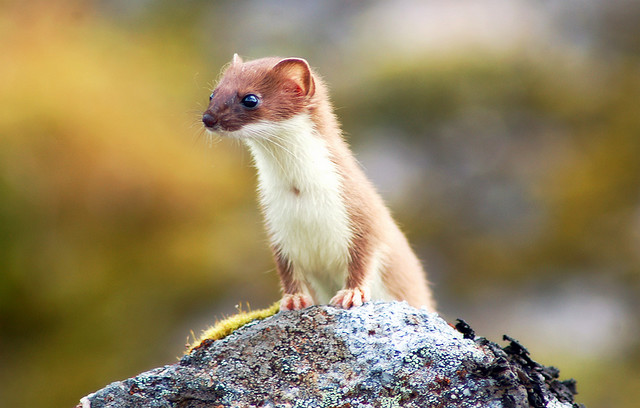
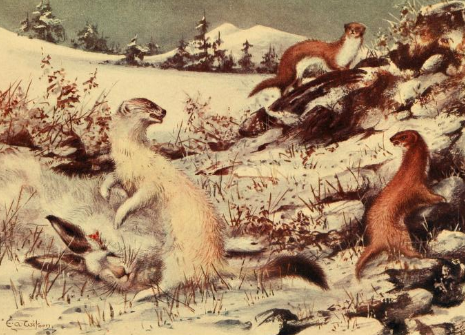
The winter fur is dense, but short and closely fitting. In northern subspecies, the fur is soft and silky, but coarse in southern forms. The summer fur is very short, sparser and rougher. The upper parts in the summer fur are dark, but vary geographically from dark-tawny or dark-chocolate to light pale tawny or sandy. The lower parts, including the lower jaw and inner sides of the legs, are white. There is often a brown spot at the corner of the mouth. The dividing line between the dark upper and light lower parts is usually straight but sometimes forms an irregular line. The tail is brown, and sometimes the tip is a little darker but it is never black. In the northern part of its range and at high altitudes, the least weasel changes colour in the winter, the coat becoming pure white and exhibiting a few black hairs in rare circumstances.
Distribution and habitat

The least weasel has a circumboreal, Holarctic distribution, encompassing much of Europe and North Africa, Asia and parts of northern North America. It has been introduced to New Zealand, It also occurs on Honshu and Hokkaido Islands in Japan and on Kunashir, Iturup, and Sakhalin Islands in Russia.
The least weasel inhabits fields, open woodland, bushy and rocky areas, parks and gardens at elevations of up to about 3000 m.
Fossilised remains of the least weasel are known from Denisova Cave.
Behaviour and ecology
Reproduction and development
The least weasel mates in April–July and there is a 34- to 37-day gestation period. In the Northern Hemisphere, the average litter size consists of 6 kits and these reach sexual maturity in 3 to 4 months. Males may mate during their first year of life, though this is usually unsuccessful. They are fecund in February–October, though the early stages of spermatogenesis do occur throughout the winter months. Anestrus in females lasts from September until February.
The female raises her kits without help from the male. They are 1.5 to in weight at birth. Newborn kits are born pink, naked, blind and deaf, but gain a white coat of downy fur at the age of 4 days. At 10 days, the margin between the dark upper parts and light under parts becomes visible. The milk teeth erupt at 2 to 3 weeks of age, at which point the young start to eat solid food, though lactation can last 12 weeks. The eyes and ears open at 3 to 4 weeks of age, and by 8 weeks, killing behaviour is developed. The family breaks up after 9 to 12 weeks. There is a single litter each year and least weasels can live for 7 or 8 years.
Territorial and social behaviours
.jpg)
The least weasel has a typical mustelid territorial pattern, consisting of exclusive male ranges encompassing multiple female ranges. The population density of each territory depends greatly on food supply and reproductive success, thus the social structure and population density of any given territory is unstable and flexible. Like the stoat, the male least weasel extends his range during spring or during food shortages. Its scent marking behaviour is similar to that of the stoat; it uses faeces, urine and anal and dermal gland secretions, the latter two of which are deposited by anal dragging and body rubbing. The least weasel does not dig its own den, but nests in the abandoned burrow of another species such as a mole or rat. The burrow entrance measures about 2.5 cm across and leads to the nest chamber located up to 15 cm below ground. The nest chamber (which is used for sleeping, rearing kits and storing food) measures 10 cm in diameter, and is lined with straw and the skins of the weasel's prey.
The least weasel has four basic vocalisations; a guttural hiss emitted when alarmed, which is interspersed with short screaming barks and shrieks when provoked. When defensive, it emits a shrill wail or squeal. During encounters between males and females or between a mother and kits, the least weasel emits a high-pitched trilling. The least weasel's way of expressing aggression is similar to that of the stoat. Dominant weasels exhibit lunges and shrieks during aggressive encounters, while subdominant weasels will emit submissive squeals.
Diet
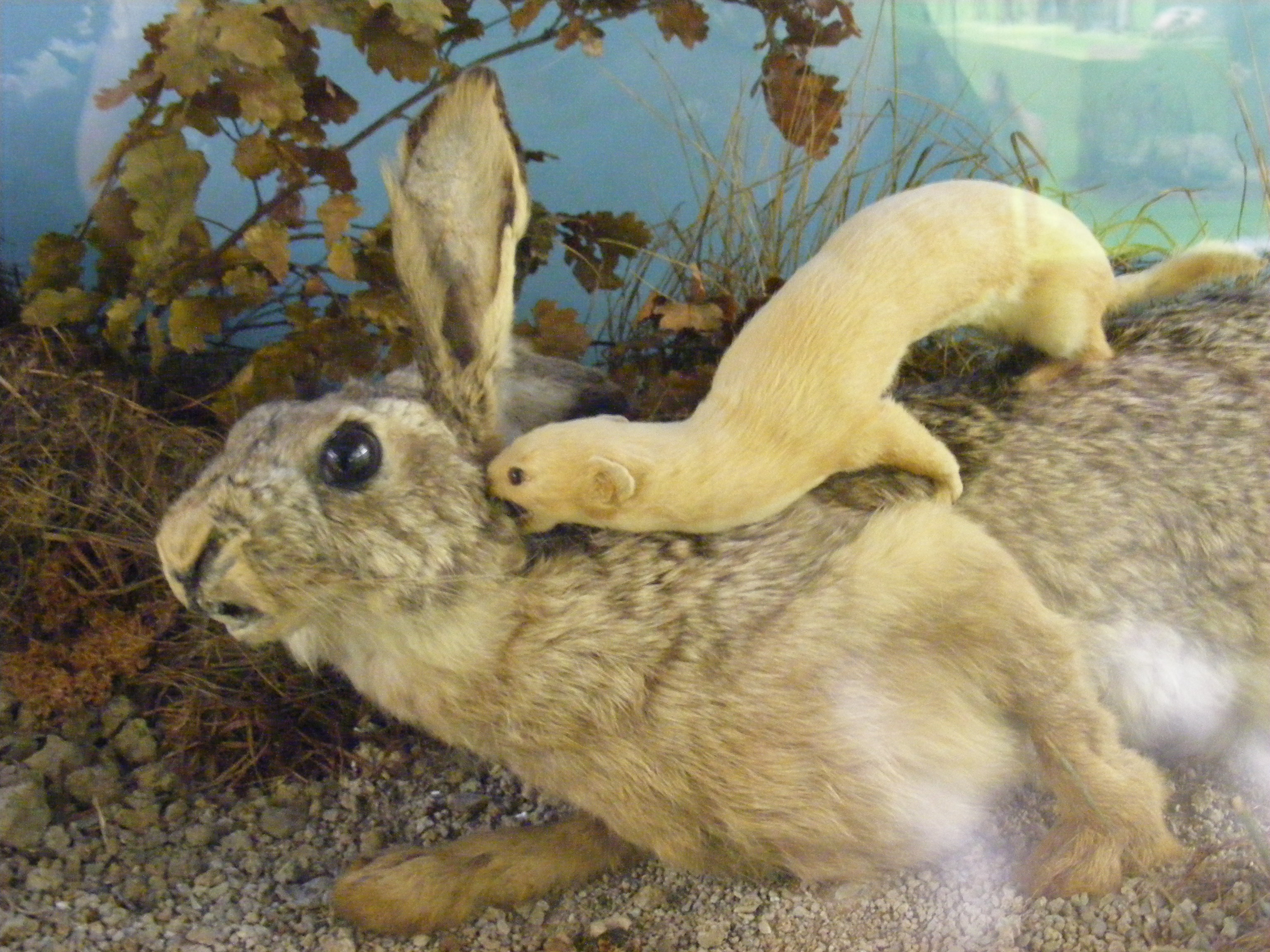
The least weasel feeds predominantly on mouse-like rodents, including mice, hamsters, gerbils and others. It usually does not attack adult hamsters and rats. Frogs, fish, small birds and bird eggs are rarely eaten. It can deal with adult pikas and gerbils, but usually cannot overcome brown rats and sousliks. Exceptional cases are known of least weasels killing prey far larger than themselves, such as capercaillie, hazel hen and hares. In England, a favoured prey item is the field vole (Microtus agrestis). These have fluctuations in population size, and in years of abundance may form up to 54% of the weasel's diet. In years of scarcity, birds form a greater proportion of the diet and female least weasels may fail to breed.
Despite its small size, the least weasel is a fierce hunter, capable of killing a rabbit five to 10 times its own weight. Although they are commonly taken, the rabbits are usually young specimens, and become an important food source during the spring, when small rodents are scarce and rabbit kits are plentiful. Male least weasels take a higher proportion of rabbits than females, as well as an overall greater variety of prey. This is linked to the fact that being larger, and having vaster territorial ranges than females, males have more opportunities to hunt a greater diversity of prey.
The least weasel forages undercover, to avoid being seen by foxes and birds of prey. It is adapted for pursuing its prey down tunnels, though it may also bolt prey from a burrow and kill it in the open. The least weasel kills small prey, such as voles, with a bite to the occipital region of the skull or the neck, dislocating the cervical vertebrae. Large prey typically dies of blood loss or circulatory shock. When food is abundant, only a small portion of the prey is eaten, usually the brain. The average daily food intake is 35 g, which is equivalent to 30–35% of the animal's body weight.
Predators and competitors
The least weasel is small enough to be preyed upon by a range of other predators. Least weasel remains have been found in the excrement of red foxes, sables, steppe and forest polecat, stoats, eagle owls and buzzards. The owls most efficient at capturing least weasels are barn, barred, and great horned owls. Other birds of prey threatening to the least weasel include broad-winged and rough-legged buzzards. Some snake species may prey on the least weasel, including the black rat snake and copperhead. Aside from its smaller size, the least weasel is more vulnerable to predation than the stoat because it lacks a black predator deflection mark on the tail.
In areas where the least weasel is sympatric with the stoat, the two species compete with each other for rodent prey. The weasel manages to avoid too much competition by living in more upland areas, feeding on smaller prey and being capable of entering smaller holes. It actively avoids encounters with stoats, though female weasels are less likely to stop foraging in the presence of stoats, perhaps because their smaller size allows them to quickly escape into holes.
Diseases and parasites
Ectoparasites known to infest weasels include the louse Trichodectes mustelae and the mites Demodex and Psoregates mustela. The species may catch fleas from the nests and burrows of its prey. Flea species known to infest weasels include Ctenophthalmus bisoctodentatus and Palaeopsylla m. minor, which they get from moles, P. s. soricis, which they get from shrews, Nosopsyllus fasciatus, which they get from rodents and Dasypsyllus gallinulae which they get from birds.
Helminths known to infest weasels include the trematode Alaria, the nematodes Capillaria, Filaroides and Trichinella and the cestode Taenia.
Conservation
The least weasel is listed as Least Concern on the IUCN Red List, because of its wide global distribution and large population that is thought to be not in decline.
In folklore and mythology
Macedonian and Greek culture

The Ancient Macedonians believed that to see a least weasel was a good omen. In some districts of Macedon, women who suffered from headaches after having washed their heads in water drawn overnight would assume that a weasel had previously used the water as a mirror, but they would refrain from mentioning the animal's name for fear that it would destroy their clothes.
Similarly, a popular superstition in southern Greece had it that the least weasel had previously been a bride, who was transformed into a bitter animal which would destroy the wedding dresses of other brides out of jealousy. According to Pliny the Elder, the least weasel was the only animal that was capable of killing the basilisk:
To this dreadful monster the effluvium of the weasel is fatal, a thing that has been tried with success, for kings have often desired to see its body when killed; so true is it that it has pleased Nature that there should be nothing without its antidote. The animal is thrown into the hole of the basilisk, which is easily known from the soil around it being infected. The weasel destroys the basilisk by its odour, but dies itself in this struggle of nature against its own self.
Ojibwe and Inuit culture
The Ojibwe believed that the least weasel could kill the dreaded wendigo by rushing up its anus.
In Inuit mythology, the least weasel is credited with both great wisdom and courage, and whenever a mythical Inuit hero wished to accomplish a valorous task, he would generally change himself into a least weasel.
References
Citations
General and cited references
References
- (2019). "''Mustela nivalis''".
- (1994). "''Mustela nivalis''". Mammalian Species.
- (2005). "Mammal Species of the World: A Taxonomic and Geographic Reference, Volume 12". JHU Press.
- (2016). "Taxonomic status and origin of the Egyptian weasel (''Mustela subpalmata'') inferred from mitochondrial DNA". Genetica.
- {{Harvnb. Heptner. Sludskii. 2002
- {{Harvnb. Kurtén. 1968
- {{Harvnb. Macdonald. 1992
- {{Harvnb. Heptner. Sludskii. 2002
- {{Harvnb. Heptner. Sludskii. 2002
- Rhoades, S. M.. (1900). "A New Weasel from western Pennsylvania". Proceedings of the Academy of Natural Sciences of Philadelphia.
- {{Harvnb. Heptner. Sludskii. 2002
- Swenk, M. H.. (1926). "Notes on ''Mustela campestris'' Jackson, and on the American forms of Least Weasels". Journal of Mammalogy.
- {{Harvnb. Heptner. Sludskii. 2002
- Kuroda, N.. (1921). "On three new mammals from Japan". Journal of Mammalogy.
- {{Harvnb. Heptner. Sludskii. 2002
- {{Harvnb. Heptner. Sludskii. 2002
- {{Harvnb. Merriam. 1896
- {{Harvnb. Heptner. Sludskii. 2002
- Long, J. L. (2003). ''Introduced Mammals of the World: Their History, Distribution and Influence''. Cabi Publishing. pp. 271–272. {{ISBN. 9780643099166
- King, C.. (2005). "The Handbook of New Zealand Mammals". Oxford University Press.
- {{Harvnb. Heptner. Sludskii. 2002
- {{Harvnb. Heptner. Sludskii. 2002
- King, C. M.. (2007). "The Natural History of Weasels and Stoats: Ecology, Behavior, and Management". Oxford University Press, USA.
- {{Harvnb. Harris. Yalden. 2008
- {{Harvnb. Heptner. Sludskii. 2002
- {{Harvnb. Heptner. Sludskii. 2002
- Konig, C.. (1973). "Mammals". Collins & Co..
- (2016). "Origin and introduction history of the Least Weasels (''Mustela nivalis'') on Mediterranean and Atlantic islands inferred from genetic data". Biological Invasions.
- (2021). "Evolution of the European regional large mammals assemblages in the end of the Middle Pleistocene – The first half of the Late Pleistocene (MIS 6–MIS 4)". [[Quaternary International]].
- {{Harvnb. Harris. Yalden. 2008
- Erlinge, S.. (1974). "Distribution, territoriality and numbers of the Weasel ''Mustela nivalis'' in relation to prey abundance". Oikos.
- {{Harvnb. Harris. Yalden. 2008
- {{Harvnb. Merritt. Matinko. 1987
- {{Harvnb. Heptner. Sludskii. 2002
- Tapper, S.. (1979). "The effect of fluctuating Vole numbers (''Microtus agrestis'') on a population of Weasels (''Mustela nivalis'') on farmland". Animal Ecology.
- {{Harvnb. Macdonald. 1992
- {{Harvnb. Harris. Yalden. 2008
- {{Harvnb. Harris. Yalden. 2008
- {{Harvnb. Heptner. Sludskii. 2002
- {{Harvnb. Harris. Yalden. 2008
- King, C. M.. (1977). "The effects of the nematode parasite ''Skrjabingylus nasicola'' on British weasels (''Mustela nivalis'')". Journal of Zoology.
- Abbott, G. A. (1903), [https://archive.org/details/macedonianfolklo00abborich ''Macedonian Folklore''], pp. 108–109, Cambridge University Press
- Pliny the Elder. (1855). "The Natural History".
- Barnouw, Victor (1979). ''Wisconsin Chippewa Myths & Tales: And Their Relation to Chippewa Life'', p. 53, University of Wisconsin Press, {{ISBN. 0-299-07314-9
- Dufresne, Frank (2005), ''Alaska's Animals and Fishes'', p. 109, Kessinger Publishing, {{ISBN. 1-4179-8416-3
This article was imported from Wikipedia and is available under the Creative Commons Attribution-ShareAlike 4.0 License. Content has been adapted to SurfDoc format. Original contributors can be found on the article history page.
Ask Mako anything about Least weasel — get instant answers, deeper analysis, and related topics.
Research with MakoFree with your Surf account
Create a free account to save articles, ask Mako questions, and organize your research.
Sign up freeThis content may have been generated or modified by AI. CloudSurf Software LLC is not responsible for the accuracy, completeness, or reliability of AI-generated content. Always verify important information from primary sources.
Report