From Surf Wiki (app.surf) — the open knowledge base
Law of the United Kingdom
none

none
The United Kingdom has three distinctly different legal systems, each of which derives from a particular geographical area for a variety of historical reasons: English law (in the joint jurisdiction of England and Wales), Scots law and Northern Ireland law. As a result, there is no single unified legal system of the United Kingdom as a result of the continuation of the separate legal systems of England (and Wales), Scotland and Northern Ireland.
In fulfilment of its former EU treaty obligations, European Union directives had been transposed into the UK legal system on an ongoing basis by the UK parliament. Upon Brexit, non-transposed EU law (such as regulations) was transplanted into domestic law as "retained EU law", with an additional period of alignment with EU law during the transition period from 31 January to 31 December 2020.
Since 2007, there have been calls for a fourth type, that of purely Welsh law as a result of Welsh devolution, with further calls for a Welsh justice system.
Legal jurisdictions
Main article: List of national legal systems}}{{See also, Proposed Welsh justice system
There are three distinct legal jurisdictions in the United Kingdom: England and Wales, Northern Ireland and Scotland. Each has its own legal system, distinct history and origins, although there is a substantial overlap between these three legal systems and the three legal jurisdictions.
Unlike the other three, Welsh law is not a separate legal system per se, merely the primary and secondary legislation generated by the Senedd, interpreted in accordance with the doctrines of English law and not impacting upon English common law (except where such Welsh legislation ousts a common law rule by virtue of being a superior form of law).
The UK does not have a single legal system because it was created by the political union of previously independent countries. Article 19 of the Treaty of Union, put into effect by the Acts of Union in 1707, created the Kingdom of Great Britain but guaranteed the continued existence of Scotland's and England's separate legal systems. The Acts of Union of 1800, which joined Great Britain and Ireland into the United Kingdom of Great Britain and Ireland, contained no equivalent provisions but preserved the principle of different courts to be held in Ireland, of which the part called Northern Ireland continues to follow as part of the United Kingdom.
Each legal system defaults to its jurisdiction, each of whose courts further that law through jurisprudence. Choice of which jurisdiction's law to use is possible in private law: for example, a company in Edinburgh, Scotland and a company in Belfast, Northern Ireland are free to contract using English law. This is not so in public law (for example, criminal law), where there are set rules of procedure in each jurisdiction.
Structure and history
Although Scotland and Northern Ireland form part of the United Kingdom and share Westminster as a primary legislature, they have separate legal systems. (Even though Scotland became part of the UK over 300 years ago, Scots law has remained remarkably distinct from English law). The UK's highest civil appeal court is the Supreme Court of the United Kingdom, whose decisions are binding on all three UK jurisdictions, as in Donoghue v Stevenson, a Scots case that forms the basis of the UK's law of negligence.
"Great Britain" means England, Wales, Scotland, their adjacent territorial waters and the islands of Orkney and Shetland, the Hebrides and, by virtue of the Island of Rockall Act 1972, Rockall. "United Kingdom" means Great Britain and Northern Ireland and their adjacent territorial waters, but not the Isle of Man, nor the Channel Islands, whose independent status was discussed in Rover International Ltd. v Canon Film Sales Ltd. (1987) and Chloride Industrial Batteries Ltd. v F. & W. Freight Ltd. (1989). "British Islands"but not "British Isles"means the United Kingdom, the Isle of Man and the Channel Islands.
The first schedule of the Interpretation Act 1978, defines the following terms: "British Islands", "England", and "United Kingdom". The use of the term "British Isles" is virtually obsolete in statutes and, when it does appear, it is taken to be synonymous with "British Islands". For interpretation purposes, England includes a number of specified elements:
- Wales and Berwick Act 1746, section 3 (entire act now repealed) formally incorporated Wales and Berwick-upon-Tweed into England. But section 4 Welsh Language Act 1967 provided that references to England in future acts of Parliament should no longer include Wales (see now Interpretation Act 1978, schedule 3, part 1). But Dicey & Morris say (at p28) "It seems desirable to adhere to Dicey's (the original) definition for reasons of convenience and especially of brevity. It would be cumbersome to have to add "or Wales" after "England" and "or Welsh" after "English" every time those words are used."
- the "adjacent islands" of the Isle of Wight and Anglesey are a part of England and Wales by custom, while Harman v Bolt (1931) expressly confirms that Lundy is a part of England.
- the "adjacent territorial waters" by virtue of the Territorial Waters Jurisdiction Act 1878 and the Continental Shelf Act 1964 as amended by the Oil and Gas (Enterprise) Act 1982.
England And Wales
Main article: English and Welsh law
English and Welsh law (or just English law) refers to the legal system administered by the courts in England and Wales, which rule on both civil and criminal matters. English and Welsh law is based on the principles of common law. English and Welsh law can be described as having its own legal doctrine, distinct from civil law legal systems since 1189.
There has been no major codification of the law, rather the law is developed by judges in court, applying statute, precedent and case-by-case reasoning to give explanatory judgments of the relevant legal principles. These judgments are binding in future similar cases (stare decisis), and for this reason are often reported in law reports.
The courts of England and Wales are headed by the Senior Courts of England and Wales, consisting of the Court of Appeal, the High Court of Justice (for civil cases) and the Crown Court (for criminal cases). The Supreme Court is the highest court in the land for both criminal and civil appeal cases in England and Wales (also in Northern Ireland cases and civil cases in Scots law) and any decision it makes is binding on every other court in the same jurisdiction, and often has persuasive effect in its other jurisdictions.
On appeal, a court may overrule the decisions of its inferior courts, such as county courts (civil) and magistrates' courts (criminal). The High Court may also quash on judicial review both administrative decisions of the Government and delegated legislation. Before the Supreme Court of the United Kingdom was created in October 2009, the highest appellate body was the Appellate Committee of the House of Lords, usually just referred to as "The House of Lords".
After the Acts of Union, in 1707 English law became one of two legal systems in different parts of the same United Kingdom and has been influenced by Scots law, most notably in the development and integration of the law merchant by Lord Mansfield and in time the development of the law of negligence. Scottish influence may have influenced the abolition of the forms of action in the nineteenth century and extensive procedural reforms in the twentieth. Since the accession of the United Kingdom to the European Communities in 1973, English law has also been affected by European law under the Treaty of Rome.
Wales
Main article: Welsh law}}{{See also, Proposed Wales criminal justice system
Welsh law is the primary and secondary legislation generated by the Senedd, using the devolved authority granted in the Government of Wales Act 2006, amended substantially by Wales Act 2014 and Wales Act 2017, and in effect since May 2007. Each piece of Welsh legislation is known as an Act of Senedd Cymru.
As there is no criminal law within contemporary Welsh law, Wales is not generally considered a fourth jurisdiction of the United Kingdom. This is because the judiciary and the courts follow England and Wales law, which is made by the Parliament at Westminster, and is not specific to Wales. Although Welsh law is recognised as separate in operation, this is not sufficient for Wales to constitute a separate legal jurisdiction.
A commission set up in 2017 by the First Minister of Wales known as "The Commission on Justice in Wales" and chaired by Lord Thomas of Cwmgiedd, looked into the operation of justice in the country. Its aim was to further clarify the legal and political identity of Wales within the UK constitution. The commission's report was released in October 2019 and recommended the full devolution of the justice system. This would formalise Wales as the fourth jurisdiction of the UK.
There have been multiple calls from both academics and politicians however for a Wales criminal justice system.
Northern Ireland
Main article: Law of Northern Ireland
The law of Northern Ireland is a common law system. It is administered by the courts of Northern Ireland, with ultimate appeal to the Supreme Court of the United Kingdom in both civil and criminal matters. The law of Northern Ireland is closely similar to English law, the rules of common law having been imported into the Kingdom of Ireland under English rule. However, there are important differences.
The sources of the law of Northern Ireland are Irish common law, and statute law. Of the latter, statutes of the Parliaments of Ireland, of the United Kingdom and of Northern Ireland are in force, and latterly statutes of the devolved Northern Ireland Assembly. The courts of Northern Ireland are headed by the Court of Judicature of Northern Ireland, consisting of the Northern Ireland Court of Appeal, the Northern Ireland High Court of Justice and the Northern Ireland Crown Court.
Below that are county courts and magistrates' courts. The Supreme Court is the highest court in the land for both criminal and civil appeal cases in Northern Ireland and any decision it makes is binding on every other court in the same jurisdiction and often has persuasive effect in its other jurisdictions.
Scotland
Main article: Scots law
Scots law is a unique legal system with an ancient basis in Roman law. Grounded in uncodified civil law dating back to the Corpus Juris Civilis, it also features elements of common law with medieval sources. Thus Scotland has a pluralistic, or 'mixed', legal system, comparable to that of South Africa, and, to a lesser degree, the partly codified pluralistic systems of Louisiana and Quebec.
Upon the formation of the Kingdom of Great Britain under the 1707 Acts of Union, Scots law shared a legislature with England and Wales. While each retained fundamentally different legal systems, the 1707 Union brought English and Welsh influence upon Scots law, and vice versa. Since the accession of the United Kingdom to the European Communities in 1973, Scots law has been affected by European law under the Treaty of Rome. The establishment of the Scottish Parliament and creation of the Scottish Government in 1999, which legislates on all matters within domestic areas of legislative competence, has created a further major source of Scots law.
Under the UK Withdrawal from the European Union (Continuity) (Scotland) Act 2020 following the withdrawal of the United Kingdom from the European Union in 2020 it is required that devolved Scots law has to stay in alignment with future EU law despite the virtue of no longer being a member state.
The chief courts are the Court of Session, for civil cases, and the High Court of Justiciary, for criminal cases. The Supreme Court of the United Kingdom serves as the highest court of appeal for civil cases under Scots law, with leave to appeal from the Court of Session not required as a general rule. However, unlike in the rest of the United Kingdom, the Supreme Court of the United Kingdom has no role as the highest court of appeal for Scottish criminal cases: this is forbidden by Article XIX of the Treaty of Union between Scotland and England.
Sheriff courts deal with most civil and criminal cases including conducting criminal trials with a jury, known as sheriff solemn court, or with a sheriff and no jury, known as sheriff summary court. The sheriff courts provide a local court service with 49 sheriff courts organised across six sheriffdoms. The Scottish legal system is unique in having three possible verdicts for a criminal trial: "guilty", "not guilty" and "not proven". Both "not guilty" and "not proven" result in an acquittal with no possibility of retrial. In very rare circumstances, the High Court of Justiciary can create new criminal offences without reference to Parliament, using its declaratory power to do so.
The Cabinet Secretary for Justice and Home Affairs is the member of the Scottish Government responsible for Police Scotland, the courts and criminal justice, and the Scottish Prison Service, which manages the prisons in Scotland.
Retained EU law
Retained EU law (REUL) is a category of law in the United Kingdom created at the end of the transition period following the UK's withdrawal from the EU. REUL includes EU legislation which was "cut and pasted" into domestic law, along with certain domestic laws whose role was to implement EU regulations and directives. The objective of REUL is to maintain "legislative continuity".
Courts and tribunals
Main article: Judiciaries of the United Kingdom
The Supreme Court of the United Kingdom is the highest court in the UK for all criminal and civil cases in England and Wales and Northern Ireland, and for all civil cases in Scots law. The Supreme Court is the final court, in the normal sense of the term, for interpreting United Kingdom law. Unlike in some other systems, for example, the United States, the Supreme Court cannot strike down statutes. Its precedents can be expressly overridden by Parliament, by virtue of the doctrine of parliamentary sovereignty. The Supreme Court came into being in October 2009, replacing the Appellate Committee of the House of Lords.
In England and Wales, the court system is headed by the Senior Courts of England and Wales, consisting of the Court of Appeal, the High Court of Justice (for civil cases) and the Crown Court (for criminal cases). The Courts of Northern Ireland follow the same pattern.
In Scotland, the chief courts are the Court of Session, for civil cases, and the High Court of Justiciary, for criminal cases. Sheriff courts, as they deal with both criminal and civil caseloads, have no equivalent outside Scotland.
Certain tribunals for administrative law cases have UK-wide jurisdiction, notably those dealing with immigration—the Upper Tribunal (Immigration and Asylum Chamber) and Special Immigration Appeals Commission—military and national security, competition and intellectual property, and a few others. Similarly, the Employment Appeal Tribunal has jurisdiction throughout Great Britain but not in Northern Ireland.
The Judicial Committee of the Privy Council is the highest court of appeal for several independent Commonwealth countries, the British Overseas Territories, and the British Crown Dependencies.
United Kingdom legislatures
Main article: Legislatures of the United Kingdom
United Kingdom Parliament
Main article: Parliament of the United Kingdom
The Parliament of the United Kingdom is bicameral, with an upper house – the House of Lords, and a lower house – the House of Commons. In addition to the two houses, the King is also a component of Parliament.
The House of Lords includes two different types of members: The Lords Spiritual (the senior bishops of the Church of England) and the Lords Temporal (members of the Peerage). Its members are not elected by the population at large.
The House of Commons is a democratically elected chamber. The two Houses meet in separate chambers in the Palace of Westminster, commonly known as the "Houses of Parliament", in the City of Westminster in London. By constitutional convention, all government ministers, including the Prime Minister, are members of the House of Commons or House of Lords.
Parliament evolved from the early medieval councils that advised the sovereigns of England and Scotland. The King, Lords, and Commons acting together to legislate may be described as the King-in-Parliament. The King-in-Parliament is, according to the doctrine of parliamentary sovereignty, completely sovereign with the power to make and unmake any law other than to bind itself.
Real power is vested in the House of Commons. The Sovereign acts only as a figurehead and the powers of the House of Lords are greatly limited. The parliament retains some law-making powers for some jurisdictions outside of the United Kingdom proper.
Northern Ireland Assembly
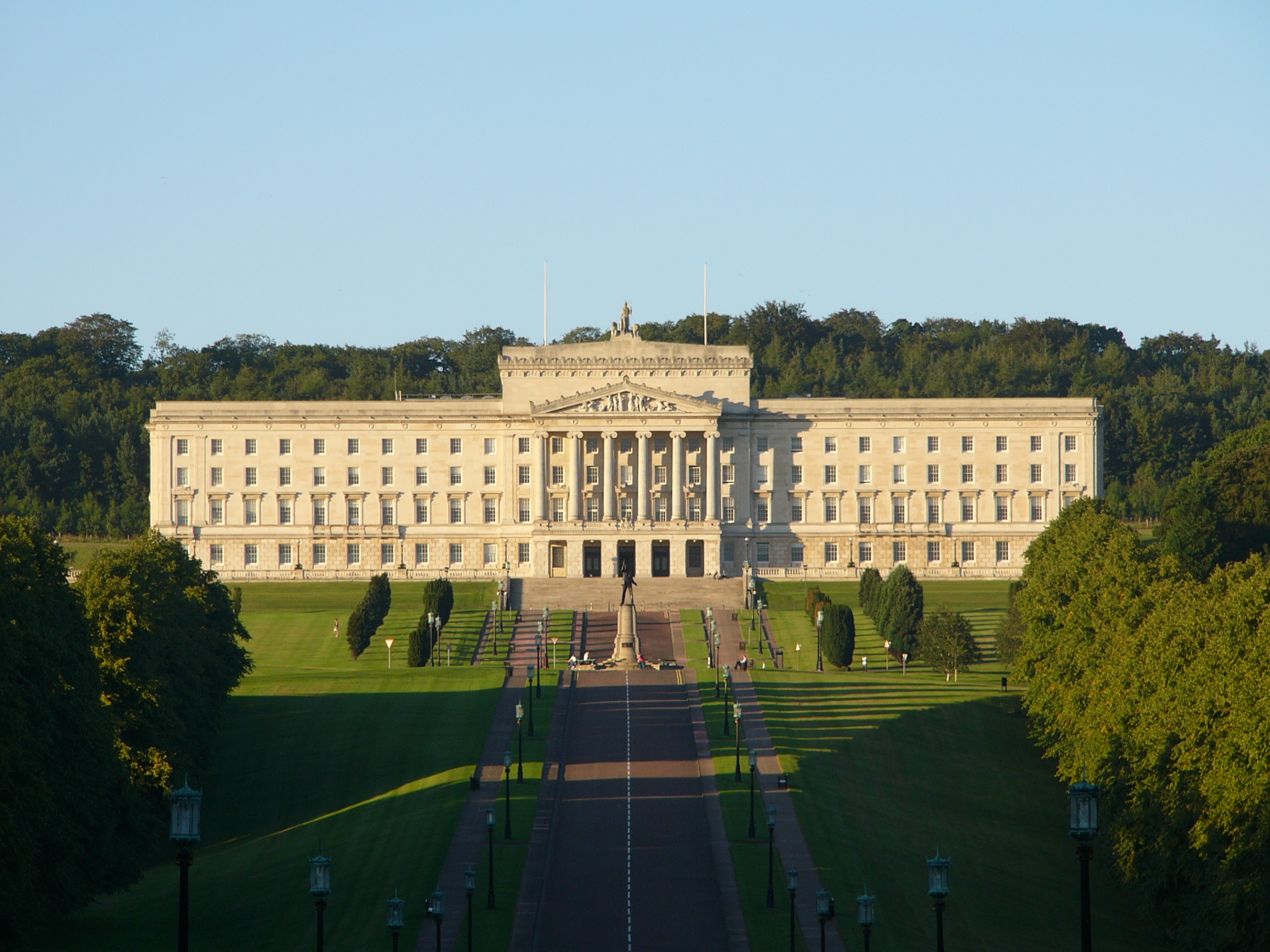
Main article: Northern Ireland Assembly
The Northern Ireland Assembly (, Ulster Scots: Norlin Airlann Semmlie) is the devolved legislature of Northern Ireland. It has power to legislate in a wide range of areas that are not explicitly reserved to the Parliament of the United Kingdom, and to appoint the Northern Ireland Executive. It sits at Parliament Buildings at Stormont in Belfast.
The latest incarnation of the Assembly was established under the Good Friday Agreement of 1998, an accord aimed at bringing an end to Northern Ireland's violent 30-year Troubles. It is based on the principle of power-sharing under the D'Hondt method to ensure that Northern Ireland's largest political communities, the unionist and nationalist communities both participate in governing the region.
The Assembly is a unicameral, democratically elected body comprising 90 members who are known as Members of the Legislative Assembly, or MLAs. Members are elected under the single transferable vote form of proportional representation.
Scottish Parliament
Main article: Scottish Parliament

The Scottish Parliament (; ) is located in the Holyrood area of the capital Edinburgh. The Parliament, which is informally referred to as "Holyrood" (cf. "Westminster"), is a democratically elected body of 129 members who are known as Members of the Scottish Parliament or MSPs. Members are elected for four-year terms under the Additional Member System of proportional representation.
73 MSPs represent individual geographical constituencies elected by the plurality voting system ("first past the post"). A further 56 are returned from eight additional member regions, each electing seven MSPs. The Scottish Parliament, as it was created by devolution and an act of parliament, does not get its legislative powers by virtue of sovereignty or by virtue of 'being the Scottish Parliament'. It legally exists as a subset of Westminster and derives its powers as such.
The original Parliament of Scotland (or "Estates of Scotland") was the national legislature of the independent Kingdom of Scotland and existed from the early thirteenth century until the Kingdom of Scotland merged with the Kingdom of England under the Acts of Union 1707 to form the Kingdom of Great Britain. As a consequence, the Parliament of Scotland merged with the Parliament of England, to form the Parliament of Great Britain, which sat at Westminster in London.
Senedd
Main article: Senedd
Since 2007, the Senedd (Welsh Parliament; ), previously known as the 'National Assembly for Wales', has been invested with legislative powers. It is situated in Cardiff. The Senedd, first elected in 1999, is a democratically elected body of 60 members who are known as Members of the Senedd or MSs. Members are elected for five-year terms under the Additional Member System of proportional representation. 40 MSs represent individual geographical constituencies elected by the plurality voting system ("first past the post"). 20 are returned from five additional member regions. Each region elects four MSs.
References
References
- (9 June 2014). "Two jurisdictions: a shared inheritance". UK Government.
- "The UK has three legal systems, operating in England and Wales, Scotland and Northern Ireland"], [[direct.gov.uk]], accessed 12 March 2007
- "The Court and legal System - UK Supreme Court".
- (30 September 2021). "Written Statement: Update on the development of the justice system and the legal sector in Wales (30 September 2021)".
- (2022-11-29). "Plaid Cymru call for devolution of justice to Wales - 'we can't be treated as an appendage to England'".
- "Devolution a 'necessary step' towards a better Welsh criminal justice system, academics argue".
- "Conflict of Laws}} {{small".
- "The Treaty (act) of the Union of Parliament 1706". Scottish History Online.
- ''Donoghue v Stevenson'' [1932] UKHL [1932] UKHL
- (1987) 1 WLR 1597
- (1989) 1 WLR 823
- (1931) 47 TLR 219
- (2017). "The English Legal System". Routledge.
- "The Commission on Justice in Wales (Thomas Commission) {{!}} Centre on Constitutional Change l Researching the issues. Informing the debate.".
- (23 December 2020). "MSPs pass Brexit bill to 'keep pace' with EU laws". BBC News.
- "Court of Session – Introduction". Scottish Courts.
- "High Court of Justiciary – Introduction". Scottish Courts.
- "House of Lords – Practice Directions on Permission to Appeal". UK Parliament.
- "Introduction". Scottish Courts.
- (20 March 2005). "The case for keeping 'not proven' verdict". Times Online.
- "Scottish Cabinet and Ministers". [[Scottish Executive]].
- Cabinet Office, [https://www.gov.uk/government/publications/retained-eu-law-dashboard Retained EU law dashboard], published 22 June 2022, accessed 16 September 2022
- "''Constitutional reform: A Supreme Court for the United Kingdom''".
- [https://news.bbc.co.uk/2/hi/uk_news/8283939.stm UK Supreme Court judges sworn in] BBC News, 1 October 2009
- "Constitutional reform: A Supreme Court for the United Kingdom".
- "Queen in Parliament". [[Monarchy of the United Kingdom.
- "Comhaontú idir Rialtas na hÉireann agus Rialtas Ríocht Aontaithe na Breataine Móire agus Thuaisceart Éireann ag Bunú Comhlachtaí Forfheidhmithe". [[Oireachtas]].
- "Tha Boord o Ulstèr-Scotch – Tha Boord". [[Ulster-Scots Agency]].
- "Scottish Parliament Word Bank". Scottish Parliament.
- "Scottish Parliament MSPs". Scottish Parliament.
- "The First Scottish Parliament: the Middle Ages – 1707". Scottish Parliament.
- "Marshall Decision Nova Scotia Legal System".
- "Virtual Law Office: Royal Proclamation of 1763".
- [https://www.lawsociety.org.uk/contact-or-visit-us/law-society-library/research-guides/how-to-find-isle-of-man-and-channel-islands-law How to find Isle of Man and Channel Islands law]
- "Isle of Man Constitutional Crisis". Offshore Radio Museum.
This article was imported from Wikipedia and is available under the Creative Commons Attribution-ShareAlike 4.0 License. Content has been adapted to SurfDoc format. Original contributors can be found on the article history page.
Ask Mako anything about Law of the United Kingdom — get instant answers, deeper analysis, and related topics.
Research with MakoFree with your Surf account
Create a free account to save articles, ask Mako questions, and organize your research.
Sign up freeThis content may have been generated or modified by AI. CloudSurf Software LLC is not responsible for the accuracy, completeness, or reliability of AI-generated content. Always verify important information from primary sources.
Report