From Surf Wiki (app.surf) — the open knowledge base
Lautenthal
Formerly free mining town in Langelsheim, Germany
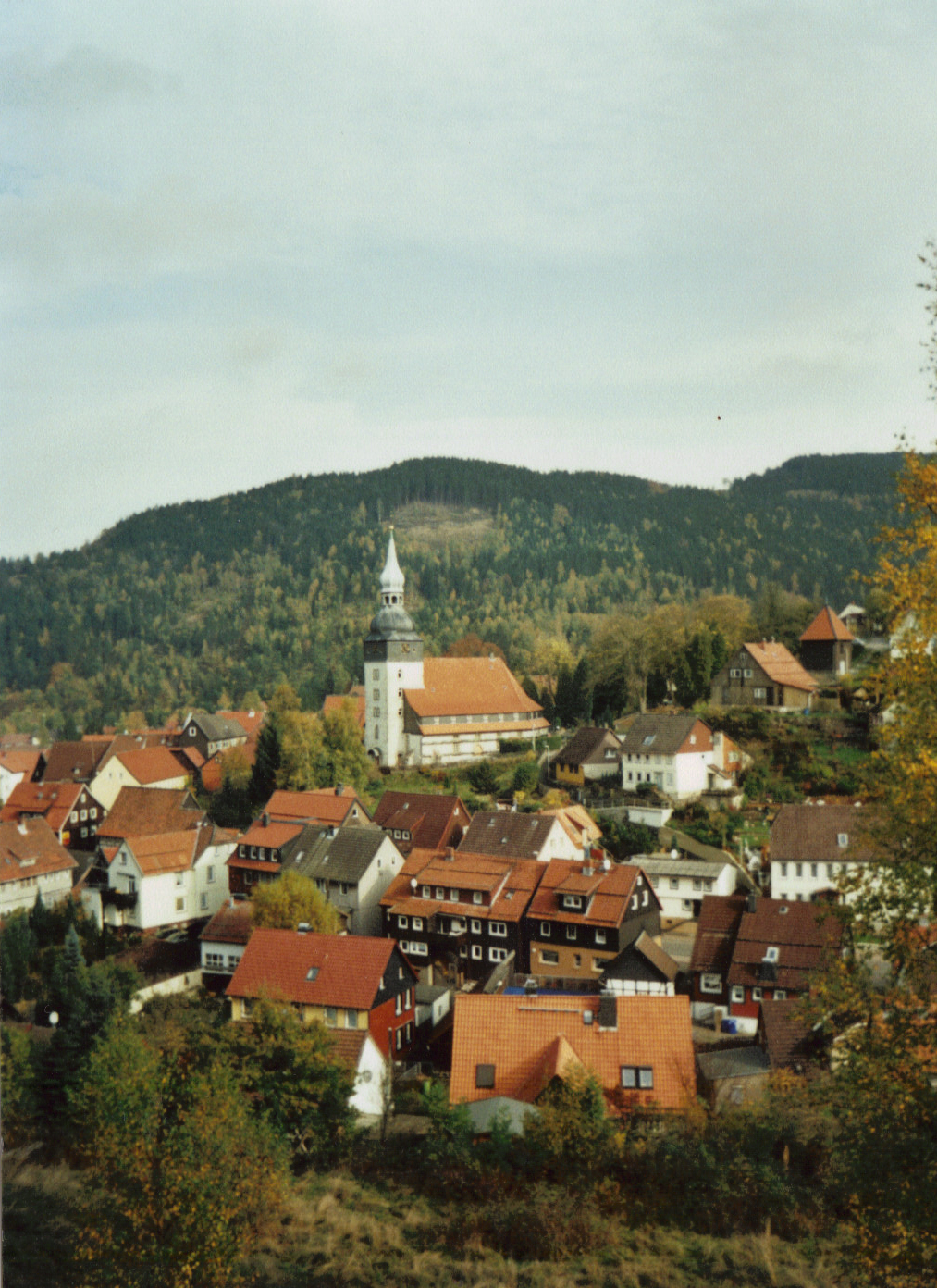
Formerly free mining town in Langelsheim, Germany
The formerly free mining town (Bergstadt) of Lautenthal in Germany is a state-recognised, climatic spa with around 1,570 inhabitants and has been part of the borough of Langelsheim since 1972.
Geography


Lautenthal lies in the Innerste valley between Clausthal-Zellerfeld and Langelsheim in the northwestern Upper Harz. The town is located at a height of about in a valley bowl, the surrounding mountains being up to . The two rivers of the Innerste and the Laute flow through the town. Towards Langelsheim the Innerste is impounded by the Innerste Dam.
History
Mining of copper, lead and silver in the area around Lautenthal started about 1225. In the middle of the 14th century, however, the Harz was depopulated because of plague and mining came to an end.
Mining in the Harz was started again in 1524. Lautenthal was founded in 1538 as a mining settlement on the river Laute, a small tributary of the Innerste, and had already been given the status of a town by 1580. Sixteen years later it became a free mining town. The town was enlarged in 1560 and a rectangular market place was laid out. A comparatively large town hall was built in 1570. The building was transformed into a hotel later. In 1626, the town was plundered by the troops of Johann Tserclaes, Count of Tilly in the Thirty Years' War. The Protestant town church was built 1649-59. In 1690, 28 mines were operated in and around Lautenthal. In 1821, the town had 2.006 inhabitants. The railway line to Lautenthal, Innerste Valley Railway, was inaugurated in 1875 and extended to Altenau in 1914. Railway bridges were built over the Laute and the Innerste. Tourism gradually developed creating more and more jobs. At the beginning of the 20th century, Lautenthal had 2.626 inhabitants.
As of 30 June 2018, Lautenthal had a population of 1,570.
With the closure of the mines in 1959 the town lost its significance and was incorporated into the borough of Langelsheim in 1972. In 1976 the railway line to Lautenthal was closed and the former railway station was transformed into a hotel.
Politik
Ortsrat
Der Ortstrat setzt sich nach der Kommunalwahl vom 10. September 2006 zusammen aus:
- SPD: 3 Sitze
- CDU: 4 Sitze
Kultur und Sehenswürdigkeiten
Lautenthal ist von zwei Skilanglaufloipen und vielen Wanderwegen umgeben, über die man Sehenswürdigkeiten in der Umgebung wie die Innerstetalsperre erreichen kann. Es existiert ein Bergbaulehrpfad. Sehenswert sind die Paul-Gerhardt-Kirche aus dem 17. Jahrhundert, sowie der Marktplatz mit dem ehemaligen Rathaus und einer im Originalstil nachgebauten Köhlerhütte.
Bild:LautenthalMarkt.jpg|Marktplatz mit Köhlerhütte Bild:LautenthalHahnenkleeerStr.jpg|Hahnenkleer Straße Bild:LautenthalKleinstesHaus.jpg|Kleinstes Haus des Westharzes in der Straße "An der Laute" Bild:InnersteLaute.jpg|Die Laute in der Ortsmitte
Museen
thumb|Heute Bergbaumuseum, früher Silberbergwerk [[Grube Lautenthalsglück|Lautenthals Glück]] Im historischen Brauhaus von 1600, Betrieb 1959 als „Zwergen-Bräu“ eingestellt, ist heute ein Brauereimuseum eingerichtet. Das ganzjährig geöffnete Bergbaumuseum befindet sich auf dem Gelände des ehemaligen Silberbergwerks „Lautenthals Glück“. Es liegt auf einem etwa 500 m langen Gelände an der Straße nach Wildemann. Beim Eingangsgebäude handelt es sich um einen markanten Förderturm, der eine Nachbildung des Schachthauses „Herzog Johann Friedrich“ in Bockswiese ist. Das Museum bietet die Einfahrt in das Bergwerk mit einer Grubenbahn, ein Freilichtmuseum mit Bergbautechnik und etwa 30 historischen Grubenloks, die Befahrung einer Kahnstrecke untertage, die St.-Barbara-Kapelle in 266 m Tiefe, in der Gottesdienste, Hochzeiten und Taufen stattfinden, sowie Exponate zur historischen Bergbautechnik, wie Fahrkunstanlage, ein Kunstrad, ein Steigerhaus und eine Silberhütte. Ein weiteres Museum ist die Heimatstube in der alten Schule am Marktplatz.
Musik
Das Hüttenmusikkorps Lautenthal, der Männergesangsverein Fortuna und der Mandolinen-Club Lautenthal von 1920 sind die musikalischen Kulturträger der Gemeinde. Guntram Hecht, Musikpädagoge, Organist und Komponist, bekleidete lange Jahre das Organistenamt in Lautenthal.
Vereine
z.Zt. gibt es in Lautenthal 32 Vereine und Organisationen:
Arbeiterwohlfahrt Lautenthal , Bergwerks- und Geschichtsverein Lautenthal , Biochemischer Verein , Boule Club Lautenthal , Bürgerbad Bergstadt Lautenthal , Bürgerschützengesellschaft Lautenthal , Bürger für Lautenthal , CDU-Ortsverband Lautenthal , Club "Abstemius" , Club "Einigkeit von 1908" Lautenthal , Club "Frohsinn" , DEHOGA , Deutsches Rotes Kreuz Ortsverein Lautenthal , Doko-Club Schlauer Fuchs , Ev.-luth. Kirchengemeinde Lautenthal , Fahrradclub Lautenthal , FFW Langelsheim Ortsfeuerwehr Lautenthal , Förderverein Grundschule Lautenthal , Fremdenverkehrsverein Lautenthal e.V. , Gebrauchshundeverein Lautenthal e.V. , Harzklub Zweigverein Lautenthal , Haus- und Grundbesitzerverein Lautenthal , Hüttenmusikkorps Lautenthal , Mandolinenclub Lautenthal , Männer-Gesangverein Fortuna Lautenthal , Rheumaliga Ortsverein Lautenthal , Skatclub "Blanke 10" , Sozialverband Deutschland Ortsgruppe Lautenthal , SPD-Abteilung Lautenthal , Sportverein Lautenthal von 1920 e.V. , Turnverein Lautenthal von 1862 e.V. , Werbegemeinschaft Bergstadt Lautenthal
Bauwerke
Neben der Paul-Gerhardt-Kirche ist vor allem das Kleinste Haus des Westharzes, in der Straße "An der Laute" im alten Stadtkern, ein bekanntes Bauwerk Lautenthals.
Regelmäßige Veranstaltungen
Immer am Samstag vor Ostern wird das Osterfeuer am Kranichsberg abgehalten. Am 30. April feiern die Lautenthaler Walpurgis auf dem historischen Bergfestplatz und am letzten Wochenende im Juni steigt das traditionelle Bergstadtfest.
Wirtschaft und Infrastruktur
Verkehr
Von Lautenthal aus verkehren Linienbusse des ÖPNV nach Goslar, Clausthal-Zellerfeld bzw. Altenau und Hahnenklee. Bis Ende der 1970er Jahre hielten die Züge der Innerstetalbahn am ehemaligen Bahnhof Lautenthal. Die damalige Bahnstrecke ist heute als Wander- und Fahrradweg oder Skiloipe im Winter nutzbar.
Öffentliche Einrichtungen
Es gibt ein Bürgerbad Bergstadt Lautenthal, die Touristinfo Lautenthal und den Kurpark. Das Kurhaus der Stadt ist derzeit nicht verpachtet und wird daher nicht genutzt. Lautenthal verfügt über eine eigene Grundschule. --
Sights
- The former silver mine Lautenthals Glück was transformed into a museum in 1975.
- Paul Gerhardt Church, a Protestant church in the old town centre, was built from 1649-59. Its altar and the organ date from 1719.
- Originally, Lautenthal did not have a real Market Place, but an oblong street market on both sides of the oldest street Hahnenkleer Straße, the high street. Several well-preserved half-timbered houses from the 18th and 19th centuries can be seen here.
- One of the half-timbered houses in Hahnenkleer Straße was a brewery called Zwergenbräu from 1660-1959. It was transformed into a brewery museum in 1960.
- The present Market Place (Marktplatz) was laid out in 1560. In the Middle Ages, many inhabitants of Lautenthal worked as charcoal-burners who lived in small wooden huts in the forest in summer. A small charcoal-burner's hut, rebuilt in a traditional style, can be seen in the middle of the Market Place. The former Town Hall was built in 1570 and transformed into a hotel in 1658. It was inhabited by Goethe in 1784 and by King George V. in 1862.
- The old clocktower was built in 1680 on a hill offering a scenic view of the town. Opposite, the former hospital is worth a look.
- One of the tourist attractions of Lautenthal is the smallest house of the western Harz Mountains which can be seen in the lane An der Laute.
- The former railway station of Lautenthal was inaugurated in 1877. After the railway line had been closed in 1976, it was transformed into a hotel.
References
Sources
References
- Evert Heusinkveld: ''Die Innerstetalbahn Langelsheim - Altenau'', p. 64. Nordhorn 2007
- W. Keil: ''Neumanns Orts- und Verkehrslexikon'', p. 593. Leipzig 1905
- "Einwohner der Gemeinden und Ortsteile".
- [[G. Ulrich Großmann]]: ''Hannover und Südniedersachsen'', p. 189. Köln 1999.
- G. Ulrich Großmann: ''Hannover und Südniedersachsen'', p. 188. Köln 1999.
This article was imported from Wikipedia and is available under the Creative Commons Attribution-ShareAlike 4.0 License. Content has been adapted to SurfDoc format. Original contributors can be found on the article history page.
Ask Mako anything about Lautenthal — get instant answers, deeper analysis, and related topics.
Research with MakoFree with your Surf account
Create a free account to save articles, ask Mako questions, and organize your research.
Sign up freeThis content may have been generated or modified by AI. CloudSurf Software LLC is not responsible for the accuracy, completeness, or reliability of AI-generated content. Always verify important information from primary sources.
Report