From Surf Wiki (app.surf) — the open knowledge base
Lathe dog
Mechanical component of a lathe
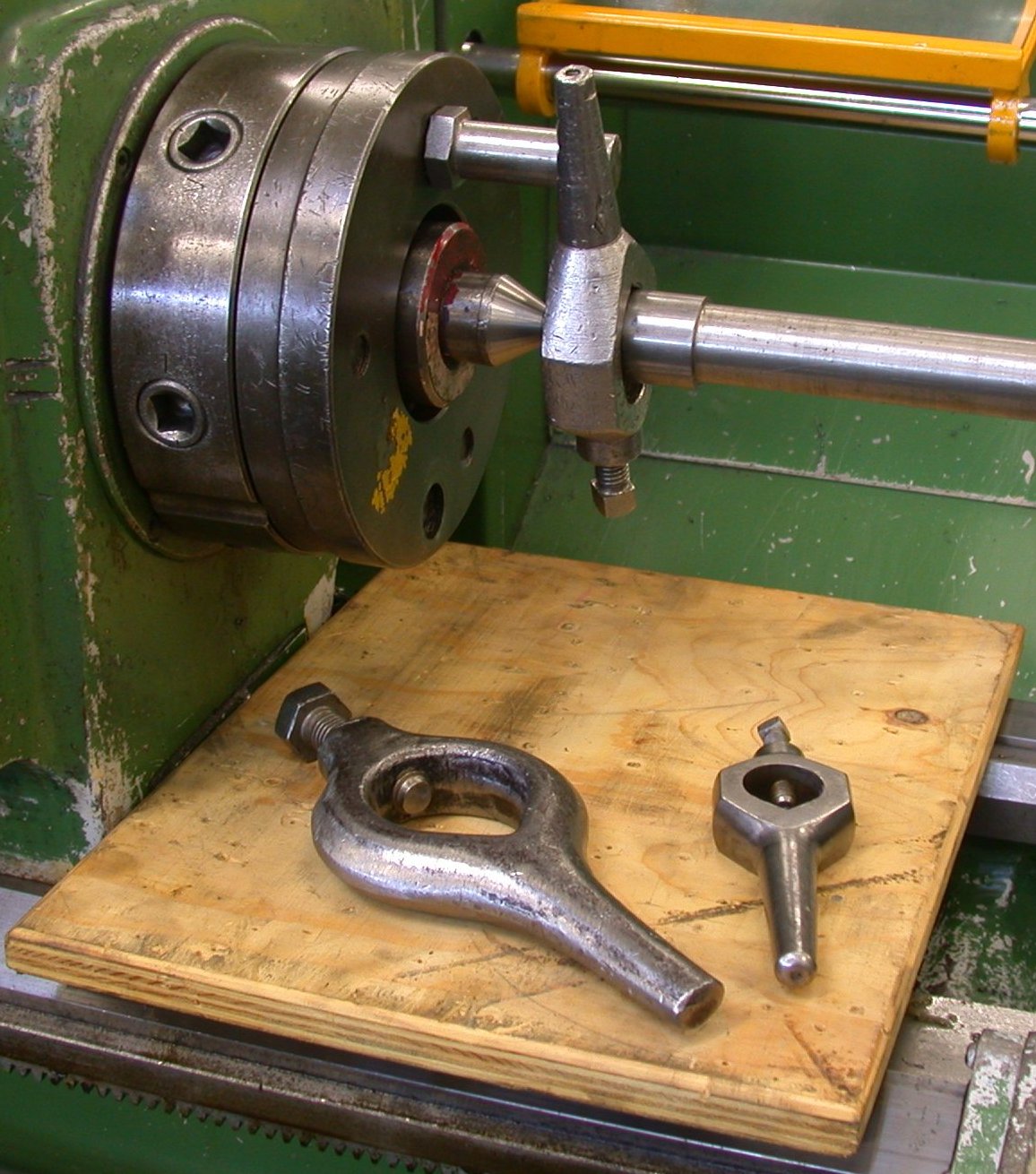
Mechanical component of a lathe

A lathe dog is a mechanical device typically made of cast iron, steel or aluminum that transmits rotary motion from a faceplate to a workpiece mounted between centers in a lathe. The tail of the dog is rotated by a slot in a driving faceplate, a stud mounted on a faceplate, or sometimes a side of a chuck jaw. The workpiece passes through an aperture in the dog into which the work is secured by one or more setscrews or a clamp arrangement. The maximum cross sectional dimension of the workpiece is limited by the dimensions of the dog aperture. Lathe dogs are provided in straight tail or bent tail form, and may be single tail or double tail. A lathe dog designed to hold square, rectangular or odd-shaped work and having a moveable portion secured typically by two cap screws is called a clamp dog. Bent tail dogs are able to engage directly with a driving faceplate slot or a chuck jaw but can crowd work off centre if clearance is not present between the dog tail and a closed end of the faceplate slot. Straight tail dogs do not present the issue of crowding work off centre but require at least one driving stud to be mounted on the faceplate. If the rotating mass of the dog setup is not balanced, eccentric motion of the work may occur. Counterbalancing or reduced spindle speed may be required. Care must be taken by the operator when using lathe dogs, as it is easy to get snagged on one. Use of headless setscrews, preferably of multiple-spline drive design, that do not protrude above the outer surface of the dog is recommended. A lathe dog may also be used with some indexing heads and other tools with similar faceplates that turn about a center.
Patents
- —Buss, Charles. Improvement in lathe-dogs
References
References
- (1945). "American Machinists' Handbook and Dictionary of Shop Terms: A Reference Book of Machine Shop and Drawing Room Data, Methods and Definitions, 8th ed.". McGraw-Hill book Company.
- War Department (1941). [https://archive.org/details/TM10-445/page/n55/mode/2up?view=theater Technical Manual TM 10-445 ''The Machinist'']. pp. 55-56
- (1943). "Turning And Boring Practice". McGraw-Hill book company.
- Bond, A. Russell, (1910). [https://archive.org/details/handymansworksh00bond/page/161/mode/2up ''Handy Man's Workshop and Laboratory'']. New York; Munn & Co., Inc. p. 161
This article was imported from Wikipedia and is available under the Creative Commons Attribution-ShareAlike 4.0 License. Content has been adapted to SurfDoc format. Original contributors can be found on the article history page.
Ask Mako anything about Lathe dog — get instant answers, deeper analysis, and related topics.
Research with MakoFree with your Surf account
Create a free account to save articles, ask Mako questions, and organize your research.
Sign up freeThis content may have been generated or modified by AI. CloudSurf Software LLC is not responsible for the accuracy, completeness, or reliability of AI-generated content. Always verify important information from primary sources.
Report