From Surf Wiki (app.surf) — the open knowledge base
Last Interglacial
Interglacial period which began 130,000 years ago

Interglacial period which began 130,000 years ago

The Last Interglacial was the interglacial period that began about 130,000 years ago at the end of the Penultimate Glacial Period, and ended about 115,000 years ago at the beginning of the Last Glacial Period. It corresponds to Marine Isotope Stage 5e. It was the second-to-latest interglacial of the current Ice Age, the most recent being the Holocene which extends to the present day (having followed the Last Glacial Period). During the Last Interglacial, the proportion of in the atmosphere was about 280 parts per million. The Last Interglacial was one of the warmest periods of the last 800,000 years, with temperatures comparable to and at times warmer (by up to on average 2 degrees Celsius) than the contemporary Holocene interglacial, with the maximum sea level being up to 6 to 9 metres higher than at present, with global ice volume likely also being smaller than the Holocene interglacial.
The Last Interglacial is known as the Eemian in northern Europe (sometimes used to describe the global interglacial), Ipswichian in Britain, the Mikulino (also spelled Milukin) interglacial in Russia, the Kaydaky in Ukraine, the Valdivia interglacial in Chile, and the Riss-Würm interglacial in the Alps. Depending on how a specific publication defines the Sangamonian of North America, the Last Interglacial is equivalent to either all or part of it.
The period falls into the Middle Paleolithic and is of some interest for the evolution of early modern humans, who were present in West Asia (the Skhul and Qafzeh hominins) as well as in Southern Africa by this time, representing the earliest split of modern human populations that persists to the present time (associated with mitochondrial haplogroup L0). As the most recent point in time with a climate comparable to the Holocene, the Last Interglacial is also of relevance as a point of reference (baseline) for nature conservation.
Definition

Van Voorthuysen (1958) described the foraminifera from the type site, whereas Zagwijn (1961) published the palynology, providing a subdivision of this stage into pollen stages. At the end of the 20th century, the type site was re-investigated using old and new data in a multi-disciplinary approach (Cleveringa et al., 2000). At the same time, a parastratotype was selected in the Amsterdam glacial basin in the Amsterdam-Terminal borehole and was the subject of a multidisciplinary investigation (Van Leeuwen et al., 2000). These authors also published a U/Th age for late Last Interglacial deposits from this borehole of 118,200 ± 6,300 years ago. A historical review of Dutch Last Interglacial research is provided by Bosch, Cleveringa and Meijer, 2000.
Climate

Global temperatures
The Last Interglacial climate is believed to have been warmer than the current Holocene. The temperature of the Last Interglacial peaked during the early part of the period, around 128,000 to 123,000 years Before Present, before declining during the latter half of the period. Changes in the Earth's orbital parameters from today (greater obliquity and eccentricity, and perihelion), known as Milankovitch cycles, probably led to greater seasonal temperature variations in the Northern Hemisphere. As the Last Interglacial cooled, pCO2 remained stable.
During the northern summer, temperatures in the Arctic region were about 2–4 °C higher than in 2011. The Arctic Last Interglacial climate was highly unstable, with pronounced temperature swings revealed by δ18O fluctuations in Greenlandic ice cores, though some of the instability inferred from Greenland ice core project records may be a result of mixing of Last Interglacial ice with ice from the preceding or succeeding glacial intervals.
The warmest peak of the Last Interglacial was around 125,000 years ago, when forests reached as far north as North Cape, Norway (which is now tundra) well above the Arctic Circle at . Hardwood trees such as hazel and oak grew as far north as Oulu, Finland. At the peak of the Last Interglacial, the Northern Hemisphere winters were generally warmer and wetter than now, though some areas were actually slightly cooler than today. A cooling event similar to but not exactly mirroring the 8.2-kiloyear event is recorded from Beckentin during the E5 phase of the Eemian, some 6,290 years after the start of interglacial afforestation. A 2018 study based on soil samples from Sokli in northern Finland identified abrupt cold spells ca. 120,000 years ago caused by shifts in the North Atlantic Current, lasting hundreds of years and causing temperature drops of a few degrees and vegetation changes in these regions. In Northern Europe, winter temperatures rose over the course of the Last Interglacial while summer temperatures fell. During an insolation maximum from 133,000 to 130,000 BP, meltwater from the Dnieper and Volga caused the Black and Caspian Seas to connect. During the middle of the Last Interglacial, a weakened Atlantic Meridional Overturning Circulation (AMOC) began to cool the eastern Mediterranean region. The period closed as temperatures steadily fell to conditions cooler and drier than the present, with a 468-year-long aridity pulse in central Europe at about 116,000 BC, and by 112,000 BC, ice caps began to form in southern Norway, marking the start of a new glacial period. The Eemian lasted about 1,500 to 3,000 years longer in Southern Europe than in Northern Europe. Kaspar et al. (GRL, 2005) performed a comparison of a coupled general circulation model (GCM) with reconstructed Last Interglacial temperatures for Europe. Central Europe (north of the Alps) was found to be 1 - warmer than present; south of the Alps, conditions were 1–2 °C cooler than today. The model (generated using observed greenhouse gas concentrations and Last Interglacial orbital parameters) generally reproduces these observations, leading them to conclude that these factors are enough to explain the Last Interglacial temperatures.
Meltwater pulse 2B, approximately 133,000 BP, substantially weakened the Indian Summer Monsoon (ISM).
Trees grew as far north as southern Baffin Island in the Canadian Arctic Archipelago: currently, the northern limit is further south at Kuujjuaq in northern Quebec. Coastal Alaska was warm enough during the summer due to reduced sea ice in the Arctic Ocean to allow Saint Lawrence Island (now tundra) to have boreal forest, although inadequate precipitation caused a reduction in the forest cover in interior Alaska and Yukon Territory despite warmer conditions. The prairie-forest boundary in the Great Plains of the United States lay further west near Lubbock, Texas, whereas the current boundary is near Dallas.
Interglacial conditions ended on Antarctica while the Northern Hemisphere was still experiencing warmth.[[Image:All palaeotemps.svg|800px|center]]
Sea level
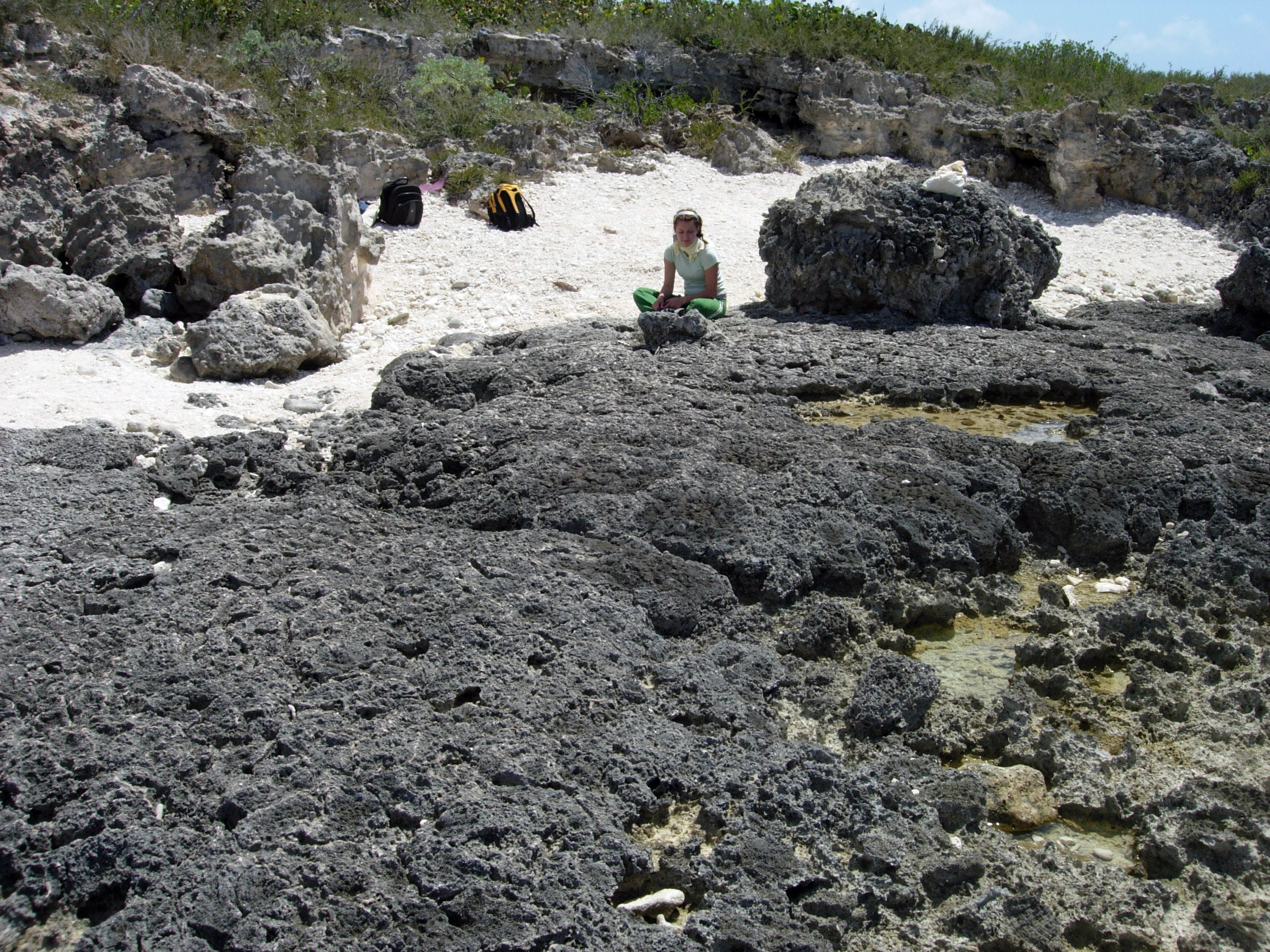
Sea level at peak was probably 6 to higher than today, with Greenland contributing 0.6 to, thermal expansion and mountain glaciers contributing up to 1 m, and an uncertain contribution from Antarctica. A 2007 study found evidence that the Greenland ice core site Dye 3 was glaciated during the Last Interglacial, which implies that Greenland could have contributed at most 2 m to sea level rise. Recent research on marine sediment cores offshore of the West Antarctic Ice Sheet suggest that the sheet melted during the Last Interglacial, and that ocean waters rose as fast as 2.5 meters per century. Global mean sea surface temperatures are thought to have been higher than in the Holocene, but not by enough to explain the rise in sea level through thermal expansion alone, and so melting of polar ice caps must also have occurred.
Because of the sea level drop since the Last Interglacial, exposed fossil coral reefs are common in the tropics, especially in the Caribbean and along the Red Sea coastlines. These reefs often contain internal erosion surfaces showing significant sea level instability during the Last Interglacial.

Along the Central Mediterranean Spanish coast, sea levels were comparable to those of the present. Due to high sea levels, Fennoscandia formed an island during the Last Interglacial because of a seaway passage existing between the Gulf of Finland of the Baltic Sea and the White Sea of Russia, resulting in the Baltic Sea (sometimes referred to as the Eemian Sea during this time period) having a much higher salinity (salt content) than today, with the coastline of the Baltic Sea also being considerably further inland relative to today's coastlines, with Jutland also forming an island. Vast areas of northwestern Europe and the West Siberian Plain were also inundated.
Fauna

.jpg)
The warmness of the interval allowed temperate-adapted taxa to extend their range considerably northward, with the range of the hippopotamus (Hippopotamus amphibius) notably extending as far north as North Yorkshire in northern England, though their range outside of southern Europe did not extend much further east than the Rhine. The temperate landscapes of Europe were inhabited by large now extinct megafauna including the straight-tusked elephant (Palaeoloxodon antiquus), the narrow-nosed rhinoceros (Stephanorhinus hemitoechus), Merck's rhinoceros (Stephanorhinus kirchbergensis), Irish elk (Megaloceros giganteus) and aurochs (Bos primigenius), alongside still-living species like red deer (Cervus elaphus), fallow deer (Dama dama), roe deer (Capreolus capreolus) and wild boar (Sus scrofa), with predators including lions (the extinct Panthera spelaea) and cave hyenas (Crocuta (Crocuta) spelaea), brown bears (Ursus arctos) and wolves (Canis lupus). The Last Interglacial ecosystems of Europe, which existed prior to the global wave of megafauna extinctions that occurred during the following Last Glacial Period, has been suggested as a "baseline" reference point for the analysis and restoration of modern European ecosystems.
Due to having higher water temperatures than today, the Mediterranean Sea was colonised during the Last Interglacial by now exotic species of marine invertebrates of the "Senegalese Fauna", such as the conch Thetystrombus latus, the cone snail Conus ermineus and the sea snail Linatella caudata, currently only found much further south in the tropical waters of the Atlantic, including off the coast of West Africa.
Following the melting of the Laurentide Ice Sheet, a number of North American megafauna species migrated northwards to inhabit northern Canada and Alaska during the Last Interglacial, including the American camel Camelops hesternus, mastodons (genus Mammut) the large ground sloth Megalonyx jeffersonii, and the bear sized giant beaver Castoroides, with the lower latitudes of Canada being inhabited (in addition to the aformentioned taxa) by species like Columbian mammoth (Mammuthus columbi), stag-moose (Cervalces), and the llama Hemiauchenia. The steppe bison (Bison priscus) migrated into the heartlands of North America from Alaska at the beginning of the Last Interglacial, giving rise to the giant long-horned bison Bison latifrons (which is first known from the Snowmass site in Colorado, dating to around 120,000 years ago) and ultimately all North American bison species, and marking the beginning of the Rancholabrean faunal age in North America. Also during this time period the American lion (Panthera atrox) appeared and become widespread across North America, having descended from populations of the Eurasian cave lion (Panthera spelaea) that had migrated into Alaska during the preceding Penultimate Glacial Period.
The range of cold-adapted taxa like the woolly mammoth (Mammuthus primigenius) contracted towards refugia.
Paleoanthropology
Neanderthals managed to colonise the higher latitudes of Europe during this time interval, after having retreated from the region due to unfavourable conditions during the Penultimate Glacial Period. However, unlike previous interglacials, they were absent from Britain, likely due to Britain being an island during this time. During the Last Interglacial, Neanderthals engaged in a variety of food-gathering activities, including fishing, as well as big-game hunting, including the largest animals living in Europe at the time, straight-tusked elephants. Modern humans were present outside Africa in Arabia during this interval, as far east as the Persian Gulf.
References
References
- (2013). "Eemian interglacial reconstructed from a Greenland folded ice core". [[Nature (journal).
- (2003). "Marine Isotope Substage 5e and the Eemian Interglacial". [[Global and Planetary Change]].
- Kaufman, Mark. (27 August 2018). "Earth is the warmest it's been in 120,000 years". Mashable.
- (2020-01-02). "Global ocean heat content in the Last Interglacial". Nature Geoscience.
- (April 2020). "Tipping elements and amplified polar warming during the Last Interglacial". Quaternary Science Reviews.
- (September 2018). "Lack of evidence for a substantial sea-level fluctuation within the Last Interglacial". Nature Geoscience.
- M Richards et al. in: Bandelt et al. (eds.), ''Human Mitochondrial DNA and the Evolution of Homo sapiens'', Springer (2006), p. 233.
- "Current & Historical Global Temperature Graph".
- Arctic Council, Impacts of a Warming Climate: Arctic Climate Impact Assessment, Cambridge U. Press, Cambridge, 2004
- (2021-01-28). "Seasonal origin of the thermal maxima at the Holocene and the last interglacial". Nature.
- (1 April 2016). "Comparative carbon cycle dynamics of the present and last interglacial". [[Quaternary Science Reviews]].
- Nathaelle Bouttes. (2011). "Warm past climates: is our future in the past?". The National Centre for Atmospheric Science.
- (30 November 1997). "The δ 18 O record along the Greenland Ice Core Project deep ice core and the problem of possible Eemian climatic instability". [[Journal of Geophysical Research: Oceans]].
- (30 November 1997). "CH 4 and δ 18 O of O 2 records from Antarctic and Greenland ice: A clue for stratigraphic disturbance in the bottom part of the Greenland Ice Core Project and the Greenland Ice Sheet Project 2 ice cores". [[Journal of Geophysical Research: Oceans]].
- (20 December 2021). "Eemian (MIS 5e) climate oscillations based on palaeobotanical analysis from the Beckentin profile (NE Germany)". [[Quaternary International]].
- (20 July 2018). "Abrupt high-latitude climate events and decoupled seasonal trends during the Eemian". [[Nature Communications]].
- (1 September 2019). "Major hydrological shifts in the Black Sea "Lake" in response to ice sheet collapses during MIS 6 (130–184 ka BP)". [[Quaternary Science Reviews]].
- (25 August 2023). "Weakened AMOC related to cooling and atmospheric circulation shifts in the last interglacial Eastern Mediterranean". [[Nature Communications]].
- (11 August 2005). "A late Eemian aridity pulse in central Europe during the last glacial inception". [[Nature (journal).
- (1995). "A time dependent glaciological model of the Weichselian Ice Sheet". [[Quaternary International]].
- (12 February 2024). "Re-investigation of the Bispingen palaeolake sediment succession (northern Germany) reveals that the Last Interglacial (Eemian) in northern-central Europe lasted at least ~15 000 years". [[Boreas (journal).
- (2005). "A model-data comparison of European temperatures in the Eemian interglacial". [[Geophysical Research Letters]].
- (18 November 2021). "Penultimate deglaciation Asian monsoon response to North Atlantic circulation collapse". [[Nature Geoscience]].
- [https://esp.cr.usgs.gov/archive/lite/alaska/alaska.html Vegetation and paleoclimate of the last interglacial period, central Alaska] {{Webarchive. link. (2015-09-15 . USGS)
- Landais, Amaelle. (16 September 2003). "A tentative reconstruction of the last interglacial and glacial inception in Greenland based on new gas measurements in the Greenland Ice Core Project (GRIP) ice core". [[Journal of Geophysical Research]].
- (2007). "Paleontological evidence of a brief global sea-level event during the last interglacial". Lethaia.
- (13 July 2012). "Ice volume and sea level during the last interglacial.". [[Science (journal).
- (17 December 2009). "Probabilistic assessment of sea level during the last interglacial stage.". [[Nature (journal).
- (2013). "Quantification of Greenland ice-sheet contribution to Last Interglacial sea-level rise". [[Climate of the Past]].
- (July 2011). "The role of ocean thermal expansion in Last Interglacial sea level rise". Geophysical Research Letters.
- (3 July 1998). "Pleistocene collapse of the west antarctic ice sheet". Science.
- (2007). "Ancient Biomolecules from Deep Ice Cores Reveal a Forested Southern Greenland". Science.
- (2000). "Substantial contribution to sea-level rise during the last interglacial from the Greenland ice sheet". Nature.
- (2006). "Simulating Arctic Climate Warmth and Icefield Retreat in the Last Interglaciation". Science.
- Voosen, Paul. (20 December 2018). "Antarctic ice melt 125,000 years ago offers warning". [[Science (journal).
- (1 February 2016). "Stratigraphy and evolution of emerged Pleistocene reefs at the Red Sea coast of Sudan". [[Journal of African Earth Sciences]].
- (January 1995). "Quaternary development and evolution of the sedimentary environments in the Central Mediterranean Spanish coast". [[Quaternary International]].
- (2025-11-05). "Palaeoenvironmental evolution of the Baltic Sea basin during the Last Interglacial (Eemian, Mikulino stages): a review". Boreas.
- (2013). "Rising Seas: Past, Present, Future". Columbia University Press.
- Schreve, Danielle C.. (January 2009). "A new record of Pleistocene hippopotamus from River Severn terrace deposits, Gloucester, UK—palaeoenvironmental setting and stratigraphical significance". Proceedings of the Geologists' Association.
- van Kolfschoten, Th.. (August 2000). "The Eemian mammal fauna of central Europe". Netherlands Journal of Geosciences.
- (January 2024). "Megafauna diversity and functional declines in Europe from the Last Interglacial to the present". Global Ecology and Biogeography.
- Pushkina, Diana. (July 2007). "The Pleistocene easternmost distribution in Eurasia of the species associated with the Eemian Palaeoloxodon antiquus assemblage". Mammal Review.
- (2023-11-10). "Substantial light woodland and open vegetation characterized the temperate forest biome before Homo sapiens". Science Advances.
- (2025-07-21). "Upper Pleistocene Marine Levels of the Es Copinar–Es Estufadors (Formentera, Balearic Islands, West Mediterranean)". Quaternary.
- (2025-11-13). "Integrating Aegean Last Interglacial faunas into the Mediterranean palaeobiogeographic framework: New evidence from Karpathos (Greece)". Journal of Quaternary Science.
- (September 2011). "Last interglacial western camel (Camelops hesternus) from eastern Beringia". Quaternary Science Reviews.
- (2014-12-30). "American mastodon extirpation in the Arctic and Subarctic predates human colonization and terminal Pleistocene climate change". Proceedings of the National Academy of Sciences.
- Harington, C. Richard. (2007-12-18). "Vertebrates of the Last Interglaciation in Canada: A Review, with New Data". Géographie physique et Quaternaire.
- (March 28, 2017). "Fossil and genomic evidence constrains the timing of bison arrival in North America". Proceedings of the National Academy of Sciences.
- (2016-07-20). "First occurrence of <i>Panthera atrox</i> (Felidae, Pantherinae) in the Mexican state of Hidalgo and a review of the record of felids from the Pleistocene of Mexico". Fossil Record.
- (2008-04-01). "Climate Change, Humans, and the Extinction of the Woolly Mammoth". PLOS Biology.
- (2021-12-17). "Landscape modification by Last Interglacial Neanderthals". Science Advances.
- (2011). "Testing Human Presence During the Last Interglacial (MIS 5e): A Review of the British Evidence". Elsevier.
- (2020-03-27). "Last Interglacial Iberian Neandertals as fisher-hunter-gatherers". Science.
- (2023). "Hunting and processing of straight-tusked elephants 125.000 years ago: Implications for Neanderthal behavior". Science Advances.
- (June 2021). "Beyond arrows on a map: The dynamics of Homo sapiens dispersal and occupation of Arabia during Marine Isotope Stage 5". Journal of Anthropological Archaeology.
This article was imported from Wikipedia and is available under the Creative Commons Attribution-ShareAlike 4.0 License. Content has been adapted to SurfDoc format. Original contributors can be found on the article history page.
Ask Mako anything about Last Interglacial — get instant answers, deeper analysis, and related topics.
Research with MakoFree with your Surf account
Create a free account to save articles, ask Mako questions, and organize your research.
Sign up freeThis content may have been generated or modified by AI. CloudSurf Software LLC is not responsible for the accuracy, completeness, or reliability of AI-generated content. Always verify important information from primary sources.
Report