From Surf Wiki (app.surf) — the open knowledge base
Larissa (mythology)
Greek mythological figure
Greek mythological figure
In Greek mythology, Larissa or Larisa (Ancient Greek: Λάρισσα) was the name of two different figures that appears in various accounts:
Larisa, daughter of Pelasgus
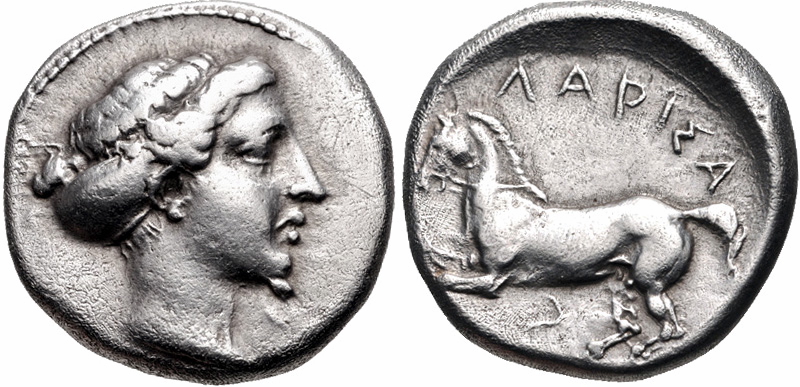
Larisa was a nymph from Thessaly. She was described by Pausanias as a daughter of Pelasgus, son of Triopas, king of Argos. Hellanicus states that the sons of Poseidon and Larissa were Achaios, Phthios, and Pelasgus. These sons left Argos and arrived in Haemonia (Thessaly) where they drove out the barbarian inhabitants and divided the country into three parts, calling them, after their names, Phthiotis, Achaia and Pelasgiotis.
The arx of Argos and two towns (Larissa in Thessaly and one in the Peneus) are believed to have derived their name (meaning "citadel"Λάρισα, Henry George Liddell, Robert Scott, A Greek-English Lexicon, on Perseus) from her.
A moon of Neptune was discovered by Harold J. Reitsema, William B. Hubbard, Larry A. Lebofsky and David J. Tholen on May 24, 1981, and later given the name Larissa. Larissa is also designated as "Neptune VII", S/1981 N 1 and "S/1989 N 2".
Larisa, daughter of Piasus
Main article: Larissa (daughter of Piasus)
Larissa was the daughter of the Pelasgian king, Piasus and wife of Cyzicus, king of the Dolionians, the people of northwestern Asia Minor visited by the Argonauts. Strabo reported that "before her marriage, her father Piasus fell in love with her and, having violated her, paid the penalty for the outrage; on that account Larisa, observing him leaning over a cask of wine, seized him by the legs, raised him, and plunged him into the cask, drowning him."
Notes
References
- Dionysus of Halicarnassus, Roman Antiquities. English translation by Earnest Cary in the Loeb Classical Library, 7 volumes. Harvard University Press, 1937–1950. Online version at Bill Thayer's Web Site
- Dionysius of Halicarnassus, Antiquitatum Romanarum quae supersunt, Vol I-IV. . Karl Jacoby. In Aedibus B.G. Teubneri. Leipzig. 1885. Greek text available at the Perseus Digital Library.
- Larson, Jennifer S. (2001) Greek Nymphs: Myth, Cult, Lore. Oxford, Oxford University Press.
- Mørkholm, Otto (1991) Early Hellenistic Coinage from the Accession of Alexander to the Peace of Apamaea (336–188 BC). Cambridge, Cambridge University Press.
- Parthenius, Love Romances translated by Sir Stephen Gaselee (1882–1943), S. Loeb Classical Library Volume 69. Cambridge, MA. Harvard University Press. 1916. Online version at the Topos Text Project.
- Parthenius, Erotici Scriptores Graeci, Vol. 1. Rudolf Hercher. in aedibus B. G. Teubneri. Leipzig. 1858. Greek text available at the Perseus Digital Library.
- Pausanias, Description of Greece with an English Translation by W.H.S. Jones, Litt.D., and H.A. Ormerod, M.A., in 4 Volumes. Cambridge, MA, Harvard University Press; London, William Heinemann Ltd. 1918. . Online version at the Perseus Digital Library
- Pausanias, Graeciae Descriptio. 3 vols. Leipzig, Teubner. 1903. Greek text available at the Perseus Digital Library.
- Smith, William (1849) Dictionary of Greek and Roman Biography and Mythology.
- Strabo, The Geography of Strabo. Edition by H.L. Jones. Cambridge, Mass.: Harvard University Press; London: William Heinemann, Ltd. 1924. Online version at the Perseus Digital Library.
- Strabo, Geographica edited by A. Meineke. Leipzig: Teubner. 1877. Greek text available at the Perseus Digital Library.
References
- [[Pausanias (geographer)
- [[Dionysius of Halicarnassus]], ''Antiquitates Romanae'' [https://penelope.uchicago.edu/Thayer/E/Roman/Texts/Dionysius_of_Halicarnassus/1B*.html 1.17.3]
- Smith p.722
- Mørkholm p.85
- Larson p.166
- Bellinger
- Larson p.165
- [[Parthenius of Nicaea. Parthenius]]'','' [https://topostext.org/work/550#28 28.1] from the ''Apollodorus'' of [[Euphorion of Chalcis. Euphorion]] and the latter part from the first book of the ''[[Argonautica]]'' of [[Apollonius of Rhodes. Apollonius Rhodius]]
- [[Strabo]], [https://www.perseus.tufts.edu/hopper/text?doc=Strab.+13.3.4&fromdoc=Perseus%3Atext%3A1999.01.0198 13.3.4.]
This article was imported from Wikipedia and is available under the Creative Commons Attribution-ShareAlike 4.0 License. Content has been adapted to SurfDoc format. Original contributors can be found on the article history page.
Ask Mako anything about Larissa (mythology) — get instant answers, deeper analysis, and related topics.
Research with MakoFree with your Surf account
Create a free account to save articles, ask Mako questions, and organize your research.
Sign up freeThis content may have been generated or modified by AI. CloudSurf Software LLC is not responsible for the accuracy, completeness, or reliability of AI-generated content. Always verify important information from primary sources.
Report