From Surf Wiki (app.surf) — the open knowledge base
Largo, Sofia
Architectural ensemble of three Socialist Classicism edifices in central Sofia
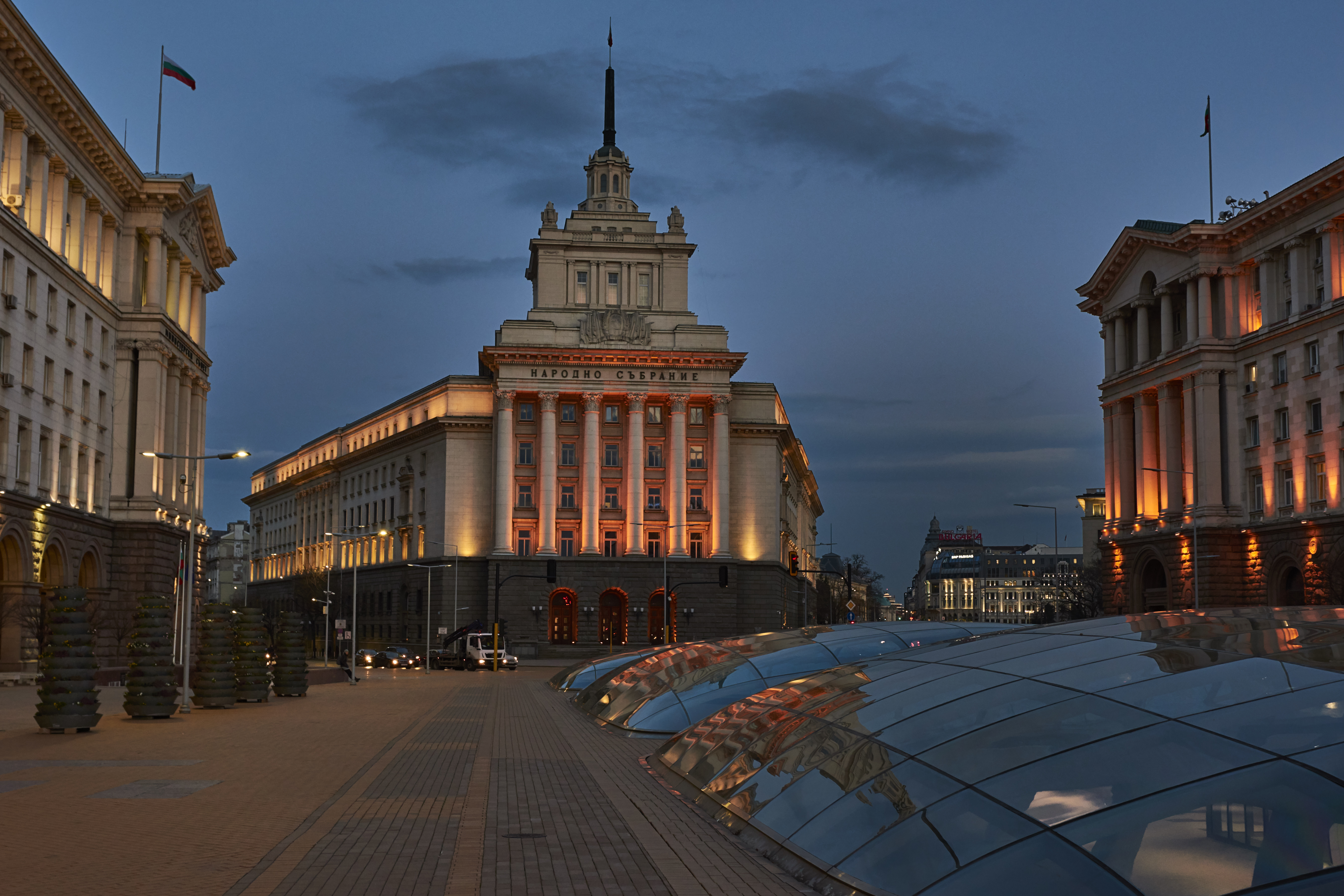
Architectural ensemble of three Socialist Classicism edifices in central Sofia
| Field | Value |
|---|---|
| name | Independence Square |
| native_name | bg |
| alternate_name | Largo |
| image | Party House, Sofia (by Pudelek).JPG |
| caption | View of the Largo from the west |
| type | Public square |
| length_m | 200 |
| width | 50 m |
| location | Sofia, Bulgaria |
| coordinates | |
| completion_date | 1955 |
The Largo (, definite form Ларгото, Largoto) is an architectural ensemble of three Socialist Classicism buildings around Independence Square () in central Sofia, the capital of Bulgaria. It was designed and built in the 1950s with the intention of becoming the city's new representative centre. Today it is regarded as one of the prime examples of Socialist Classicism architecture in Southeastern Europe, as well as one of the main landmarks of Sofia.
The Largo complex consists of three buildings around Independence Square: The Council of Ministers and the TSUM department store on the north side, the National Assembly (former Communist Party headquarters) with its iconic spire on the east side, the Presidential Administration (former Council of State) and the Balkan Hotel to the south side. Plans for a 16-storey House of Soviets on the east side, resembling the Moscow State University main building, were not carried out following de-Stalinisation.
History
The yellow-cobblestoned square around which the ensemble is centred is called Independence Square. It is formed by the Knyaz Aleksandar Dondukov Boulevard and Tsar Osvoboditel Boulevard merging from the east to continue as Todor Aleksandrov Boulevard west of the Largo. Originally, the square was named after Lenin. A Council of Ministers of Bulgaria decree was published in 1951 regarding the construction of the Largo. The lot in the centre of the city, damaged by the bombing of Sofia in World War II, was cleared in the autumn of 1952, so that the construction of the new buildings could begin in the following years.
The Party House building, once crowned by a red star on a pole, was designed by a team under architect Petso Zlatev and completed in 1955.
Instead, a statue of Vladimir Lenin was erected on the east side of the square in 1966, which was replaced by the one of St. Sophia in 2000.
Refurbishment
Following the democratic changes after 1989, the symbols of communism in the decoration of the Largo were removed, with the most symbolic act being the removing of the red star on a pole atop the former Party House using a helicopter and its substitution by the flag of Bulgaria. In the 1990s there have been suggestions to reshape the former Party House, sometimes regarded as an imposing remnant of a past ideology, by introducing more modern architectural elements.
According to the new architectural plan of Sofia, Independence Square is being reorganized. The lawn and the flags in the centre are replaced by glass domes, so that the ruins of the ancient Thracian and Roman city of Serdica can be exposed in an impressive way, thus becoming a tourist attraction. The two underpasses, the one in front of the former Party House and the one with the medieval Church of St Petka, are also connected to ease the access to the nearby Serdika and Serdika II stations of the Sofia Metro.
Gallery
Image:Sofia, 1984.jpg|The former Party House in 1984, before the removal of the red star on spire Image:Sofia-former-party-house-ifb.JPG|The former Party House in 2006 Image:P7120045.JPG|Council of Ministers Image:Largo-president-ifb.JPG|Presidential Administration Image:Flags of all Nato member states near Bulgarian parliament in Sofia, Bulgaria September 2005.jpg|TZUM department store Image:StGeorgeRotundaSofia.JPG|The 4th-century St George Rotunda behind the Balkan Hotel Image:Bulgaria Bulgaria-0537 - Presidential Palace (7390213724).jpg|Presidential Guard
References
References
- "Bulgaria Sofia Sights Around the Center of the Capital". monkeytravel.org.
- [http://www.stara-sofia.com/ploal.html Stara Sofia (Old Sofia)]
- Kiradzhiev, Svetlin. (2006). "Sofia 125 Years Capital 1879-2004 Chronicle". IK Gutenberg.
- Soviets]] on the east side, resembling the [[Moscow State University]] main building, were not carried out following [[De-Stalinization. de-Stalinisation]].[http://www.stara-sofia.com/ploal.html Stara Sofia (Old Sofia)]
- Todorov, Petar. (2001-01-10). "Glass Dome Project". Demokratsiya.
- Panchev, Lyubomir. (2006-08-19). "Pro and con the reorganization of the Party House". Duma.
- Aleksandrova, Nina. (2006-09-04). "The Largo is to be covered by a glass lid". Standart News.
This article was imported from Wikipedia and is available under the Creative Commons Attribution-ShareAlike 4.0 License. Content has been adapted to SurfDoc format. Original contributors can be found on the article history page.
Ask Mako anything about Largo, Sofia — get instant answers, deeper analysis, and related topics.
Research with MakoFree with your Surf account
Create a free account to save articles, ask Mako questions, and organize your research.
Sign up freeThis content may have been generated or modified by AI. CloudSurf Software LLC is not responsible for the accuracy, completeness, or reliability of AI-generated content. Always verify important information from primary sources.
Report