From Surf Wiki (app.surf) — the open knowledge base
Lanx
Ancient Roman serving platter
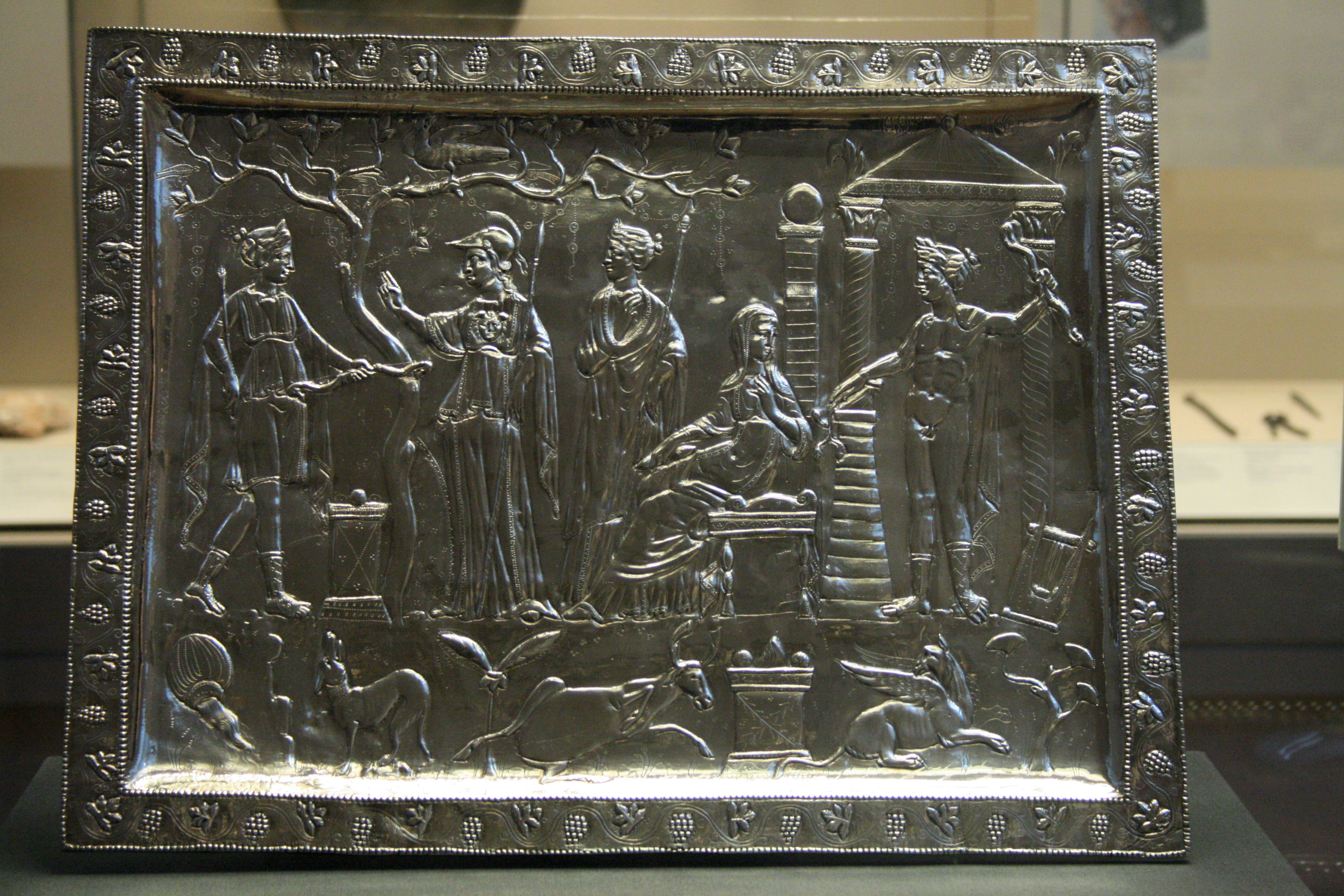
Ancient Roman serving platter
A lanx (Latin for dish) was a large ancient Roman serving platter. Particularly ornamented ones were used to make offerings or sacrifices. Indeed, the silver Corbridge Lanx, the second discovered in Britain, has depicted on it a lanx itself, set beside various gods and goddesses: Minerva, Diana, Juno, Vesta and Apollo.
Positioned atop an altar, "of a globular form". Fruit as well as sheep parts and "other small victims" were likely used. However, the exact meaning in this representation has not been determined. The inscription on the now lost Risley Park Lanx, which was the first lanx discovered in Britain indicated that it was "church plate."
Notes
References
- [https://www.britishmuseum.org/explore/highlights/highlight_objects/pe_prb/t/the_corbridge_lanx.aspx British Museum Highlights]
- Lysons, Daniel & Lysons, Samuel. [http://www.british-history.ac.uk/report.aspx?compid=50714 "Antiquities: British and Roman"], Magna Britannia vol 5, 1817, pp. CCIII-CCXVIII. Accessed November 26, 2007.
- Dunlop, John Colin. [https://books.google.com/books?id=iRkOAAAAYAAJ&pg=PA233&dq=lanx%5DDunlop ''History of Roman Literature from its Earliest Periods to the Augustan Age'']' Eve Littel, New York: 1827, p233.
- Discovered in 1735 the Corbridge Lanx was owned by the [[Duke of Northumberland]], and purchased by the British Museumin 1993. [http://www.artfund.org/artwork/5376/the-corbridge-lanx]. Multiple images here [http://rubens.anu.edu.au/raid1cdroms/england/london/museums/british_museum/hoards_and_treasures/corbridge_lanx/ eight] and here [http://rubens.anu.edu.au/new/england/london/museums/british_museum/hoards_treasures/corbridge_lanx/ twelve].
- Note divinities otherwise characterised as the Greek equivalents, see: Nicholson, Oliver. [https://www.jstor.org/stable/526885 "The Corbridge Lanx and the Emperor Julian"], ''Britannia'', Vol. 26, 1995, p312
- Hodgson cited in Bruce, John Collingwood. [https://books.google.com/books?id=yx_G5MYXeLoC&pg=RA28-PA337&dq=lanx&output=html ''The Roman wall: a historical, topographical and descriptive account of the Barrier of the Lower Isthmus extending from the Tyne to the Solway.''], London: John Russell Smith, 1851: p335-7; plate p335.
- Nicholson,Oliver. [https://www.jstor.org/stable/526885 "The Corbridge Lanx and the Emperor Julian"], ''Britannia'', Vol. 26, 1995, p312
- Johns, Catherine & Painter, Kenneth. [http://www.biab.ac.uk/online/results1.asp?ItemID=20285 "The Risley Park Lanx 'rediscovered'(abstract)"], ''Minerva'' 2(6) 1991, 6–13.
This article was imported from Wikipedia and is available under the Creative Commons Attribution-ShareAlike 4.0 License. Content has been adapted to SurfDoc format. Original contributors can be found on the article history page.
Ask Mako anything about Lanx — get instant answers, deeper analysis, and related topics.
Research with MakoFree with your Surf account
Create a free account to save articles, ask Mako questions, and organize your research.
Sign up freeThis content may have been generated or modified by AI. CloudSurf Software LLC is not responsible for the accuracy, completeness, or reliability of AI-generated content. Always verify important information from primary sources.
Report