From Surf Wiki (app.surf) — the open knowledge base
Lanka Sama Samaja Party
Sri Lankan Trotskyist political party

Sri Lankan Trotskyist political party
| Field | Value |
|---|---|
| name | Lanka Sama Samaja Party |
| native_name | ලංකා සම සමාජ පක්ෂය |
| லங்கா சமசமாஜக் கட்சி | |
| Lanka Equal Society Party | |
| logo | LankaSamaSamajaLogo.png |
| colorcode | Red |
| abbreviation | LSSP |
| leader2_title | Leader |
| leader2_name | N.M. Perera (first; 1947–1959) |
| Tissa Vitharana (current) | |
| secretary_general | Leslie Goonewardene (first; 1945–1977) |
| founders | Leslie Goonewardene |
| N.M. Perera | |
| Colvin R. de Silva | |
| Philip Gunawardena | |
| Robert Gunawardena | |
| founded | |
| headquarters | 457 Union Place, Colombo 02 |
| newspaper | Samasamajaya |
| Janadina daily | |
| Janasathiya | |
| youth_wing | Congress of Samasamaja Youth Leagues |
| ideology | Communism |
| Trotskyism | |
| position | Far-left |
| national | PA |
| Formerly: | |
| BLPI | |
| ULS | |
| FPA | |
| SLPFA | |
| UPFA | |
| United Front | |
| international | Fourth International |
| seats1_title | Parliament of Sri Lanka |
| seats1 | |
| symbol | Key |
| [[File:Election Symbol Lanka Sama Samaja Pakshaya Sri Lanka.png]] | |
| website | lssplk.com |
| country | Sri Lanka |
Janadina daily Janasathiya Trotskyism Formerly: BLPI ULS FPA SLPFA UPFA United Front
The Lanka Sama Samaja Party, often abbreviated as LSSP (, Sinhala: ලංකා සම සමාජ පක්ෂය, Tamil: லங்கா சமசமாஜக் கட்சி), is a major Trotskyist political party in Sri Lanka. It was the first political party in Sri Lanka (at the time known as British Ceylon), having been founded in 1935 by Leslie Goonewardene, N. M. Perera, Colvin R. de Silva, Philip Gunawardena and Robert Gunawardena. The party is currently led by Tissa Vitharana. The party was founded with Leninist ideals, and is classified as a party with socialist aims.
The LSSP emerged as a major political force in the Sri Lankan independence movement during the 1940s, during which time the party was forced to go underground due to its opposition to the British war effort. The party played an instrumental role in the Indian independence movement and later Quit India Movement through the Bolshevik–Leninist Party of India, Ceylon and Burma (BLPI). Its efforts contributed to India's and Sri Lanka's independence from the British Empire, in 1947 and 1948 respectively.
The LSSP spearheaded the 1953 Hartal (strike), caused by vast food price inflation under the United National Party (UNP) government. Maintaining the price of rice at 25 cents per measure had been an electoral promise by the UNP in the 1952 elections, and the introduction of the new rate of 70 cents elicited massive public anger.
From the late 1940s to 1960s, the Lanka Sama Samaja Party served as the main opposition party of Sri Lanka, whilst being recognised as the Sri Lankan wing of the Fourth International, a Trotskyist political international. During this period, the party was able to use its considerable political influence to reform the former British colony of Ceylon into a socialist republic by nationalising organisations in the banking, education, industry, media and trade sectors. In 1964, the party joined the United Front alongside the Sri Lanka Freedom Party (SLFP) and formed a socialist SLFP-led government, leading to its expulsion from the Fourth International. Through their election landslide in 1964, the United Front brought the world's first non-hereditary female head of government in modern history, Sirimavo Bandaranaike to power as Prime Minister of Sri Lanka. The party peaked in political strength in the 1970s, when it was again leading a coalition government with several of its leaders in key cabinet roles.
In recent years, the party has played a supporting role in several coalition governments led by the SLFP, such as from 1994–2001, 2004–2015, and 2020–2022. The party has had no parliamentary representation since 2024.
Name
The Lanka Sama Samaja Party was the first modern political party in Ceylon, later Sri Lanka. It was noted for its choice to use a native name rather than an English name, and its members were known as "Samasamajists". The party was the first Marxist party in South Asia. The Sinhala term samasamajaya was one coined by Dally Jayawardena in the Swadesa Mitraya to translate the term 'socialist'. However, the usage of samasamajaya has since been superseded by samajavadaya (which corresponds to similar usage in various Indian languages) in everything but in the names of the LSSP and various of its splinter groups. The Tamil term samadharmam was used to translate 'socialist', but nowadays the English term is used.
History
The Lanka Sama Samaja Party was founded on 18 December 1935, with the broad aims of Sri Lankan Independence and Socialism, by a group of young politicians. The group at the foundation numbered a bare half-dozen, and composed principally of students who had returned from study abroad, influenced deeply by the ideas of Karl Marx and Lenin. The original group consisted of Leslie Goonewardene, N.M. Perera, Colvin R. de Silva, Philip Gunawardena and Robert Gunawardena.
Origins
The LSSP grew out of the Youth Leagues of Ceylon – societies of young people, mainly intellectuals, who wanted independence for British-ruled Sri Lanka – in which a nucleus of Marxists had developed. The party's leaders were predominantly educated returnees from study in London; youth who had come into contact with the ideas of the European Left and were influenced by Harold Laski, an English political theorist and professor at the London School of Economics. Dr S.A. Wickremasinghe, an early returnee and a member of the State Council from 1931, was part of this group. The Youth Leagues campaigned for independence from Britain, notably organising opposition to the so-called 'Ministers' Memorandum', one which in essence called for the colonial authorities to grant increased power to local ministers.
Wellawatte Spinning and Weaving Mills Strike
The group, through the South Colombo Youth League, became involved in a strike at the Wellawatte Spinning and Weaving Mills in 1933. The mills; the island’s largest textile factory at that time with 1,400 workers (two-thirds of Indian origin and one-third Sinhalese), gave the members of the Youth League a chance for leadership as well as experience in trade union agitation. During this period, the collective published an irregular journal in Sinhala, Kamkaruwa (The Worker).
Suriya-Mal movement
In 1933 the group got involved in the Suriya-Mal movement, which had been formed to provide support for indigenous ex-servicemen by the sale of Suriya (Portia tree) flowers. The Suriya-Mal movement surged as a reaction to the fact that at the time Poppy Day funds went solely to British ex-servicemen. The movement was honed by volunteer work among the poor during the Malaria Epidemic of 1934-1935. The volunteers found that there was widespread malnutrition, which they helped fight by making pills of Marmite yeast extract.
Early period
In 1936 the LSSP contested the State Council elections in four constituencies and won two of them, Avissawella and Ruanwella. The two new members, Philip Gunawardena and N.M. Perera, worked at the dismay of the British Colonial government; one that they were trying to dismantle.
Around this time, the LSSP began fraternal relations with the Congress Socialist Party (CSP) of India. Mrs Kamaladevi Chattopadhyaya of the CSP was invited by the LSSP for a highly successful political tour of the island. Leslie Goonewardene was also sent as a delegate to the CSP. Despite their move towards Indian relations, the LSSP maintained a clear distance from the Indian radical left, and considered the Communist Party of India to be an extremist force.
Bracegirdle Incident
In 1937, the British Colonial Governor Sir Reginald Stubbs attempted to deport a young Anglo-Australian planter, Mark Anthony Bracegirdle, who had joined the LSSP. He went into hiding in defiance of the Governor and the LSSP started a campaign to defend him. He appeared on the platform at that year's May Day rally, and was able to have his deportation order quashed in the courts. Through this incident, Stubbs was isolated. The incident led to the further strengthening of an argument for independence as the Bracegirdle incident had brought almost the entire State Council into opposition to the colonial government.
Bracegirdle had been working among the plantation labourers, who were often working in squalid conditions, receiving very little health care, education and living in 'line rooms'. In 1940, the Lanka Estate Workers' Union (LEWU) intervened in a strike at Mooloya, becoming the harbinger of a wave of trade-union action on the plantations.
Initial Trotskyist ideals
Meanwhile, in the LSSP a number of members had become influenced by the ideas of the Left Opposition led by Leon Trotsky. Individual party members, notably Philip Gunawardena, had encountered Trotskyist groups earlier during stays in Britain and the USA. The Trotskyists within the LSSP came together and formed a secret faction known as the "T" (after Trotsky) group. The group's original members were Philip Gunawardena, N. M. Perera, Colvin R. de Silva, Leslie Goonewardene, Robert Gunawardena and Vernon Gunasekera, the Party Secretary. They were later joined by Edmund Samarakkody and V. Karalasingham.
Fourth International
In 1940, the LSSP split with the expulsion of the pro-Moscow fraction led by S. A. Wickremasinghe, M. G. Mendis, Pieter Keuneman and A. Vaidialingam. The expelled members formed the United Socialist Party (USP) which later evolved into the Communist Party of Ceylon (CPC). With the expulsion of the communists, the LSSP planted itself as an independent Trotskyist party. In its heyday, the LSSP was the Fourth International's most successful component.
At the outbreak of the Second World War, the party was forced to go underground due to its opposition to the British war effort. The two State Council members of the party and others on its Central committee were arrested and jailed, but Leslie Goonewardene evaded arrest and went underground.
New Programme and adoption of Constitution
On 20 April 1941, a secret conference in Kandy, attended by 42 delegates, was held. Leslie Goonewardene, who was in hiding, attended this conference at which the new programme and constitution were adopted. The cover organisation of the party enabled him to work for a period of one year and three months till he left for India. An openly functioning section of the party was established, led by Robert Gunawardena, S.C.C. Anthonipillai, V. Karalasingham, K.V. Lourenz Perera and William de Silva. The 'open' section of the party led a strike wave in May 1941 and strikes in 1942 and 1944.
Proscription and move to India
Following the Japanese raid on Colombo on 5 April 1942, the imprisoned leaders escaped and fled to India. In India, the proscribed LSSPers merged their party into the Bolshevik-Leninist Party of India, Ceylon and Burma (BLPI). Preparatory work had been done in this connection by Leslie Goonewardene, Doric de Souza and Bernard Soysa. The LSSP thus became the Ceylon section of BLPI. Through the BLPI, the Ceylonese trotskyists attained their formal membership in the Fourth International. The Ceylonese Samasamajists who went to India participated actively along with the BLPI in the struggle for independence that commenced in August 1942 in India. It was generally realised that the impending open revolt against imperialism in India was going to be decisive for the future not only of India but of Ceylon as well. Their property and assets back home were confiscated. Various other members were arrested. Only Colvin R. de Silva, Leslie Goonewardene, Vivienne Goonewardena and Selina Perera succeeded in evading arrest up to the end.
During the war there was a split in the movement. N. M. Perera and Philip Gunawardena opposed a merger into the BLPI and formed the 'Workers' Opposition'. After the war, they reconstructed LSSP as an independent party. Members of the other section, formed out of the exiled BLPI nucleus, effectively maintained a separate party, the Bolshevik Samasamaja Party. The latter group functioned as the Ceylon section of BLPI and was led by Colvin R. de Silva, Leslie Goonawardene and Edmund Samarakkoddy.
The relation between the two groups was often antagonistic. The BSP accused the LSSP of "organisational Menshevism". The LSSP accused the BSP of being introvert doctrinaires. LSSP wanted to build a mass-based party, whereas the BSP concentrated on building a cadre-based (revolutionary) party. On 25 October 1945 fist-fights broke out at between the two groups at a meeting of the BSP.
Main party
The LSSP and the BSP were both at the helm of the strike waves that occurred in the post-war period. In 1946 there was a brief reconciliation between the two factions. At the general election of 1947 the LSSP emerged as the main opposition party, with 10 seats. The BSP obtained 5 seats. They also had the support of the Ceylon Indian Congress (CIC – which later became the Ceylon Workers' Congress) of Natesa Iyer, which had 6 members in Parliament and of various independent members. However, SWRD Bandaranaike and his Sinhala Maha Sabha backed the newly formed United National Party (UNP), which was thus able to form a government under DS Senanayake.
The BLPI-affiliated BSP became an independent party in 1948, and was recognised as the Ceylonese section of the Fourth International when the BLPI was dissolved.

Success in the Independence Movement
In 1948, the country was granted Dominion status by the British. The armed forces continued to be commanded by British Officers, and the Royal Navy and the RAF continued to have bases on the island (at Trincomalee and Katunayake). The Government was heavily pro-British and anti-Soviet. The new government proceeded to disenfranchise plantation workers of Indian Tamils descent, using the Ceylon Citizenship Act of 1948 and the Parliamentary Elections Amendment Act of 1949. These measures were intended primarily to undermine the Left electorally. Of these acts, N. M. Perera said:'I thought racialism of this type died with Houston Chamberlain and Adolf Hitler. I do not believe that anyone claiming to be a Statesman would ask us to accede to a bill of this nature ... We cannot proceed as if we were God's chosen race quite apart from the rest of the world; that we and we alone have the right to be citizens of this country.'
Reunification
The split between the LSSP and the BSP had weakened the movement, and in particular the BSP which was clearly the smaller of the two parties. A process of reunification was initiated, and in 1950 the BSP merged into the LSSP. Through the reunification, the LSSP became the Ceylonese section of the Fourth International. However, Philip Gunawardena opposed the reconciliation with the BSP. Thus he left LSSP and formed a new party, Viplavakari Lanka Sama Samaja Party (VLSSP).
At the 1952 general election, the electoral performance was harmed by the relative prosperity due to the price of natural rubber being driven up by the Korean War. Also, the disenfranchisement of the Indian Tamil estate workers by the UNP government deprived the LSSP of one of its main bases. Moreover, it damaged the electoral fortunes of its ally, the CIC, which went unrepresented.
Hartal and after
In 1953, the LSSP took the lead in organising the Hartal. The immediate cause of the Hartal was a hike in the price of rice from 25 cents to 70 cents per measure by the UNP government. At the time, J.R. Jayawardena was the finance minister of the country. Maintaining the price of rice at 25 cent had been an electoral promise given by UNP in the 1952 elections, and when the new rates were introduced to the public, uproar ensued. This anger was furthered by the suspension of the meals given to schoolchildren and hikes in rail ticket fares and postal fees.
Prior to 1953, the concept of a 'Hartal', or general strike, was relatively unknown in Ceylon. Through their exile, the LSSP leaders had witnessed the immense impact of the hartals during the Quit India Movement, ensuring that this knowledge was brought with them.
The Communist Party and VLSSP supported the Hartal and the SLFP and CIC expressed sympathy for the demand of the Hartal, but did not actively support the call for strike. Rather it encouraged their members to go to work wearing black armbands as a means to protest.
The Hartal took the country to a complete standstill. Afraid of a revolution in the making, the government cabinet sought refuge on , a Royal Navy warship offshore. The mass upsurge that accompanied the action of the strikers caused Dudley Senanayake to resign from the premiership. The Hartal emoboldended the LSSP to start to consider that the party might be able to seize state power.
In 1956 the LSSP went into a no-contest pact with the Mahajana Eksath Peramuna (People's United Front) of SWRD Bandaranaike, which he had formed with Philip Gunawardena and the VLSSP. The MEP won a landslide in the polls held that year. The LSSP once again became the main opposition party, and N. M. Perera became the Leader of Opposition. Through this, the LSSP supported the reforms initiated by the new government, but strongly opposed the 'Sinhala Only' policy. In July 1959, both LSSP and the Communist Party withdrew their support for the government, as inner-party feuds within the SLFP had resulted in a temporary victory for the right-wing and expulsions of leftist ministers like Philip Gunawardena.
In March 1960, the LSSP contested the general elections on the slogan 'forward to a Sama Samaja Government'. The votes won by the LSSP, the Communists and the Mahajana Eksath Peramuna (a new party, not the 1956 front) of Philip Gunawardena, were sufficient to have made them the biggest bloc in Parliament. However, due to their contesting separately, the LSSP and the MEP won just 10 seats each, the CP a mere 3. Elections were held again in July and the LSSP had a no-contest pact with the Sri Lanka Freedom Party (SLFP) of Sirimavo Bandaranaike, which was thus able to form a government. The Fourth International was highly critical of the electoral tactics of LSSP, and the LSSP chose not to attend the World Congress of International the following year.
In 1962, officers of the Army and Police attempted a coup d'état aimed at overthrowing the government and bringing the UNP to power. This plot was foiled, and the SLFP lurched leftwards in terms of policy. The local branches of petroleum companies were nationalised, leading to a boycott of the country by the oil multi-nationals; the boycott was broken with help from the Kansas Oil Producers Co-operative and the Romanian Government.
A parallel process was one of increasing self-confidence and unity amongst the Ceylonese left-wing. In the parliament they were in the opposition. On May Day 1963 the three main left parties (LSSP, CP and MEP) held a massive joint rally. That was followed by the launching of United Front on 12 August, the tenth anniversary of the 1953 Hartal. The front launched agitations on issues like bring down the prices of essential commodities, leading it to represent an immediate threat to the governance of SLFP. The SLFP began to offer the left parties ministerial posts and worked intensively to break the unity of ULF.
Trade union activities
The 1950s and 1960s were in many ways the "Golden era" of LSSP. At the time, the most powerful trade unions in the country supported LSSP politics. The most prominent trade union in the public sector in this period was the Government Clerical Service Union, which gave the a great support to the political struggle of LSSP. The forefront leader of GCSU, I. J. Wickrema, openly appealed for support to the LSSP-CP coalition in order to defeat imperialism. The GCSU publication Red Tape constantly criticised the UNP government and asked the people to support the left.
Coalition politics
In 1964, the LSSP held a conference at which the majority agreed with a theoretical categorisation of the SLFP by Hector Abhayavardhana as a petty bourgeois party, leaving the door open to a united front with it. A minority faction, led by Colvin R. de Silva and Leslie Goonewardene, opposed the move but opted to stay within the Party. Another minority faction led by Edmund Samarakkody, Merryl Fernando, V Karalasingham and Bala Tampoe, left the party and formed the Lanka Sama Samaja Party (Revolutionary) - the LSSP(R).
Later that year, the LSSP joined the coalition government of Sirimavo Bandaranaike. Three of its MPs became Ministers; Dr N. M. Perera (Finance), Cholomondely Goonewardena (Public Works) and Anil Moonesinghe (Communications). The LSSP was expelled from the Fourth International, and the membership was passed on to the LSSP(R).
The Coalition Government fell in 1965, due to the desertion of several members. However, the number of votes won by the LSSP increased at the general election held that year. After the election, supporters of the party were subject to a co-ordinated campaign of victimisation by the new seven-party coalition led by the UNP. In 1968, the LSSP joined the SLFP and the CP in a United Front; one that suffered clashes due to the Moscow-oriented focus of the CP. That year's joint May Day rally was said to be the biggest ever to take place in Sri Lanka.
In 1970, the United Front, of which the LSSP was part, was elected to power in landslide. The LSSP had 19 MPs in the House of Representatives. Dr NM Perera, Dr Colvin R de Silva and Leslie Goonewardene became Ministers of Finance, Constitutional Affairs with Plantation Industries and Transport and Communication, respectively.
The Party was able to advance parts of its programme considerably: Foreign-owned plantations were nationalised, local ownership was restricted, democratically elected workers' councils were established in state corporations and government departments under the purview of its ministries, and measures were taken that narrowed the gap between the rich and poor.
Several LSSP members were appointed to important posts in which they could press forward the party programme: Anil Moonesinghe became Chairman of the Ceylon Transport Board and theoretician Hector Abhayavardhana was made Chairman of the People's Bank and Doric de Souza was appointed permanent secretary to the Ministry of Plantations.
Dr Seneka Bibile, a member of the LSSP, became the founder Chairperson of the State Pharmaceuticals Corporation (SPC) - which distributed drugs at affordable rates, by generic name instead of by trade name. The SPC, which became a model for the Third World and remains so today, was based on a report on Pharmaceuticals in Sri Lanka of which the authors were Dr S. A. Wickremesinghe and Seneka Bibile.
The Congress of Samasamaja Youth Leagues and the other bodies affiliated to the party (membership of the party proper was still restricted to a small cadre, on a Leninist model) saw unprecedented growth at this time. The leadership looked to Salvador Allende's Chile as a model of revolution through parliamentary means. Leslie Goonewardene, easily the most cosmopolitan of the party's leaders, established contact with the 'Captains' of the Movement of the Armed Forces ('Movimento das Forças Armadas' – MFA) of Portugal, after the Carnation Revolution of April 1974; he also became a theoretician of Eurocommunism and its application to Sri Lanka, writing a pamphlet 'Can we Get To Socialism This Way'.
In 1975, the United Front broke up with the expulsion of the LSSP ministers. The party then pursued a line of forming a new socialist alliance, the Socialist United Front (SUF). This was finally formed in 1977 with the CPSL and with the People's Democratic Party (PDP), made up of leftist elements from the SLFP led by Nanda Ellawala.
Electoral struggle (1977)
In 1977, the LSSP and CP lost all their Parliamentary seats, and the Left was unrepresented - something that had not happened in the 46 years since the introduction of universal suffrage. The party and its allies received over 8% of the vote, but this was not sufficient to win any seats under the first-past-the-post system then in place in Sri Lanka. The same year the LSSP suffered another split, as a group led by the youth leader Vasudeva Nanayakkara broke away and formed the Nava Sama Samaja Party (NSSP).
This was compounded by the death of N. M. Perera in 1979. His funeral was one of the largest ever seen in Colombo.
The end of the LSSP trade union movement
In 1980, an even worse catastrophe occurred. The UNP Government provoked a strike in the Railway Department. The strike became a general strike. The government cracked down on the trade unions, jailing many labour leaders, including Anil Moonesinghe and G.E.H. Perera of the Government Workers' Trade Union Federation. The strike was crushed and with it the LSSP trade union movement.
Further splits
In 1982 the LSSP split over the question of a coalition with the SLFP. Anil Moonesinghe, Cholomondely Goonewardena, G. E. H. Perera, Wilfred Senanayake and others formed the Sri Lanka Sama Samaja Party (SLSSP), which dissolved the next year and merged with the SLFP. Moonesinghe charged that the LSSP had been taken over by the BSP faction. Scuffles broke out between the LSSP and the SLSSP at the joint May Day procession that year.
At the Presidential election held that year, the LSSP put forward Dr Colvin R de Silva as its candidate, the SLSSP backed Hector Kobbekaduwa of the SLFP. Dr Colvin R de Silva was beaten into 5th place.
Following the signing of the Indo-Sri Lanka Accord in 1987, the party was at the receiving end of the terror campaign.
1994 and after
The LSSP joined the People's Alliance, the front led by the Sri Lanka Freedom Party in 1994. It had three members elected to Parliament that year. Bernard Soysa was Minister of Science and Technology. In 1999, Vasudeva Nanayakkara was expelled after having publicly criticized the People's Alliance government. Nanayakkara had joined LSSP from the NSSP in 1994 and had been elected MP for Ratnapura. After his expulsion, Nanayakkara floated the Democratic Left Front.
When the SLFP shelved the PA and formed the United People's Freedom Alliance together with Janatha Vimukthi Peramuna ahead of the 2004 elections, the CPSL and LSSP initially stayed out. They did however, sign a memorandum with the UPFA at a later stage and contested the elections on the UPFA platform. LSSP won one parliamentary seat. Its lone MP, Tissa Vitharana, was named Minister of Science and Technology.
The LSSP has gradually decreased in strength. The Congress of Samasamaja Youth Leagues has been disbanded. The party celebrated its 70th anniversary in December 2005, with a well-attended rally in Colombo.
On 4 December 2019, Tissa Vitharana was appointed as Governor for the North Central Province, Sri Lanka, being sworn in before President Gotabaya Rajapaksa.
Organisational model
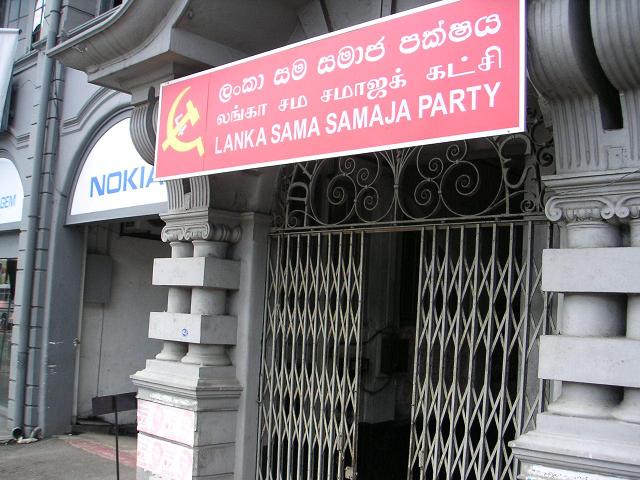
The LSSP operated as a cadre party on the Leninist model. In order to become a member one had first to be active in the peripheral organisations such as the trade unions, women's organisations and youth leagues. Thereafter it was necessary to serve several months' apprenticeship as a candidate member before being elevated to full membership with voting rights. The basic unit of the Party is the Local, consisting of only full- and candidate-members. Locals also exist inside trade unions.
Internally, the LSSP uses democratic process. The supreme body is the conference, which is summoned every few years. The conference decides on policy and elects a Central Committee (CC) to preside over its implementation. The CC appoints members to bureaux to look after specific area, such as the Educational Bureau (EB), Organisational Bureau (Orgburo) and Trade Union Bureau (TUB); The Political Bureau (Politburo) is appointed to deal with day-to-day political matters and effectively provides leadership. The CC also appoints an Editorial Board for running the Samasamajaya newspaper.
The Party also has regional groupings, which have conferences and appoint office bearers for the Regional Committees (RCs). Internationally, there was just one Local, the London Branch. This was also known as the Lanka Socialist League, and was anchored around Wesley Muthiah.
General Secretary
There is strictly no General Secretary, but a Secretary to the Central Committee, assisted by a Deputy and an Assistant. Secretaries have been:
- Vernon Gunasekera
- Leslie Goonewardene
- Bernard Soysa
- Batty Weerakoon
- Wimalasiri de Mel
Electoral results
Parliamentary
| Year | Votes | Percentage of votes | Vote swing | Seats won | Change in seats | Party leader | Outcome | 1947 | 1952 | 1956 | 1960 (March) | 1960 (July) | 1965 | 1970 | 1977 | |||||
|---|---|---|---|---|---|---|---|---|---|---|---|---|---|---|---|---|---|---|---|---|
| 204,020 | 10.81% | 10.81% | 10 | Leslie Goonewardene & N. M. Perera | ||||||||||||||||
| 305,133 | 13.11% | 2.30% | 1 | |||||||||||||||||
| 274,204 | 10.36% | 2.75% | 5 | |||||||||||||||||
| 325,286 | 10.70% | 0.34% | 4 | |||||||||||||||||
| 224,995 | 7.31% | 3.39% | 2 | |||||||||||||||||
| 302,095 | 7.47% | 0.16% | 2 | |||||||||||||||||
| 433,224 | 8.68% | 1.21% | 9 | |||||||||||||||||
| 225,317 | 3.61% | 5.07% | 19 |
:In the 1947, 1952 and 1956 elections the assembly had 95 single-member constituencies. In 1960 it was expanded to 151 seats and in 1977 to 168. :In 1965 Bernard Soysa was elected unopposed in his constituency. In recent elections, the LSSP has contested as part of a political coalition of multiple parties.
- In 1989, the LSSP contested as part of the United Socialist Alliance.
- From 1994 to 2001 the LSSP contested on the lists of the People's Alliance.
- From 2004 to 2015, the LSSP contested on the lists of the United People's Freedom Alliance.
- In 2020, the LSSP contested on the lists of the Sri Lanka People's Freedom Alliance.
Presidential
| Year | Candidate | Votes | % | Result | 1982 |
|---|---|---|---|---|---|
| Colvin R. de Silva | 58,531 | 0.90% |
Leaders and important members
:See List of Members of the Lanka Sama Samaja Party. The LSSP has never had a formal leader. In the period immediately after its formation, Dr Colvin R de Silva was elected President, but the post was later removed. For many years, N. M. Perera was the leader of the LSSP Parliamentary Group and was recognised by the public as the party leader. However, the actual leadership has always been that of a group represented in the various bureaux of the Central Committee.
A large proportion of the leadership of the Left in Sri Lanka started their political lives in the LSSP. This is even true of the political right; for example, Esmond Wickremasinghe (the father of Ranil Wickremasinghe) was a leading member of the party - before marrying the daughter of the wealthy press baron D. R Wijewardena and being appointed editor-in-chief of Lake House. W. Dahanayake, the later prime minister, was associated with the LSSP before gravitating right-wards (finally ending up in the UNP).
Tissa Abeysekara was at one time tipped to stand for parliament on the National list; however, on two occasions he was holding public office (Chairman National Film Corporation) and therefore turned down, but remained an integral member of the party.
Publications
The LSSP's main organ has always been the Samasamajaya newspaper. Today, its publication is somewhat irregular. For many years it was supplemented by the Tamil Samadharmam which was commenced in 1938. Its first editor was K. Ramanathan, later succeeded by T. E. Pushparajan.
In the period of underground struggle, the Kamkaruwa, was revived as a legal Sinhalese weekly the 'open' section of the Party and published until banned by Admiral Sir Geoffrey Layton. The 'open' section also brought out Straight Left in English.
In 1960 a special magazine was brought out to commemorate the 25th anniversary of the foundation of the LSSP, Visi Pas Vasrak. The large number of members of the Ceylon Mercantile Union (CMU) who had been sacked from Lake House that year collaborated in its production.
In 1965, in response to the need for a broad-left popular newspaper to counteract Lake House's Dinamina, the LSSP and members of the SLFP began the Janadina daily and the Janasathiya weekly newspaper, later supplemented by the poetry periodical Janakavi. The CMU members sacked from Lake House were prominent in these publications as well. A similar task was carried out in English by The Nation; however, when this weekly was taken over by the SLFP, the LSSP started the Socialist Nation, edited by Hector Abhayavardhana.
A press, the 'Star Press', was begun as a semi-commercial venture, to print the LSSP's publications, and it still operates.
A theoretical journal, Rajaya, edited by a board led by Osmund Jayaratne, was published in 1975. This and its English version State were suspended after a few issues.
Footnotes
References
- "The Lanka Sama Samaja Party from its Beginnings to its Expulsion".
- Pinto, Leonard. (2015-07-14). "Being a Christian in Sri Lanka: Historical, Political, Social, and Religious Considerations". Balboa Press.
- (1968). "Origins of Trotskyism in Ceylon: A Documentary History of the Lanka Sama Samaja Party, 1935-1942". Hoover Institution on War, Revolution and Peace.
- (1965). "Parliamentary Debates".
- (1975). "Singaravelu, First Communist in South India". People's Publishing House.
- Wickramasinghe, Nira. (2006). "Sri Lanka in the Modern Age: A History of Contested Indentities". University of Hawaii Press.
- (December 1981). "Tribune". Ceylon News Service.
- Duraisingam, Thambimuttu. (2000). "Politics and Life in Our Times: Selected Articles Published for Over a Century". Thambimuttu Duraisingam.
- "A Short History of the Lanka Sama Samaja Party". Marxists Internet Archive(MIA).
- Charles Wesley Ervin, ''Tomorrow is Ours:the Trotskyist Movement in India and Ceylon, 1935-48'', Colombo: Social Scientists Association, 2006
- Guruge, Ananda. (2011-10-28). "Peace at Last in Paradise". AuthorHouse.
- (1959). "History of Ceylon: From the beginning of the nineteenth century to 1948". Ceylon University Press.
- Duraisingam, Thambimuttu. (2000). "Politics and Life in Our Times: Selected Articles Published for Over a Century". Thambimuttu Duraisingam.
- Gunawardena, Charles A.. (2005). "Encyclopedia of Sri Lanka". Sterling Publishers Pvt. Ltd.
- Jayasuriya, Laksiri. (2010-08-17). "Taking Social Development Seriously: The Experience of Sri Lanka". SAGE Publishing India.
- (1973). "Problems of Communism". Documentary Studies Section, International Information Administration.
- "S. A. Wickremasinghe {{!}} Making Britain".
- (1968). "Origins of Trotskyism in Ceylon: A Documentary History of the Lanka Sama Samaja Party, 1935-1942". Hoover Institution on War, Revolution and Peace.
- (1997). "The Bracegirdle Affair: An Episode in the History of the Lanka Sama Samaja Party". Young Socialist Publication.
- "The Island".
- "T. Perera: Edmund Samarakkody".
- Amarasinghe, Y. Ranjith. (2000). "Revolutionary Idealism and Parliamentary Politics: A Study of Trotskyism in Sri Lanka". Social Scientists' Association.
- Seneviratne, H. L.. (1999). "The Work of Kings". University of Chicago Press.
- Jasentuliyana, Nandasiri. (2016-07-29). "Same Sky, Different Nights". AuthorHouse.
- "Lerski: Origins of Trotskyism in Ceylon (Chap.1)".
- (2013-10-18). "The Tsunami of 2004 in Sri Lanka: Impacts and Policy in the Shadow of Civil War". Routledge.
- "The Island-Midweek Review".
- (15 August 2004). "Dr.N.M.Perera 1905-1979:An honest and upright politician". Sunday Observer.
- Alexander, Robert Jackson. (1991). "International Trotskyism, 1929-1985: A Documented Analysis of the Movement". Duke University Press.
- Silva, E. P. De. (1975). "A Short Biography of Dr. N. M. Perera, Ph.D., D.S.c., B.Sc". De Silva.
- Ralhan, O.P.. (1998). "Concept of socialism". Anmol Publications.
- "Glossary of People: Go".
- Nyrop, Richard F.. (1975). "Area Handbook for India".
- (1970). "Ceylon Studies Seminar". University of Ceylon.
- (1937-11-25). "Bracegirdle Case.". Sydney Morning Herald (NSW: 1842–1954).
- (1999-09-23). "Obituary: Mark Bracegirdle".
- (2016-04-21). "The Bracegirdle Incident".
- (1996-01-01). "Britain, World War 2 & the Sama Samajists: A Study of the Documents Contained in the Secret Files Maintained by the Public Record Office, London". Young Socialist Publication.
- (2000). "Nēthrā: A Non-specialist Journal for Lively Minds". International Centre for Ethnic Studies.
- Ludowyk, Evelyn Frederick Charles. (1967). "A Short History of Ceylon". Praeger.
- Silva, Lloyd Oscar De. (1992). "Echoes in the Memory". Lantana.
- Warnapala, W.A. Wiswa. (1974). "Civil Service Administration in Ceylon: A Study in Bureaucratic Adaptation". Department of Cultural Affairs.
- Sumatipāla, Kē Ec Ăm. (1968). "History of Education in Ceylon, 1796-1965: With Special Reference to the Contribution Made by C.W.W. Kannangara to the Educational Development of Ceylon". Tisara Prakasakayo.
- Goonaratna, Colvin. (2006-01-01). "NM, in His Own Words, As Seen by Others". Dr. N.M. Perera Centre.
- Syed, M. H.. (2002). "Encyclopaedia of Saarc Nations". Gyan Publishing House.
- Alexander, Robert Jackson. (1991). "International Trotskyism, 1929-1985: A Documented Analysis of the Movement". Duke University Press.
- "The Fight for Trotskyism in South Asia".
- Alexander, Robert Jackson. (1991). "International Trotskyism, 1929-1985: A Documented Analysis of the Movement". Duke University Press.
- "Edmund Samarakkody, 1912-1992".
- Duraisingam, Thambimuttu. (2000). "Politics and Life in Our Times: Selected Articles Published for Over a Century". Thambimuttu Duraisingam.
- (1973). "Problems of Communism". Documentary Studies Section, International Information Administration.
- (1992). "Political Parties of Asia and the Pacific: A Reference Guide". Longman.
- (1953). "Strength of the International Communist Movement: Special Subcommittee on Security Affairs". United States Congress Senate Foreign Relations Committee.
- Gunawardena, Charles A.. (2005). "Encyclopedia of Sri Lanka". Sterling Publishers Pvt. Ltd.
- Saran, Parmatma. (1982). "Government and Politics of Sri Lanka". Metropolitan.
- Silva, K. M. De. (1997). "Sri Lanka: The Second World War and the Soulbury Commission, 1939-1945". Stationery Office.
- "Glossary of Organisations: La".
- Perera, T.. (2006). "Revolutionary trails, Edmund Samarakkody: a political profile". Social Scientists' Association.
- Jasentuliyana, Nandasiri. (2016-07-29). "Same Sky, Different Nights". AuthorHouse.
- Sanmugathasan, N.. (1989). "Political Memoirs of an Unrepentant Communist". N. Sanmugathasan.
- (1960). "A Short History of the Lanka Sama Samaja Party". Gunaratne.
- Jasentuliyana, Nandasiri. (2016-07-29). "Same Sky, Different Nights". AuthorHouse.
- (1968). "Origins of Trotskyism in Ceylon: A Documentary History of the Lanka Sama Samaja Party, 1935-1942". Hoover Institution on War, Revolution and Peace.
- Amerasinghe, E.F.G.. (1998). "Employee Relations and Industrial Law: A Collection of Papers". Employers' Federation of Ceylon.
- (1961). "Ceylon Sessional Papers". Government Press.
- (2000-04-13). "Intelligence and the War Against Japan: Britain, America and the Politics of Secret Service". Cambridge University Press.
- Jackson, Ashley. (2006-03-09). "The British Empire and the Second World War". A&C Black.
- Ervin, Charles W.. (2001). "Philip Gunawardena: The Making of a Revolutionary". Social Scientists' Association.
- Rose, Saul. (1959). "Socialism in Southern Asia". Oxford University Press.
- Talwar, Sada Nand. (1985). "Under the Banyan Tree: The Communist Movement in India, 1920-1964". Allied Publishers.
- Best, Anthony. (2000). "British Documents on Foreign Affairs--reports and Papers from the Foreign Office Confidential Print: Burma, India, Pakistan, Ceylon, Indonesia, The Philippines and South-East Asia and the Far East (General) January 1949-December 1949".
- (1942). "Manifesto of the Fourth International to the Workers and Peasants of India". Pioneer Publishers.
- Perera, T.. (2006). "Revolutionary trails, Edmund Samarakkody: a political profile". Social Scientists' Association.
- Rana, Mahendra Singh. (1981). "Indian Government and Politics: A Bibliographical Study (1885–1980)". Wiley Eastern.
- (1996-01-01). "Britain, World War 2 & the Sama Samajists: A Study of the Documents Contained in the Secret Files Maintained by the Public Record Office, London". Young Socialist Publication.
- Sheppard, Barry. (2005). "The Party: The Socialist Workers Party, 1960-1988". Resistance Books.
- Goonatilake, Susantha. (2006-09-05). "Recolonisation: Foreign Funded NGOs in Sri Lanka". SAGE Publishing India.
- Wriggins, William Howard. (2015-12-08). "Ceylon: Dilemmas of a New Nation". Princeton University Press.
- Richardson, Al. (1997). "Blows Against the Empire: Trotskyism in Ceylon: The Lanka Sama Samaja Party, 1935-1964". Porcupine Press.
- Baring, Maurice. (1924). "C". Doubleday, Page.
- (1985). "Political Parties of Asia and the Pacific". Greenwood Press.
- Ervin, Charles Wesley. (2006). "Tomorrow is Ours: The Trotskyist Movement in India and Ceylon, 1935-48". Social Scientists' Association.
- Amarasinghe, Y. Ranjith. (2000). "Revolutionary Idealism and Parliamentary Politics: A Study of Trotskyism in Sri Lanka". Social Scientists' Association.
- Biyanwila, S. Janaka. (2010-10-18). "The Labour Movement in the Global South: Trade Unions in Sri Lanka". Routledge.
- Siriwardena, Regi. (1999). "Working Underground: The LSSP in Wartime : a Memoir of Happenings and Personalities". International Centre for Ethnic Studies.
- "Edmund Samarakkody, 1912–1992".
- Liyanage, Pulsara. (1998). "Vivi: A Biography of Vivienne Goonewardena". Women's Education and Research Centre.
- Richardson, Al. (1997). "Blows Against the Empire: Trotskyism in Ceylon: The Lanka Sama Samaja Party, 1935–1964". Porcupine Press.
- (2016-02-04). "Results of Parliamentary General Election - 1947".
- Kanapathipillai, Valli. (2009-08-01). "Citizenship and Statelessness in Sri Lanka: The Case of the Tamil Estate Workers". Anthem Press.
- Vanniasingham, Somasundaram. (1989). "Sri Lanka: The Conflict Within". Sangam Books.
- Rambukwella, Harshana. (2018-07-02). "The Politics and Poetics of Authenticity: A Cultural Genealogy of Sinhala Nationalism". UCL Press.
- (2000). "British Documents on Foreign Affairs--reports and Papers from the Foreign Office Confidential Print: Burma, India, Pakistan, Ceylon, Indonesia, The Philippines and South-East Asia and the Far East (General) January 1949-December 1949". Univ. Publ. of America.
- Geographer, United States Department of State Office of the. (1965). "Profiles of Newly Independent States". Office of Media Services, Bureauof Public Affairs.
- "Independence Day in Ceylon".
- "Removing "remnants of colonialism"".
- "The RAF and RCyAF - A parting of the ways". Sri Lanka Air Force.
- United States Department of State Public Services Division. (1959). "The Subcontinent of South Asia: Afghanistan, Ceylon, India, Nepal [and] Pakistan: Background". U.S. Government Printing Office.
- Kanapathipillai, Valli. (2009-08-01). "Citizenship and Statelessness in Sri Lanka: The Case of the Tamil Estate Workers". Anthem Press.
- Chowdhory, Nasreen. (2018-06-13). "Refugees, Citizenship and Belonging in South Asia: Contested Terrains". Springer.
- Vamadevan, M.. (1989). "Sri Lankan Repatriates in Tamil Nadu: Rehabilitation and Integration". Zen Publishers.
- Weiss, Gordon. (2012-09-04). "The Cage: The Fight for Sri Lanka and the Last Days of the Tamil Tigers". Bellevue Literary Press.
- "Welcome to UTHR, Sri Lanka".
- Amarasinghe, Y. Ranjith. (2000). "Revolutionary Idealism and Parliamentary Politics: A Study of Trotskyism in Sri Lanka". Social Scientists' Association.
- Silva, Colvin R. De. (1954). "Their Politics and Ours". Lanka Samasamaja.
- (1977). "Intercontinental Press Combined with Inprecor". Intercontinental Press.
- Alexander, Robert Jackson. (1991). "International Trotskyism, 1929-1985: A Documented Analysis of the Movement". Duke University Press.
- Scalapino, Robert A.. (1965). "The Communist Revolution in Asia: Tactics, Goals, and Achievements". Prentice-Hall.
- Kearney, Robert N.. (1983). "The Political Party System in Sri Lanka". Political Science Quarterly.
- "The Fall of the Leftist Movement".
- Nyrop, Richard F.. (1971). "Area Handbook for Ceylon". U.S. Government Printing Office.
- Wijeyeratne, Roshan de Silva. (2013-08-15). "Nation, Constitutionalism and Buddhism in Sri Lanka". Routledge.
- Mitra, Subrata K.. (2009-02-06). "Politics of Modern South Asia". Taylor & Francis.
- (2013-02-18). "The Debasement Of Politics After The 1953 Hartal".
- Wickramasinghe, Nira. (2014). "Sri Lanka in the Modern Age: A History". Oxford University Press.
- Biziouras, Nikolaos. (2014-03-26). "The Political Economy of Ethnic Conflict in Sri Lanka: Economic Liberalization, Mobilizational Resources, and Ethnic Collective Action". Routledge.
- (2013-08-11). "60 years since the Great Hartal".
- (2003-01-01). "Major Trends and Issues in Early Childhood Education: Challenges, Controversies, and Insights". Teachers College Press.
- Lanka), the Socialist Equality Party (Sri. (4 February 2008). "Sri Lankan independence: 60 years of communalism, social decay and war".
- "De Silva: Hartal!".
- Nossiter, Thomas Johnson. (1982-01-01). "Communism in Kerala: A Study in Political Adaptation". University of California Press.
- Fernando, Warnakulasuriya Thomas Aquinas Leslie. (2006). "Being close to them: among some eminent personalities". Godage International Publishers.
- (2001). "Women & the Nation's Narrative: Gender and Nationalism in Twentieth Century Sri Lanka". Rowman & Littlefield.
- Dumont, René. (1972). "Paysanneries aux abois: Ceylan, Tunisie, Sénégal". Éditions du Seuil.
- (2002). "We Were Making History: The Hartal of 1953". Young Socialist.
- (2018-08-12). "The day Trotskyists shut down a country: 65th anniversary of the Sri Lankan Hartal".
- "14 Aug 1953, 5 – The Guardian at Newspapers.com".
- Perera, Mario. "WHILE GOD SLEPT: "Forces of darkness as Angels of Light Sri Lanka: 1971–2009"". Wordit CDE.
- Mehta, Raj K.. (2010). "Lost Victory: The Rise & Fall of LTTE Supremo, V. Prabhakaran". Pentagon Press.
- (1988). "J.R. Jayewardene of Sri Lanka: 1906-1956". University of Hawaii Press.
- Perera, Mario. "WHILE GOD SLEPT: "Forces of darkness as Angels of Light Sri Lanka: 1971-2009"". Wordit CDE.
- "The Island".
- Wickramasinghe, Nira. (2014-01-03). "Sri Lanka in the Modern Age: A History". Oxford University Press.
- Namasivayam, S.. (1955-01-01). "The General Election in Ceylon in 1956". Parliamentary Affairs.
- United States Department of State Public Services Division. (1957). "Ceylon, 1957: Background". U.S. Government Printing Office.
- Riaz, Ali. (2010-02-26). "Religion and Politics in South Asia". Routledge.
- (1986). "Volumes 6–7". University of California, Los Angeles.
- Alexander, Robert Jackson. (1991). "International Trotskyism, 1929-1985: A Documented Analysis of the Movement". Duke University Press.
- Palmer, Norman Dunbar. (1975). "Elections and Political Development: The South Asian Experience". Duke University Press.
- (1990). "The Commonwealth Yearbook". H.M. Stationery Office.
- Abhayavardhana, Hector. (2001-01-01). "Hector Abhayavardhana: Selected Writings". Social Scientists' Association.
- (1975). "Intercontinental Press". Intercontinental Press.
- "28. Ceylon/Sri Lanka (1948-present)".
- United States Directorate for Armed Forces Information and Education. (1968). "Ceylon". Department of Defense, Armed Forces Information Service.
- (1960-07-20). "1960: Ceylon chooses world's first woman PM".
- Frank, Pierre. (1979). "The Fourth International: The Long March of the Trotskyists". Ink Links.
- Horowitz, Donald L.. (2014-07-14). "Coup Theories and Officers' Motives: Sri Lanka in Comparative Perspective". Princeton University Press.
- Warnapala, W. A. Wiswa. (2005-01-01). "Sri Lanka Freedom Party: A Political Profile". Godage International Publishers.
- United States Congress House Foreign Affairs Committee. (1963). "Expropriation of American-owned Property by Foreign Governments in the Twentieth Century, Report Prepared by the Legislative Reference Service, Library of Congress, for the Committee on Foreign Affairs. Committee Print ... 88-1 ... July 19, 1963".
- Nayyar, Deepak. (1977-06-17). "Economic Relations between Socialist Countries and the Third World". Springer.
- "28. Ceylon/Sri Lanka (1948-present)".
- Kearney, Robert N.. (2021-01-08). "Trade Unions and Politics in Ceylon". University of California Press.
- (1963). "World Marxist Review".
- "Hartal!". revolutionary-history.co.uk.
- Guṇavardhana, Pilip. (2006). "The State Council Years, 1936-1942: Speeches Made in the Legislature Compiled Under the Auspices of the Philip Gunawardena Commemoration Society". Godage International Publishers.
- Kearney, Robert N.. (2021-01-08). "Trade Unions and Politics in Ceylon". University of California Press.
- Kearney, Robert N.. (2021-01-08). "Trade Unions and Politics in Ceylon". University of California Press.
- (1972). "Asian Survey". University of California Press.
- Jayaratne, Osmund. (2004). "Memoirs of Osmund Jayaratne". Godage International Publishers.
- Nyrop, Richard F.. (1971). "Area Handbook for Ceylon". U.S. Government Printing Office.
- (1964-05-10). "Talks on Ceylon Coalition Approved by Ruling Party". New York Times.
- Biyanwila, S. Janaka. (2010-10-18). "The Labour Movement in the Global South: Trade Unions in Sri Lanka". Routledge.
- "BRITONS CRITICIZE CEYLON PROPOSAL; Say a Ban on Remittances Would Damage Trade". The New York Times.
- Samaranāyaka, Gāmiṇi. (2008). "Political Violence in Sri Lanka, 1971–1987". Gyan Publishing House.
- Kearney, Robert N.. (2021-01-08). "Trade Unions and Politics in Ceylon". University of California Press.
- Kearney, Robert N.. (2021-01-08). "Trade Unions and Politics in Ceylon". University of California Press.
- Nubin, Walter. (2002). "Sri Lanka: Current Issues and Historical Background". Nova Publishers.
- (1973). "Problems of Communism". Special Materials Section, United States Information Agency.
- (1968). "Summary of World Broadcasts: Far East". Monitoring Service of the British Broadcasting Corporation.
- Roberts, Michael. (1994). "Exploring Confrontation: Sri Lanka--politics, Culture and History". Taylor & Francis.
- Oberst, Robert C.. (2019-04-03). "Legislators And Representation In Sri Lanka: The Decentralization Of Development Planning". Routledge.
- "1 Aug 1970, Page 17 - The Gazette and Daily at Newspapers.com".
- Wilson, A. Jeyaratnam. (1975). "Electoral Politics in an Emergent State: The Ceylon General Election of May 1970". CUP Archive.
- (1975). "Tribune". Ceylon News Service.
- (1971). "Asian Almanac". V.T. Sambandan.
- Alexander, Robert Jackson. (1991). "International Trotskyism, 1929-1985: A Documented Analysis of the Movement". Duke University Press.
- Abhayavardhana, Hector. (2001-01-01). "Hector Abhayavardhana: Selected Writings". Social Scientists' Association.
- Sri Lanka Pārlimēntuva Senate. (1970). "Parliamentary Debates".
- Jayaratne, Osmund. (2004). "Memoirs of Osmund Jayaratne". Godage International Publishers.
- (2016-02-13). "Pharmacy Practice in Developing Countries: Achievements and Challenges". Academic Press.
- (2015-06-10). "N. M., Allende & Chavez: Re-reading Three Strategies For Socialism".
- "The Island".
- (2006). "Socialist Women of Sri Lanka". Young Socialist Publication.
- Wilson, A. Jeyaratnam. (1988). "The Break-up of Sri Lanka: The Sinhalese-Tamil Conflict". Hurst.
- Duraisingam, Thambimuttu. (2000). "Politics and Life in Our Times: Selected Articles Published for Over a Century". Thambimuttu Duraisingam.
- Goonewardene, Leslie. "Can we get to socialism this way?". The Times of Ceylon.
- (1977). "The Economist". Economist Newspaper Limited.
- (July 2020). "Unknown". Intercontinental Press.
- (1977). "Link: Indian Newsmagazine".
- Muller, Tom. (2012-04-02). "Political Handbook of the World 2012". SAGE.
- (1988). "J.R. Jayewardene of Sri Lanka: 1956-1989". University of Hawaii Press.
- (2003-08-23). "Can Democracy be Designed?: The Politics of Institutional Choice in Conflict-Torn Societies". Zed Books.
- (1992). "Political Parties of Asia and the Pacific: A Reference Guide". Longman.
- Gunawardena, Charles A.. (2005). "Encyclopedia of Sri Lanka". Sterling Publishers Pvt. Ltd.
- (1985). "Political Parties of Asia and the Pacific". Greenwood Press.
- "The Island-Features".
- Duraisingam, Thambimuttu. (2000). "Politics and Life in Our Times: Selected Articles Published for Over a Century". Thambimuttu Duraisingam.
- (1979). "Tribune". Ceylon News Service.
- Biyanwila, S. Janaka. (2010-10-18). "The Labour Movement in the Global South: Trade Unions in Sri Lanka". Routledge.
- Jayatilake, Linus. (1980). "General Strike 1980: Sri Lanka President J.R. Jayawardene's Democracy Unmasked". National Committee.
- (1983). "Labour Capital and Society: Travail Capital Et Société". Centre for Developing-Area Studies, McGill University..
- Fernando, J. Basil. (1991). "Sri Lanka: Militarization Vs. Modernization". Asia Monitor Resource Center.
- (2013). "Sri Lanka Sama Samaja Party Political Parties in Sri Lanka, Trotskyist Organisations of Sri Lanka". TypPRESS.
- (1982). "Tribune". Ceylon News Service.
- Jayawardane, Lakshman. (1988). "Sri Lanka presidential election, 88: issues and trends". Lakshman Jayawardane.
- Bhasin, Avtar Singh. (2001). "India-Sri Lanka relations and Sri Lanka's ethnic conflict documents, 1947-2000". Indian Research Press.
- Busky, Donald F.. (2002). "Communism in History and Theory: Asia, Africa, and the Americas". Greenwood Publishing Group.
- Biyanwila, S. Janaka. (2010-10-18). "The Labour Movement in the Global South: Trade Unions in Sri Lanka". Routledge.
- (1997). "Sri Lanka News". Embassy of Sri Lanka.
- Sri Lanka Embassy (U.S.). (1995). "News Letter". The Embassy.
- Lansford, Tom. (2015-03-24). "Political Handbook of the World 2015". CQ Press.
- Dissanayaka, T.D.S.A.. (1994). "The Politics of Sri Lanka: The provincial council election of 1999". Swastika (Private) Limited.
- "Vasudeva never changed his party, policies– PM".
- (1 October 2005). "Divisions in the left emerge". BBC News.
- "Ceylon/Sri Lanka: The Rise of the Lanka Sama Samaja Party". Marxists Internet Archive(MIA).
- (24 December 2007). "Lanka Sama Samaja Party and the working class". Daily News.
- "Origins Of Trotskyism In Ceylon". Marxists Internet Archive(MIA).
- "The Struggle for Trotskyism in Ceylon". International Bolshevik Tendency (IBT).
- "Governor post for Tissa Vitharana".
- (2019-12-04). "Tissa Vitharana among two new Governors appointed".
- Roberts, Michael. (1994). "Exploring Confrontation: Sri Lanka--politics, Culture and History". Taylor & Francis.
- Kearney, Robert N.. (2021-01-08). "Trade Unions and Politics in Ceylon". University of California Press.
- "Leslie Goonewardene: A Short History of the LSSP".
- Alexander, Robert Jackson. (1991). "International Trotskyism, 1929-1985: A Documented Analysis of the Movement". Duke University Press.
- (1975). "Asian Recorder".
- Wickramasinghe, Nira. (2006). "Sri Lanka in the Modern Age: A History of Contested Indentities". University of Hawaii Press.
- Karalasingham, V.. (1964). "Politics of Coalition". International Publishers.
- Perera, T.. (2006). "Revolutionary trails, Edmund Samarakkody: a political profile". Social Scientists' Association.
- (1997). "The Bracegirdle Affair: An Episode in the History of the Lanka Sama Samaja Party". Young Socialist Publication.
- (1975). "Towards a History of the Fourth International: Education for Socialists Bulletins Towards a History of the Fourth International". National Education Department, Socialist Workers Party.
- (1996-01-01). "Britain, World War 2 & the Sama Samajists: A Study of the Documents Contained in the Secret Files Maintained by the Public Record Office, London". Young Socialist Publication.
- Amarasinghe, Y. Ranjith. (2000). "Revolutionary Idealism and Parliamentary Politics: A Study of Trotskyism in Sri Lanka". Social Scientists' Association.
- Wickramasinghe, Nira. (2006). "Sri Lanka in the Modern Age: A History of Contested Indentities". University of Hawaii Press.
- Jayaratne, Osmund. (2004). "Memoirs of Osmund Jayaratne". Godage International Publishers.
- (1952). "The Ceylon Historical Journal". Tisara Prakasakayo.
- Richardson, Al. (1997). "Blows Against the Empire: Trotskyism in Ceylon: The Lanka Sama Samaja Party, 1935-1964". Porcupine Press.
- (22 April 2009). "True humanist". dailynews.
- (1996-01-01). "Britain, World War 2 & the Sama Samajists: A Study of the Documents Contained in the Secret Files Maintained by the Public Record Office, London". Young Socialist Publication.
- Amarasinghe, Y. Ranjith. (2000). "Revolutionary Idealism and Parliamentary Politics: A Study of Trotskyism in Sri Lanka". Social Scientists' Association.
- (1980). "Social Science Review". Social Scientists Association.
- Sworakowski, Witold S.. (1973). "World Communism; a Handbook, 1918-1965". Hoover Institution Press.
- Amarasinghe, Y. Ranjith. (2000). "Revolutionary Idealism and Parliamentary Politics: A Study of Trotskyism in Sri Lanka". Social Scientists' Association.
- Kearney, Robert N.. (2021-01-08). "Trade Unions and Politics in Ceylon". University of California Press.
- Wilson, A. Jeyaratnam. (2010-06-10). "Electoral Politics in an Emergent State: The Ceylon General Election of May 1970". Cambridge University Press.
- Abhayavardhana, Hector. (2001-01-01). "Hector Abhayavardhana: Selected Writings". Social Scientists' Association.
- Wriggins, William Howard. (2015-12-08). "Ceylon: Dilemmas of a New Nation". Princeton University Press.
This article was imported from Wikipedia and is available under the Creative Commons Attribution-ShareAlike 4.0 License. Content has been adapted to SurfDoc format. Original contributors can be found on the article history page.
Ask Mako anything about Lanka Sama Samaja Party — get instant answers, deeper analysis, and related topics.
Research with MakoFree with your Surf account
Create a free account to save articles, ask Mako questions, and organize your research.
Sign up freeThis content may have been generated or modified by AI. CloudSurf Software LLC is not responsible for the accuracy, completeness, or reliability of AI-generated content. Always verify important information from primary sources.
Report