From Surf Wiki (app.surf) — the open knowledge base
Langley Research Center
NASA field center

NASA field center
| Field | Value |
|---|---|
| agency_name | NASA Langley Research Center |
| logo | NASA logo.svg |
| logo_width | 100px |
| seal_width | 140px |
| picture | NASA Langley Research Center aerial view (2011).jpg |
| picture_caption | Aerial view of the Langley Research Center in December 2011 |
| formed | 1917 |
| preceding1 | Langley Memorial Aeronautical Laboratory (NACA) |
| jurisdiction | U.S. Federal Government |
| headquarters | Hampton, Virginia, U.S. |
| employees | 1,821 (2017) |
| chief1_name | Dawn Schaible |
| chief1_position | Acting Center Director |
| chief2_name | Dr. Trina Chytka Dyal |
| chief2_position | Deputy Director |
| parent_agency | NASA |
| website | |
| footnotes | |
| map | NASA Langley Research Center Map.jpg |
| map_width | 180px |
| map_caption | Map of NASA Langley Research Center |
The Langley Research Center (LaRC or NASA Langley), located in Hampton, Virginia, near the Chesapeake Bay front of Langley Air Force Base, is the oldest of NASA's field centers. LaRC has focused primarily on aeronautical research but has also tested space hardware such as the Apollo Lunar Module. In addition, many of the earliest high-profile space missions were planned and designed on-site. Langley was also considered a potential site for NASA's Manned Spacecraft Center prior to the eventual selection of Houston, Texas.
Established in 1917 by the National Advisory Committee for Aeronautics (NACA), the research center devotes two-thirds of its programs to aeronautics and the rest to space. LaRC researchers use more than 40 wind tunnels to study and improve aircraft and spacecraft safety, performance, and efficiency. Between 1958 and 1963, when NASA (the successor agency to NACA) started Project Mercury, LaRC served as the main office of the Space Task Group.
In September 2019, after previously serving as associate director and deputy director, Clayton P. Turner was appointed director of NASA Langley.
History
After U.S.-German relations had deteriorated from neutral to hostile around 1916, the prospect of U.S. war entry became possible. On February 15, 1917, the newly established Aviation Week warned that the U.S. military aviation capability was less than what was operating in the European war. President Woodrow Wilson sent Jerome Hunsaker to Europe to investigate, and Hunsaker's report prompted Wilson to command the creation of the nation's first aeronautics laboratory, which became NASA Langley.
In 1917, less than three years after it was created, the NACA established the Langley Memorial Aeronautical Laboratory on Langley Field. Both Langley Field and the Langley Laboratory are named after aviation pioneer Samuel Pierpont Langley. The Aviation Section, U.S. Signal Corps had established a base there earlier that same year. The first research facilities were in place and aeronautical research was started by 1920. Initially, the laboratory included four researchers and 11 technicians.

Langley Field and NACA began parallel growth as air power proved its utility during World War I. The center was originally established to explore the field of aerodynamic research involving airframe and propulsion engine design and performance. In 1934 the world's largest wind tunnel was constructed at Langley Field with a 30 x test section; it was large enough to test full-scale aircraft. It remained the world's largest wind tunnel until the 1940s, when a 40 x tunnel was built at NASA's Ames Research Center in California.

The West Area Computers were African American, female mathematicians who worked as human computers at the Langley Research Center from 1943 through 1958. The West Computers were originally subject to Virginia's Jim Crow laws and got their name because they worked at Langley's West Area, while the white mathematicians worked in the East section.
Early in 1945, the center expanded to include rocket research, leading to the establishment of a flight station at Wallops Island, Virginia. A further expansion of the research program permitted Langley Research Center to orbit payloads, starting with NASA's Explorer 9 balloon satellite in mid-February 1961. As rocket research grew, aeronautics research continued to expand and played an important part when subsonic flight was advanced and supersonic and hypersonic flight were introduced.
Langley Research Center claims many historic firsts, some of which have proven to be revolutionary scientific breakthroughs. These accomplishments include: Development of the concept of research aircraft leading to supersonic flight, the world's first transonic wind tunnel, training the first crews of astronauts, the Lunar Landing Facility which provides the simulation of lunar gravity, and the Viking program for Mars exploration. The center also developed standards for the grooving of aircraft runways based on a previous British design used at Ronald Reagan Washington National Airport. Grooved runways reduce aquaplaning which permits better grip by aircraft tires in heavy rain. This grooving is now the international standard for all runways around the world.
Langley was also a contender for the site of NASA Mission Control, prior to the eventual selection of Houston, due to Langley's prominence with NASA at the time, the large existing aerospace industry already present in the Hampton Roads region, and the proximity to Washington, D.C. The selection of Houston actually took many higher-ups at Langley by surprise and caused some lingering controversy in the surrounding area over the loss and transfer of so many jobs to Houston. Though they had lost out on the Manned Spacecraft Center, Langley still played an important role in conducting research and training during the Apollo Program.
Departments
Systems Analysis and Concepts Directorate

The Systems Analysis and Concepts Directorate solves problems associated with aeronautics, exploration, and science by analyzing advanced aerospace system concepts for NASA decision makers and programs. The directorate is further broken down into four branches as follows:
- Aeronautics Systems Analysis
- Creates advanced concepts and technologies to improve the study of aeronautics.
- Space Mission Analysis – Exploration
- Enables decision making for complex space systems, architecture, and portfolios, primarily focusing on human exploration.
- Space Mission Analysis – Science and Technology
- Enables decision making for complex space systems, architecture, and portfolios, primarily focusing on remote exploration.
- Vehicle Analysis
- Designs revolutionary aircraft and launch vehicles.
Aeronautics
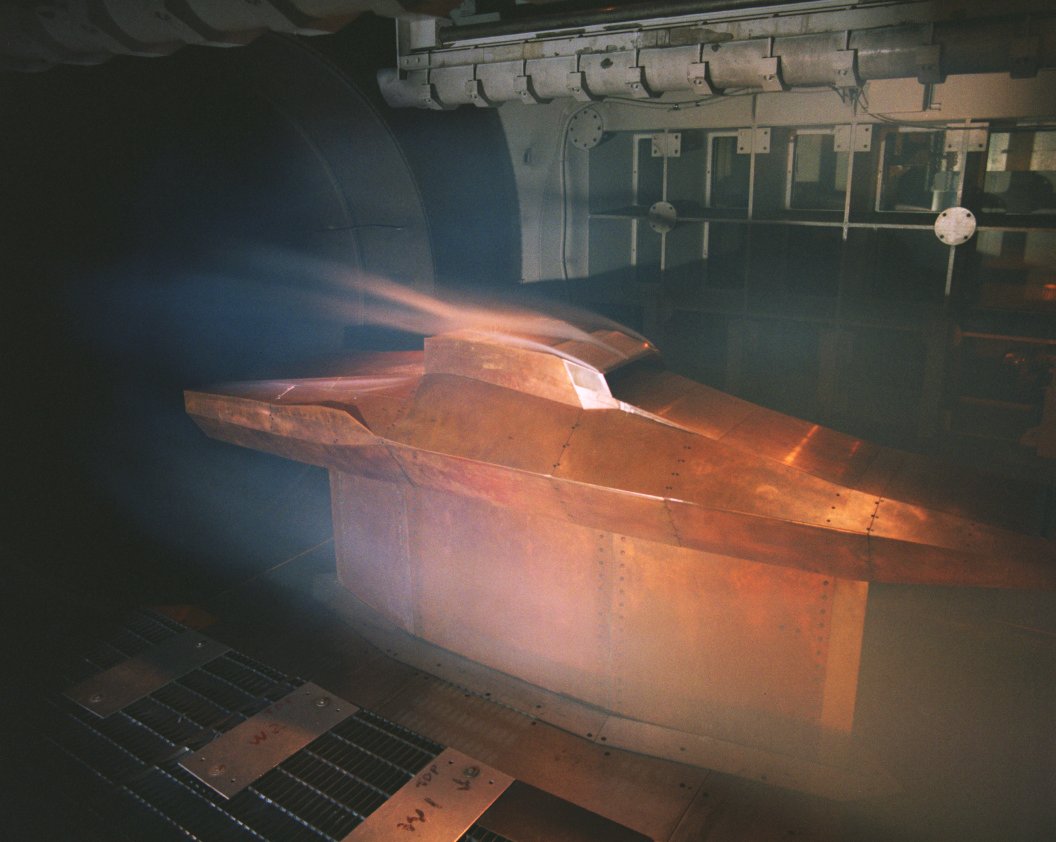
Langley Research Center performs critical research on aeronautics, including wake vortex behavior, fixed-wing aircraft, rotary wing aircraft, aviation safety, human factors and aerospace engineering. LaRC supported the design and testing of the hypersonic X-43, which achieved a world speed record of 9.6 Mach. LaRC assisted the NTSB in the investigation of the crash of American Airlines Flight 587.
Work began in July 2011 to remove the 1940s era 16 ft transonic wind tunnel. The facility supported development and propulsion integration research for many military aircraft including all fighters since 1960 (F-14, F-15, F-16, F-18 and the Joint Strike Fighter) but had been inactive since 2004. Langley retained transonic wind tunnel testing capabilities facilities in the National Transonic Facility, a high pressure, cryogenically cooled 8.2 ft closed loop wind tunnel.
Fabrication research and development
Plastic fabrication
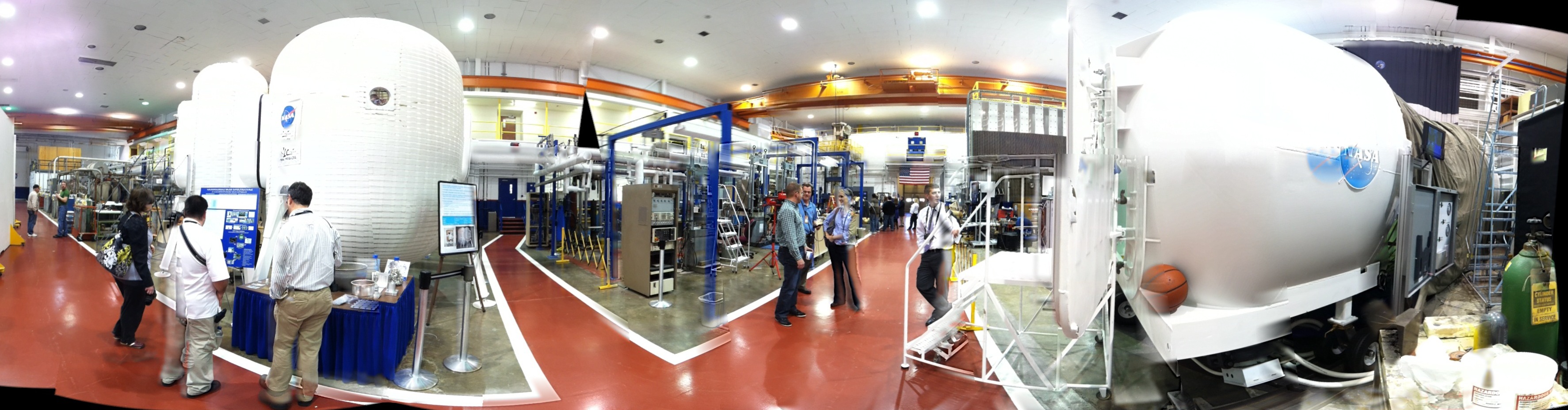
LaRC also houses a large collection of various inexpensive plastic reformation machines. These machines are used in the freeform fabrication department for faster timing, better precision, and larger quantities of low-cost toys, models, and industrial plastic parts. The fabrication of plastic parts is similar to the EBF³ process but with a thin, grated heating element as its melting apparatus. Both are run by CAD data and deal with various freeform fabrication of raw materials.
Astronautics
Moon

Since the start of Project Gemini, Langley was a center for training of rendezvous in space. In 1965, Langley opened the Lunar Landing Research Facility for simulations of Moon landings with a mock Apollo Lunar Module suspended from a gantry over a simulated lunar landscape. There was experimental work on some Lunar Landing Research Vehicles (LLRV).
Mars
Langley Research Center supported NASA's mission with the designing of a spacecraft for a landing on Mars. (see the Mars Exploration Rover.)
Earth science
Langley Research Center conducts Earth science research to support NASA's mission.
List of center directors
The following persons had served as the Langley Research Center director:
| No. | Image | Director | Start | End | Notes | ||
|---|---|---|---|---|---|---|---|
| 1 | Leigh M. Griffith | November 1, 1922 | December 31, 1925 | Engineer-in-Charge, NACA LMAL | |||
| 2 | [[File:Director at the Langley Research Center Henry J. E. Reid.jpg | 75px]] | Henry J. E. Reid | January 1, 1926 | June 1947 | Engineer-in-Charge, NACA LMAL | |
| June 1947 | May 1948 | Director, NACA LMAL | |||||
| May 1948 | October 1, 1958 | Director, NACA LAL | |||||
| October 1, 1958 | May 20, 1960 | Director | |||||
| 3 | [[File:Director at the Langley Research Center Floyd LaVerne Thompson.jpg | 75px]] | Floyd LaVerne Thompson | May 23, 1960 | May 1, 1968 | ||
| 4 | [[File:Edgar Maurice Cortright.jpg | 70px]] | Edgar M. Cortright | May 1, 1968 | nowrap | September 26, 1975 | |
| 5 | [[File:Director at the Langley Research Center Donald P. Hearth.jpg | 75px]] | Donald P. Hearth | nowrap | September 26, 1975 | November 30, 1984 | |
| 6 | Richard H. Petersen | December 3, 1984 | December 2, 1991 | ||||
| 7 | Paul F. Holloway | October 15, 1991 | August 2, 1996 | ||||
| 8 | [[File:Director at the Langley Research Center Jeremiah F. Creedon.jpg | 75px]] | Jeremiah F. Creedon | August 5, 1996 | June 15, 2002 | ||
| Acting | nowrap | Delma C. Freeman, Jr. | June 15, 2002 | June 13, 2003 | |||
| 9 | [[File:Roy Bridges.jpg | 70px]] | Roy D. Bridges Jr. | June 13, 2003 | October 3, 2005 | ||
| 10 | [[File:Lesa Roe official portrait.png | 70px]] | Lesa B. Roe | October 3, 2005 | April 28, 2014 | ||
| 11 | [[File:Steve Jurczyk official photo.jpg | 70px]] | Stephen G. Jurczyk | April 28, 2014 | March 1, 2015 | ||
| 12 | [[File:Director at the Langley Research Center David E. Bowles.jpg | 70px]] | David E. Bowles | March 2, 2015 | September 30, 2019 | ||
| 13 | [[File:Associate Administrator for the Space Technology Mission Directorate Clayton P. Turner.jpg | 70px]] | Clayton P. Turner | September 30, 2019 | July 15, 2024 | ||
| Acting | [[File:Deputy Director at the Glenn Research Center Dawn M. Schaible.jpg | 70px]] | Dawn Schaible | July 16, 2024 | February 22, 2025 | ||
| Acting | [[File:Acting Director at the Langley Research Center Trina M. Dyal.jpg | 70px]] | Trina Dyal | February 22, 2025 | present |
Awards
LRC scientists and engineers have won the Collier Trophy five times, listed below.
- 1929: for the development of the NACA cowling, a low-drag cowling for radial air-cooled aircraft engines.
- 1946: to Lewis A. Rodert, Lawrence D. Bell and Chuck Yeager for the development of an efficient wing deicing system.
- 1947: to John Stack of the then Langley Memorial Aeronautical Laboratory for research to determine the physical laws affecting supersonic flight. Lawrence D. Bell and Chuck Yeager also shared in this trophy for their work on supersonic flight.
- 1951: to John Stack for the development and use of the slotted-throat wind tunnel.
- 1954: to Richard T. Whitcomb for the development of the Whitcomb area rule, according to the citation, a "powerful, simple, and useful method of reducing greatly the sharp increase in wing drag heretofore associated with transonic flight, and which constituted a major factor requiring great reserves of power to attain supersonic speeds."
References
References
- (15 November 2017). "FY 2017 Agency Financial Report".
- (17 December 2015). "Dr. David E. Bowles, Director, NASA Langley Research Center".
- Korsgaard, Sean. (20 July 2019). "Williamsburg recalls watching Apollo 11 and helping crew get there". [[Tribune Media]].
- (1 September 2019). "Clayton P. Turner, Director, NASA Langley Research Center".
- [http://archive.aviationweek.com/issue/19170215 Aviation & Aeronautical Engineering], February 15, 1917
- Joe Anselmo. (February 17, 2017). "Aviation Week's Warning and the Founding of NASA Langley". [[Aviation Week & Space Technology]].
- Tennant, Diane. (September 5, 2011). "What's in a name? NASA Langley Research Center". [[The Virginian-Pilot]].
- "Journey in Aeronautical Research: a Career at NASA-Langley Research Center, ch. 3". NASA.
- [https://books.google.com/books?id=uSgDAAAAMBAJ&pg=PA26 "Faster, Safer Planes, Developed In Biggest Wind Tunnels"] ''Popular Science'', April 1934
- [https://books.google.com/books?id=wt8DAAAAMBAJ&pg=PA520 "Full-Size Planes Tested In Big Air Tunnel"] ''Popular Mechanics'', April 1935, pp. 520–521
- "40 X 80 and 80 X 120 Foot Wind Tunnels".
- "Human Computers at Nasa".
- Haynes, Korey. (February 2017). "Fighting FOR Visibility". Astronomy.
- "NASA Langley History and Description: Initial Activities". NASA LaRC Master Plan.
- (January 1969). "REPORT ON GROOVED RUNWAY EXPERIENCE AT WASHINGTON NATIONAL AIRPORT". Federal Aviation Administration.
- "NASA – Hypersonic X-43A Takes Flight".
- (2015-08-04). "NASA Cultural Resources (CRGIS) – NasaCRgis".
- (2011-07-08). "Tearing down NASA Langley's 16-foot transonic wind tunnel". Daily Press.
- "National Transonic Facility".
- "Langley Earth Science Research".
- "Meet the Center Directors of NASA Langley, Past and Present". NASA.
- "Personnel". NASA.
- "Henry J.E. Reid". NASA.
- "Floyd L. Thompson". NASA.
- "Edgar M. Cortright". NASA.
- "Dr. Donald P. Hearth". NASA.
- "Paul F. Holloway". NASA.
- "Dr. Jeremiah F. Creedon". NASA.
- "Roy D. Bridges, Jr.". NASA.
- "Lesa B. Roe". NASA.
- "Stephen G. Jurczyk". NASA.
- "Dr. David E. Bowles". NASA.
- "Clayton P. Turner". NASA.
- "Dawn M. Schaible". NASA.
- "Trina Dyal". NASA.
- (1992-12-31). "Exploring NASA's Roots – The History of the Langley Research Center | NASA".
This article was imported from Wikipedia and is available under the Creative Commons Attribution-ShareAlike 4.0 License. Content has been adapted to SurfDoc format. Original contributors can be found on the article history page.
Ask Mako anything about Langley Research Center — get instant answers, deeper analysis, and related topics.
Research with MakoFree with your Surf account
Create a free account to save articles, ask Mako questions, and organize your research.
Sign up freeThis content may have been generated or modified by AI. CloudSurf Software LLC is not responsible for the accuracy, completeness, or reliability of AI-generated content. Always verify important information from primary sources.
Report