From Surf Wiki (app.surf) — the open knowledge base
Langley, British Columbia (district municipality)
Municipality in British Columbia, Canada

Municipality in British Columbia, Canada
| Field | Value |
|---|---|
| name | Langley |
| official_name | The Corporation of the Township of Langley |
| native_name | |
| settlement_type | District municipality |
| image_skyline | Langley Township City Hall (2010).jpg |
| image_caption | Township of Langley City Hall |
| image_shield | Langleytownship-coatofarms.png |
| nickname | Langley Township |
| motto | "Nothing Without Effort" |
| image_map | Township of Langley in Metro Vancouver.svg |
| map_caption | Location of Langley Township in Metro Vancouver |
| subdivision_type | Country |
| subdivision_name | Canada |
| subdivision_type1 | Province |
| subdivision_type2 | Regional district |
| subdivision_name1 | British Columbia |
| subdivision_name2 | Metro Vancouver |
| established_title | Incorporated |
| established_date | April 26, 1873 |
| seat | Civic Facility |
| government_footnotes | |
| government_type | Mayor-council government |
| leader_title | Mayor |
| leader_name | Eric Woodward |
| leader_title1 | Councillors |
| leader_name1 | {{Collapsible list |
| title | List of Councillors |
| 1 | Barb Martens |
| 2 | Misty Van Popta |
| 3 | Kim Richter |
| 4 | Rob Rindt |
| 5 | Tim Baillie |
| 6 | Michael Pratt |
| 7 | Steve Ferguson |
| 8 | Margaret Kunst |
| area_footnotes | |
| area_land_km2 | 307.22 |
| elevation_footnotes | |
| population_total | 132603 |
| population_as_of | 2021 |
| population_footnotes | |
| population_density_km2 | 431.6 |
| population_est | 148653 |
| pop_est_as_of | 2023 |
| pop_est_footnotes | |
| population_rank | Ranked 44th in Canada |
| timezone1 | PST |
| utc_offset | −08:00 |
| timezone_DST | PDT |
| utc_offset_DST | −07:00 |
| postal_code_type | Forward sortation area |
| postal_code | V1M, V2Y - V3A, V4W |
| area_code | 604, 778, 236, 672 |
| area_code_type | Area codes |
| website | |
| leader_name2 | Tako Van Popta (Con) |
| leader_name3 | Harman Bhangu (BC Con) |
| leader_title2 | MP |
| leader_title3 | MLA |
| coordinates |
Sukhman Gill (Con) Tamara Jansen (Con) Jody Toor (BC Con) Misty VanPopta (BC Con)
The Township of Langley is a district municipality immediately east of the City of Surrey in southwestern British Columbia, Canada. It extends south from the Fraser River to the Canada–United States border, and west of the City of Abbotsford. Langley Township is not to be confused with the City of Langley, which is adjacent to the township but politically is a separate entity. Langley is located in the eastern part of Metro Vancouver.
History
First Nations
Throughout the last several millennia, the area that is now Langley Township was inhabited by various Stó꞉lō nations, including the Katzie and Kwantlen. There is limited recorded history from this time, as much was passed down through oral tradition rather than written documents. The Kwantlen were a major factor in the salmon trade that later operated out of the Fort Langley. Simon Fraser, while traveling through the Sto:lo territory in 1808 recorded the image of a Kwantlen village: Their houses are built of cedar planks and in shape, similar to the one already described, the whole range, which is six hundred and forty feet long by sixty broad, is under one roof, the front is eighteen feet high and the covering is slanting: all the apartments which are separated by partitions are square, except the Chief's, which is ninety feet long. In this room the posts or pillars are nearly three feet in diameter at the base and diminish gradually to the top. In one of these posts is an oval opening answering the purpose of the door through which one man may crawl in or out. Above, on the outside, are carved human figures as large as life, with other figures in imitation of beasts and birds.
Fort Langley (1827–1955)
The first Europeans to stay in the area permanently were the traders of the Hudson's Bay Company (HBC). In 1827, Fort Langley was built on the banks of the Fraser River, in the area now known as Derby Reach. It was one of a string of trading posts built along the Pacific Coast to compete with American fur traders for the rich pelts available in the region. Farming as well as cranberry and salmon exports soon replaced fur trading as the fort's primary source of income.
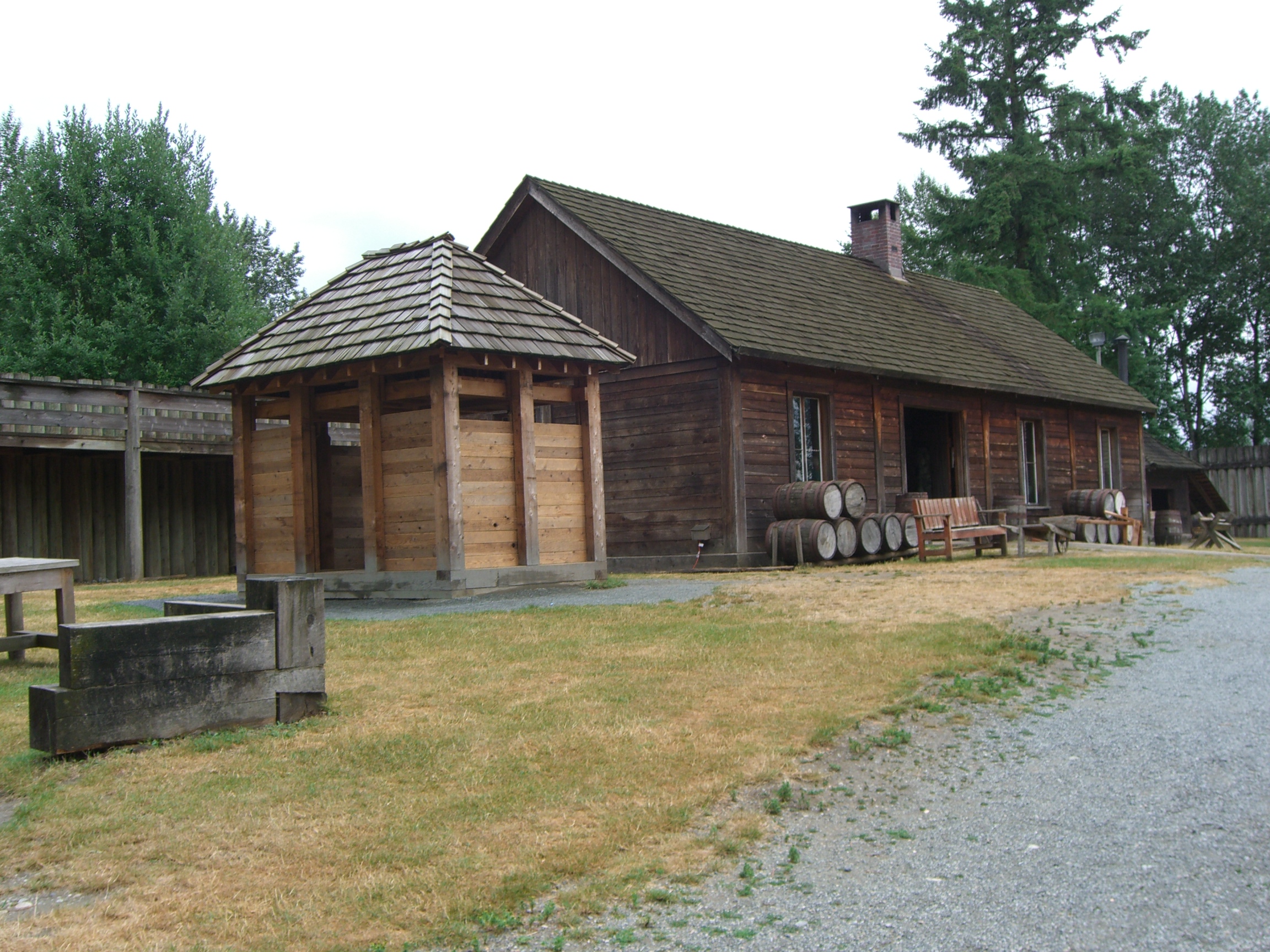
The first fort (1827-1839), built with two bastions, a wooden stockade and several buildings, proved to have been built too close to a fast-moving part of the river, in an area prone to flooding. It was rebuilt in 1839 farther upstream. As the HBC's network of forts in the interior grew, Fort Langley became a hub for farming, smithing and for shipping furs back to Europe. Along with farming, the export of cranberries and salmon would soon become the fort's main source of profit.
In 1858, gold was discovered in the Fraser River in what is now the interior of British Columbia, and the fort also became important as a supply station for the miners heading up the river toward the gold fields. With thousands of gold prospectors, many of them American, streaming into the region, the British government created British Columbia as a colony. James Douglas was sworn in as the new colony's first governor in Fort Langley, but New Westminster was chosen as the capital, as Fort Langley was less defensible from an American invasion.
When the gold rush ended, Fort Langley's importance began to decline. The Hudson's Bay Company subdivided and sold the farm it was occupying on Langley Prairie. Farming and logging took over as the dominant local industries.

In 1870, Paul Murray settled what is known today as Murrayville. Together with his sons he owned a quarter section of land on each of the four corners of Yale Road and what now is 216th Street. At that time, this area became known as "Murrays corner" after Alexander Murray, who drowned in the Fraser River in January 1884 while attempting in vain to save a friend. In 1925, the post office named it "Murrayville". The area between 216 street, 216A street, 48th ave and 48A avenue is one of the oldest subdivisions in Langley. Of the eight building lots in this subdivision there are still 6 heritage houses (built before 1930).
The Township of Langley was incorporated on April 26, 1873, with James W. Mackie as its first elected warden. Over time, New Westminster and then Vancouver developed into urban centres, but Langley Township remained predominantly a rural community.
The growth of transportation continued to connect Langley Township with its surroundings. The British Columbia Electric Railway was built through the community in 1910, followed by Fraser Highway in the 1920s, and the construction of the Pattullo Bridge in 1937, all adding to Langley's importance.
These developments impacted the Langley Prairie area in particular, transforming it into the Township's main urban and commercial core. In turn, this birthed the need for upgraded and new amenities, especially with respect to health, infrastructure, safety and sanitation, in the neighbourhood. The municipal government, however, refused to finance these projects as it bowed, instead, to politically influential farming communities and smaller, mostly rural, business centres, like Fort Langley, Milner and Murrayville, that viewed such spending as unnecessary. Talk of secession began in Langley Prairie in the 1930s, as a result. Headed by a panel of important residents and businesspersons, including Richard Langdon, president of the Langley Board of Trade, the push for independence came to a head in the 1950s. Specifically, two issues decided Langley's future - street lights, which Langley Prairie argued were not only needed for safety but also progress, but on which reeve George Brooks declared "not a nickel" would be spent, and Langley Prairie's belief that it did not have the political sway or its fair share of municipal services that it deserved relative to its local tax contribution. Langley Prairie by now made up 20% of the Township's tax base. A referendum on secession was therefore held in September 1954. It passed with over 85% of the vote. Langley Prairie officially seceded and became the City of Langley on March 15, 1955.
Post-World War II period (1955–1999)
Langley's growth increased during the economic boom after the Second World War. In 1957, Langley Township, along with other municipalities in British Columbia adopted the grid system for the road network. In 1967, Langley Township became part of Metro Vancouver. As with many other parts of Canada and cities in the United States, the Vancouver region expanded with the growth of the suburb. With the completion of the faster Trans-Canada Highway route in 1964 in the north of Langley, suburb communities such as Walnut Grove appeared in Langley which were popular with commuters. Most of this growth happened outside of the original communities of Fort Langley and Murrayville, instead happening adjacent to Langley City and near the Trans-Canada highway, likely due to the influence of private automobiles.
21st century

Since the 1980s, Langley City and surrounding lands administered by the municipality have been subject to extensive strip mall development. The old town core remains pleasant to walk through, but many core businesses (including the civil courts and several banks) have moved to the malls, fostering an automobile-dominated community. In addition to this, the community allowed extensive strip development along the Langley Bypass, which has become the new sprawled business area of the city.
In the 1990s, the Village of Fort Langley has undergone a revitalization of its core that enhanced its heritage character. In fact, there are no franchises permitted in the village and this has raised its profile as a tourist and independent retail destination with hundreds of thousands of annual visitors. A rowing facility completed in 2009 brings a whole new segment of visitors to the area. In 2016, the landmark Coulter Berry Building was completed, marking the first LEED certified building in Fort Langley.
Construction of the Golden Ears Bridge has been completed and opened to traffic on June 16, 2009. The bridge spans the Fraser River and connects the Township of Langley with the communities of Maple Ridge and Pitt Meadows. In addition, the plan for the Carvolth neighbourhood in Willoughby is promoting the construction of new office buildings in proximity to Highway 1 and 200th Street.
Climate
| Jan record high C = 18.1 | Feb record high C = 20.6 | Mar record high C = 24.9 | Apr record high C = 29.9 | May record high C = 36 | Jun record high C = 42.9 | Jul record high C = 38 | Aug record high C = 36.3 | Sep record high C = 37.5 | Oct record high C = 29.3 | Nov record high C = 20.6 | Dec record high C = 18.2 | Jan record low C = -14 | Feb record low C = -12 | Mar record low C = -8.3 | Apr record low C = -2.8 | May record low C = -0.6 | Jun record low C = 1.7 | Jul record low C = 3.9 | Aug record low C = 3.3 | Sep record low C = -1.7 | Oct record low C = -7 | Nov record low C = -16 | Dec record low C = -19.4
| access-date=May 7, 2013 | archive-date=November 6, 2011 | archive-url=https://web.archive.org/web/20111106043941/http://climate.weatheroffice.gc.ca/ | url-status=live | Jan record high C = 15 | Feb record high C = 18.5 | Mar record high C = 20 | Apr record high C = 24.4 | May record high C = 34 | Jun record high C = 32.2 | Jul record high C = 35.6 | Aug record high C = 36.1 | Sep record high C = 33.3 | Oct record high C = 27.5 | Nov record high C = 19 | Dec record high C = 16.1 | year record high C = 36.1
| Jan record low C = -17.5 | Feb record low C = -16 | Mar record low C = -8 | Apr record low C = -3 | May record low C = -0.4 | Jun record low C = 1.7 | Jul record low C = 3.9 | Aug record low C = 3.3 | Sep record low C = -0.4 | Oct record low C = -3 | Nov record low C = -16 | Dec record low C = -19.4 | year record low C = -19.4
Culture
Suburban


Historic
Fort Langley has the distinguished title of being "The Birthplace of British Columbia". The Fort Langley National Historic Site, which puts on events and exhibits relevant to the history of the area, is open to the public. Additionally, the village itself has areas of historical interest.
Elsewhere in Langley is the Twilight Drive-ina drive-in movie theatre, the Canadian Museum of Flight, numerous parks, rivers, and horse farms. The Otter Co-op is a major commercial and agricultural centre for the community of Aldergrove.
In South Langley is Campbell Valley Regional Park, a large Metro Vancouver Regional Park. Within the park boundaries are the historic Rowlatt Farmstead, clearly visible logging railway grades, and the historic Lochiel Schoolhouse.
Produce
Wine
Langley takes part in British Columbia's wine-making tradition and has many wineries with a temperate climate which allow grapes to grow. This includes places such as the Fort Wine Co. in Fort Langley, and Vista D'oro winery in the south, both of which have produced award-winning wines, with the latter reaching international acclaim at the Shanghai International Wine Competition 2012.
Other
In the agricultural areas of Langley, farms produce a variety of fruits and vegetables, meat, dairy and eggs. It is not unusual to see signs on the roadside advertising fresh produce sold direct from the farm. The Langley Circle Farm Tour is a popular way for tourists to experience the various farms and see what Langley produces.
Alpacas are farmed in Langley, Kensington Prairie Farm retails an array of specialized alpaca products including rovings, yarn, socks, toques, mitts, scarves, shawls, apparel and housewares.
Arts & sports
Langley is home to the Langley Rugby Club of the British Columbia Rugby Union, Vancouver Giants of the Western Hockey League, the Vancouver Bandits of the Canadian Elite Basketball League, the Langley Rivermen of the British Columbia Hockey League, the Langley Rams of the British Columbia Conference of the Canadian Junior Football League who are based at the MacLeod Stadium, the Langley Blaze of the PBL Premier Baseball League and the Trinity Western University Spartans in Canadian Interuniversity Sport.
In 2023, Vancouver FC from Langley debuted in the Canadian Premier League.
There are several ice rinks in town, including the George Preston Centre in Brookswood, the Sportsplex in Walnut Grove, and the Aldergrove arena. There are public swimming pools located at the Walnut Grove Community Centre, the W.C. Blair Recreation Centre in Murrayville, and the Fort Langley Outdoor Pool. The Al Anderson Memorial Pool is also nearby in Langley City.
The Langley Ukulele Ensemble is one of the more noteworthy cultural acts to be based out of the district.
| Club | League | Sport | Venue | Established | Status | Vancouver Stealth | Vancouver Bandits | Unity FC | Vancouver Giants | Langley Rivermen | Langley Trappers | Aldergrove Kodiaks | Valley West Giants | Langley Rams | Langley Thunder | Langley Warriors | Langley Blaze | Vancouver FC |
|---|---|---|---|---|---|---|---|---|---|---|---|---|---|---|---|---|---|---|
| Box lacrosse | Langley Events Centre | Defunct | ||||||||||||||||
| Basketball | Langley Events Centre | Active | ||||||||||||||||
| Soccer | Chase Office Field | Active | ||||||||||||||||
| Ice hockey | Langley Events Centre | Active | ||||||||||||||||
| Ice hockey | George Preston Recreation Centre | Active | ||||||||||||||||
| Ice hockey | George Preston Recreation Centre | Active | ||||||||||||||||
| Ice hockey | Aldergrove Credit Union Community Centre | Active | ||||||||||||||||
| Ice hockey | Langley Events Centre | Active | ||||||||||||||||
| Canadian football | McLeod Athletic Park | Active | ||||||||||||||||
| Box lacrosse | Langley Events Centre | Active | ||||||||||||||||
| Box lacrosse | Aldergrove Credit Union Community Centre | Active | ||||||||||||||||
| Baseball | McLeod Athletic Park | Active | ||||||||||||||||
| Soccer | Willoughby Community Park Stadium | Active |
Equine
With a local equine industry valued at over $60 million annually, the Township of Langley has become the Horse Capital of BC. As of 2006, Langley farms represented 7.2% of the provincial total of horses and ponies.
Transportation
Road network
Streets and avenues
0 Avenue is along the U.S. border, and avenue numbers are incremented based on eight per mile (1.6 km), so for example 80 Avenue would be 10 mi from the border. Street numbers also increment eight per mile as they go further east. There are roads that break this system such as Fraser Highway, Glover Road and Old Yale Road, because they existed before the grid system was introduced.

Many of the old road names have been replaced with numeric designations, however Heritage and Pioneer markers installed by the council are placed on many of the roads to highlight their original name.
Trans-Canada Highway

Highway 1, also known as the Trans-Canada Highway, cuts through the northern part of Langley. The Walnut Grove and Willoughby communities are popular with commuters due to being the most developed areas with the easiest access to the highway.
By road, the highway is the fastest method of reaching Vancouver and all the cities along the route, such as Surrey, Coquitlam, New Westminster and Burnaby. Depending on the traffic volume it can take between 25 and 35 minutes to enter Vancouver city limits. For reaching Downtown Vancouver, drivers can exit at Hastings Street and continue westbound into the downtown core.
In 2012, upgrades to the highway in the Langley and Surrey region have widened the highway by two lanes in each direction - one new HOV lane and one new regular lane - which has reduced traffic congestion. In addition to this there are HOV exits which provide direct access into the communities for Buses, Motorcycles and Cars with more than one occupant.
In addition to the five interchanges, three vehicle overpasses - at 208th Street, Glover Road and 248th Street - cross over the highway. An overpass carries rail traffic exclusively a few hundred metres east of Glover Road.
Fraser Highway
Fraser Highway used to be part of the Trans-Canada Highway but was replaced in 1964. It is a major road that runs from the centre of Surrey, through Cloverdale, the City of Langley, Murrayville and continues on to Abbotsford. While the speed limit between Langley and Abbotsford qualifies as highway speed at 80 km/h, between Langley and Surrey the speed limit is primarily 60 km/h with the route having frequent traffic lights. This usually means longer travel time than using Highway 1 to reach Surrey City Centre. However, since Fraser Highway goes directly between urban centres, it remains a popular route.
200 Street
200 is the longest street that runs through Langley and is a major traffic artery. It starts at 0 Avenue at the U.S. Border (as Carvolth Road), up through Brookswood, into the City of Langley centre, and continues north through Walnut Grove to the Golden Ears Bridge which leads into Pitt Meadows and Maple Ridge across the Fraser River.
United States border
Langley is situated directly north of and along the United States border, with Washington state to the south. The northernmost point in Langley is less than 25 km from the border. Langley contains one of the five Lower Mainland border crossings in the community of Aldergrove, however British Columbia Highway 15, which only 3.5 km to the west of Langley in Surrey, leads to the larger Pacific Highway Crossing. Crossing the border here is often faster due to having more open crossing lanes including NEXUS lanes which offer faster crossings for those opted into the NEXUS program.
Bus services
The region is served by TransLink which provides bus services connecting Langley to its neighbouring cities. The largest transit hub in the Township of Langley is Carvolth Exchange - a bus terminal with a park and ride situated next to the Trans-Canada Highway on 202nd Street which provides service to various parts of Langley and the Lower Mainland. Notable is the #555 service, an express bus that connects Langley to Lougheed Town Centre station in Burnaby crossing the Port Mann Bridge. This route uses the HOV interchanges on the highway, stopping at Surrey (via the 156th Street HOV interchange) and using the Government Street and 202nd Street HOV interchanges to leave and exit the highway.
Rail services
SkyTrain
The SkyTrain rapid transit system is due to be extended to Langley by 2029. Two Skytrain stations are planned for Langley, one at the border between Surrey and the Township of Langley at 196 Street, and another in the City of Langley at 203 Street.
Passenger service
The community group South Fraser Community Rail have been campaigning for TransLink to run passenger trains along existing railway tracks through the Fraser Valley from Surrey, through Langley to Chilliwack. The tracks were previously used for the BCER Interurban in the early 20th century but are maintained and in use today for freight rail traffic with passenger rail right-of-way. If implemented, this could potentially include stops at Fort Langley and Milner.
Freight
The city is served by four railways: Canadian National Railway (CN), Canadian Pacific Railway (CP), Burlington Northern and Santa Fe (BNSF), and the shortline Southern Railway of British Columbia (SRY).
Airports
CYNJ Langley is serviced by Langley Regional Airport, a small controlled airport with no scheduled service. Harbour Air, the largest float-carrier in the world, formerly served Langley with scheduled service but terminated these flights due to low passenger numbers in 2011. The Langley Airport is also home to the Canadian Museum of Flight, as well as SkyQuest Aviation and Standard Aero, a helicopter maintenance and modification contractor. It features 2 runways with a maximum length of 2743 feet and 2 helipads. In 2018 Langley airport had 75,954 movements
CBQ2 Fort Langley airport is a private airport located in north Langley adjacent to the Fraser River. It has a single 5510 foot runway and float plane access to the river.
Communities and neighbourhoods
These are the communities and neighbourhoods recognized by the Township of Langley. For a list of all communities, see Neighbourhoods in Langley, British Columbia.


Aldergrove
Aldergrove is a small community centred on Fraser Highway. It is home to the Greater Vancouver Zoo and the Aldergrove Regional Park.
Brookswood
Brookswood is a community to the south of the City of Langley. It is a mostly residential area, with Brookswood Village on 200th Street and 40th Avenue featuring independent stores as well as larger chains.
Fernridge
The small neighbourhood of Fernridge used to be a farming area. It is now a small centre with two gas stations, a grocery store and a pub. This is the location of Campbell Valley Regional Park.
Fort Langley
Fort Langley is a historically significant community in Langley, located in the north of the district municipality. Originally a trading post for the Hudson's Bay Company, today it is a small village with restored colonial style buildings dating to the late 19th and early 20th centuries. Glover Road, being the main road that runs through the village, is notable in the area for having large tree lined streets and being home to many small independent businesses in the village centre.
Milner
Milner is located along Glover Road towards Fort Langley, and along the British Columbia Electric Railway. Originally where the Hudson Bay Farm was located. It features areas of historical interest, such as the Milner Chapel and hall, dedicated on May 23, 1886. Another prominent historical structure is the barn located on Glover Road that is occupied by Milner Feed & Pet Supply. Built in 1906, it has been a staple of Langley's agriculture community selling farm supplies and equipment. It now sells a wide variety of pet food & supplies, hay and feed.
Murrayville
Murrayville is another historically significant community in Langley, being founded in 1870 by Paul Murray as "Murrays Corner". It is notable in the area for its older buildings and a 5 road roundabout in the centre that intersects Old Yale Road with the historic Porters general store to the East. Residential property there is typically on larger lots than in some of the newer developed parts of Langley. It is also the location of Langley Memorial Hospital which serves the city.
Willoughby
Located in the north of the district and south of the Trans-Canada Highway, Willoughby is a mixture of new developments, and undeveloped rural land. At the centre of Willoughby is the new Willoughby Town Centre development. It is also the location of the Langley Events Centre.
Walnut Grove
Walnut Grove is located north of Willoughby and the Trans-Canada Highway, and west of Fort Langley. It is a more established developed area, with many supermarkets and shops, and easy access to the highway making it desirable for commuters.
Government
The Township of Langley is administered by an eight-member council and a mayor. All members of council are elected to four-year terms in elections that take place in late November.
Demographics
In the 2021 Census of Population conducted by Statistics Canada, Langley had a population of 132,603 living in 46,928 of its 49,011 total private dwellings, a change of from its 2016 population of 117,285. With a land area of 307.22 km2, it had a population density of in 2021.
Ethnicity
| Panethnic group | 2021 | 2016 | 2011 | 2006 | 2001 | Pop. | % | Pop. | % | Pop. | % | Pop. | % | Pop. | % | Total responses | 130,960 | 115,835 | 103,140 | 93,040 | 86,220 | Total population | 132,603 | 117,285 | 104,177 | 93,726 | 86,896 |
|---|---|---|---|---|---|---|---|---|---|---|---|---|---|---|---|---|---|---|---|---|---|---|---|---|---|---|---|
| European | 91,055 | 89,920 | 85,840 | 81,310 | 78,195 | ||||||||||||||||||||||
| East Asian | 14,330 | 9,255 | 6,470 | 4,820 | 3,000 | ||||||||||||||||||||||
| South Asian | 8,720 | 5,140 | 2,765 | 1,445 | 1,485 | ||||||||||||||||||||||
| Southeast Asian | 5,435 | 3,515 | 2,455 | 1,475 | 905 | ||||||||||||||||||||||
| Indigenous | 5,045 | 4,310 | 3,495 | 2,450 | 1,950 | ||||||||||||||||||||||
| Latin American | 1,715 | 1,100 | 650 | 395 | 190 | ||||||||||||||||||||||
| African | 1,450 | 1,205 | 470 | 575 | 275 | ||||||||||||||||||||||
| Middle Eastern | 1,440 | 715 | 410 | 295 | 60 | ||||||||||||||||||||||
| Other | 1,770 | 680 | 600 | 280 | 170 |
Religion
According to the 2021 census, religious groups in Langley included:
- Irreligion (64,545 persons or 49.3%)
- Christianity (55,265 persons or 42.2%)
- Sikhism (5,170 persons or 3.9%)
- Islam (1,890 persons or 1.4%)
- Buddhism (1,765 persons or 1.3%)
- Hinduism (1,225 persons or 0.9%)
- Judaism (290 persons or 0.2%)
- Indigenous spirituality (65 persons or
Notable people
- Ken Anderlini (1962–2007), filmmaker, educator and activist
Notes
References
References
- "British Columbia Regional Districts, Municipalities, Corporate Name, Date of Incorporation and Postal Address". British Columbia Ministry of Communities, Sport and Cultural Development.
- "Civic Facility".
- Services, Ministry of Citizens'. "Population Estimates - Province of British Columbia".
- (August 1, 2008). "First Nation learns from the past".
- "KwantlenFN.ca History".
- "Porters Bistro".
- "Getting to Know The City of Langley".
- Groeneveld, Bob. (October 30, 2017). "ODD THOUGHTS: Divorce was inevitable – even in Langley back in the day". Langley Advance Times.
- "The History of Metropolitan Vancouver".
- "Surrey's road naming, numbering, and address location".
- (February 21, 2017). "The Award-Winning Coulter Berry Building in Fort Langley {{!}} Keystone Architecture". Keystone Architecture.
- "Carvolth Neighbourhood Plan". www.tol.ca.
- link. (June 28, 2021 , accessed June 28, 2021)
- link. (July 7, 2021 , accessed June 28, 2021)
- Site Admin. (July 18, 2016). "Birthplace of B.C. Gallery".
- "Twilight Drive-In: Metro Vancouver's only drive-in movie theatre!".
- "Shanghai International Wine Competition Winners - Select 'SIWC 2012 Bronze Medal'".
- "Agribusiness".
- "History of Langley". City of Langley.
- "Port Mann / Highway 1 Improvement Project".
- "PMH1 Project Time Savings - Updated".
- B.C. Ministry of Transportation and Infrastructure. (July 2010). "B.C. Landmark Kilometre Inventory".
- "Translink - Carvolth Exchange". [[TransLink (British Columbia).
- "Surrey Langley SkyTrain project approved, expected to be completed by 2028". [[CBC News]].
- Infrastructure, Ministry of Transportation and. "Surrey Langley SkyTrain Project - Project Overview - Province of British Columbia".
- Canadian Flight Supplement
- (June 27, 2018). "Aircraft movements, by civil and military movements, for airports with NAV CANADA towers, annual".
- Canadian flight supplement
- "Communities and Neighbourhoods".
- "History".
- "About Us - Milner Feed and Pet Supply Langley".
- "Our Story".
- "Mayor and Council".
- (February 9, 2022). "Population and dwelling counts: Canada, provinces and territories, and census subdivisions (municipalities), British Columbia". [[Statistics Canada]].
- Government of Canada, Statistics Canada. (October 26, 2022). "Census Profile, 2021 Census of Population Langley, District municipality British Columbia [Census subdivision]".
- (June 17, 2019). "Aboriginal Identity (9), Age (20), Registered or Treaty Indian Status (3) and Sex (3) for the Population in Private Households of Canada, Provinces and Territories, Census Divisions and Census Subdivisions, 2016 Census - 25% Sample Data". [[Statistics Canada]].
- (October 27, 2021). "Census Profile, 2016 Census Langley, District municipality [Census subdivision], British Columbia and Greater Vancouver, Regional district [Census division], British Columbia Visible Minority". [[Statistics Canada]].
- (January 23, 2019). "2011 National Household Survey: Data tables Aboriginal Identity (8), Age Groups (20), Registered or Treaty Indian Status (3) and Sex (3) for the Population in Private Households of Canada, Provinces, Territories, Census divisions and Census subdivisions, 2011 National Household Survey". [[Statistics Canada]].
- (November 27, 2015). "NHS Profile, Langley, DM, British Columbia, 2011 Visible Minority". [[Statistics Canada]].
- (August 20, 2019). "2006 Community Profiles Langley British Columbia (District municipality)". [[Statistics Canada]].
- (July 2, 2019). "2001 Community Profiles Langley British Columbia (District Municipality)". [[Statistics Canada]].
- link. (February 6, 2023 Vancouver Sun Obituaries [[The Vancouver Sun]].)
This article was imported from Wikipedia and is available under the Creative Commons Attribution-ShareAlike 4.0 License. Content has been adapted to SurfDoc format. Original contributors can be found on the article history page.
Ask Mako anything about Langley, British Columbia (district municipality) — get instant answers, deeper analysis, and related topics.
Research with MakoFree with your Surf account
Create a free account to save articles, ask Mako questions, and organize your research.
Sign up freeThis content may have been generated or modified by AI. CloudSurf Software LLC is not responsible for the accuracy, completeness, or reliability of AI-generated content. Always verify important information from primary sources.
Report