From Surf Wiki (app.surf) — the open knowledge base
Landing craft utility
Type of boat designed for transporting amphibious forces and cargo to shore
_assigned_to_Amphibious_Craft_Unit_Two_(ACU-2),_rehearse_storming_the_beach_in_Curacao,_Netherlands_Antilles.jpg)
Type of boat designed for transporting amphibious forces and cargo to shore
| Field | Value | ||||
|---|---|---|---|---|---|
| section1 | {{Infobox ship/image | ||||
| image | LCU Quetzal (BL-1601).webp | ||||
| image_caption | Quetzal (BL-1601) of the Guatemalan Navy | ||||
| section2 | {{Infobox ship/class overview | ||||
| name | Golfo de Tribugá class | ||||
| builders | COTECMAR | ||||
| operators | * | ||||
| in_service_range | 2014–present | ||||
| in_commission_range | 2014–present | ||||
| total_ships_completed | 8 | ||||
| total_ships_active | 8 | ||||
| section3 | {{Infobox ship/characteristics | ||||
| type | Landing Craft Utility | ||||
| displacement | 574.6 t | ||||
| length | 49.0 m | ||||
| beam | 11.0 m | ||||
| draught | 1.5 m | ||||
| propulsion | *2 × Caterpillar C18 diesel motors, 412 kW | ||||
| speed | 8.5 kn | ||||
| range | *1500 nmi at 8.5 kn | ||||
| *{{convert | 2500 | nmi | km | abbr | on}} at 6 kn |
| endurance | *20 days with 51 crew. | ||||
| capacity | 120 t | ||||
| troops | 36 | ||||
| complement | 15 (3 officers) |
A landing craft utility (LCU) is a type of boat used by amphibious forces to transport equipment and troops to the shore. They are capable of transporting tracked or wheeled vehicles and troops from amphibious assault ships to beachheads or piers.
Colombia
- 2500 nmi at 6 kn
- 40 days with 15 crew. The Golfo de Tribugá-class landing craft is an LCU developed by COTECMAR for the Colombian National Navy. The vessel class is also known as BDA () and an unarmored version for logistical and humanitarian services has also been developed, known as BALC ().
Operators
- Colombia
- : 6 in service
- ARC Golfo de Urabá
- ARC Golfo de Tribugá
- ARC Bahía Málaga
- ARC Golfo de Morrosquillo
- ARC Bahía Colombia
- ARC Bahía Solano
- UNGRD: 1 on order for civil service use
- : 6 in service
- : 1 in service
- : 2 in service
France

The Engin de débarquement amphibie rapide (EDA-R) landing catamaran or L-CAT, entered service in January 2011. They can carry a main battle tank like other European LCUs but are capable of much higher speeds, up to 30 kn.
Germany
-
Mine laying capability Germany has two Barbe-class utility landing craft (Type 520), dating from the mid-1960s, which remain in service under the SEK-M Naval Special Forces' command. Five Barbe landing crafts were transferred to Greece at the end of the Cold War.
India
- 1001 tonne full load
- Fixed-pitch propellers
- Sanket S passive electronic warfare system
- ELK 7036 communications intelligence (COMINT) system
- MiniPOP surveillance system
- 12.7 mm heavy machine guns
- 7.62 mm machine guns
- Igla man-portable surface-to-air missiles India currently has 8 Mk IV class LCU. Last MK IV class of LCU was delivered by GRSE in 2020.
Netherlands
- 1.4 m aft, full load
With the launch of the amphibious transport ship in 1998 there was a need for LCUs. The Dutch LCUs are similar to the British LCU Mk.10 with the bridge being set to one side allowing for a roll-on roll-off design. Until 2005 the Netherlands Marine Corps used the LCU Mark I (NL).
In 2005 and 2006 the five vessels were modernized to the type Mark II. The vessels have been stretched by 9 meters to decrease their draft, which increased their load carrying capacity by 20 tons and allows them to come closer to shore. In addition they were fitted with a strengthened bow ramp, and they can now accommodate the Royal Netherlands Army Leopard 2 A6 main battle tank. Because of the lengthening of the Mark II, the Rotterdam can take two LCUs (plus three LCVPs) in its dock. The dock of Rotterdams sister ship, HNLMS Johan de Witt, has the capacity to transport two LCUs, but carries four LCVPs in davits.
Russia
Dyugon
- 3 × T-90 main battle tanks or 5 × BTR-80 Armoured personnel carriers
- plus 100 marines The Dyugon-class landing craft are operated by the Russian Navy.
Spain
-
110 t loaded
-
2 × waterjets
-
13.5 kn loaded
-
1 × self-propelled howitzer plus resupply vehicle, or
-
2 × MOWAG Piranha, or
-
6 × light tactical vehicles, or
-
170 personnel with equipment
The Armada has 26 LCM-1E in service since 2001 and has been exported to Australia and Turkey.
Sweden
Mines and depth charges Sweden operates 16 small and fast (25 kn) water jet landing craft (Swedish: Lätt trossbåt) with a displacement of 65 tonnes. They are armed with one 12.7 mm machine gun but can also lay out mines and are equipped with depth charges for anti submarine warfare. The vessel type has been exported to the United Arab Emirates.
HSwMS Loke (A344) is a larger vessel with a displacement of 305 tonnes, capable of carrying 150 tonnes. The ship has a crew of 7 and is armed with two 7.62 mm machine guns.
United Kingdom
LCU Mk.9
The LCU Mk.9 was built for use on the LPDs and where they were operated from the dock in the rear of the ships. Each ship carried four LCUs and four davit mounted LCVPs. The Mk.9 was to see many changes and upgrades during its service including a move from propeller to jet in many cases. The Mk.9 was capable of traveling as an ocean-going vessel and a number would be converted into a version, affectionately known as the "Black Pig", for use in Norway. The crew had full living quarters aboard with galley and heads. In the Falklands War during the Bluff Cove Air Attacks LCU F4 from was bombed and sunk in Choiseul Sound by an Argentine Air Force A-4B Skyhawk of Grupo 5. The Mk.9, like the LPDs, served longer than ever anticipated, providing the backbone of Britain's amphibious assault capabilities.
Three Mk.9s, pennant numbers 701, 705, and 709, remained in service by 2012. However, by 2014, they had all been withdrawn from service.
LCU Mk.10
The LCU Mk.10 class vessels are operated by the Royal Marines. They are intended for use on board the assault ships and and can also be used by the Bay class landing ships. Deliveries of the class started from 1998 and the fleet currently consists of nine vessels. Both Albion and Bulwark are capable of carrying four LCUs each. These vessels are capable of operating independently for up to 14 days with a range of 600 nautical miles. They are capable of operating worldwide, from Arctic operating areas to tropical operating areas. The Mk.10 differs greatly from the Mk.9 with the bridge being set to the side allowing for a roll-on roll-off design. This greatly increases efficiency over the old Mk.9 as loading of the rear LCUs can take place without the LCUs being launched, the LPD having to dock down to do so, to change over and load up, which was a problem prior to the Falklands landings. The LCU Mk.10 has a 7-man crew and can carry up to 120 Marines or alternatively 1 battle tank or 4 lorries. British assault ships also carry smaller LCVPs on davits to transport troops and light vehicles.
Ten Mk.10s, pennant numbers 1001 to 1010, were in service as of 2012. In 2023 it was reported that 9 of the craft remained in service.
United States
The United States Navy built 1,394 Landing Craft Tank (LCT) in World War II. Those that were still in use in 1949 were redesignated as Landing Craft Utility (LCU).
Seventy old LCUs (likely ex-LCTs) were retired from amphibious duties and reclassified as Harbor utility craft (YFU).
LCU 1466, 1610 and 1627 classes
The LCU 1466, 1610 and 1627 class vessels are operated by the United States Navy at support commands. They are a self-sustaining craft complete with living accommodations and mess facilities for a crew of thirteen. Each LCU is assigned a non-commissioned-officer-in-charge (Craft Master) who is either a chief petty officer or petty officer first class in the boatswain's mate, quartermaster or operations specialist rating. These vessels have bow ramps for onload/offload and can be linked bow to stern gate to create a temporary pier-like structure. Its welded steel hull provides high durability with deck loads of 3,900 kg/m2 (800 pounds per square foot). Arrangement of machinery and equipment has taken into account built-in redundancy in the event of battle damage.
The craft features two engine rooms separated by a watertight bulkhead to permit limited operation in the event that one engine room is disabled. An anchor system is installed on the starboard side aft to assist in retracting from the beach. These vessels are normally transported to their areas of operation onboard larger amphibious vessels such as LSDs, LHDs and LHAs.
Introduction of the larger LCU-1610 class resulted in the US Navy constructing the of Landing Ships, Dock (LSD).
LCU-1618 was converted to support the testing of Remotely operated underwater vehicles and Autonomous underwater vehicles and was given the name USS Orca (IX-508).
The 40-year-old craft will be replaced under LCU 1700 (ex-Surface Connector (X) Recapitalization, or SC(X)R), project starting in 2017.
| LCU 1466 | LCU 1610 | LCU 1627 |
|---|---|---|
| Displacement – light | 180 LT | 172 LT |
| Displacement – full | n/a | 353 LT |
| Length overall | 115 ft | 134 ft |
| Beam | 34 ft | 29 ft |
| Draft – full load, forward | 6 ft | 4 ft |
| Draft – full load, aft | 2 ft | 3 ft |
| Power – sustained | 675 hp | 1000 hp |
| Propulsion | 3 x Gray Marine diesel engines | 2 x Detroit 12V-71 diesel engines |
| Shafts | 3 | 2 |
| Speed | 8 kn | 11 kn |
| Range | 1200 nmi at 6 kn | 1200 nmi at 8 kn |
| Complement | 14 | 14 |
| Capacity – troops | 300 | 400 |
| Capacity – cargo | 167 LT | 180 LT |
LCU 2000
- 1087 LT full load
- 8 ft loaded
- 4 ft beaching draft at the bow
- 6500 nmi at 10 kn loaded
- 5 × M1 main battle tanks or 12 × (24 double-stacked) 20-foot (6 m) ISO containers The Runnymede-class large landing craft or LCU 2000 class vessels are operated by the United States Army. | archive-url=https://archive.today/20121212215423/http://www.msc.navy.mil/N00p/pressrel/press98/press46.htm | url-status=dead | archive-date=December 12, 2012 | access-date=2008-02-03
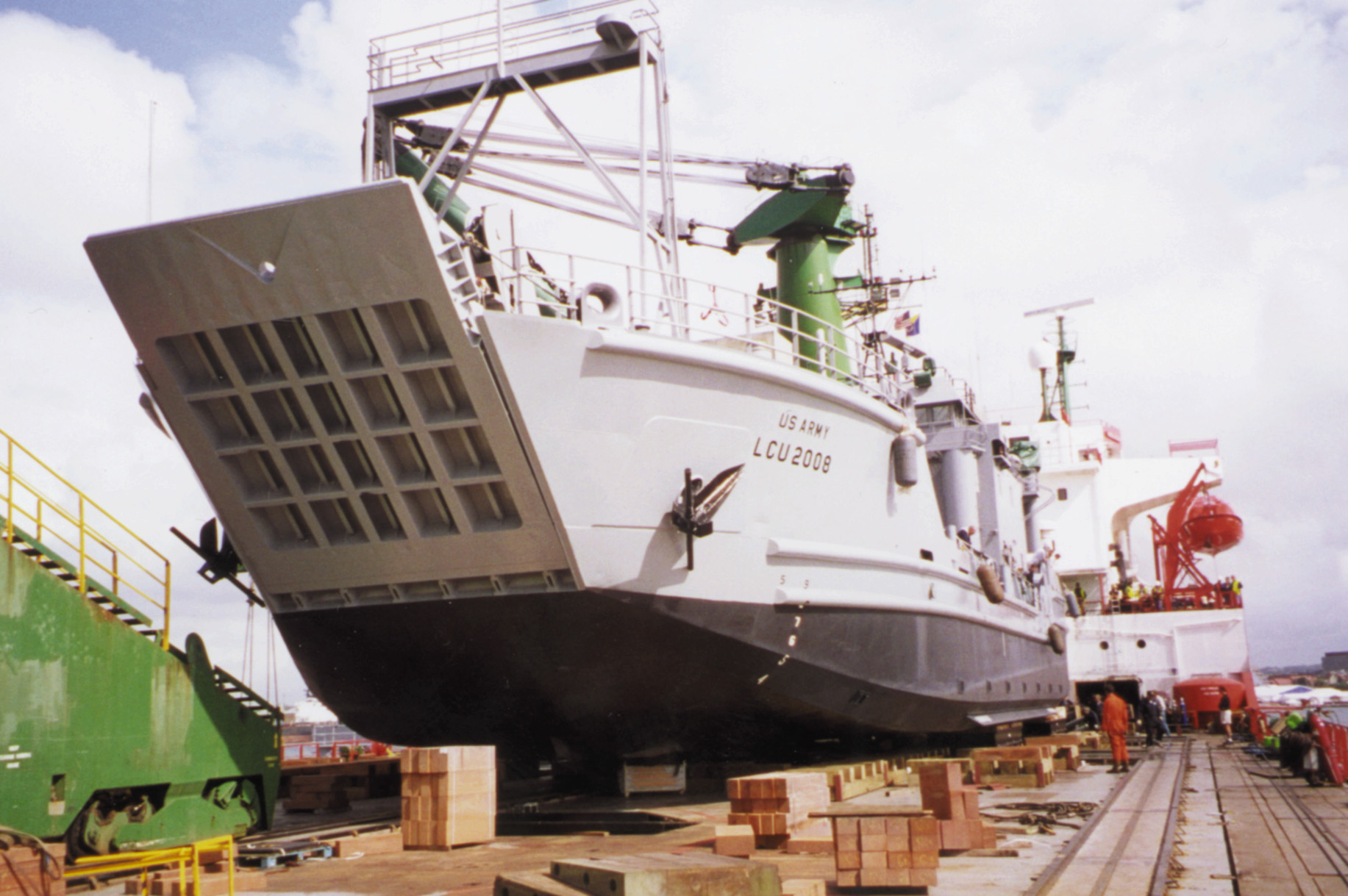
LCU 1700
The LCU 1700-class boats are destined to replace the existing LCU 1610-class of amphibious landing craft on a one-to-one basis. The LCU-1700 is 139 feet long, can reach speeds of 11 knots, has a range of 1,200 nautical miles at 8 knots, and has accommodations for a mixed gender crew of 14. It can carry two M1A1 tanks, or 350 combat troops, or 170 short tons of cargo.
The contract announcement noted that the LCU 1700s will recapitalize the LCU fleet as a similarly rugged steel craft (to the LCU 1610) with a design life of 30 years. The similarities of these two classes of ships will help the U.S. Navy to improve efficiency and reduce cost of the training programs, operations and overall ownership cost. The craft will enter, exit and be transported in well decks of current and programmed U.S. Navy amphibious warfare ships, for design purposes defined by the dimensions of LHD, LPD, LSD and LHA classes without ship alterations, while transporting loads up to 11 feet high above the craft’s vehicle deck. The contract was awarded to Swiftships in 2018 to design and build the prototype and up to 32 vessels. Work was to be performed in Morgan City, Louisiana, and was expected to be completed by November 2023. By 2020, the Navy had ordered six vessels from Swiftships at a total cost of about $95 million. In January 2024, following delays in the scheduled delivery of the first three vessels and continued design changes, the Navy ordered Swiftships to stop work on construction; the contract was terminated entirely the following month.
In September 2023, the Navy awarded Austal USA a $92 million contract to build three LCU 1700 vessels. In August 2024, the Navy ordered two more vessels from Austal for $55 million, with options for seven more remaining.
References
Citations
Sources
References
- "Productos Cotecmar | COTECMAR".
- (13 November 2019). "Presidente recibe buque BL-1601 Quetzal". Diario de Centro América.
- (7 November 2017). "Colombia entrega a Honduras buque elaborado por Cotecmar". COTECMAR.
- (31 May 2018). "Indian Navy commissions fourth Mk IV landing craft". Jane's Information Group.
- (5 October 2016). "Indian Navy receives first of new class of Mk IV LCUs". Jane's Information Group.
- Rahmat, Ridzwan. (13 March 2016). "GRSE launches Indian Navy's sixth Mk IV LCU". Jane's Information Group.
- (28 March 2017). "Commissioning of INLCU L51 by Vice Admiral Bimal Verma, AVSM Commander-in-Chief Andaman And Nicobar Command". Press Information Bureau.
- [https://army-news.ru/2012/10/desantnyj-kater-proekta-21820-dyugon/ Десантный катер проекта 21820 «Дюгонь»] «Армейский вестник». Retrieved 23 November 2021
- "Landing Craft LCU MK 10". Schottel.de.
- The Royal Navy Handbook, page 106
- "British Ships sunk and damaged - Falklands War 1982".
- "The Military Balance 2012", [[International Institute for Strategic Studies]], pp. 170–171
- Bush, Steve. (2014). "British Warships and Auxiliaries". Maritime Books.
- (February 2023). "Royal Navy Fleet Poster p.21".
- Friedman, 2002, p 390
- "Landing Craft Utility (LCU)".
- Friedman, 2002, pp 331-334
- "NavSource Online: Amphibious Photo Archive".
- (3 April 2020). "Navy Orders Four New LCU 1700 Utility Landing Craft from Swiftships".
- Scott, Richard. (28 January 2013). "US scopes objectives for new surface connector workhorse". Jane's Navy International.
- Petty, Dan. "The US Navy -- Fact File: Landing Craft, Mechanized and Utility - LCM/LCU".
- Spc. Morrene E. Randell. (5 September 2007). "Army Boat Supports Dive Teams Trying to Raise Russian Sub". army.mil.
- "LCU".
- (3 April 2020). "Navy awards". Defensedaily.
- (9 May 2021). "US Navy awards Swiftships". Militaryleak.
- (3 April 2020). "US Navy orders". debrief.
- (6 February 2019). "Swiftships to deliver". NavalNews.
- "US Navy orders Swiftships to stop work on its landing craft program".
- (7 September 2023). "Navy Sets Up Second LCU-1700 Shipyard with $92M Award to Austal". USNI News.
- (5 August 2024). "US Navy Orders Two More Landing Craft Utility Vessels from Austal USA". Marine Link.
This article was imported from Wikipedia and is available under the Creative Commons Attribution-ShareAlike 4.0 License. Content has been adapted to SurfDoc format. Original contributors can be found on the article history page.
Ask Mako anything about Landing craft utility — get instant answers, deeper analysis, and related topics.
Research with MakoFree with your Surf account
Create a free account to save articles, ask Mako questions, and organize your research.
Sign up freeThis content may have been generated or modified by AI. CloudSurf Software LLC is not responsible for the accuracy, completeness, or reliability of AI-generated content. Always verify important information from primary sources.
Report