From Surf Wiki (app.surf) — the open knowledge base
Landing craft mechanized
Landing craft designed for carrying vehicles
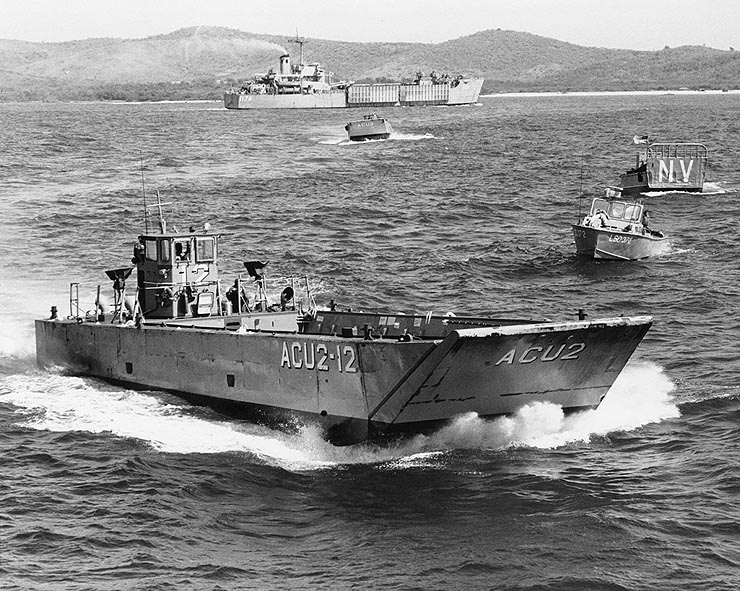
_14,_assigned_to_Assault_Craft_Unit_(ACU)_2,_transports_Sailors,_Soldiers_and_Marines_during_operations_supporting_Joint_Logistics_Over-The-Shore_(JLOTS)_exercises.jpg)
Landing craft designed for carrying vehicles


The landing craft mechanized (LCM) is a military landing craft designed for carrying personnel and vehicles from ship to shore without requiring a pier or other shore-based structure. Multiple different models with varying size, capacity, and power plants were produced starting in 1920. They came to prominence during the Second World War when they were used to land troops and tanks during Allied amphibious assaults.
Variants
There was no single design of LCM used, unlike the landing craft, vehicle, personnel (LCVP) or landing craft assault (LCA) landing craft made by the US and UK respectively. There were several different designs built by the UK and US and by different manufacturers.
The British motor landing craft (MLC) was conceived and tested in the 1920s and was used from 1924 in exercises. Nine were in service at the start of the war. It was the first purpose-built tank landing craft. It was the progenitor of all subsequent LCM designs.
LCM (1)
Main article: LCM 1

The landing craft, mechanised Mark I, was an early British model. It was able to be slung under the davits of a liner or on a cargo ship boom with the result that it was limited to a 16-ton tank.
The LCM Mark I was used during the Allied landings in Norway (one alongside the MLCs), and at Dieppe and some 600 were built.
- Displacement: 35 tonnes
- Length: 13.6 m
- Width: 4.27 m
- Draught: 1.22 m
- Machinery: two Chrysler 100 hp petrol engines
- Speed: 7 knots
- Crew: 6 men
- Armament: two .303 in. Lewis guns
- Capacity: one medium tank, or 26.8 tons of cargo or 60 troops
- 100 men
- 54,500 lb with 9 in of freeboard
LCM (2)
Main article: LCM (2)
The first American LCM design, from the US Navy's Bureau of Construction and Repair. Approximately 150 were built by American Car & Foundry and Higgins Industries.
- Displacement: 29 tons
- Length: 45 ft
- Beam: 14 ft
- Draft: 3 ft
- Speed: 8.5 kn
- Armament: two .50-cal M2 Browning machine guns
- Crew: 4
- Capacity; 100 troops, or one 13.5 ton tank, or 15 tons of cargo
LCM (3)

There were two designs:
-
Bureau Capable of carrying 120000 lb of cargo
-
Higgins In appearance very similar to the LCVP which Higgins Industries also constructed, with a 10 ft wide load area at the front and a small armoured (1/4 inch steel) wheelhouse on the aft decking over the engine room. A vessel claiming to be a Higgins LCM-3 is on display at the Battleship Cove maritime museum in Fall River, Massachusetts, however this vessel has the superstructure and overall length of an LCM-6. Another Higgins LCM-3 is displayed at the Museo Storico Piana delle Orme in Province of Latina, Italy, 18 miles east of Anzio.
-
Displacement: 52 tons (loaded); 23 tons (empty)
-
Length: 50 ft
-
Beam: 14 ft
-
Draft: 3 ft (forward); 4 ft (aft)
-
Speed: 8 kn (loaded); 11 kn (empty)
-
Armament: two .50-cal M2 Browning machine guns
-
Crew: 4
-
Capacity: One 30-ton tank (e.g. M4 Sherman), 60 troops, or 60000 lb of cargo
LCM (4)
In 1943 and 1944, seventy-seven LCM(4)s were built. Externally, the LCM(4) resembled a late model LCM(1) but inside the pontoon special bilge pumps and ballast tanks allowed the LCM(4) to alter trim to increase stability when partially loaded.
LCM (5)
British model of LCM
LCM (6)
The LCM (6) was an LCM (3) extended by 6 ft amidships.
- Power plant:
- 2 Detroit 6-71 diesel engines; 348 hp sustained; twin shaft; or
- 2 Detroit 8V-71 diesel engines; 460 hp sustained; twin shaft
- Length: 56 ft
- Beam: 14 ft
- Displacement: 64 tons (65 tonnes) full load
- Speed: 9 kn
- Range: 130 mi at 9 kn
- Military lift: 34 tons (34.6 tonnes) or 80 troops
- Crew: 5
Many LCM-6s were later adapted for the Mobile Riverine Force in the Vietnam War. Some were modified as armored troop carriers (ATCs or "Tangos"), others became "monitors" with 105 mm guns, "Zippos" with flamethrowers or "Charlie" command variants.
A few LCMs were converted to lay and repair hoses for tankers equipped with the offshore petroleum discharge system (OPDS).
LCM (7)
British model of LCM
LCM (8)
Main article: LCM-8
General characteristics, LCM 8 Type
- Power plant: four 6-71 six-cylinder diesels, two hydraulic transmissions, two propeller shafts. (Lighterage Division, Naval Support Activity Danang 1969–1970) crew of 3: coxswain, bowhook, and engineer (aka "snipe")
- Power plant: 2 Detroit 12V-71 diesel engines; 680 hp sustained; twin shafts
- Length: 73.7 ft
- Beam: 21 ft
- Displacement: 105 tons (106.7 tonnes) full load
- Speed: 12 kn
- Range: 190 nmi at 9 kn full load
- Capacity: 53.5 tons (54.4 tonnes)
- Military lift: one M48 or one M60 tank or 200 troops
- Crew: 5
Operators
- Turkey – Turkish Naval Forces
- United States – United States Navy, U.S. Army 7th Transportation Brigade Expeditionary
- Thailand – Royal Thai Navy
- Australia – Royal Australian Navy
- Australia – Australian Army
- Spain – Spanish Navy
- El Salvador – Navy of El Salvador
- New Zealand – Royal New Zealand Navy
- Egypt – Egyptian Navy
- Saudi Arabia – Royal Saudi Navy
- Pakistan - Pakistan Navy
- Japan - Japan Maritime Self-Defense Force
- Vietnam - Vietnam People's Navy
Former operators
- Khmer Republic – Khmer National Navy
- South Vietnam – Republic of Vietnam Navy
Notes
References
- Gordon L. Rottman & Tony Bryan, Landing Ship, Tank (LST) 1942–2002, New Vanguard series 115, Osprey Publishing Ltd, Oxford 2005.
- Gordon L. Rottman & Hugh Johnson, Vietnam Riverine Craft 1962–75, New Vanguard series 128, Osprey Publishing Ltd, Oxford 2006.
- Gordon L. Rottman & Peter Bull, Landing Craft, Infantry and Fire Support, New Vanguard series 157, Osprey Publishing Ltd, Oxford 2009.
- Maund, LEH Assault From the Sea, Methuen & Co. Ltd., London 1949.
References
- William F Buckingham. ''D-Day the First 72 hours'' Tempus Publishing, Stroud. 2004
- Maund 1949, p. 41
- "French Riverine Craft".
- Norman Friedman ''U.S. Amphibious Ships and Craft: An Illustrated Design History'' Naval Institute Press, 2002 9781557502506
- "Landing Craft Mechanized".
- "Info about Piana delle Orme museum on site about Anzio".
- Ladd, 1976, p. 44
- "Offshore Petroleum Discharge System (OPDS)". GlobalSecurity.org.
- (24 March 2013). "Ç-302 LCM CLASS".
This article was imported from Wikipedia and is available under the Creative Commons Attribution-ShareAlike 4.0 License. Content has been adapted to SurfDoc format. Original contributors can be found on the article history page.
Ask Mako anything about Landing craft mechanized — get instant answers, deeper analysis, and related topics.
Research with MakoFree with your Surf account
Create a free account to save articles, ask Mako questions, and organize your research.
Sign up freeThis content may have been generated or modified by AI. CloudSurf Software LLC is not responsible for the accuracy, completeness, or reliability of AI-generated content. Always verify important information from primary sources.
Report