From Surf Wiki (app.surf) — the open knowledge base
Lancia Dedra
.jpg)
| Field | Value |
|---|---|
| image | Lancia Dedra Sedan.jpg |
| name | Lancia Dedra |
| manufacturer | Alfa-Lancia Industriale (1989–1991) |
| Fiat Auto (1991–1999) | |
| production | 1989–March 1999 |
| 418,150 saloons + 44,488 SW built | |
| assembly | Italy: |
| predecessor | Lancia Prisma |
| successor | Lancia Lybra |
| class | Compact executive car (D) |
| transmission | {{ubl |
| 4-speed automatic<ref name | "carsfromitaly.net" |
| layout | {{ubl |
| engine | {{ubl |
| platform | Type Three (Tipo Tre) |
| wheelbase | 2540 mm |
| length | 4340 mm |
| 4343 mm (SW) | |
| width | 1700 mm |
| height | 1430 mm |
| 1446 mm (SW) | |
| weight | 1060 – |
| body_style | {{ubl |
| related | {{ubl |
| designer | Ercole Spada at I.DE.A Institute |
Fiat Auto (1991–1999) 418,150 saloons + 44,488 SW built
| 5-speed manual | 4-speed automatic | Front-engine, front-wheel-drive | Front-engine, all-wheel-drive | petrol: | 1.6 L I4 | 1.6 L 16V I4 | 1.8 L I4 | 1.8 L 16V I4 | 2.0 L I4 | 2.0 L 16V I4 | 2.0 L turbocharged I4 | diesel: | 1.9 L turbocharged I4 4343 mm (SW) 1446 mm (SW) | 4-door saloon | 5-door station wagon | Lancia Delta | Fiat Tempra | Alfa Romeo 155
The Lancia Dedra (Type 835) is a compact executive car produced by the Italian automaker Lancia from 1989 to 1999. It was initially designed to support, and went on to replace, the Prisma which, six years after its launch, was having difficulty remaining competitive in the market. It was based on a stretched version of the platform underpinning the second generation of the Delta (which launched in 1993) and is often considered a saloon variant of the Delta.
History
The task of the Dedra was demanding, it had to continue the legacy of the Prisma, which relaunched the Lancia brand in the field of compact executive cars, and to expand its market share if possible. Being larger than its predecessor, the Dedra was positioned as the second flagship car of Lancia that could satisfy those looking for an elegant medium-sized sedan but did not want to buy an executive car, such as the Thema.
The Dedra was designed by Ercole Spada of the I.DE.A Institute and produced an excellent drag coefficient of only 0.29. The core concept of the Dedra was prestige, exclusivity, personality and comfort, achieved through a high level of equipment and use of materials (e.g. Alcantara) as well as details such as configurable colours, alloy wheels and an attention given to soundproofing, ventilation and other creature comforts. The ability to obtain the perfect driving position was helped by the adjustable seats, steering wheel and electrically adjustable mirrors. Safety, both passive with a structure designed to minimize injury in an accident, and active, such as ABS and airbag, was also near the top of the Dedra's agenda.
In order to help the Fiat Group achieve economies of scale, the Dedra was based on the Fiat Tipo Tre platform. This single floorpan thus formed the basis for three different cars with three different product themes: elegance for the Lancia Dedra (1989), convenience at a competitive price for the large-booted Fiat Tempra (1990), and sportsmanship for the Alfa Romeo 155 (1992).
Lancia Dedra from La Spezia.jpg|Initial, pre-facelift model (front) Auto Italia Stanford Hall June 2010 IMG 9414 (4679287525).jpg|Pre-facelift Lancia Dedra Berlina rear Cuadro Dedra.jpg|Dashboard of first facelift
In 1991, a performance focused variant called the Dedra Integrale was launched. It used a similar engine and transmission to the Delta Integrale 8v. The engine was touted at the time as one of the world's most competition proven units. It is a 2-litre four-cylinder fuel injected twin cam engine, fitted with contra-rotating balancing shafts, a Garrett T3 turbocharger and an associated inter-cooler to aid volumetric efficiency that boosts power output to 169 PS in the catalyzed version. The Dedra Integrale was also fitted with the new Visco Drive 2000 traction control system, as well as the electronically controlled suspension which was available as option in the 2.0 and upper models. The equipment was largely equivalent to that of the Dedra LX, with some modifications such as more bolstered seats and a sporty steering wheel. The Integrale retained a front-wheel bias, with 56 percent of the power going to the front axle. The Integrale was equipped with a standard rear spoiler for improved high-speed stability.
A front-wheel drive model with a turbocharged engine called the Dedra 2000 turbo was released simultaneously with the Integrale; it had slightly less power so as to not overwhelm the chassis. This model also benefitted from the Visco Drive 2000 system, a necessity to avoid wheelspin. Aside from being lighter, the model was also somewhat lower. The Integrale's spoiler was an option on the turbo.
When the Dedra was launched, it was a good time for Lancia: The Thema had been facelifted a year earlier, and despite being on the market for five years was selling well, the Delta launched initially in 1979, due to its continued success in rally competition was living a second youth, and the Y10 had a slight restyling and good sales. However, the Dedra was not a strong success outside Italy. A major facelift in 1993 did little to boost the car's sales success and the whole Lancia range including the Dedra was withdrawn from right hand drive markets a year later. From 1994 the car was also sold as a station wagon, developed by French coachbuilders Heuliez. The Dedra remained reasonably popular in the Italian market until it was replaced by the all-new Lybra in 1999.
A total of 418,150 Dedra saloons and 44,488 Dedra stationwagons were manufactured during its production run.
Summary
- January 1989: Start of production
- April 1989: Official launch of the 1.6 L, 1.8 L, 2.0 L, and 1.9 L tds models.
- May 1991: Launch of the Integrale and 2000 turbo models.
- May 1992: Launch of the automatic transmission for the range.
- October 1992: First facelift.
- January 1993: Enhancement of security equipment.
- July 1994: Addition of new engines, introduction of the station wagon body style, and other minor enhancements.
- January 1995: Further enhancement of security equipment with the launch of the anti-theft device.
- November 1995: Second facelift.
- February 1996: Replacement of the 2.0 L engine with the 1.8 L 16 V.
- January 1997: Launch of the facelifted Integrale with the 2.0 L 16 V engine.
- May 1997: Updates to the interior.
- July 1997: Introduction of a new 1.8 L 113 PS engine.
- December 1997: Third facelift with new engines, updates to the new front-end design, new doors and other minor enhancements.
- January 2000: End of production.
Model year changes
The Dedra had some revisions made during its production run. The first revision was in 1992 which introduced revisions to the engines, updates to the features and introducing the turbo and Integrale models. The second revision was between 1994 and 1998, which featured the introduction of the Station Wagon body style and the DOHC 16V engine.
Phase one (1992)

- Dedra 1.6 ie 8V - 90 PS
- Dedra 1.6 ie cat - 76 PS
- Dedra 1.8 ie cat - 107 PS
- Dedra 2.0 ie cat - 115 PS
- Dedra 2.0 ie Automatic - 115 PS (4-speed)
- Dedra 2.0 Turbo 8v HF - 165 PS (FWD)
- Dedra 2.0 Turbo 8v HF Integrale - 180 PS
- Dedra 1.9 Turbo DS cat - 90 PS
Phase two (1994) (facelift)
- Dedra 1.6 8V MPI - 90 PS
- Dedra 1.8 16V - 108 PS
- Dedra 2.0 16V - 139 PS
- Dedra 2.0 16V Integrale - 139 PS
Three years later, the HF versions were replaced by atmospheric 16V engines.
Phase three (1996–1998)
- Dedra 1.8 16v 113 PS (1996). This engine was also used in Fiat Bravo.
- Dedra 1.8 16v VVT 131 PS (1996). Replaced the 2.0 16v.
- Dedra 1.6 16v 103 PS (1998). This engine was also used in Fiat Bravo.
| Engine | Displacement | Power | Torque | Top speed | 0–100 km/h | |||
|---|---|---|---|---|---|---|---|---|
| (0–62 mph) | Years | Petrol engines | Diesel engines | |||||
| 1.6 i.e. | 1581 cc | 90 PS | 128 Nm | 180 km/h | 13.4 s | 1989–1998 | ||
| 1.6 16v | 1581 cc | 103 PS | 145 Nm | 186 km/h | 1998–1999 | |||
| 1.8 i.e. bialbero | 1756 cc | 109 PS | 142 Nm | 187 km/h | 12.5 s | 1989–1994 | ||
| 1.8 16v | 1747 cc | 113 PS | 157 Nm | 195 km/h | 10.3 s | 1996–1997 | ||
| 1.8 16v V.V.T. | 1747 cc | 131 PS | 167 Nm | 203 km/h | 10.0 s | 1996–1999 | ||
| 2.0 i.e. | 1995 cc | 117 PS | ||||||
| Cat. 113 PS | 162 Nm | |||||||
| Cat. 156 Nm | 195 km/h | 9.8 s | 1989–1994 | |||||
| 2.0 16v | 1995 cc | 139 PS | 185 Nm | 210 km/h | 9.4 s | 1994–1996 | ||
| 2.0 16v Integrale | 1995 cc | 139 PS | 185 Nm | 195 km/h | 1994–1997 | |||
| 2.0 turbo | 1995 cc | 165 PS | ||||||
| Cat. 162 PS | 285 Nm | 215 km/h | 8.3 s | 1991–1994 | ||||
| Integrale | 1995 cc | 180 PS | ||||||
| Cat. 169 PS | 275 Nm | 215 km/h | 6.9 s | 1991–1994 | ||||
| 2.0 tds | 1929 cc | 92 PS | 194 Nm | 187 km/h | 12.9 s | 1989–1993 | ||
| 2.0 TD cat. | 1929 cc | 90 PS | 186 Nm | 184 km/h | 12.9 s | 1993–1999 |
Reception
In October 2013, Top Gear magazine placed the Dedra on its list of "The 13 worst cars of the last 20 years.", the main reason being the car being a depiction of the loss of spirit in Lancia cars after the takeover by Fiat.
Concept cars
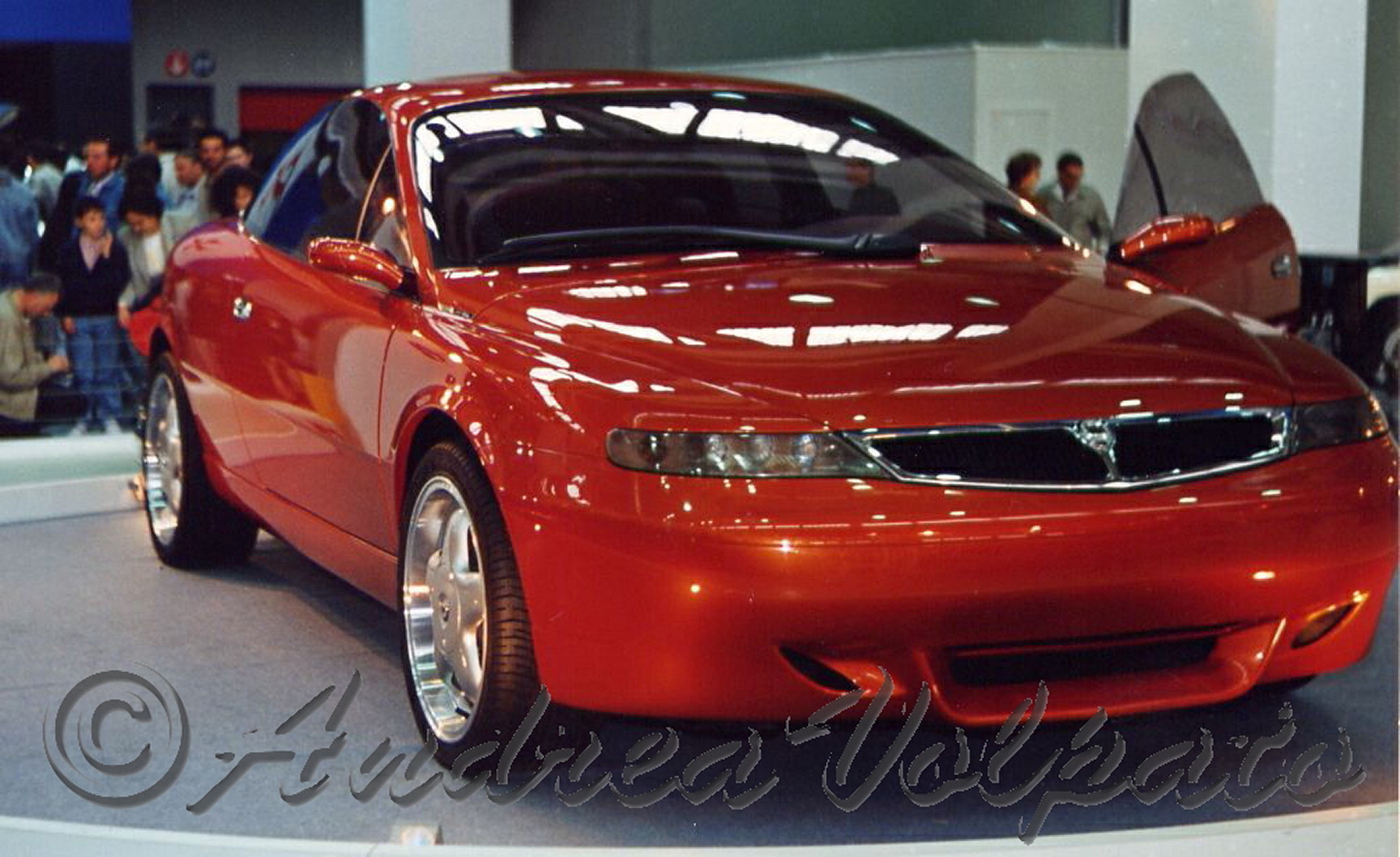
In 1992, IAD Studio presented its Magia prototype based on a Dedra Integrale rolling chassis. It was a four-seat coupé that was finished in bright orange and had a distinctive wedge shape that combined soft lines and aggressive details. It was designed by Michael Ani and Chris Garfield of IAD.
References
References
- "Produktionszahlen marke Lancia bis 2004".
- Mazzocchi Bordone, Maria Giovanna. (July 2010). "Lancia - Tutti modelli del novecento, parte II". Editoriale Domus S.p.A..
- "Lancia Dedra". carsfromitaly.net.
- "Curiosidades Tipo". Fiat Tipo Portugal.
- "1990 Lancia Dedra 1.6i". carfolio.com/specifications.
- "Lancia Dedra 1.6 16v Station Wagon". carfolio.com.
- Koopmann, Chris. "Ercole Spada".
- Kjellström, PeO. (1991-01-24). "På rätt väg - mot bättre kvalitet och mot Sverige". Specialtidningsförlaget AB.
- Carretto, Bianca. (1 May 1992). "Automaticamente Dedra alla conquista d'Europa". Corriere della Sera.
- (2013-10-31). "The 13 Worst Cars of the Last 20 Years".
- "Michael Ani".
This article was imported from Wikipedia and is available under the Creative Commons Attribution-ShareAlike 4.0 License. Content has been adapted to SurfDoc format. Original contributors can be found on the article history page.
Ask Mako anything about Lancia Dedra — get instant answers, deeper analysis, and related topics.
Research with MakoFree with your Surf account
Create a free account to save articles, ask Mako questions, and organize your research.
Sign up freeThis content may have been generated or modified by AI. CloudSurf Software LLC is not responsible for the accuracy, completeness, or reliability of AI-generated content. Always verify important information from primary sources.
Report