From Surf Wiki (app.surf) — the open knowledge base
Lancaster Gate
Development in Bayswater, London
Development in Bayswater, London
| Field | Value |
|---|---|
| image_skyline | File:Lancaster Gate London 2024.jpg |
| imagesize | 325px |
| image_alt | see cpationy |
| image_caption | Lancaster Gate, houses 14-26 |
| coordinates | |
| subdivision_type | Country |
| website |
Lancaster Gate is a mid-19th century development in the Bayswater district of central London, immediately to the north of Kensington Gardens.
History
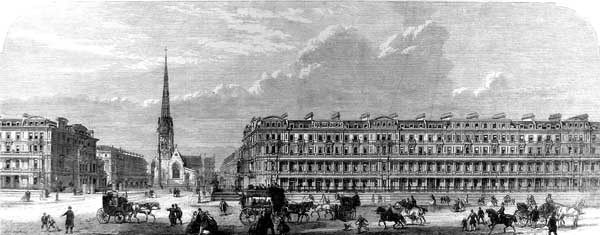
It consists of two long terraces of houses overlooking the park, with a wide gap between them opening onto a square containing a church. Further terraces back onto the pair overlooking the park and loop around the square. Until 1865 the terraces were known as Upper Hyde Park Gardens, with the name Lancaster Gate limited to the square surrounding the church. The development takes its name from Lancaster Gate, a nearby entrance to Kensington Gardens, itself named in honour of Queen Victoria as Duke of Lancaster.
The terraces are stuccoed and are in an eclectic classical style featuring English Baroque details and French touches. The last service in the church was on 6 March 1977, and demolition began on 15 August 1977; only the tower and spire survive. The rest of the building was replaced by a housing scheme called Spire House in 1983.
Lancaster Gate stands alongside Hyde Park Gardens as one of the two grandest of the 19th-century housing schemes lining the northern side of Hyde Park and Kensington Gardens.
The development was planned in 1856–57 on the site of a nursery and tea gardens, and construction took at least 10 years. The terraces overlooking the park were designed by Sancton Wood and those around the square by John Johnson.
Lancaster Gate is also an electoral ward of Westminster City Council. The population at the 2011 Census was 13,195.
Gallery
File:Paddington Met. B Ward Map 1916.svg|A map showing the Lancaster Gate wards of the Metropolitan Borough of Paddington as they appeared in 1916. File:Lancaster Gate 2.jpg|The Lancaster Gate of Kensington Gardens File:Spire House (formerly Christ Church, Lancaster Gate) front (= South face).jpg|South face of Spire House (formerly Christ Church, Lancaster Gate) File:London - Lancaster Gate - View South on Spire House 1983 (former Christ Church).jpg|Spire House File:London - Lancaster Gate - View North on statue & former Christ Church Spire.jpg|Memorial to Reginald Brabazon, 12th Earl of Meath (South face), artist Joseph Hermon Cawthra, (Spire House in background) File:Brabazon memorial Lancaster Gate, portrait and main inscription.jpg|Meath memorial, detail of bas-relief portrait and main inscription File:Back (North side) of Brabazon memorial, Lancaster Gate.jpg|Back (North face) of Meath memorial, showing view of Kensington Gardens to the south File:Brabazon (Meath) memorial, Lancaster Gate, West face.jpg|West face of Meath memorial (viewer facing east).Inscription reads "Duty, Sympathy, Self-Sacrifice"
References
Notes
Bibliography
- Cherry, Bridget and Pevsner, Nikolaus (1999) The Buildings of England. London 3: North West London: Penguin
References
- (2011). "London's Places". [[Greater London Authority]].
- (1989). "Paddington: Bayswater". [[British History Online]].
- (July 2025). "Lancaster Gate". Chambers.
- The church, known as Christ Church, Lancaster Gate, was an asymmetrical gothic composition with a needle spire. The architects were F. & H. Francis. The church was one of the best-known in London, but when dry rot was discovered in the roof the decision was taken to demolish most of the building and redevelop the site.Donald Wintersgill, "Change and decay is undermining the very cornerstones of faith", ''The Guardian'', 15 August 1977, p. 11.
- ''The Guardian'', 7 March 1977, p. 4.
- (1989). "Paddington: Churches". [[British History Online]].
- Walford, Edward. (1878). "Notting Hill and Bayswater". [[British History Online]].
- "City of Westminster Ward population 2011". Office for National Statistics.
This article was imported from Wikipedia and is available under the Creative Commons Attribution-ShareAlike 4.0 License. Content has been adapted to SurfDoc format. Original contributors can be found on the article history page.
Ask Mako anything about Lancaster Gate — get instant answers, deeper analysis, and related topics.
Research with MakoFree with your Surf account
Create a free account to save articles, ask Mako questions, and organize your research.
Sign up freeThis content may have been generated or modified by AI. CloudSurf Software LLC is not responsible for the accuracy, completeness, or reliability of AI-generated content. Always verify important information from primary sources.
Report