From Surf Wiki (app.surf) — the open knowledge base
Lamp under a bushel
Parable taught by Jesus of Nazareth according to Christian gospels
Parable taught by Jesus of Nazareth according to Christian gospels
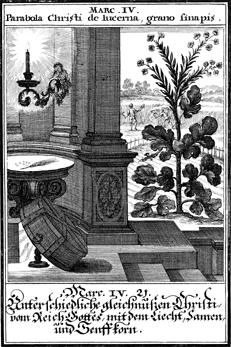
The parable of the lamp under a bushel (also known as the lamp under a bowl) is one of the parables of Jesus. It appears in Matthew 5:14–15, Mark and Luke . In Matthew, the parable is a continuation of the discourse on salt and light in Jesus' Sermon on the Mount, whereas in Mark and Luke, it is connected with Jesus' explanation of the Parable of the Sower. The parable also appears in the non-canonical Gospel of Thomas as saying 33.
Passage
Interpretation
The key idea of the parable is that "Light is to be revealed, not concealed."John R. Donahue and Daniel J. Harrington, The Gospel of Mark, Liturgical Press, 2005, , p. 149. The light here has been interpreted as referring to Jesus,William L. Lane, The Gospel According to Mark: The English text with introduction, exposition, and notes, Eerdmans, 1974, , pp. 165–166. or to His message,Barbara E. Reid, Parables for Preachers: Year B. The Gospel of Mark, Liturgical Press, 1999, , pp. 106–107. or to the believer's response to that message.
Jesus quotes a pessimistic proverb on how the rich get richer and the poor keep losing even the little they have. He later denounces the saying in the next parable in Mark, which alludes to Joel in assuring that God's judgment on the ruling powers will come and holds out revolutionary hope to those resigned to thinking that nothing will ever change.
Cornelius a Lapide, commenting on this parable, writes that allegorically, "saints Hilary, Ambrose, and Bede say, that it is here meant that the light of the Gospel was not to be shut up within the narrow confines of Judæa, but to be placed upon the height of Rome, that it might illuminate all the subject nations".
John McEvilly writes that "These words have the same object as the preceding, to stimulate the Apostles to shine as lights before the world, to enlighten the surrounding darkness, and impart to all the world the light of a holy, spotless life, and of pure teaching. As a city on a hill cannot be hid, so neither can the Apostles, from their exalted position, be concealed from the eyes of men; and, hence, their duty, to live so as to edify men. As no one lights a candle for the purpose of concealing its light, so neither did God constitute the Apostles as the lights of the world, in order to hide their light and detain the truth of God in injustice. Their duty is quite plain, viz., to diffuse this light far and near; to be deterred by no obstacles, in the free exercise of the exalted commission confided to them by God Himself, and to show forth the brilliancy of their virtues, and by their example to allure others to God."
Heinrich Meyer states that the connection between the sayings and Jesus' explanation of the parable of the sower is substantially the same in Mark and Luke:
Proverb
The parable is the source of the proverb "to hide one's light under a bushel", the use of the word "bushel", an obsolete word for bowl (now relegated to usage as a unit of measure), appearing in William Tyndale's translation of the New Testament: "Neither do men light a candle, and put it under a bushel, but on a candlestick, and it lighteth all them which are in the house." The original Greek is μόδιος (modios), usually translated as "basket".
References
References
- Meyer, H. A. W. (1880), [https://biblehub.com/commentaries/meyer/luke/8.htm Meyer's NT Commentary] on Luke 8, translated from the German sixth edition, accessed on 15 April 2025
- The Ecumenical Coptic Project, [https://metalogos.org/files/thomas.html Gospel of Thomas], Saying 33, accessed on 15 April 2025
- 0-8028-2315-7, p. 329.
- Lapide, Cornelius. (1889). "The great commentary of Cornelius à Lapide". John Hodges.
- MacEvilly, Rev. John. (1898). "An Exposition of the Gospels". Benziger Brothers.
- Wilson, F. P. ed. (1970). ''The Oxford Dictionary of Proverbs''. Third Edition. Oxford University Press. p.371. "Hide one's light (candle) under a bushel, To."
- "Strong's Greek: 3426. μόδιος (modios) -- modius, a dry measure of one peck".
This article was imported from Wikipedia and is available under the Creative Commons Attribution-ShareAlike 4.0 License. Content has been adapted to SurfDoc format. Original contributors can be found on the article history page.
Ask Mako anything about Lamp under a bushel — get instant answers, deeper analysis, and related topics.
Research with MakoFree with your Surf account
Create a free account to save articles, ask Mako questions, and organize your research.
Sign up freeThis content may have been generated or modified by AI. CloudSurf Software LLC is not responsible for the accuracy, completeness, or reliability of AI-generated content. Always verify important information from primary sources.
Report