From Surf Wiki (app.surf) — the open knowledge base
Lambeth Bridge
Grade II listed road bridge in London, United Kingdom
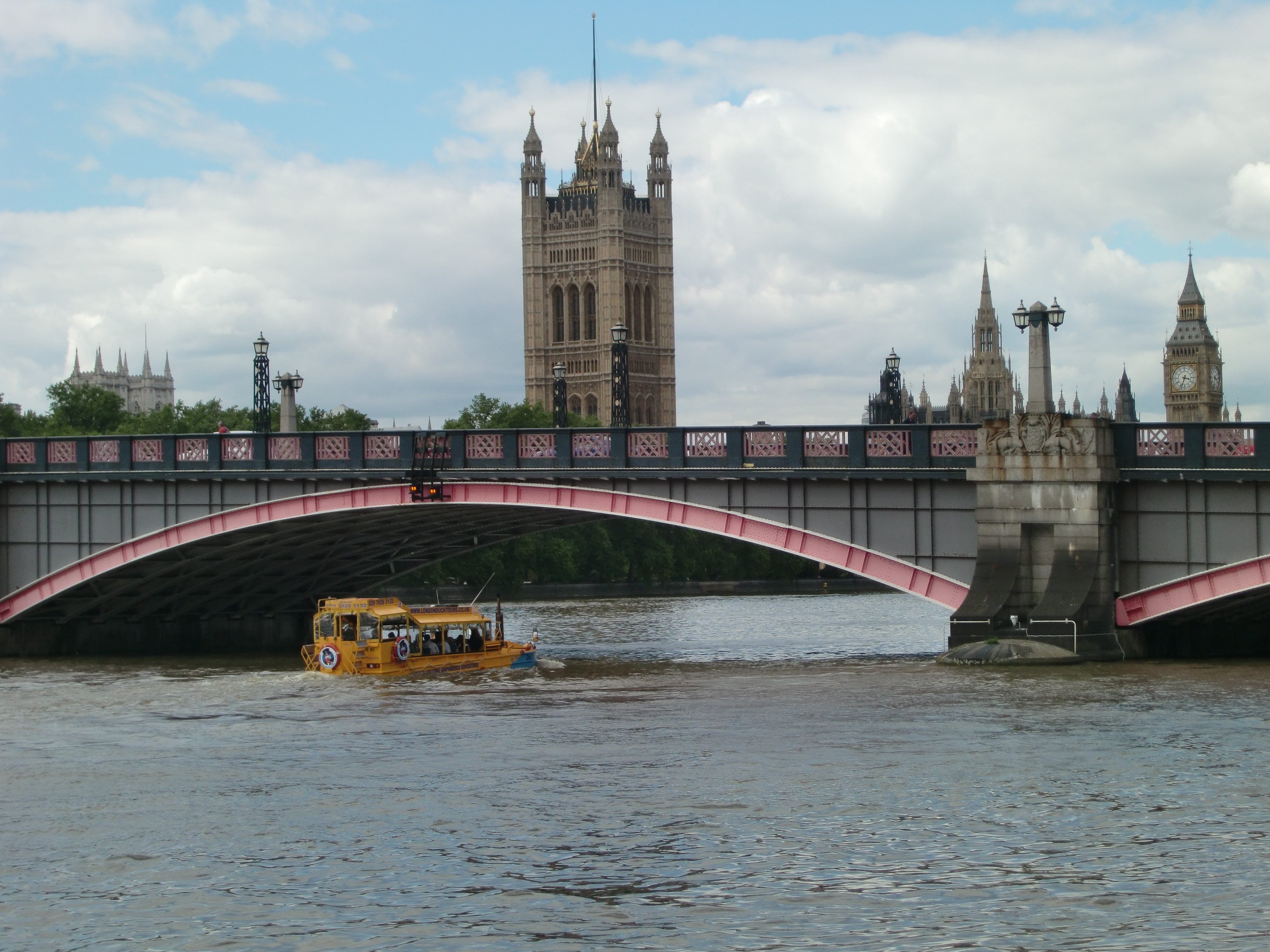
Grade II listed road bridge in London, United Kingdom
| Field | Value | ||||
|---|---|---|---|---|---|
| image | River Thames and Lambeth Bridge-7July2007.jpg | ||||
| image_size | 300px | ||||
| bridge_name | Lambeth Bridge | ||||
| caption | River Thames; Lambeth Bridge with Vauxhall Bridge in the distance (as seen from London Eye) | ||||
| locale | London | ||||
| carries | Lambeth Road | ||||
| crosses | River Thames | ||||
| maint | Transport for London | ||||
| open | (first bridge) | ||||
| (second bridge) {{Start date and age | df | y | 1932 | 7 | 19}} |
| design | Arch | ||||
| toll | coordinates = | ||||
| preceded | Vauxhall Bridge | ||||
| followed | Westminster Bridge |
(second bridge)
Lambeth Bridge is a road traffic and footbridge crossing the River Thames in an east–west direction in central London. The river flows north at the crossing point. Downstream, the next bridge is Westminster Bridge; upstream, the next bridge is Vauxhall Bridge.
The most conspicuous colour in the bridge's paint scheme is red, the same colour as the leather benches in the House of Lords, which is at the southern end of the Palace of Westminster nearest the bridge. This is in contrast to Westminster Bridge, which is predominantly green, the same colour as the benches in the House of Commons at the northern end of the Houses of Parliament.
On the east side, in Lambeth, are Lambeth Palace, the Albert Embankment, St. Thomas' Hospital, and the International Maritime Organization. On the west side, in Westminster, are Thames House (the headquarters of MI5), behind which is Horseferry House (the National Probation Service headquarters), and Clelland House and Abell House (the headquarters of HM Prison Service), and the Millbank Tower and Tate Britain. The Palace of Westminster is a short walk downstream to the north through the Victoria Tower Garden.
History
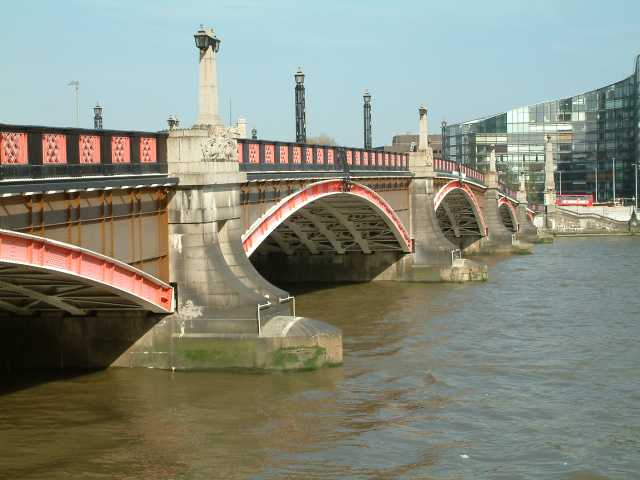
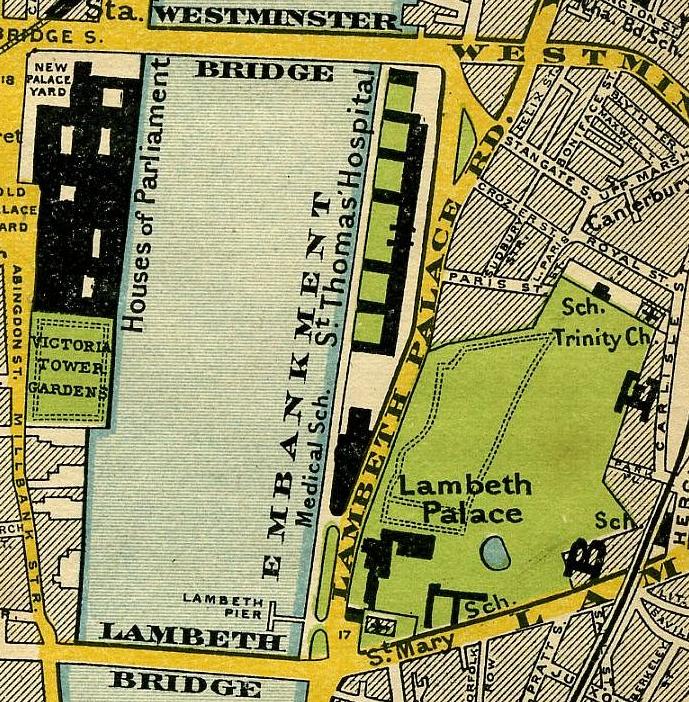


Lambeth Bridge is on the site of a horse ferry between the Palace of Westminster and Lambeth Palace on the south bank. Its name lives on in Horseferry Road, which forms the approach to the bridge on the north bank.
The first modern bridge was a suspension bridge, 828 ft long, designed by Peter W. Barlow. Sanctioned by the Lambeth Bridge Act 1861 (24 & 25 Vict. c. cxvii), it opened as a toll bridge on 10 November 1862. Doubts about its safety, coupled with its awkwardly steep approaches deterring horse-drawn traffic, meant it soon became used almost solely as a pedestrian crossing. It ceased to be a toll bridge in 1879 when the Metropolitan Board of Works assumed responsibility for its upkeep — it was by then severely corroded, and by 1910 it was closed to vehicular traffic.
The London County Council prepared a masterplan for the area, including a replacement road bridge linking to a widened Horseferry Road, which was authorised by London County Council (Lambeth Bridge) Act 1924 (14 & 15 Geo. 5. c. lxvii). Before work had started on the project, the 1928 Thames flood caused extensive destruction of property in the Millbank area. Following the flood the Chelsea Embankment was rebuilt and raised, resulting in some minor redesign of the approaches, and creating the open space to the north of Lambeth Bridge now known as Victoria Tower Gardens South. During the period of delay, the bridge was also redesigned to be able to cope with a higher weight of motorised traffic.
The current structure, a five-span steel arch, designed by engineer Sir George Humphreys and architects Sir Reginald Blomfield and G. Topham Forrest, was built by Dorman Long and opened on 19 July 1932 by King George V. It formerly carried four lanes of road traffic (now reduced to three lanes, one of which is a buses-only lane flowing eastbound) from a roundabout junction by the Lambeth Palace northwards to another roundabout, where the Millbank road meets Horseferry Road .
The bridge is notable at road level for the pairs of obelisks at either end of the bridge, which are surmounted by stone pinecones. However, there is a popular urban legend that they are pineapples, as a tribute to Lambeth resident John Tradescant the younger, who is said to have grown the first pineapple in Britain.
The bridge was declared a Grade II listed structure in 2008, providing protection to preserve its special character from unsympathetic development. The listing designation includes the parapets, lamps, obelisks and the approach walls.
References
References
- [http://www.british-history.ac.uk/report.aspx?compid=47053 Lambeth Bridge and its predecessor the Horseferry]
- (11 November 1862). "Lambeth Suspension Bridge". [[The Times]].
- [http://www.britishlistedbuildings.co.uk/en-496913-lambeth-bridge-and-attached-parapets-lig Listing description on British Listed Buildings]
- [http://thames.me.uk/s00140.htm Where Thames Smooth Waters Glide]
- Dorrell, Christopher. (2025-08-20). "Pineapples are hiding in plain sight across London".
- "commemorative pineapples".
- [http://www.vauxhallcivicsociety.org.uk/history/tradescant-family/ Vauxhall Society:Tradescants] {{webarchive. link. (7 April 2014)
- (26 November 2008). "London bridges get listed status". BBC News.
This article was imported from Wikipedia and is available under the Creative Commons Attribution-ShareAlike 4.0 License. Content has been adapted to SurfDoc format. Original contributors can be found on the article history page.
Ask Mako anything about Lambeth Bridge — get instant answers, deeper analysis, and related topics.
Research with MakoFree with your Surf account
Create a free account to save articles, ask Mako questions, and organize your research.
Sign up freeThis content may have been generated or modified by AI. CloudSurf Software LLC is not responsible for the accuracy, completeness, or reliability of AI-generated content. Always verify important information from primary sources.
Report