From Surf Wiki (app.surf) — the open knowledge base
Lake Tanganyika
Rift lake in East-Central Africa

Rift lake in East-Central Africa
| Field | Value |
|---|---|
| name | Lake Tanganyika |
| native_name | rn |
| image | STS51G-034-0012_Lake_Tanganyika_June1985.jpg |
| alt | Satellite image of Lake Tanganyika on Earth in center and left, space in upper right. |
| caption | Lake Tanganyika from space, June 1985 |
| image_bathymetry | Lake Tanganyika map.png |
| caption_bathymetry | Lake Tanganyika map |
| alt_bathymetry | Long rift lake with outflow to Congo River in the middle of western shore. |
| coords | |
| lake_type | Ancient lake, Rift Valley Lake |
| inflow | Ruzizi River |
| Malagarasi River | |
| Kalambo River | |
| outflow | Lukuga River |
| catchment | 231000 km2 |
| basin_countries | Burundi, DR Congo, Tanzania, and Zambia |
| length | 673 km |
| width | 72 km |
| area | 32900 km2 |
| depth | 570 m |
| max-depth | 1470 m |
| volume | 18750 km3 |
| residence_time | 5500 years |
| shore | 1828 km |
| elevation | 773 m |
| cities | Kigoma, Tanzania |
| Rukwa, Tanzania | |
| Kalemie, the DRC | |
| Bujumbura, Burundi | |
| Mpulungu, Zambia | |
| pushpin_map | Africa |
| pushpin_map_alt | Located in East African rift between Tanzania and the DRC. |
| reference | |
| embedded | {{Designation list |
| embed | yes |
| designation1 | Ramsar |
| designation1_offname | Tanganyika |
| designation1_date | 2 February 2007 |
| designation1_number | 1671}} |
Malagarasi River Kalambo River | max-depth = 1470 m Rukwa, Tanzania Kalemie, the DRC Bujumbura, Burundi Mpulungu, Zambia
Lake Tanganyika ( ; ) is an African Great Lake. It is the world's second-largest freshwater lake by volume and the second deepest, in both cases after Lake Baikal in Siberia. It is the world's longest freshwater lake. The lake is shared among four countries—Tanzania, the Democratic Republic of the Congo (the DRC), Burundi, and Zambia—with Tanzania (46%) and the DRC (40%) possessing the majority of the lake. It drains via the Lukuga River into the Congo River system, which ultimately discharges at Banana, Democratic Republic of the Congo into the Atlantic Ocean.
Geography
Lake Tanganyika is situated within the Albertine Rift, the western branch of the East African Rift, and is confined by the mountainous walls of the valley. It is the largest rift lake in Africa and the second-largest freshwater lake by volume in the world. It is the deepest lake in Africa and holds the greatest volume of fresh water on the continent, accounting for 16% of the world's available fresh water. It extends for 676 km in a general north–south direction and averages 50 km in width. The lake covers 32000 km2, with a shoreline of 1900 km, a mean depth of 572 m and a maximum depth of 1471 m (in the northern basin). It holds an estimated 18750 km3 of water.
The catchment area of the lake is 231000 km2. Two main rivers flow into the lake, as well as numerous smaller rivers and streams (whose lengths are limited by the steep mountains around the lake). The one major outflow is the Lukuga River, which empties into the Congo River drainage. Precipitation and evaporation play a greater role than the rivers. At least 90% of the water influx is from rain falling on the lake's surface and at least 90% of the water loss is from direct evaporation.
The major river flowing into the lake is the Ruzizi River, formed about 10,000 years ago, which enters the north of the lake from Lake Kivu. The Malagarasi River, which is Tanzania's second largest river, enters the east side of Lake Tanganyika. The Malagarasi is older than Lake Tanganyika, and before the lake was formed, it probably was a headwater of the Lualaba River, the main Congo River headstream.
The lake has a complex history of changing flow patterns, due to its high altitude, great depth, slow rate of refill, and mountainous location in a turbulently volcanic area that has undergone climate changes. Apparently, it has rarely in the past had an outflow to the sea. It has been described as "practically endorheic" for this reason. The lake's connection to the sea is dependent on a high water level allowing water to overflow out of the lake through the Lukuga River into the Congo. When not overflowing, the lake's exit into the Lukuga River typically is blocked by sand bars and masses of weed, and instead this river depends on its own tributaries, especially the Niemba River, to maintain a flow.
The lake may also have at times had different inflows and outflows; inward flows from a higher Lake Rukwa, access to Lake Malawi and an exit route to the Nile have all been proposed to have existed at some point in the lake's history.
Lake Tanganyika is an ancient lake, one of only twenty more than a million years old. Its three basins, which in periods with much lower water levels were separate lakes, are of different ages. The central began to form 9–12 million years ago (Mya), the northern 7–8 Mya and the southern 2–4 Mya.
Water characteristics

The lake's water is alkaline with a pH around 9 at depths of 0-100 m. Below this, it is around 8.7, gradually decreasing to 8.3–8.5 in the deepest parts of Tanganyika. A similar pattern can be seen in the electric conductivity, ranging from about 670 μS/cm in the upper part to 690 μS/cm in the deepest.
Surface temperatures generally range from about 24 C in the southern part of the lake in early August to 28 - in the late rainy season in March—April. At depths greater than 400 m, the temperature is very stable at 23.1 -. The water has gradually warmed since the 19th century and this has accelerated with global warming since the 1950s.
The lake is stratified and seasonal mixing generally does not extend beyond depths of 150 m. As a consequence of the stratification, the deep sections contain "fossil water". This also means it has no oxygen (it is anoxic) in the deeper parts, essentially limiting fish and other aerobic organisms to the upper part. Some geographical variations are seen in this limit, but it is typically at depths around 100 m in the northern part of the lake and 240-250 m in the south. The oxygen-devoid deepest sections contain high levels of toxic hydrogen sulfide and are essentially lifeless,
Biology
Reptiles
Lake Tanganyika and its associated wetlands are home to Nile crocodiles (including famous giant Gustave), Zambian hinged terrapins, serrated hinged terrapins, and pan hinged terrapins (last species not in the lake itself, but in adjacent lagoons). Storm's water cobra, a threatened subspecies of banded water cobra that feeds mainly on fish, is only found in Lake Tanganyika, where it prefers rocky shores.
Cichlid fishes
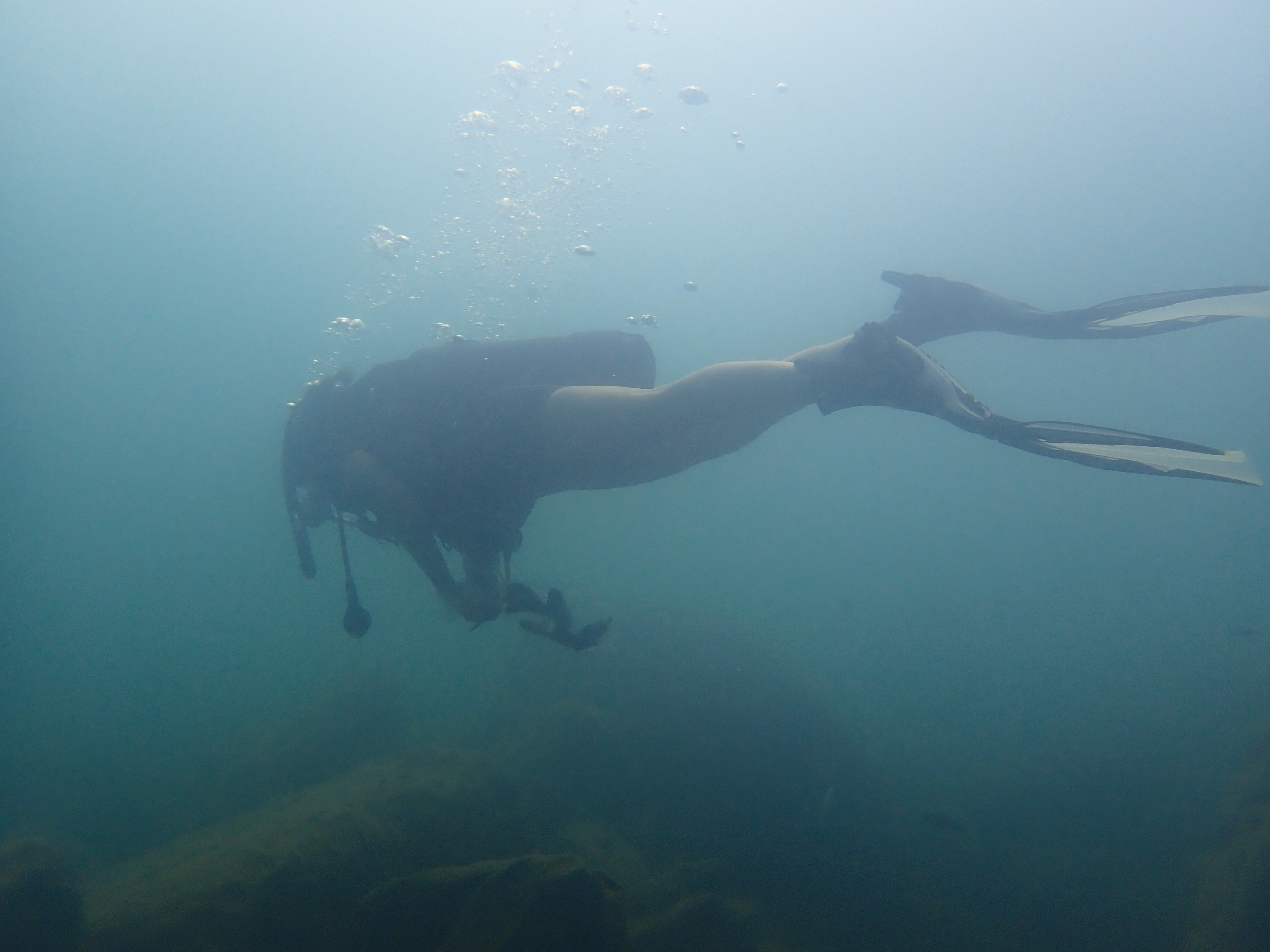

Lake Tanganyika is home to at least 250 endemic species of cichlids, and undescribed species likely remain to be discovered. Almost all (roughly 98%) of the lake's cichlid species are found solely there, and nowhere else, thus making it a precious biological resource for the study of speciation and evolution. The cichlids of the African Great Lakes, including Tanganyika, represent the most diverse extent of adaptive radiation in vertebrates. Some of the endemic species do occur slightly into the upper Lukuga River (Lake Tanganyika's outflow), but any further distribution into the Congo River basin is stemmed purely by geography and chemistry—Tanganyika's lake environment is far more stable and consistent than the rapids and fast-flowing sections of the Congo River. Additionally, Lake Tanganyika's water is alkaline and of a higher pH (which the cichlids prefer), containing a higher calcium and mineral content than the Congo's acidic, sediment-rich waters, which collect much organic detritus from the surrounding rainforests. In areas of the Congo away from rapids or whitewater, the accumulated sediment and organic matter creates sections of "blackwater", with a high concentration of tannins from dissolving wood and leaves, creating an environment in which cichlids simply do not thrive. Likewise, many tropical riverine species would likely suffer if exposed to the crisp, alkaline lake water.
Although Lake Tanganyika has fewer cichlid species than Lakes Malawi or Victoria—which both have experienced relatively recent explosive species radiations (resulting in many closely related species)—, its cichlids are the most morphologically and genetically diverse. This is linked to the maturity of Tanganyika, as it is far older than the other lakes. Tanganyika has the largest number of endemic cichlid genera of all African lakes. All Tanganyika cichlids are in the subfamily Pseudocrenilabrinae. Of the 10 tribes in this subfamily, half are largely or entirely restricted to the lake (Cyprichromini, Ectodini, Lamprologini, Limnochromini and Tropheini), while another three have species in the lake (Haplochromini, Tilapiini and Tylochromini). Others have proposed splitting the Tanganyika cichlids into as many as 12–16 tribes (Bathybatini, Benthochromini, Boulengerochromini, Cyphotilapiini, Eretmodini, Greenwoodochromini, Perissodini and Trematocarini, in addition to the aforementioned tribes).
Most Tanganyika cichlids live along the shoreline, down to a depth of 100 m, but some deep-water species regularly descend to 200 m. Trematocara species have, exceptionally, been found at more than 300 m, which is deeper than any other cichlid known. Some of the deepwater genera (e.g., Bathybates, Gnathochromis, Hemibates and Xenochromis) have been caught in places virtually devoid of oxygen, and how they are able to survive there is unclear. No Tanganyika cichlids are truly pelagic and offshore, except for some of the piscivorous Bathybates. The fishes' breeding behavior falls into two main groups: the substrate- or sand-spawners (often in caves or rock crevices) and the mouthbrooders. Among the endemic species are two of the world's smallest cichlids, Neolamprologus multifasciatus and N. similis (both shell dwellers), measuring up to 4-5 cm, and one of the largest, the giant cichlid (Boulengerochromis microlepis) at up to 90 cm.
Many cichlids from Lake Tanganyika, such as species from the genera Altolamprologus, Cyprichromis, Eretmodus, Julidochromis, Lamprologus, Neolamprologus, Tropheus and Xenotilapia, are popular aquarium fish due to their bright colors and patterns, and interesting behaviors.
File:Bathybates ferox.jpg|Bathybatini (E): Bathybates ferox is benthic and piscivorous, but the genus also includes pelagic species. File:Benthochromis tricoti.jpg|Benthochromini (E): Benthochromis horii was scientifically described in 2008, but has often been misidentifed as B. tricoti File:DKoehl Boulengerochromis microlepis.jpg|Boulengerochromini (E): Boulengerochromis microlepis is one of the world's largest cichlids and only member of its tribe File:Cyphotilapia frontosa2.jpg|Cyphotilapiini (E): Cyphotilapia frontosa, one of only two similar species in the tribe File:Kleinschuppiger Kaerpflingsbuntbarsch Cyprichromis microlepidotus Tierpark Hellabrunn-1.jpg|Cyprichromini (E): Cyprichromis microlepidotus and other members of this tribe are open-water planktivores File:Ophthalmotilapia nasuta Kipili.jpg|Ectodini (E): Ophthalmotilapia nasuta (male) is sexually dimorphic, males being more colorful with longer fins and nose File:Eretmodus-sp-kavala1.jpg|Eretmodini (E): Eretmodus cyanostictus lives near the bottom in the turbulent, coastal surf zone, like other members of its tribe File:Astatotilapia burtoni.png|Haplochromini: Astatotilapia burtoni is one of the few Tanganyika species, File:Schachbrett-Schlankcichlide.jpg|Lamprologini (E): Julidochromis marlieri is popular in the aquarium trade where members of the genus are known as "Julies" File:Gnathochromis premaxillaris.jpg|Limnochromini (E): Gnathochromis permaxillaris is a zooplanktivore with an unusual protractile mouth File:Perissodus microlepis juvenile in aquarium.jpg|Perissodini (E): Perissodus microlepis, a specialized scale-eating species File:Oreochromis tanganicae (Günther).jpg|Tilapiini: Oreochromis tanganicae is one of the most common coastal species found in local fish markets File:TropheusspRed200.jpg|Tropheini (E): Tropheus moorii ("red" Chimba morph) is highly variable and the taxonomy of some of the morphs is questionable
Other fish
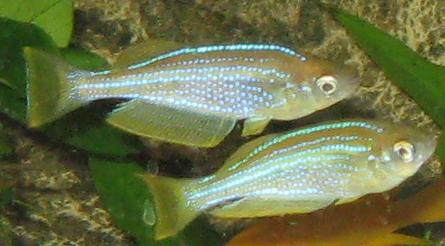
Lake Tanganyika is home to more than 80 species of non-cichlid fish and about 60% of these are endemic.
The open waters of the pelagic zone are dominated by four non-cichlid species: Two species of "Tanganyika sardine" (Limnothrissa miodon and Stolothrissa tanganicae) form the largest biomass of fish in this zone, and they are important prey for the forktail lates (Lates microlepis) and sleek lates (L. stappersii). Two additional lates are found in the lake, the Tanganyika lates (L. angustifrons) and bigeye lates (L. mariae), but both these are primarily benthic hunters, although they also may move into open waters. The four lates, all endemic to Tanganyika, have been overfished and larger individuals are rare today.
Among the more unusual fish in the lake are the endemic, facultatively brood parasitic "cuckoo catfish", including at least Synodontis grandiops and S. multipunctatus. The facultative brood parasites often lay their eggs synchronously with mouthbrooding cichlids. The cichlid pick up the eggs in their mouth as if they were their own. Once the catfish eggs hatch the young eat the cichlid eggs. Although not endemic on a genus level, six species of Chrysichthys catfish are only found in the Tanganyika basin where they live both in shallow and relatively deep waters; Although other African Great Lakes have Synodontis catfish, endemic catfish genera and Mastacembelus spiny eels, the relatively high diversity is unique to Tanganyika, which likely is related to its old age.
Among the non-endemic fish, some are widespread African species but several are only shared with the Malagarasi and Congo River basins, such as the Congo bichir (Polypterus congicus), goliath tigerfish (Hydrocynus goliath), Citharinus citharus, six-banded distichodus (Distichodus sexfasciatus) and mbu puffer (Tetraodon mbu).
Molluscs and crustaceans

A total of 83 freshwater snail species (65 endemic) and 11 bivalve species (8 endemic) are known from the lake. Among the endemic bivalves are three monotypic genera: Grandidieria burtoni, Pseudospatha tanganyicensis and Brazzaea anceyi. All the Tanganyika thalassoids, which are part of Prosobranchia, are endemic to the lake. A total of 17 freshwater snail genera are endemic to the lake, such as Hirthia, Lavigeria, Paramelania, Reymondia, Spekia, Stanleya, Tanganyicia and Tiphobia.
Crustaceans are also highly diverse in Tanganyika with more than 200 species, of which more than half are endemic. at least 11 species of small atyid shrimp (Atyella, Caridella and Limnocaridina), an endemic palaemonid shrimp (Macrobrachium moorei), about 100 ostracods, including many endemics, and several copepods. Among these, Limnocaridina iridinae lives inside the mantle cavity of the unionid mussel Pleiodon spekei, making it one of only two known commensal species of freshwater shrimp (the other is the sponge-living Caridina spongicola from Lake Towuti, Indonesia).
Among Rift Valley lakes, Lake Tanganyika far surpasses all others in terms of crustacean and freshwater snail richness (both in total number of species and number of endemics). For example, the only other Rift Valley lake with endemic freshwater crabs are Lake Kivu and Lake Victoria with two species each.
Other invertebrates
The diversity of other invertebrate groups in Lake Tanganyika is often not well-known, but there are at least 20 described species of leeches (12 endemics), 9 sponges (7 endemic), 6 bryozoa (2 endemic), 11 flatworms (7 endemic), 20 nematodes (7 endemic), 28 annelids (17 endemic)
Fishing


Lake Tanganyika supports a major fishery, which, depending on source, provides 25–40% or 60% of the animal protein in the diet of the people living in the region.
Lake Tanganyika fish can be found exported throughout East Africa. Major commercial fishing began in the mid-1950s and has, together with global warming, had a heavy impact on the fish populations, causing significant declines. In 2016, it was estimated that the total catch was up to 200,000 tonnes.
History

It is thought that early Homo sapiens were making an impact on the region during the Stone Age. The time period of the Middle Stone Age to Late Stone Age is described as an age of advanced hunter-gatherers.
There are many methods which the native people of the area used for fishing. Most of them included using a lantern as a lure for fish that are attracted to light. There were three basic forms. One called Lusenga which is a wide net used by one person from a canoe. The second one is using a lift net. This was done by dropping a net deep below the boat using two parallel canoes and then simultaneously pulling it up. The third is called Chiromila which consisted of three canoes. One canoe was stationary with a lantern while another canoe holds one end of the net and the other circles the stationary one to meet up with the net.
The first known Westerners to find the lake were the British explorers Richard Burton and John Speke, in 1858. They located it while searching for the source of the Nile River. Speke continued and found the actual source, Lake Victoria. Later David Livingstone passed by the lake. He noted the name "Liemba" for its southern part, a word probably from the Fipa language. Tanganyika means "stars" in the Luvale language.
The lake was the scene of Battle for Lake Tanganyika during World War I. With the aid of the Graf Goetzen, the Germans had complete control of the lake in the early stages of the war. The ship was used both to ferry cargo and personnel across the lake, and as a base from which to launch surprise attacks on Allied troops. It therefore became essential for the Allied forces to gain control of the lake themselves. Under the command of Lieutenant Commander Geoffrey Spicer-Simson the British Royal Navy achieved the monumental task of bringing two armed motor boats HMS Mimi and HMS Toutou from England to the lake by rail, road and river to Albertville (since renamed Kalemie in 1971) on the western shore of Lake Tanganyika. The two boats waited until December 1915, and mounted a surprise attack on the Germans, with the capture of the gunboat Kingani. Another German vessel, the Hedwig, was sunk in February 1916, leaving the Götzen as the only German vessel remaining to control the lake. In order to avoid his prize ship falling into Allied hands, Zimmer scuttled the vessel on July 26, 1916. The vessel was later raised in 1924 and renamed MV Liemba.
References
References
- Yohannes, Okbazghi. (2008). "Water resources and inter-riparian relations in the Nile basin". SUNY Press.
- "LAKE TANGANYIKA". World Lake Database, International Lake Environment Committee Foundation.
- "Tanganyika".
- {{cite LPD. 3
- Burton, Richard Francis. (1965). "Burton and Lake Tanganyika". East African Literature Bureau.
- "Lake Tanganyika". www.zambiatourism.com.
- Lewis, R.. (16 May 2010). "Brown Geologists Show Unprecedented Warming in Lake Tanganyika". Brown University.
- "World’s largest lakes {{!}} Description, Area, & Facts {{!}} Britannica".
- "Datbase Summary: Lake Tanganyika". International Lake Environment Committee Foundation.
- (2011). "Out of Lake Tanganyika: endemic lake fishes inhabit rapids of the Lukuga River". Ichthyol. Explor. Freshwaters.
- (1980). "Natural Wonders of the World". Reader's Digest Association, Inc.
- Lévêque, Christian. (1997). "Biodiversity Dynamics and Conservation: The Freshwater Fish of Tropical Africa". [[Cambridge University Press]].
- (1993). "Estimating the age of formation of lakes: An example from Lake Tanganyika, East African Rift system". Geology.
- (2005). "Bacterial Community Composition in Lake Tanganyika: Vertical and Horizontal Heterogeneity". Appl Environ Microbiol.
- (1993). "Nutrient chemistry of the water column of Lake Tanganyika". Limnol. Oceanogr..
- (August 14, 2003). "Climate change decreases aquatic ecosystem productivity of Lake Tanganyika, Africa". Nature.
- Jensen, M.R.. (8 August 2016). "Lake Tanganyika Fisheries Declining From Global Warming". University of Arizona.
- (2003). "Recent research in the African Great Lakes: Fisheries, biodiversity and cichlid evolution". Freshwater Forum.
- Hutter; Yongqi; and Chubarenko (2011). Physics of Lakes, volume 1: Foundation of the Mathematical and Physical Background. P. 11. {{ISBN. 978-3-642-15178-1.
- Wright, J.J.; and L.M. Page (2006). Taxonomic revision of Lake Tanganyikan Synodontis (Siluriformes: Mochokidae). Florida Mus. Nat. Hist. Bull. 46(4): 99–154.
- Lowe-McConnell, R.H. (1987). Ecological Studies in Tropical Fish Communities. {{ISBN. 0-521-28064-8.
- Spawls, Howell, Drewes, and Ashe (2002). A Field Guide to the Reptiles of East Africa. Academic Press, London. {{ISBN. 0-12-656470-1.
- (2005). "Boulengerina annulata stormsi (Storm's water cobra). Attempted predation". Herpetological Review.
- (1999). "Reproductive parasitism of broodcare helpers in a cooperatively breeding fish". Behavioral Ecology.
- (1998). "Individual recognition in a cooperatively breeding cichlid: Evidence from video playback experiments". Behaviour.
- (2003). "Helping opportunities and space segregation in cooperatively breeding cichlids". Behavioral Ecology.
- (28 February 2001). "Results and Experiences of the UNDP/GEF Conservation Initiative (RAF/92/G32) in Burundi, D.R. Congo, Tanzania, and Zambia".
- (24 December 2009). "Lake Tanganyika and its Diverse Cichlids".
- (2012). "Genetic and Morphological Evidence Implies Existence of Two Sympatric Species in Cyathopharynx furcifer (Teleostei: Cichlidae) from Lake Tanganyika". International Journal of Evolutionary Biology.
- (2000). "African Cichlid Fishes: Model Systems for Evolutionary Biology". Annual Review of Ecology and Systematics.
- (2001). "How many species of cichlid fishes are there in African lakes?". Molecular Ecology.
- (25 November 2013). "A tribal level phylogeny of Lake Tanganyika cichlid fishes based on a genomic multi-marker approach". Molecular Phylogenetics and Evolution.
- Seehausen, O.. (2015). "Process and pattern in cichlid radiations – inferences for understanding unusually high rates of evolutionary diversification". New Phytologist.
- (1991). "Lake Tanganyika as an evolutionary reservoir of old lineages of East African cichlid fishes: Inferences from allozyme data". Experientia.
- (2004). "Phylogeny and biogeography of cichlid fishes (Teleostei: Perciformes: Cichlidae)". Cladistics.
- (2012). "Evolutionary History of Lake Tanganyika's Predatory Deepwater Cichlids". International Journal of Evolutionary Biology.
- Loiselle, Paul (1994). The Cichlid Aquarium, p. 304. Tetra Press, Germany. {{ISBN. 978-1564651464.
- 978-0792360179
- (2019). "Playing out Liem's Paradox: Opportunistic Piscivory across Lake Tanganyikan Cichlids". The American Naturalist.
- Schliewen, U. (1992). Aquarium Fish. Barron's Educational Series. {{ISBN. 978-0812013504.
- {{FishBase. (2017)
- {{FishBase. (2017)
- (13 June 2016). "The 10 biggest cichlids". Practical Fishkeeping.
- (2010-02-10). "tanganyika biotope aquarium". Aquariums Life.
- (2015). "A tribal level phylogeny of Lake Tanganyika cichlid fishes based on a genomic multi-marker approach". Molecular Phylogenetics and Evolution.
- (2008). "Description of a new cichlid fish species of the genus Benthochromis (Perciformes: Cichlidae) from Lake Tanganyika". Journal of Fish Biology.
- (2003). "New species of Cyphotilapia (Perciformes: Cichlidae) from Lake Tanganyika, Africa". Copeia.
- Bigirimana, C.. (2006). "''Cyprichromis microlepidotus''".
- Smith, M.P. (1998). Lake Tanganyikan Cichlids, pp. 9–10. {{ISBN. 0-7641-0615-5
- "Ophthalmotilapia nasuta".
- {{FishBase. (2017)
- (2009). "Fisheries and cichlid evolution in the African Great Lakes: progress and problems". Freshwater Reviews.
- "Julidochromis marlieri (Marlier's Julie)".
- Bigirimana, C.. (2006). "''Gnathochromis permaxillaris''".
- (2010). "Evolution of a unique predatory feeding apparatus: functional anatomy, development and a genetic locus for jaw laterality in Lake Tanganyika scale-eating cichlids". BMC Biology.
- Ntakimazi, G.. (2006). "''Oreochromis tanganicae''".
- Begon, M.; and A.H. Fitter (1995). Advances in Ecological Research, vol. 26, p. 203. {{ISBN. 0-12-013926-X
- (2006). "Colour-assortative mating among populations of Tropheus moorii, a cichlid fish from Lake Tanganyika, East Africa". Proc Biol Sci.
- (2017). "Tropheus Genus Evolution".
- {{FishBase genus. (2017)
- (2011). "Pectoral fin loss in the Mastacembelidae: a new species from Lake Tanganyika". Journal of Zoology.
- (2012). "Systematic revision of the formerly monotypic genus Tanganikallabes (Siluriformes: Clariidae)". Zoological Journal of the Linnean Society.
- (2020). "Synodontis grandiops • Mochokidae".
- Wright, J.J.. (2017). "A new diminutive genus and species of catfish from Lake Tanganyika (Siluriformes: Clariidae)". J Fish Biol.
- (2011). "Freshwater molluscs of Africa: diversity, distribution, and conservation". IUCN.
- Many of the snails are unusual for species living in freshwater in having noticeably thickened shells and/or distinct [[Sculpture (mollusc). 0-7484-0026-5
- (1996). "Shell microstructure of gastropods from Lake Tanganyika, Africa: adaptation, convergent evolution, and escalation.". Evolution.
- (2006). "Molecular evidence for recent divergence of Lake Tanganyika endemic crabs (Decapoda: Platythelphusidae)". Molecular Phylogenetics and Evolution.
- (2006). "Evolution in ancient lakes: radiation of Tanganyikan atyid prawns and speciation of pelagic cichlid fishes in Lake Malawi.". Hydrobiologia.
- De Grave, S.. (2013). "''Macrobrachium moorei''".
- (2008). "Global diversity of ostracods (Ostracoda, Crustacea) in freshwater". Hydrobiologia.
- (2015). "Sub-Decadal Resolution in Sediments of Late Miocene Lake Pannon Reveals Speciation of Cyprideis (Crustacea, Ostracoda)". PLOS ONE.
- (2012). "Molecular analyses of ostracod flocks from Lake Baikal and Lake Tanganyika". Hydrobiologia.
- (2016). "Composition and seasonal variations in abundance of Copepod (Crustacea) populations from the northern part of Lake Tanganyika". Aquatic Ecosystem Health & Management.
- (2008). "Global diversity of shrimps (Crustacea: Decapoda: Caridea) in freshwater". Hydrobiologia.
- De Grave, S.. (2013). "''Limnocaridina iridinae''".
- Segers, H.; and Martens, K; editors (2005). ''The Diversity of Aquatic Ecosystems.'' p. 46. Developments in Hydrobiology. Aquatic Biodiversity. {{ISBN. 1-4020-3745-7
- link. (25 July 2014 '' Journal Articles. Paper 30.)
- (2017). "Description of three new species of Potamonautes MacLeay, 1838 from the Lake Victoria region in southern Uganda, East Africa (Brachyura: Potamoidea: Potamonautidae)". European Journal of Taxonomy.
- Segers, H.; and Martens, K; editors (2005). ''The Diversity of Aquatic Ecosystems.'' p. 44. Developments in Hydrobiology. Aquatic Biodiversity. {{ISBN. 1-4020-3745-7
- "Global warming is killing off tropical lake fish – Study of Lake Tanganyika". www.mongabay.com.
- McGrath, M.. (8 August 2016). "Decline of fishing in Lake Tanganyika 'due to warming'". BBC.
- "East African Ecosystems and Their Conservation". New York: Oxford University Press.
- (1991). "Lake Tanganyika and Its Life". Oxford Press.
- David Livingstone. (2008). "The Last Journals of David Livingstone in Central Africa from 1865 to His Death". BiblioBazaar.
- Daniel J. Crowley. (Summer 1966). "An African Aesthetic". Wiley.
- Giles Foden: ''Mimi and Toutou Go Forth — The Bizarre Battle for Lake Tanganyika'', Penguin, 2004.
This article was imported from Wikipedia and is available under the Creative Commons Attribution-ShareAlike 4.0 License. Content has been adapted to SurfDoc format. Original contributors can be found on the article history page.
Ask Mako anything about Lake Tanganyika — get instant answers, deeper analysis, and related topics.
Research with MakoFree with your Surf account
Create a free account to save articles, ask Mako questions, and organize your research.
Sign up freeThis content may have been generated or modified by AI. CloudSurf Software LLC is not responsible for the accuracy, completeness, or reliability of AI-generated content. Always verify important information from primary sources.
Report