From Surf Wiki (app.surf) — the open knowledge base
Lake St. Clair
Lake bordering Ontario, Canada and Michigan, US

Lake bordering Ontario, Canada and Michigan, US
| Field | Value |
|---|---|
| name | Lake St. Clair |
| image | Lake St Clair by Sentinel-2 2022-08-13.jpg |
| caption | True-color imagery from Sentinel-2, showing Lake St. Clair in August 2022 |
| location | (Great Lakes) |
| coords | |
| type | Freshwater lake |
| inflow | St. Clair River, Thames River, Sydenham River, Clinton River, |
| outflow | Detroit River |
| basin_countries | Canada, United States |
| residence_time | 7 days |
| length | 26 mi |
| width | 24 mi |
| area | 430 sqmi |
| depth | 11 ft |
| max-depth | 27 ft |
| volume | 0.82 cumi |
| shore | 130 mi plus 127 mi for islands |
| elevation | 574 ft |
| islands | Gull Island, Harsens Island, Strawberry Island Fantasy Island and Peche Island |
| cities | Detroit |
| pushpin_map | Michigan |
| pushpin_map_alt | Location of the lake in Michigan. |
|max-depth = 27 ft
Lake St. Clair () is a freshwater lake that lies between the Canadian province of Ontario and the U.S. state of Michigan. It was named in 1679 by French Catholic explorers after Saint Clare of Assisi, on whose feast day they first saw the lake.
It is part of the Great Lakes system (although not considered one of the five Great Lakes), and along with the St. Clair River and Detroit River, Lake St. Clair connects Lake Huron (to the north) with Lake Erie (to the south). It has a total surface area of about 430 sqmi and an average depth of just 11 ft; to ensure an uninterrupted waterway, government agencies in both countries have maintained a 30 ft shipping channel through the shallow lake for more than a century.
Geography
This lake is situated about 6 mi northeast of the downtown areas of Detroit, Michigan, and Windsor, Ontario. Along with the St. Clair River and Detroit River, Lake St. Clair connects Lake Huron (to its north) with Lake Erie (to its south). The area is notable for the fact that the Canadian territory around the lake (Windsor metropolitan area) lies south of the adjacent United States territory.
Lake St. Clair measures about 22.5 nmi from north to south and about 21 nmi from east to west. Its total surface area is about 430 sqmi. This is a rather shallow lake for its size, with an average depth of about 11 ft, and a maximum natural depth of 23 ft. However, it is 27 ft deep in the navigation channel which is dredged for lake freighter passage by the U.S. Army Corps of Engineers. The lake is fed by the St. Clair River, which flows to the south from Lake Huron and has an extensive river delta where it enters Lake St. Clair. This is the largest delta of the Great Lakes System.
Other rivers which feed Lake St. Clair are the Thames and Sydenham rivers which originate in Southwestern Ontario, and the Clinton River, which originates in Michigan. The outflow from Lake St. Clair travels from its southwestern end into the Detroit River, and then into Lake Erie.
The tarry time (i.e., the time between entering and leaving) of the water in Lake St. Clair averages about seven days, but this can vary from as little as two to as many as thirty days, depending on the direction of the winds, the water circulation patterns, and the amount of water that is flowing out of Lake Huron. For water flowing through the navigation channel, the time period is only about two days.
Lake St. Clair is part of the Great Lakes system, but very rarely included as one; the smallest Great Lake, Lake Ontario, is 17 times larger by surface area, and more than 80 times by volume. It is occasionally referred to as "the sixth Great Lake". Scattered proposals have called for it to be officially recognized as a Great Lake, which might enable it to attract greater public funding for scientific research and other projects.
File:Carte du lac Sainte-Claire.jpg|1702 map of Lake St. Clair File:Michigan Macomb county Anchor Bay Selfridge AFB IMG 1812.JPG|Aerial view of Anchor Bay at Lake St. Clair File:Lake Erie and Lake Saint Clair bathymetry map.png|Lake Erie and Lake Saint Clair bathymetric shaded relief map File:Frozen Lake St Clair.JPG|Frozen Lake St Clair File:Shoreline muck in Lake St. Clair (8741968452).jpg|Shoreline muck in Lake St. Clair File: View of Lake St. Clair from Lake St. Clair Metropark’s trail 2025-09-17 2.jpg| Lake St. Clair from Lake St. Clair Metropark in 2025, with Foxtail Grass in the foreground.
Naming
First Nations/Native Americans used the lake as part of their extensive navigation of the Great Lakes. The Mississauga called it Waawiyaataan(ong), meaning "(at) the whirlpool". The Wea derived their name from a Miami cognate: Waayaahtanonki.
In the latter part of the 17th century, the Mississauga established a village near the lake. Early French mapmakers had identified the lake by a variety of French and Iroquoian-language names, including Lac des Eaux de Mer [Seawater Lake]; Lac Ganatchio ("kettle," for its shape), in French Lac de la Chaudière. A variety of Native names were associated with sweetness, as the lake was freshwater as opposed to saltwater. These included Otsiketa (sugar or candy), Kandequio or Kandekio (possibly candy), Oiatinatchiketo (probably a form of Otsiketa), and Oiatinonchikebo. Similarly, the Iroquois nations called present-day Lake Huron a term meaning "The Grand Lake of the Sweet Sea" (fresh water as opposed to salt water.)
The French expressed this association on their maps as Mer Douce (sweet sea) and the Dutch identified it in Latin as Mare Dulce.
On August 12, 1679, the French explorer René Robert Cavelier, Sieur de La Salle arrived with an expedition. He named the body of water Lac Sainte-Claire, as the expedition sighted it on the feast day of Saint Clare of Assisi. The historian on the voyage, Louis Hennepin, recorded that the Iroquoian tribes referred to the lake as Otseketa.
As early as 1710, the English adopted the French name, identifying the lake on their maps as Saint Clare. By the Mitchell Map in 1755, the spelling appeared as the shorter "St. Clair," the form that became most widely used. Some scholars credit the name as honoring the American Revolutionary War General Arthur St. Clair, later Governor of the Northwest Territory, but the name Lake St. Clair was in use with this current spelling long before St. Clair became a notable figure. Together the place name and general's name likely influenced settlers' naming a proliferation of nearby political jurisdictions: the Michigan county and township of St. Clair, as well as the cities of St. Clair and St. Clair Shores.
Some local historians attributed the namesake to Patrick Sinclair, a British officer who purchased land on the St. Clair River at the outlet of the Pine River. There, in 1764, he built Fort Sinclair, which was in use for nearly twenty years before being abandoned.
Unlike most smaller lakes in the region—but like the Great Lakes—Lake comes at the front of its proper name, rather than the end; this is reflective of its French origins.
Human history
The Crawford Knoll Site located on the eastern branch of the St. Clair River delta uncovered bone and projectile points dating back to 1500 to 1000 BCE which suggest seasonal usage by the local Indigenous population.
Water quality
Lake St Clair's location, downstream from the largest freshwater delta in the Great Lakes, has a large effect on its turbidity (clarity). Current water quality is quite good despite past incidents and a history of chemical bio-accumulation. A number of cities source drinking water from or just downstream of the lake and quality is closely monitored.
In the early 1970s, the Canadian and American governments closed the commercial fishery over concerns of bio-accumulation of mercury. The industry responsible for this contamination was the Dow Chemical Chlor-Alkali Plant in Sarnia, Ontario. Since 1949, Dow Chemical had been operating mercury cell plants for the production of chlorine and other chemicals. Through its production process, it discharged mercury into the river and contaminated the fishery. The fishery has since not been re-opened, although studies have now confirmed mercury levels are well within the safe range.
Sport fishing remains popular in the lake. The governments on both sides of the lakes continue to monitor and publish guides for sport fish consumption.
Boat clubs


Many yacht clubs (boating and sailing clubs) are located along the shores. Some of these include:
- The Great Lakes Yacht Club, St. Clair Shores, Michigan
- Grosse Pointe Yacht Club in Grosse Pointe Shores, Michigan
- The Old Club, on Harsens Island, Michigan
- North Channel Yacht Club, on Harsens Island, Michigan
- Crescent Sail Yacht Club in Grosse Pointe Farms, Michigan
- Grosse Pointe Club (Little Club) in Grosse Pointe, Michigan
- Clinton River Boat Club (Club Island), near Harsens Island, Michigan
- Albatross Yacht Club, Anchor Bay, Michigan
- North Star Sail Club, on the Clinton River, Harrison Twp, Michigan
- Lake St. Clair Powerboat Club, Saint Clair Shores, Michigan
- Lakeshore Sail Club, St. Clair Shores, Michigan
- Windsor Yacht Club in Windsor, Ontario
- Southport Sailing Club, Windsor, Ontario
- St. Clair Sail Club, Belle River (now Lakeshore), Ontario
- Thames River Yacht Club, Lighthouse Cove (now Lakeshore), Ontario
Public beaches
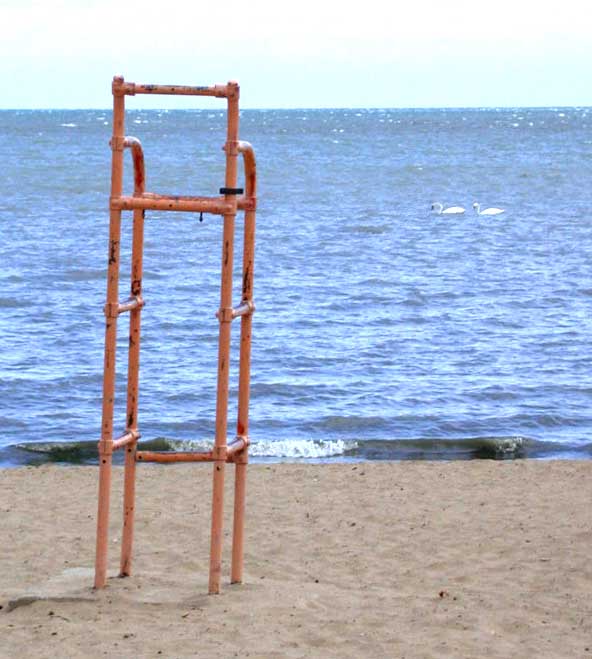

- Mitchell's Bay Beach, Mitchell's Bay, Ontario.
- New Baltimore Beach, New Baltimore, Michigan.
- Sandpoint Beach, located in Windsor, Ontario.
- Lakeview Park West Beach, located in Belle River, Ontario.
- Marine City Beach, Marine City, Michigan.
- Lake St Clair Metropark, Harrison Township, Michigan.
- Belle Isle Beach, Belle Isle, Michigan.
References
References
- "Shorelines of the Great Lakes". [[Michigan Department of Environmental Quality]].
- "Lake St. Clair summary report". Great Lakes.net.
- (June 2004). "Chapter 1:Introduction to Lake St. Clair and the St. Clair River". [[United States Army Corps of Engineers]].
- Jones, Terril Yue. (October 20, 2002). "Movement Would Thrust Greatness on Lake St. Clair". [[Los Angeles Times]].
- Jenks, William Lee. (2005). "St. Clair County, Michigan, its history and its people". University of Michigan Library.
- {{harvp. Jenks. 2005
- {{harvp. Jenks. 2005
- Fuller, George Newman. (2005). "Local History and Personal Sketches of St. Clair and Shiawassee Counties". [[University of Michigan]] Library.
- (January 2002). "The Crawford Knoll Site". Newsletter of the London Chapter, Ontario Archaeological Society.
- "Water Quality in Windsor". City of Windsor.
- "Thames–Sydenham Source Protection Region". Thames-Sydenham and Region Source Water Protection.
- "Mercury in Lake St. Clair Walleye". [[United States Environmental Protection Agency]].
- "Eating Ontario Fish". [[Ministry of the Environment and Climate Change]].
- "Eating Fish from Michigan's Lakes & Rivers". [[Michigan Department of Health and Human Services]].
- "Crescent Sail Yacht Club".
- "Clinton River Boat Club".
- "Albatross Yacht Club".
- "North Star Sail Club".
- "Lakeshore Sail Club".
- "South Port Sailing Club".
- "St. Clair Sail Club".
- "Thames River Yacht Club".
This article was imported from Wikipedia and is available under the Creative Commons Attribution-ShareAlike 4.0 License. Content has been adapted to SurfDoc format. Original contributors can be found on the article history page.
Ask Mako anything about Lake St. Clair — get instant answers, deeper analysis, and related topics.
Research with MakoFree with your Surf account
Create a free account to save articles, ask Mako questions, and organize your research.
Sign up freeThis content may have been generated or modified by AI. CloudSurf Software LLC is not responsible for the accuracy, completeness, or reliability of AI-generated content. Always verify important information from primary sources.
Report