From Surf Wiki (app.surf) — the open knowledge base
Lake Manasarovar
Freshwater lake in the Tibet Region

Freshwater lake in the Tibet Region
| Field | Value | |
|---|---|---|
| name | Lake Mansarovar | |
| native_name | bo | |
| image | Yaks-Kailash-Manasarovar.jpg | |
| caption | Lake Manasarovar with Mount Kailash in the background | |
| location | Burang County, Ngari Prefecture, Tibet Autonomous Region, China | |
| coords | ||
| area | 320 km2 | |
| max-depth | 100 m | |
| elevation | 4600 m | |
| frozen | Winter | |
| <!-- Map --> | pushpin_map | Tibet#China Tibet Ngari#China |
| pushpin_map_alt | Location of the lake in Tibet##Location within Ngari Prefecture | |
| pushpin_map_caption |
| max-depth = 100 m Lake Manasarovar (Sanskrit: मानसरोवर, Hunterian: Mānsarovara) also called Mapam Yumtso (; ) locally, is a high altitude freshwater lake near Mount Kailash in Burang County, Ngari Prefecture, Tibet Autonomous Region, China. It is located at an elevation of 4600 m, near the western trijunction between China, India and Nepal. It overflows into the adjacent salt-water lake of Rakshastal via the Ganga Chhu. The sources of four rivers: Indus, Sutlej, Brahmaputra, and Karnali lie in the vicinity of the region.
The lake is sacred in Hinduism, Buddhism, Jainism and the Bon religion. People from India, China, Nepal and other countries in the region undertake a pilgrimage to the region. The pilgrimage generally involves trekking towards Lake Manasarovar and a circumambulation of the nearby Mount Kailash.
Etymology
The Sanskrit word "Manasarovar" (मानसरोवर) is a combination of two Sanskrit words, Mānas (मानस्) meaning "mind" (generally denotes the mental powers associated including intellect, perception, conscience) and sarovar (सरोवर) meaning "lake or a large pond". The lake is called as Mapam Yumtso (; ) and Tso Madröpa locally. In his Tibetan-English dictionary, Sarat Chandra Das states that Mapam Yumtso is derived from Mapam meaning unconquerable or invincible and Tso Madröpa is derived from Madropa meaning "ground heated by the Sun" both used in combination with Tso, the Tibetan word for lake.
Geography
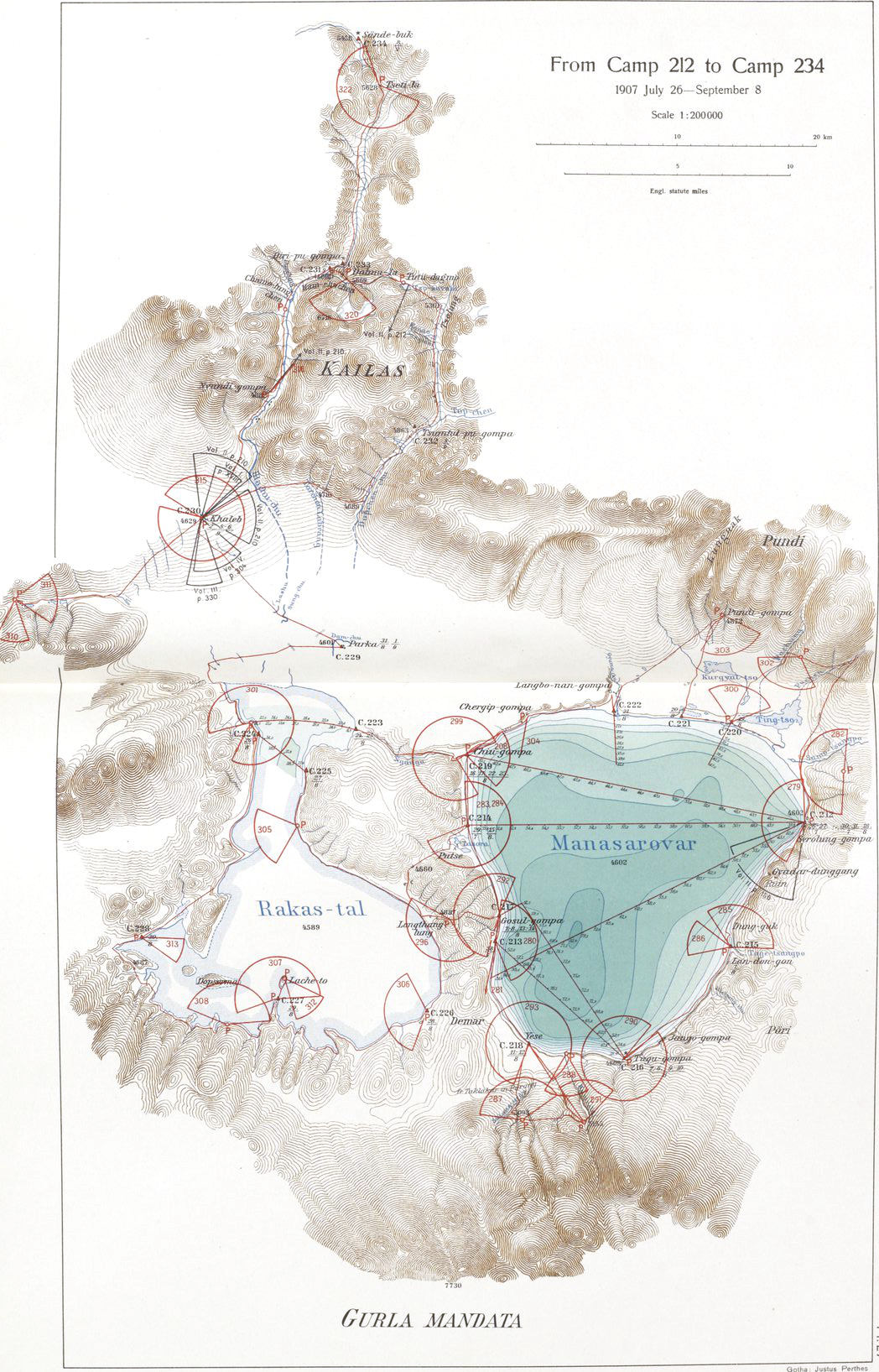
Lake Manasarovar is located in Ngari Prefecture, Tibet Autonomous Region of China. It is located in the southwest region of Tibet north of the western tripoint of the border between China, India and Nepal. It is visible from the Lapcha La pass above the Limi valley in Nepal on a clear day. The freshwater lake lies at 4600 m above mean sea level on the mostly saline lake-studded Tibetan Plateau and is one of the highest freshwater lakes in Asia.
Spread over a surface area of 320 km2, Lake Manasarovar is relatively round in shape with a circumference of 88 km and a maximum depth of 100 m. Manasarovar overflows into the salt-water endorheic lake of Rakshastal via the natural Ganga Chhu channel. The major rivers rising from the region include Yarlung Tsangpo (which becomes the Brahmaputra), the Indus, the Sutlej and the Karnali, a tributary of Ganges.
Climate
The weather is fairly dry during April to June with day time temperatures of more than 5 °C and night time temperatures close to 0 °C. The temperature starts to decrease in October with January being the coldest. Winters have day time temperatures below freezing with colder nights. Monsoons bring rain from late June to August with cold winds.
Global warming is described as happening more rapidly on the Tibetan Plateau than anywhere else in the world. According to locals, the land around the region has been growing warmer in recent years with winters not as cold as it used to be. The retreating glaciers and thawing of the permafrost in the Tibet region might lead to uncertain effects on water resources of the region. These effects along with population explosion and tourism has put severe stress on the fragile ecosystem.
Religious significance
Hinduism
Main article: Panch Sarovar
In Hindu literature, Mansarovar is mentioned by name in the Hindu epics Ramayana and Mahabharata. Though modern texts state the lake to be among the most sacred sites of Hinduism, there is no explicit mention of the lake in early Vedic literature. The Rigveda mentions that the Indus River flows north because of Indra, a geographical reality only in the Tibet region. According to Frits Staal, this makes it likely that some of the ancient Vedic people traced the route of the Indus river and had seen the valley near Mount Kailash.
The early Hindu texts mention a mythical Mount Meru and lake Manasa. The mythical Manasa lake is described as one created through the mind of Brahma as the preferred abode of his vahana hamsa. In the Ramayana, Vishvamitra tells Rama that Brahma created a lake out of his consciousness (Manas), hence the name Manas Sarovar (lake of consciousness) and a river was born out of that lake called Sarayu, which flowed through the kingdom of Ayodhya.
Mount Kailash on the banks of Lake Manasarovar is believed to be the abode of Shiva. This is where the holy river Ganges was tamed by Shiva and sent to nourish the fertile valleys below the Himalayas.
Buddhism and Bon

Lake Manasarovar and Mount Kailash are central to Buddhist cosmology, and a major pilgrimage site for some Buddhist traditions. Kailash is known as the mythological Mount Meru. In Buddhism, Kailash represents the father of the world and Lake Mansarovar symbolizes the mother. According to mythology, Maya bathed at Manasarovar to purify herself before Buddha could enter her womb. Numerous sites in the region are associated with Padmasambhava, who is credited with establishing Tantric Buddhism in Tibet in the 8th century CE. Vajrayana Buddhists believe that saint Milarepa () had a challenge with Naro Böncham, a follower of Bön religion on the banks of Manasarovar.
For the Bon people, the region was the centre of the ancient Bon empire of Zhang Zhung and is associated with the holy place of Zhang Zhung Meri deity. As per Tibetan beliefs, the region was the source of the mythical Lion, Horse, Peacock, and Elephant Rivers. When Tonpa Shenrab, the founder of the Bon religion, visited Tibet for the first time and bathed in the lake.
Jainism
In Jainism, Lake Manasarovar is associated with its founder and the first Tirthankara, Rishabhanatha. As per Jain scriptures, he attained nirvana on the Ashtapad Mountain. It is believed by Jains that after Rishabhanatha attained nirvana, his son emperor Bharata had constructed three stupas and twenty four shrines of the 24 tirthankaras in the region. There are other stories related to the region relating to Mahavira, Kumar and Sagar, Tapas Kher Parna, Ravana and Mandodari, among many others.
Pilgrimage
.jpg)
The lake has been mentioned in various Hindu and Buddhist religious literature. It was part of one of the oldest pilgrimage routes, which has been in existence for many years. Though modern texts state the lake to be among the most sacred sites of various religions, there is no explicit mention of the lake being a pilgrimage site in early literature. Typically, historic pilgrimage sites that were frequented by Buddhists, Hindus and Jains attracted discussion in their respective texts and the construction of infrastructure by wealthy patrons or kings. The Hindu Puranas indicate various infrastructure, such as temples, dharmasalas, ashrams, and pilgrimage facilities at such sites. But at least until the 1930s, there was no evidence of such structures in the Kailash-Manasarovar region. According to Luciano Petech, Tibetan records indicate that the region was considered to be their sacred geography by the late 12th-century, with reports of Buddhist monks meditating in the Go-zul cave of Kailash and circumambulating the mountain.{{cite book|url=https://books.google.com/books?id=V1GkmBOQLkAC|title=China and Tibet in the Early XVIIIth Century: History of the Establishment of Chinese Protectorate in Tibet|isbn=978-9-00403-442-6|author-link= Luciano Petech|author=Luciano Petech|year=1972|publisher=Brill Publishers}} According to Alex McKay, the possible synthesis of esoteric Buddhism and Shaivism may have expanded and brought Kailash and Manasarovar into the shared sacred geography for both Buddhists and Hindus. The 13th-century text Mahanirvana Tantra dedicates it first chapter to Kailash and Manasarovar lake as a pilgrimage site.

Due to its perceived sacredness to various religions, people undertake a pilgrimage called yatra to the Kailash-Manasarovar. Pilgrimage to the mountain increased in the 1930s but was affected later due to both China and the British Empire claiming the region. Religious pilgrimages to Mount Kailas and Manasarovar were permitted by China after its occupation of Tibet in 1950-51. While pilgrimage from India was guaranteed by the 1954 Sino-Indian Agreement, access was restricted after the subsequent 1959 Tibetan uprising, and the borders were closed after the Sino-Indian War in 1962. After nearly two decades, pilgrimage from India was allowed in 1981 after an agreement between the governments of India and China. The pilgrimage was suspended for three years since 2020 due to the COVID-19 pandemic. The route was re-opened in 2023 with new regulations. Since the reopening of the pilgrimage route from India in 1981, the numbers of pilgrims going on the annual yatra has grown considerably. Before the closure in 2020, several thousand pilgrims from India were going to this pilgrimage every year.

In India, the pilgrimage is organized by the Government of India and is permitted between June and September. Since 2015, aspiring pilgrims from India were required to apply in advance to the Ministry of External Affairs and specific number of passes were issued to pilgrims by computerized random selection with preference given to first timers. Pilgrims from India travel through two routes opened for the purpose, with border crossings at Lipu Lekh pass in Uttarakhand and the Nathu La pass in Sikkim. Since 2020, a motorable road is available till the Lipu Lekh pass through the Indian side of the Mahakali valley, before crossing over to China. The Nathu La route was opened in 2015 and involves traveling to Gangtok before crossing the Nathu La pass into China.

As the April 2015 Nepal Earthquake resulted in the closure of the border crossing at Tatopani-Zangmu, the pilgrimage from Nepal is generally done from the nearby Humla district in northwestern Nepal. Another route exists through the crossing at Rasuwa-Gyirong. Pilgrims could reach Lhasa by air before the journey to Lake Manasarovar.
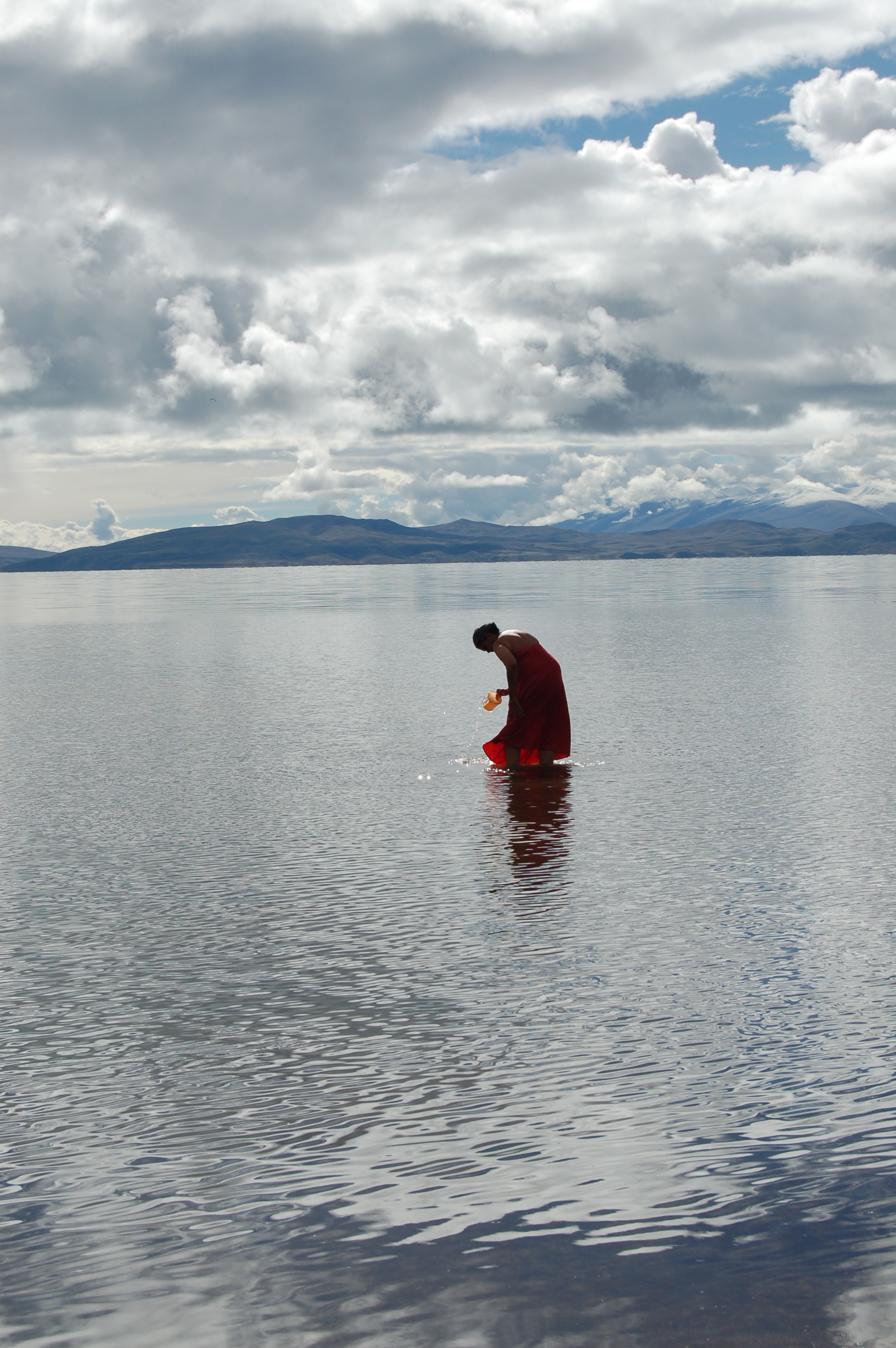
The pilgrimage involves trekking towards Lake Mansarovar and a circumambulation of Mount Kailash. The path around Mount Kailash is 53 km long. The circumambulation known as kora, is made in a clockwise direction by Hindus, Buddhists, and Jains, while Bönpos circumambulate the mountain in a counterclockwise direction. Pilgrims believe that bathing in the lake and circling the mountain is a spiritually beneficial practice that can bring various positive effects, such as the cleansing of one's sins. For the Khas people of the nearby region of Humla in northwest Nepal, a ritual bath in the lake is an important step in gaining their shamanic powers. There are many stupas, flag poles, Buddhist monasteries and praying stations on the banks of the lake, many of which were destroyed during the Cultural Revolution of China from 1966 to 1976.
Notes
References
References
- (3 June 2018). "Geographical names of Tibet AR (China): Ngari prefecture". Institute of the Estonian Language.
- (2013). "Pilgrimage in Tibet". [[Routledge]].
- "Monier-Williams Sanskrit-English Dictionary". [[Monier-Williams]].
- "Monier-Williams Sanskrit-English Dictionary". [[Monier-Williams]].
- Das, Sarat Chandra. (1902). "Tibetan-English Dictionary with Sanskrit Synonyms". Bengal Secretariat Book Depot.
- "Mount Kailas".
- Samkar, Nyima. (2020). "Mount Kailash: the White Mirror". [[Library of Tibetan Works and Archives]].
- Claude Arpi. (23 February 2024). "China playing new border games close to Mt Kailash". [[Deccan Chronicle]].
- (13 March 2021). "Limi-Lapcha could be an alternative route to Kailash Manasarovar". [[The Himalayan Times]].
- Brockman, Norbert. (2011). "Encyclopedia of Sacred Places, Volume 1". [[ABC-Clio]].
- Likens, Gene. (2009). "Encyclopedia of Inland Waters". [[Elsevier Science]].
- "Lake Mansarovar". [[Government of Uttarakhand]].
- Likens, Gene. (2010). "Lake Ecosystem Ecology: A Global Perspective". [[Elsevier Science]].
- John Vincent Bellezza. (2024). "A Comprehensive Survey of Rock Art in Upper Tibet: Volume III". [[Archaeopress]].
- Freeman Attwood. (2003). "Gangdise Mountains". [[Alpine Journal]].
- Singh, Dhruv Sen. (30 December 2017). "The Indian Rivers: Scientific and Socio-economic Aspects". [[Springer Publishing]].
- "Tibet Weather". Tibet tour.
- (12 May 2006). "Kailash Yatra". [[Government of India]].
- Qiu, Jane. (1 July 2008). "China: The third pole". Nature.
- (15 September 2019). "The world has a third pole – and it's melting quickly". [[The Guardian]].
- (9 January 2019). "Ignoring climate change in the Himalayas". The Third Pole.
- Tanguang Gao. (23 April 2021). "Accelerating permafrost collapse on the eastern Tibetan Plateau". Environmental Research Letters.
- (22 June 2009). "Kailash Sacred Landscape Conservation Initiative: Feasibility Assessment Report". [[ICIMOD]].
- McKay, Alex. (2015). "Kailas Histories: Renunciate Traditions and the Construction of Himalayan Sacred Geography". [[Brill Publishers]].
- Eckard Schleberger. (1997). "Die Indische Götterwelt". Eugen Diederich Verlag.
- [[Valmiki]]. "Ramayana".
- Archer, W. G.. (1973). "Indian paintings from the Punjab Hills : a survey and history of Pahari miniature painting". [[Oxford University Press]].
- Flood, Gavin. (1996). "An Introduction to Hinduism". [[Cambridge University Press]].
- Buswell, Robert. (2004). "Encyclopedia of Buddhism: A-L". [[Macmillan Publishers]].
- (1966). "The Way of the White Clouds: A Buddhist Pilgrim in Tibet". [[Shambhala Publications]].
- (2015). "Lonely Planet Tibet". [[Lonely Planet]].
- "Padmasambhava". [[Britannica]].
- (2003). "Discoveries in Western Tibet and the Western Himalayas". [[Brill Publishers]].
- Gyatso, Tenzing. (2022). "The Fourteenth Dalai Lama's Stages of the Path, Volume 1". [[Wisdom Publications]].
- Batchelor, Stephen. (1987). "The Tibet Guide". [[Wisdom Publications]].
- Albinia, Alice. (2008). "Empires of the Indus: The Story of a River". [[John Murray (publishing house).
- Allen, Charles. (2013). "A Mountain in Tibet: The Search for Mount Kailas and the Sources of the Great Rivers of Asia". [[Little, Brown Book Group.
- "Rishabhanatha".
- Rai, Champat. (1929). "Riṣabha Deva, the Founder of Jainism". Indian Press.
- (2009). "Faith & Philosophy of Jainism". Kalpaz Publications.
- (30 December 2011). "'Lost' tirth of Jains traced to Himalayas - Latest News & Updates at Daily News & Analysis". DNA India.
- "Jainism Literature Center - Rituals".
- (1985). "India: Art and Culture, 1300-1900". [[Metropolitan Museum of Art]].
- (2011). "To a Mountain in Tibet". [[Chatto & Windus]].
- "Kailash Mansarovar Yatra". [[Government of Uttarakhand]].
- "Mount Kailas".
- (7 April 2022). "Kailash-Mansarovar yatra unlikely to resume this year, say officials". [[The Hindu]].
- (8 May 2023). "Pilgrims to Kailash discouraged by new Chinese rules". [[Kathmandu Post]].
- (19 May 2023). "Kailash Masarovar Yatra hits hurdles ahead of opening next month". [[The Indian Express]].
- (2011). "Kailash Sacred Landscape Conservation Initiative: Feasibility Assessment Report". [[International Centre for Integrated Mountain Development]].
- "Kailash Manasarovar Yatra likely to see record numbers". [[Kathmandu Post]].
- (16 May 2019). "First-time pilgrims get preference for Mansarovar Yatra". [[The Hindu]].
- "Mansarovar Yatra: First-time pilgrims get preference in computerized draw of lots". [[The Economic Times]].
- "Kailash Manasarovar Yatra". [[Government of India]].
- (11 May 2020). "New road to Kailash Mansarovar via Lipulekh Pass and why Nepal is objecting to it". [[The Print]].
- (15 May 2015). "Alternate Route for Kailash-Mansarovar Yatra Will Become Operational Next Month: PM Modi". [[NDTV]].
- (2024). "Kathmandu Chronicle:Reclaiming India–Nepal Relations". [[Penguin Random House]].
- "A Personal Account of Border Crossing Reveals the Deep Ties Between Nepal, China". [[The Wire (India).
- Macfarlane, Robert. (2012). "The Old Ways: A Journey on Foot". [[Penguin Books]].
- (1999). "Circling the Sacred Mountain: A Spiritual Adventure Through the Himalayas". [[Bantam Books]].
- Berreman, Gerald Duane. (1972). "Hindus of the Himalayas: Ethnography and Change". [[University of California Press]].
- (2018). "Kailash Yatra: a Long Walk to Mount Kailash through Humla". [[Penguin Random House]].
This article was imported from Wikipedia and is available under the Creative Commons Attribution-ShareAlike 4.0 License. Content has been adapted to SurfDoc format. Original contributors can be found on the article history page.
Ask Mako anything about Lake Manasarovar — get instant answers, deeper analysis, and related topics.
Research with MakoFree with your Surf account
Create a free account to save articles, ask Mako questions, and organize your research.
Sign up freeThis content may have been generated or modified by AI. CloudSurf Software LLC is not responsible for the accuracy, completeness, or reliability of AI-generated content. Always verify important information from primary sources.
Report