From Surf Wiki (app.surf) — the open knowledge base
Lake freighter
North American Great Lakes "boats" (ships)
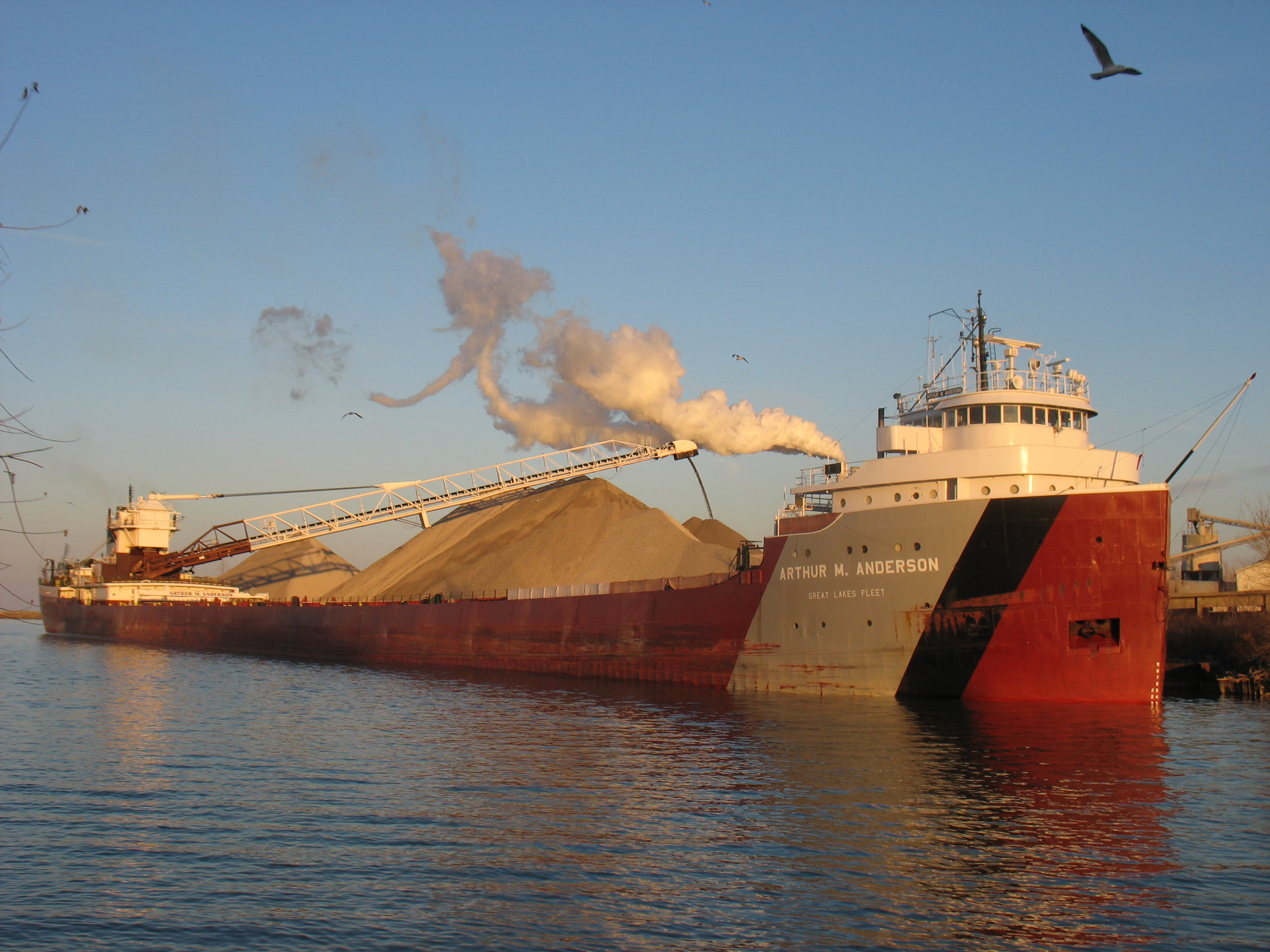
North American Great Lakes "boats" (ships)
Lake freighters, or lakers, are bulk carriers operating on the Great Lakes of North America. These vessels are traditionally called boats, although classified as ships. Freighters typically have a long, narrow hull, a raised pilothouse, and the engine located at the rear of the ship.
Lakers have been used since the late 19th century to haul raw material from docks in the Great Lakes and St Lawrence Seaway regions to the industrial centers of Ontario, Quebec, and the American Midwest. The navigation season typically runs from late March through next mid-January due to the formation of ice on the lakes.
The largest lake freighters can travel up to 15 kn and can carry as much as 78,850 LT of bulk cargo.
, which sank in 1975, became widely known as the largest vessel to be wrecked on the Great Lakes.
History
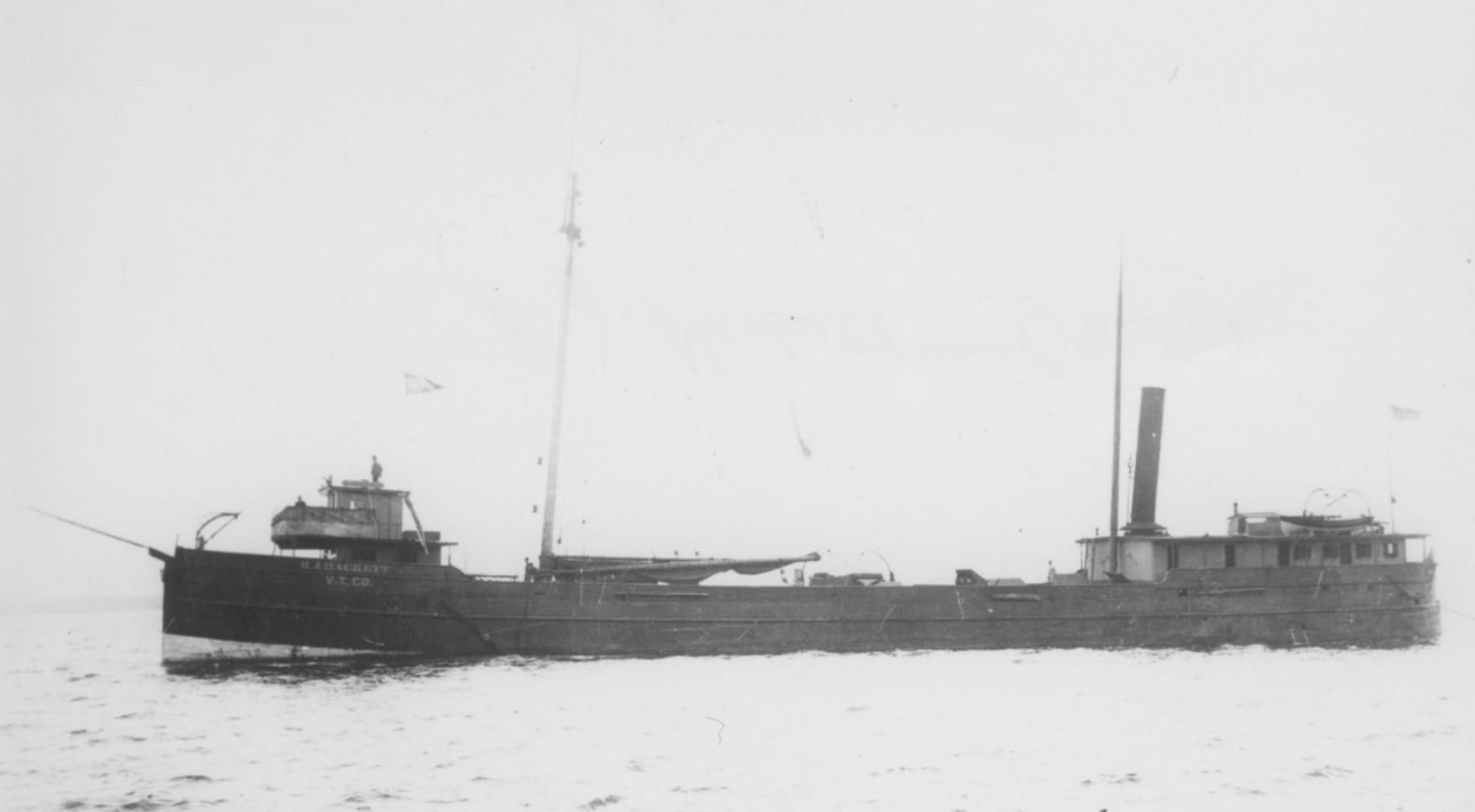
The lake freighter's recognizable design emerged from many years of innovation in Great Lakes shipping. By the late 1860s, most bulk cargo was still carried by unpowered barges and sailing ships. Often, these ships had accessible deck hatches, useful for loading and unloading cargo. Also around this time, passenger steamboats were gaining popularity for their steam-powered shipping abilities, which were faster and more reliable.
In 1869, the wood-hulled was launched. It was designed specifically for the iron ore trade and had an experimental design that would soon set the standard for subsequent bulk carriers on the Great Lakes. R. J. Hackett featured a raised pilothouse at the bow, situated on top of a set of cabins, and a boxy hull to maximize cargo capacity. Between the raised forecastle and engine funnel at the stern was a long, unbroken deck lined with hatches spaced 24 ft apart. This spacing was to match the chutes of the gravity ore dock in Marquette, Michigan. [[File:Soo Locks 19th Century.jpg|thumb|The State Lock at the Michigan State Locks (now [[Soo Locks]])]]
The falls of the St. Marys River forced ships to portage their cargo 1.25 mi around the falls. In an effort to make shipping more efficient and profitable, Michigan representatives appealed to the federal government for funding to build a canal. In 1855, the Michigan State Locks (now Soo Locks) opened, allowing vessels to keep up with demands for iron ore from further east. This would fuel the development of bulk carriers on the Great Lakes.
Early lakers often had a wooden hull, or a composite hull consisting of an oak frame wrapped in iron plating. With the depletion of high-quality timber near the lakeshore, shipbuilders increasingly opted for metal hulls. In 1881 and 1882, the first entirely iron-hulled freighters, Brunswick and , were launched. Around this time, steel was quickly becoming a standard hull material as a result of the Bessemer process making it more affordable. The first steel-hulled freighter, Spokane, launched in 1886. Soon both iron and composite hulls were phased out. Wood was used for smaller vessels into the early 1900s.

An early variation on the lake freighter was the whaleback, designed by Alexander McDougall. These had cigar-shaped bodies that barely rose out of the water when fully loaded, and carried bulk cargo on the lakes from 1888 through 1970.
The early lake freighters required cargo to be manually unloaded, or with assistance from unloading machinery at the docks. In 1902, Hennepin was the first ship to be retrofitted with self-unloading equipment, allowing its cargo to be landed in a fraction of the time.
Around 1916, 600 ft vessels more or less became the standard size.
After World War II, several oceangoing freighters and tankers were transported to the Great Lakes and converted to bulk carriers as a way to acquire ships cheaply. The oil tanker became the bulk freighter MV Lee A. Tregurtha In addition, the freighter Outer Island was originally commissioned as LCT-203 for use as a tank landing craft during World War II.
In the mid-20th century, 300 lakers worked the lakes, but by the early 21st century, there were fewer than 140 active. By the 1990s, older and smaller self-unloaders and straight-deck freighters were converted into tug-barges.
Landmark vessels
| Name | Launched | Notes | ||||||
|---|---|---|---|---|---|---|---|---|
| R. J. Hackett | 1869 | First of the lake freighters. R. J. Hackett burned at Whaleback Shoal in 1905. | ||||||
| Brunswick | 1881 | First iron-hulled lake freighter. | ||||||
| {{SS | Onoko | 2}} | 1882 | |||||
| Spokane | 1886 | First steel-hulled lake freighter. | ||||||
| {{SS | Hennepin | 2}} | 1888 | |||||
| SS Western Reserve | 1890 | last=Heinz | first=James | title=The Wreck of the Western Reserve | work=Wisconsin Marine Historical Society | date=July 23, 2023 | access-date=March 13, 2025 | url=https://wmhs.org/the-wreck-of-the-western-reserve-steinbrenner-story-chapter-two/ }} |
| Wyandotte | 1908 | First ship built as a self-unloader. | ||||||
| Henry Ford II, {{ship | Benson Ford | 1924 ship | 2}} | 1924 | ||||
| S. T. Crapo | 1927 | The last coal-fired freighter on the Great Lakes. In 1995, the ship's boiler was converted to be oil-firing. The 95-year-old ship was scrapped in 2022. | ||||||
| Feux Follets | 1967 | Last ship built with a steam turbine. | ||||||
| Stewart J. Cort | 1972 | title=M/V Stewart J. Cort Interlake Steamship | url=https://www.interlake-steamship.com/our-fleet/m-v-stewart-j-cort/ | access-date=April 29, 2024 | website=www.interlake-steamship.com | date=January 31, 2024 }} | ||
| Presque Isle | 1973 | The first 1,000-foot integrated tugboat/barge and the second 1,000 footer overall. | ||||||
| {{ship | James R. Barker | 1976 ship | 2}} | 1976 | ||||
| {{MV | Edwin H. Gott | 2}} | 1978 | |||||
| {{MV | Paul R. Tregurtha | 2}} | 1981 |
Types of lake freighters
The many lake freighters operating on the Great Lakes can be differentiated by how they are used. They may be classified according to where they work, their design, their size, or other factors. The ships are not always exclusive to one category. These types include:
- Laker – a bulk carrier operating primarily in the upper Great Lakes.
- Longboats – lakers noted for their slender appearance.
- Oreboat/Ironboat – a bulk carrier used primarily to transport iron ore and taconite pellets.
- Saltie – ocean-going, seawaymax vessels that access the Great Lakes through the Saint Lawrence Seaway.
- Self-unloader – a lake freighter equipped with self-unloading gear.
- Stern-ender – a lake freighter with all cabins aft.
- Straight decker (bulker) – a freighter built without conveyors and cranes to offload cargo, instead using port facilities.
- Tug-barge - a bulk carrier created by pairing barges (former self-unloaders and straight-deckers) with a tugboat.
Some of the newer classes of lake freighters include:
- – a new class of lake freighter, several of which entered service in the 2010s for Seaway Marine Transport, a division of Algoma Central. A class of vessel is created any time a new design is used to build a ship and is notable when multiple ships are built to the same design plans. The ships are used as dry-bulk lake freighters (two gearless bulk freighter and three self-unloading vessel). The first in the series, , was launched in 2013.
- – a new class of lake freighter delivered for Canada Steamship Lines in 2012 () and 2013 (, and ). An additional pair (CSL Welland and CSL St. Laurent) began service on the Great Lakes in 2015.
- – a new class of lake freighter, one of which, , was commissioned by Interlake Steamship Company and entered service on July 1, 2022.
Cargo
| Source: "Cargo Reports – Year-in-Review 2023 – U.S.-Flag Vessels" |
|---|
In 2023, 81.4 million tons of cargo were shipped on the Great Lakes. The most common cargoes include taconite, limestone, grain, salt, coal, cement, gypsum, and sand. The cargo is carried in large contiguous holds, not packed into containers.
The iron ore transported from the upper Great Lakes primarily supplies the steel mills of the Midwest. Iron ore makes up a majority of the cargo shipped annually.
The 1940s saw the rise in the use of taconite pellets, as sources of higher quality ore diminished.

Other destinations include coal-fired power plants, highway department salt domes, and stone docks, where limestone is unloaded for the construction industry. U.S.-flagged freighters carried the largest portion of the trade, accounting for two-thirds of all cargo by weight. U.S. hulls carried most of the iron, limestone and cement, while Canadian boats carried most of the potash, and almost all of the salt and grain moved on the lakes.
Destination harbors, ship sizes, and legal restrictions greatly affect the pattern of haulage. Large U.S. ships hauled most of the iron ore on the lakes (79%) from U.S. mines to U.S. mills. This reflects the requirement of the Jones Act, as well as the industry using large volumes of material while being concentrated in a few large harbor locations. Salt and Canadian grain can be hauled to numerous smaller ports of either country on smaller, mostly Canadian, ships, which can also enter the St. Lawrence Seaway with the Canadian ports of Montreal and Quebec City.
Because of their deeper draft and freshwater's lower buoyancy, salties often take on partial loads. Conversely, the Seaway allows smaller lakers to access the Atlantic Ocean. The larger, newer ships are restricted to the upper lakes.
Design
Lakers feature a design distinct from their ocean-going counterparts. Because of the R. J. Hackett (1869), lake freighters typically had the bridge and associated superstructure at the bow. Additionally, a second island would be located over the engine room in the stern. In 1974, was the final vessel designed this way.


Lake vessels are designed with the greatest block coefficient to maximize the vessel's size in the locks within the Great Lakes/St Lawrence Seaway system. Therefore, ship designers have favored bluff bows over streamlined bows.
Another distinguishing feature of lake vessels versus ocean vessels is the cargo hatch configuration. On the lake vessels, the hatches are traditionally spaced 24 ft apart. This configuration was needed to match the chutes at loading facilities.
Since Great Lakes waves do not achieve the great length or period of ocean waves, particularly compared to the waves' height, ships are in less danger of being suspended between two waves and breaking, so the ratio between the ship's length, beam and its depth can be larger than that of an ocean-going ship. The lake vessels generally have a 10:1 length to beam ratio, whereas ocean vessels are typically 7:1.
Size

The size of a lake freighter determines where it may work. The shallow draft imposed by the St. Marys River and Lake St. Clair restrict the cargo capacity of lakers. Poe Lock at the Soo Locks is the largest deep lock at 1,200 ft long and 110 ft wide.
Many of the larger American ships are unable to navigate the locks of the St. Lawrence Seaway, which restricts vessel size to 740 ft in length and 78 ft in breadth. Seawaymax vessels are able to access the Great Lakes and the ocean. The Canadian fleet needs to travel to and from its major cities along the St. Lawrence Seaway, so the largest length for the Canadian vessels is 740 ft.
Lake boats in the 600 and classes are more common, because of the limitations of the Welland Canal. These vessels vary greatly in configuration and cargo capacity, being capable of hauling between 10,000 and 40,000 tons per trip depending on the individual boat. The smaller boats serve smaller harbors around the lakes which have irregular need for their services.
Another reason for the lack of larger Canadian vessels is legislative in nature. Larger ships on the lakes are generally used to transport American-mined ore bound for American mills. Because of the Jones Act of 1920, only American ships can carry ore from American mines to American mills in American ports; ergo, larger Canadian ships are not needed.
1000-footers
These are the largest vessels on the lakes. Thirteen were built between 1976 and 1981, and all remain in service today. These are all U.S.-flagged vessels between 1000 and long, 105 ft wide and of 56 ft hull depth.
| Name | Type | Dimensions | Cargo capacity | Notes | ||
|---|---|---|---|---|---|---|
| {{MV | American Integrity | 2}} | Bulk freighter (self unloading) | 1,000 ft × 105 ft | 89,000 tons | |
| American Spirit | Bulk freighter (self unloading) | 1,004 ft × 105 ft | 80,900 tons | |||
| {{MV | American Century | 2}} | Bulk freighter (self unloading) | 1,000 ft × 105 ft | 73,700 tons | |
| {{MV | Edgar B. Speer | 2}} | Bulk freighter (self unloading) | 1,004 ft × 105 ft | 80,900 tons | |
| {{MV | Edwin H. Gott | 2}} | Bulk freighter (self unloading) | 1,000 ft × 105 ft | ||
| {{ship | James R. Barker | 1976 ship | 2}} | Bulk freighter (self unloading) | 1,000 ft × 105 ft | |
| {{ship | Mesabi Miner}} | Bulk freighter (self unloading) | 1,004 ft × 105 ft | |||
| {{ship | Paul R. Tregurtha}} | Bulk freighter (self unloading) | 1,013.5 ft × 105 ft | 68,000 tons | ||
| Stewart J. Cort | Bulk freighter (self unloading) | 1,000 ft × 105 ft | title=Great Lakes Fleet Page Vessel Feature -- Stewart J. Cort | url=http://www.boatnerd.com/pictures/fleet/cort.htm | website=Boat Nerd}} | |
| {{MV | Burns Harbor | 2}} | Bulk freighter (self unloading) | 1,000 ft × 105 ft | ||
| {{MV | Indiana Harbor | 2}} | Bulk freighter (self unloading) | 1,000 ft × 105 ft | ||
| {{MV | Walter J. McCarthy Jr. | 2}} | Bulk freighter (self unloading) | 1,000 ft × 105 ft | 80,120 tons | |
| Presque Isle | Tug/barge combination | 1,000 ft × 104 ft 7 in | Only 1000 ft tug/barge combination unit |
Lifespan

Modern lakers are usually designed and constructed for a 45-50 year service life, outlasting ocean-going bulk carriers. As of 2023, ocean-going bulk freighters average an 11-year lifespan, due in part to the corrosive effects of saltwater.
Some of the lakers have been known to have long careers. The launched in 1906 and worked independently until 2013. The St. Marys Challenger is still in service as a barge at 118 years old. E. M. Ford had one of the longest careers, having been built in 1898 until being sold for scrap in November 2008.
Some shipping companies are building new freighters to ply the waters of the Great Lakes. The following are new freighters in use or will be launched for use in the Great Lakes:
- – built by Chengxi Shipyard of Jiangyin, China, delivered in August 2011 for Algoma Central Corporation.
Ship losses and incidents

The Great Lakes have a long history of shipwrecks, groundings, storms, and collisions. From the 1679 sinking of Le Griffon with its cargo of furs to the 1975 loss of Edmund Fitzgerald, thousands of ships and thousands of lives have been lost, many involving vessels in the cargo trade. The Great Lakes Shipwreck Museum uses the approximate numbers of 6,000 ships and 30,000 lives lost. David D. Swayze has compiled a list which details over 4,750 well-documented shipwrecks, mostly of commercial vessels and a list of known names of over 5,000 victims of those sinkings. Maritime historian Mark Thompson reports that based on nautical records, nearly 6,000 shipwrecks on the Great Lakes occurred between 1878 and 1994, with about a quarter of those being listed as total losses with a total of 1,166 lives lost.
The most recent losses of modern lakers were:
- , November 10, 1975, Lake Superior, 29 of 29 crew died, (unknown cause during a storm)
- , November 29, 1966, Lake Huron, 28 of 29 crew died, (split in half by hogging during a storm)
- , May 7, 1965, Straits of Mackinac, 10 of 35 crew died, (collision with the saltie Topdalsfjord)
- , November 18, 1958, Lake Michigan, 33 of 35 crew died, (split in half by hogging during a storm)
- , June 20, 1953, Lake Superior, 1 of 29 crew died, (rammed by freighter Burlington in heavy fog)
- , May 11, 1953, Lake Superior, 17 of 31 crew died, (flooded after the cargo hatch covers were lost during a storm)
- SS Emperor, June 4, 1947, Lake Superior, 12 of 33 crew died, (ran into rocks at Isle Royale)
- SS Superior City, August 20, 1920, Lake Superior, 29 of 33 crew died, (collision with freighter Willis L. King) The salties Prins Willem V and Monrovia sank in the Great Lakes during the 1950s; both in collisions with other ships. The saltie Francisco Morazan was a total loss after running aground off South Manitou Island on November 29, 1960. Another saltie Nordmeer grounded on Thunder Bay Island Shoal in November 1966, but before it could be refloated, it was further damaged in the same storm that sank the Morrell and was declared a total loss.
Ships on the lakes have been involved in many lesser incidents. Lakers have been subject to frequent groundings in ports and channels because of varying lake levels and silting, collisions with objects (such as the 1993 collision of the Indiana Harbor with the Lansing Shoals Light Station), icing in during winter trips and shipboard fires (including the unusual case in 2001 where a drawbridge ran into the Canadian grain carrier Windoc causing a fire). To prevent collisions and groundings, the Great Lakes are well-served with lighthouses and lights, and floating navigation aids. The U.S. Coast Guard and Canadian Coast Guard maintain stations around the Great Lakes including icebreakers and rescue helicopters. The U.S. Army Corps of Engineers and other agencies maintain the harbors and seaways to limit groundings by dredging and seawalling.
November was the traditional last month of shipping before the winter layup (and lake freeze-up). During November, much of the worst weather of the navigation season occurs which has resulted in a disproportionate number of accidents. One study shows that over half of all strandings and one-third of all vessels lost to foundering between 1900 and 1950 were lost during November.
Famous vessels
.jpg)
The most well-known lake freighter was Edmund Fitzgerald, which sank during a storm on Lake Superior on November 10, 1975. Gordon Lightfoot's ballad, "The Wreck of the Edmund Fitzgerald", publicized the incident. The Edmund Fitzgerald became the largest ship on the lakes at 729 ft when launched in 1958. In addition to this, the ship was regarded for its "DJ Captain", Peter Pulcer, who frequently played music to entertain onlookers.
. launched in 1952, is known for having last contact with Edmund Fitzgerald and was the first vessel on-scene to search for the Edmund Fitzgerald.
MV Paul R. Tregurtha currently holds the title "Queen of the Lakes" as the largest ship on the lakes since launching in 1981. The modern stern-ender was first launched MV William J. Delancy and measures 1013.5 feet (308.9 m).
Notable vessels
Onoko was the second iron-hulled laker, launched in 1882. At 302 ft, Onoko was the longest ship on the lakes and became the first bulk carrier to hold the unofficial title of "Queen of the Lakes". The title that has been passed down to record-breaking lake freighters since. held the title for 22 years, longer than any other laker of the classic design.
Ford Motor Company's Henry Ford II and of 1924 were the first lakeboats with diesel engines. The Canadian grainboat Feux-Follets of 1967 was the last laker built with a steam turbine on the lakes.[[File:Paul R. Tregurtha.jpg|thumb|right| on winter lay-up in [[Sturgeon Bay, Wisconsin]], on February 19, 2008.]]
Wilfred Sykes (1949 – 678 ft) is considered to be the first of the modern lakers, and when converted to a self-unloader in 1975 was the first to have the equipment mounted aft. Since then all self-unloading equipment has been mounted aft. Algoisle (formerly Silver Isle) (1962 – 715.9 ft) was the first modern laker built with all cabins aft (a "stern-ender"), following the lead of ocean-going bulk carriers and reprising a century old form used by little river steam barges and the whalebacks. (1974–2015 730 ft) was the last laker built in the classic style.
Also of note is the steamer , widely known for her artistic design and being the only remaining straight-decker still in active service on the US side of the Great Lakes. In mid 2006, Edward L. Ryerson was fitted out and put into service following a long-term lay-up that began in 1998. Edward L. Ryerson has been in long-term layup since 2009.
Museum ships and surviving hulls
Museum ships
Cleveland, Ohio
The was first built in 1925 and served as the Cleveland-Cliffs Iron Company's flagship until 1980. In 1987, the ship was donated to the Great Lakes Historical Society for restoration and preservation. In 2005, the ship was moved to its present location at Cleveland's North Coast Harbor. Then, in 2006, the ship was acquired by the Great Lakes Science Center for use as a museum ship. The ship is available to tour seasonally.
Duluth-Superior, Minnesota-Wisconsin
The served as the flagship of U.S. Steel's Great Lakes fleet from 1938 to 1975. The William A. Irvin was retired in 1978 and purchased eight years later by the Duluth Entertainment Convention Center and is available for touring.
The SS Meteor, the last surviving whaleback ship, floats as a museum less than a mile from where it was launched in Superior, Wisconsin. The ship is permanently land-berthed on Barker's Island.
Sault Ste. Marie, Michigan
launched as Louis W. Hill in 1917 and transported cargo until retiring in 1966. Two years later, in 1968, the ship arrived in Sault Ste. Marie Michigan on July 6, during the town's tri-centennial celebrations for use as a museum ship. The museum ship displays many relics of the sinking of Edmund Fitzgerald including two of Edmund Fitzgeralds mauled lifeboats.
.jpg)
Toledo, Ohio
The 120-year-old SS St. Mary's Challengers pilothouse is displayed at the National Museum of the Great Lakes' museum.
The (formerly Willis B. Boyer) floats in the Maumee River as a museum ship for the National Museum of the Great Lakes. When launched in 1911, it was the largest bulk freighter in the world. The Col. James M. Schoonmaker formerly served as a floating museum after being purchased by the City of Toledo, Ohio in 1987.
Surviving hulls and partial ships
DeTour Village, Michigan
Lewis G. Harrimans bow and bow superstructure are preserved as a residence in DeTour, Michigan. The ship was christened as the SS John W. Boardman in 1923. In 1965, the John W. Boardman was renamed Lewis G. Harriman and used to store cement during the Poe Lock construction in Sault Ste. Marie, Michigan. The ship was sold for scrap 2003, but the pilothouse and hull of Lewis G. Harriman were saved and now are used as a residence along the lake shore.
SS John Sherwin, not sailed since 1981, is currently docked at the Interlake Steamship Dock in DeTour, Michigan after conversion to a self-unloader and repowering was halted in November 2008.
Detroit, Michigan
The pilothouse of SS William Clay Ford is part of the Dossin Great Lakes Museum on Belle Isle. The pilothouse is open for tours and overlooks the Detroit River.
Mississauga, Ontario
SS Ridgetown was partially sunk as a breakwater (with stack and cabins intact) near Toronto at Port Credit. It was built in 1905 and is one of the oldest surviving hulls on the lake. Its silhouette provides an example of the appearance of early 1900s lake freighters.
South Bass Island, Ohio
MV Benson Ford was the flagship of the Ford Motor Company fleet when launched in 1924. The forward cabin and pilothouse was moved in 1986 to a cliff on South Bass Island, near the village of Put-in-Bay, Ohio in Lake Erie. It has been a private island residence since 1999 and they offer tours on select dates.
Failed museum attempts, ships scrapped

Several other lakers nearly became museums, but were scrapped for lack of funding, political opposition, and other causes.
- SS Niagara: 1897-built freighter, later converted to a sand-sucker. Scrapped in 1997 by Liberty Iron & Metal of Erie, Pennsylvania, after a failed attempt to convert the ship into a museum in Erie. She had been saved from the scrapyard 11 years earlier.
- John Ericsson: The second-to-last whaleback freighter. John Ericsson was scrapped in 1969 in the city of Hamilton, Ontario. Politics, as was the case with Canadiana, played a central role in the loss of the ship.
- SS Seaway Queen: The Canadian straight decker Seaway Queen, formerly owned by Upper Lakes Shipping, and the setting for the movie version of David Mamet's play Lakeboat, was involved in an attempt to save the ship as a museum. In the end, the company failed to locate an organization that was capable and willing to preserve the ship and she was sold and scrapped in Alang, India, in 2004.
- J. B. Ford: 1904 freighter that survived the 1905 Mataafa storm and the Great Lakes Storm of 1913 with the last three-cycle reciprocating steam engine was too expensive to turn into a museum and was sent to Azcon Metals in Duluth to be scrapped in 2015.
References
References
- (1998). "Cruising Guide to New York Waterways & Lake Champlain". Pelican Publishing.
- (1991). "Steamboats & Sailors of the Great Lakes". Wayne State University Press.
- LCA. "Icebreaking FAQs".
- Thompson, Mark L.. (1991). "Steamboats & Sailors of the Great Lakes". Wayne State University Press.
- "Hackett, R.J.". Bowling Green State University University Libraries.
- Brotherton, R. S.. (1955). "The Soo Locks – One Hundred Years Ago".
- "iron ore & taconite".
- Lengieza, Joseph. (April 2016). "Vernacular in Curves: The Mythologizing of the Great Lakes Whaleback". East Carolina University.
- Thompson, Mark L.. (1994). "Queen of the Lakes". Wayne State University Press.
- "Whaleback Boats on the Great Lakes {{!}} Minnesota Digital Library".
- [https://books.google.com/books?id=aNwDAAAAMBAJ&pg=PA74 "Giant Jaws Upload Ore Ship"]. ''Popular Mechanics'', May 1953, pp. 74–77.
- Harkins, Wesley. (November 1954). "Iron Ore Traffic on the Great Lakes". U. S. Naval Institute.
- Wharton, George. (April 20, 2021). "Lee A. Tregurtha".
- "LCT-203 - Historical Collections of the Great Lakes - BGSU University Libraries".
- (December 30, 2007). "Ship fans mourn scrapping of the Calumet". The Grand Rapids Press.
- "Great Lakes ships".
- Heinz, James. (July 23, 2023). "The Wreck of the Western Reserve". Wisconsin Marine Historical Society.
- "The Ford Fleet -- The Henry Ford Blog - Blog - The Henry Ford".
- (September 23, 2022). "95-year-old Laker S.T. Crapo to Be Scrapped".
- (January 31, 2024). "M/V Stewart J. Cort {{!}} Interlake Steamship".
- (April 27, 2020). "Presque Isle".
- "Edwin H. Gott".
- Bawal, Raymond A.. (2011). "Superships of the Great Lakes: Thousand-foot Ships on the Great Lakes". Inland Expressions.
- (April 2011). "M/V Gott Repowering Project Completion". Great Lakes Maritime Research Institute.
- (January 31, 2024). "M/V Paul R. Tregurtha {{!}} Interlake Steamship".
- "Boating Glossary".
- McLean, Samuel. (November 29, 2021). "Lakers and Salties and Bulkers, Oh My!".
- Gross, Bob. (May 18, 2015). "Fun facts about freighters".
- (April 2018)
- Lofton, Justine. (July 6, 2022). "First new ship built for the Great Lakes in 35 years is underway".
- (January 31, 2024). "Cargo Reports – Year-in-Review 2023 – U.S.-Flag Vessels". Lake Carriers’ Association.
- matt. (February 2, 2024). "U.S.-flag Great Lakes cargo float increased 6.5 percent in 2023".
- "Lake Carriers' Association".
- Pete, Joseph S.. (March 30, 2016). "Iron ore to flow to steel mills as Soo Locks reopen".
- (July 2018). "Economic Impacts of the Soo Locks". Martin Associates.
- "Taconite".
- (January 17, 2023). "Marine shipping in the Great Lakes: What you need to know".
- "Soo Locks History".
- "The Seaway".
- (January 31, 2024). "M/V Paul R. Tregurtha".
- [http://www.interlake-steamship.com/our-fleet/m-v-stewart-j.-cort/ Stewart J. Cort]
- "Great Lakes Fleet Page Vessel Feature -- Stewart J. Cort".
- (November 2014). "Ballast Water Treatment, U.S. Great Lakes Bulk Carrier Engineering and Cost Study". United States Coast Guard.
- "An ageing bulk carrier fleet {{!}} Hellenic Shipping News Worldwide".
- Rashid, Kaosar. (2023). "COMPARISON OF CORROSIVE NATURE OF SHIPBUILDING PLATES IN FRESH WATER AND SEA WATER".
- Bansek, Ed. (November 15, 2023). "Meeting the Challenge: The St. Mary's Challenger".
- Mid-Michigan, Amy L. Payne {{!}} Booth. (November 11, 2008). "Attempts to save oldest freighter on Great Lakes fail; E.M. Ford headed to scrapyard".
- "Fleet Renewal".
- "SMT Announces Equinox Class of Newbuild Vessels".
- [http://www.shipwreckmuseum.com/memorial.phtml Great Lakes Shipwreck Museum] {{webarchive. link. (December 17, 2009 , accessed February 28, 2009)
- [http://greatlakeshistory.homestead.com/home.html#anchor_12871 The Great Lakes Shipwreck File], David D. Swayze, October 3, 2008.
- Thompson, Mark L.. (2000). "Graveyard of the Lakes". Wayne State University Press.
- ''Wreck of the Carl D.'', Michael Schumacher, Bloomsbury, 2008, {{ISBN. 978-1-59691-484-1.
- [https://web.archive.org/web/20070701171428/http://www.lre.usace.army.mil/newsandevents/publications/publications/dredgingonthegreatlakes/ Dredging on the Great Lakes], U.S. Army Corps of Engineers, July 31, 2006.
- "Shipwrecks of the Lakes", Dana T. Bowen, Freshwater Press, January 1, 1952, quoted in the U.S. Coast Guard's Board of Inquiry report on the foundering of the SS ''Carl D. Bradley'', published 1958.
- Ives, Mike. (May 2, 2023). "How 'The Wreck of the Edmund Fitzgerald' Defied Top 40 Logic". The New York Times.
- Fisanick, Christina. (May 4, 2023). "The Wheeling Connection to Gordon Lightfoot & His Ballad".
- Gmiter, Tanda. (November 11, 2020). "45 years after Edmund Fitzgerald sank, Arthur Anderson crosses Lake Superior under gale warning, snowstorm".
- (January 31, 2024). "M/V Paul R. Tregurtha {{!}} Interlake Steamship".
- "The Ford Fleet -- The Henry Ford Blog - Blog - The Henry Ford".
- (November 9, 2019). "Edward Ryerson returns to Cumming Slip".
- Yeoman. "William G. Mather".
- (September 2, 2016). "William G. Mather Steamship".
- (June 6, 2016). "William A. Irvin –A History of Canal Park's Flagship".
- (August 3, 2015). "History".
- "SS Meteor".
- "Valley Camp History Sault Ste Marie".
- "Explore an actual Great Lakes Freighter!". Sault Historic Sites.
- "The Second Wave – National Museum of the Great Lakes".
- Dispatch, Steve Stephens. "On the waterfront: Relocated museum celebrates Great Lakes".
- "Col. James M. Schoonmaker – National Museum of the Great Lakes".
- (October 1, 2020). "John W. Boardman".
- (August 15, 2016). "Shipwatching is a fun, addictive habit".
- "William Clay Ford Pilot House | Detroit Historical Society".
- (April 3, 2021). "History - Benson Ford Shiphouse".
- (April 3, 2021). "Tours - Benson Ford Shiphouse".
- Slater, Brady. (October 8, 2015). "One final sail set for J.B. Ford". Duluth News Tribune.
This article was imported from Wikipedia and is available under the Creative Commons Attribution-ShareAlike 4.0 License. Content has been adapted to SurfDoc format. Original contributors can be found on the article history page.
Ask Mako anything about Lake freighter — get instant answers, deeper analysis, and related topics.
Research with MakoFree with your Surf account
Create a free account to save articles, ask Mako questions, and organize your research.
Sign up freeThis content may have been generated or modified by AI. CloudSurf Software LLC is not responsible for the accuracy, completeness, or reliability of AI-generated content. Always verify important information from primary sources.
Report