From Surf Wiki (app.surf) — the open knowledge base
Lake Chad
Lake in Central Africa
Lake in Central Africa
| Field | Value | |
|---|---|---|
| name | Lake Chad | |
| other_name | {{plainlist | |
| image | Lake Chad (MODIS 2018-06-07).jpg | |
| caption | Lake Chad in 2018 | |
| location | Sahelian zone at the conjunction of Chad, Cameroon, Nigeria, and Niger | |
| coordinates | ||
| inflow | Chari River, Yobe River, Ngadda River | |
| outflow | Bahr el-Ghazal | |
| catchment | ||
| basin_countries | Chad, Cameroon, Nigeria, Niger | |
| pushpin_map | Chad#Cameroon#Niger#Nigeria#Africa | |
| pushpin_map_alt | Location of Lake Chad in Chad. | |
| length | ||
| width | ||
| area | 2000 km2 | |
| max-depth | 2 m | |
| volume | ||
| temperature_high | ||
| temperature_low | ||
| islands | Bogomerom Archipelago | |
| cities | ||
| extra | {{Designation list | |
| embed | yes | |
| designation1 | Ramsar | |
| designation1_offname | Lac Tchad | |
| designation1_date | 17 June 2001 | |
| designation1_number | 1072 | |
| designation2 | Ramsar | |
| designation2_offname | Partie tchadienne du lac Tchad | |
| designation2_date | 14 August 2001 | |
| designation2_number | 1134 | |
| designation3 | Ramsar | |
| designation3_offname | Lake Chad Wetlands in Nigeria | |
| designation3_date | 30 April 2008 | |
| designation3_number | 1749 | |
| designation4 | Ramsar | |
| designation4_offname | Partie Camerounaise du Lac Tchad | |
| designation4_date | 2 February 2010 | |
| designation4_number | 1903}} |
the lake in Africa
- Ar
- kr
- fr | max-depth = 2 m
- Bol, Chad
- Abadam, Nigeria
- Baga, Nigeria
- N'guigmi, Niger
- Bosso, Niger
- Makary, Cameroon Lake Chad (, Kanuri: Sádǝ, ) is an endorheic freshwater lake located at the junction of four countries: Nigeria, Niger, Chad, and Cameroon, in western and central Africa respectively, with a catchment area in excess of 1000000 km2. It is an important wetland ecosystem in West-Central Africa. The lakeside is rich in reeds and swamps, and the plain along the lake is fertile, making it an important irrigated agricultural area. The lake is rich in aquatic resources and is one of the important freshwater fish producing areas in Africa.
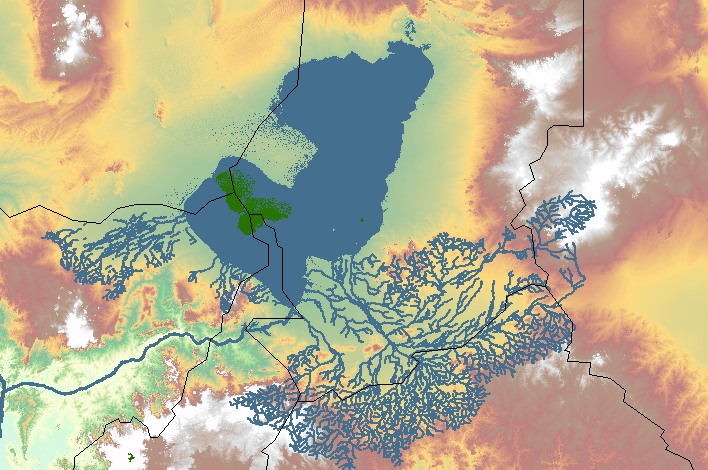
Lake Chad is divided into deeper southern parts and shallower northern parts. The water source of the lake mainly comes from rivers such as the Chari River that enter the lake. The water level varies greatly seasonally, and the area of the lake also changes dramatically. During the African humid period, the lake's area reached 400000 km2. Due to the increasingly arid climate, the lake surface gradually shrank. In the 19th century, it still had an area of 28000 km2. However, due to climate change and human water diversion, it has shrunk significantly since the mid-1970s, and its area has fluctuated between 2000 and.
Prehistory and history
The Chad Basin was formed by the depression of the African Shield. For most of the Quaternary, the basin had abundant water sources. Towards the end of this period the climate became drier. Around 20,000–40,000 years ago, eolianite sand dunes began to form in the north of the basin. The area of Lake Chad experienced four heydays between 39,000 BC and 300 BC, leaving thick diatomaceous earth and lacustrine deposits in the strata. This has been called Mega-Chad. The maximum depth of Mega-Chad exceeded 180 m and it covered an area of approximately 400000 km2,
The vast waters formed during the African humid period provided conditions for the emergence of lakeside fishermen's settlements, and the Nilo-Saharan ethnic group also migrated to Lake Chad during this period. Agriculture also emerged in the Sahel region at this time. By 1800 BC, a pottery culture known as Gajiganna had emerged, initially as pastoralists, but, starting around 1500 BC, living in settled hamlets at the side of the lake. The archaeological discovery revealed wild grasses, mostly of the tribe Paniceae, and wild rice together with the earliest domesticated Pearl millet in the Lake Chad region, dating to 1200–1000 cal BC. One of the oldest domesticated Pearl millet in West Africa was found in the Chad Basin, charred together with wild grasses, and their era can be traced back to 800–1000 cal BC.
Permanent villages were established to the south of the lake by 500 BC, and major archaeological discoveries include the Sao civilization. By the 5th century AD camels were being used for trans-Saharan trade via the Fezzan, or to the east via Darfur. After the Arabs conquered North Africa during the 7th and 8th centuries, the Chad Basin became increasingly linked to the Muslim countries.
Trade and improved agricultural techniques enabled more sophisticated societies. and even reached into Lake Chad. This was the deepest Ottoman incursion into the interior of Africa before the nineteenth century. The Ottoman Empire extended its influence on central region of the Central Sahel during the reign of Murad III, And Lake Chad becoming a part of Ottoman sphere of influence, and in the second half of the 16th century, the Bornu Empire began importing firearms from the ottoman Empire, consolidating its military hegemony. The Bornu Empire declined in the 18th century, and later lost its western region to the Sokoto Caliphate during the early 19th century. It was later colonised by European powers in the 20th century.
Following the growing interest in Africa among European academic and business communities, the Lake Chad area was extensively described by Europeans in the 19th century. Three scientific expeditions were conducted between 1898 and 1909. At the beginning of independence, the countries surrounding Lake Chad not only had a poor economic foundation, but also had more complex ethnic, religious, and political conflicts. Nigeria and Niger, which had just gained independence, experienced continuous coups, while Chad also experienced ongoing civil war. The inability of countries along the lake to consider the protection of Lake Chad has led to a series of environmental problems.
Geography

The Chad Basin includes Chad, Nigeria, Cameroon, Niger, Sudan, and the Central African Republic. It is an extensional fault depression type rift basin, which can be divided into four secondary structural units: southern depression, northern depression, central uplift, and eastern slope. The southern depression of the basin is characterized by an asymmetric fault depression composite rift with steep slopes in the east and gentle slopes in the west on the profile, and is distributed in an NNW direction on the plane. There are two large basin‐bounding normal faults developed on both sides of the basin, with a graben style fault and depression in the middle. The east and west sides are outward dipping low angle gentle slope areas. The eastern boundary fault is steep with a dip angle of about 55°, while the western fault has a dip angle of about 45°. The overall thickness of the inner layer in the slope area is relatively thin. In the central area of the basin, the thickness of the sedimentary strata is large, and the thickness of the sedimentary center zone reaches over 10000 m. The northern part of the basin appears steep in the west and gentle in the east on the profile. Five fault structural zones parallel to the basin‐bounding faults have developed from west to east.
Lake Chad is divided into north and south parts by a shallow sill called the Great Barrier, with the bottom of the northern basin at an altitude of 275.3 m and the bottom of the southern basin at 278.2 m. When the water level in the south exceeds 279 m above sea level, it will flow into the north. and the sand dunes that are not completely submerged in the eastern waters form an archipelago.
The climate of the Lake Chad region is strongly influenced by continental and maritime air masses. The maritime air mass moves northward during the summer, producing seasonal precipitation. In late summer, continental air mass dominate again.
Hydrology

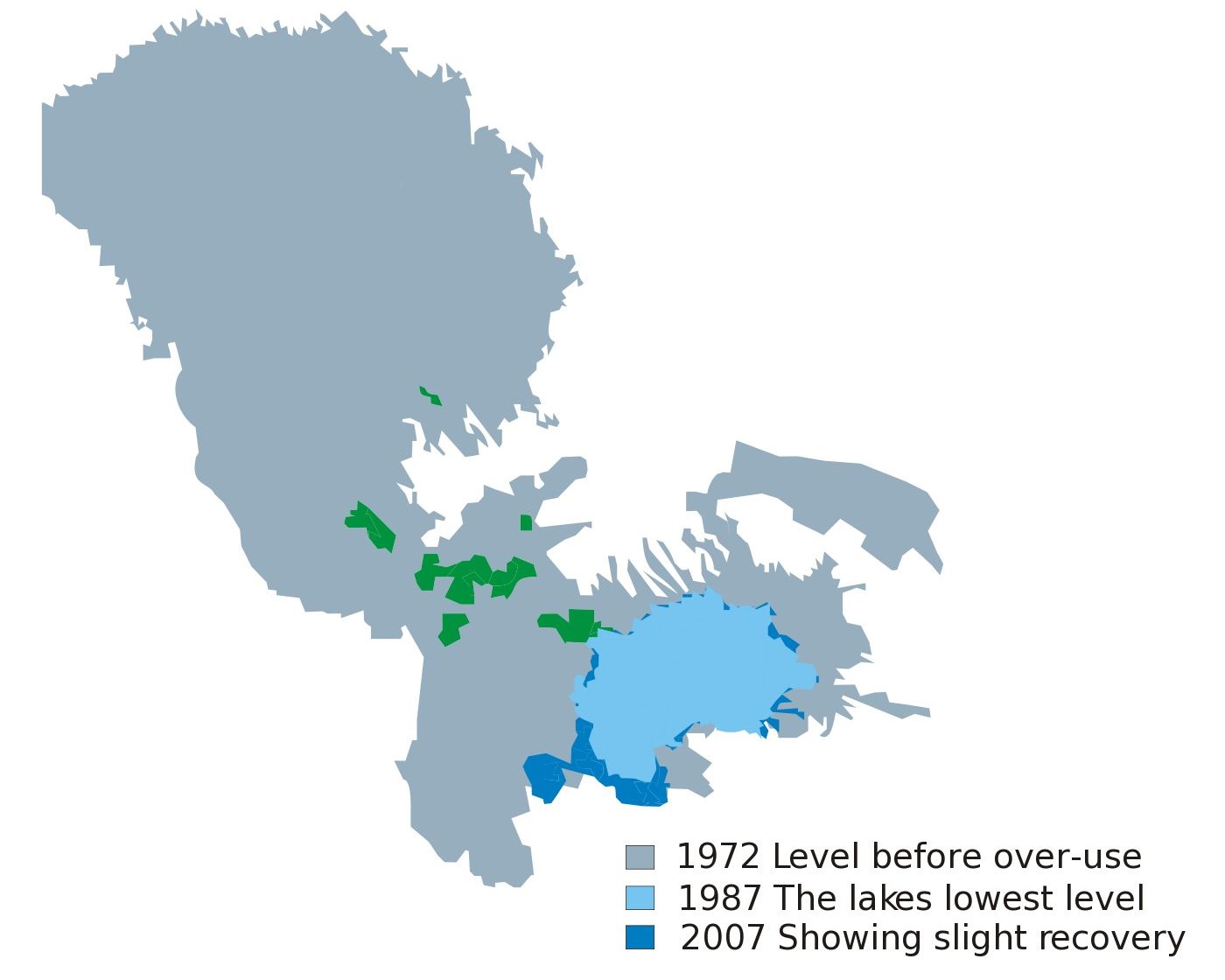
The Chad Basin covers an area of about 1 e6km2, and is injected by the Chari, Logone, and Yobe Rivers.
The water volume of most large lakes in Africa depends on rainfall and evaporation, which means that temperature and precipitation are crucial for regulating the water balance of these bodies of water, and any fluctuations can cause significant changes in their water level and area. Lake Chad is a shallow inland lake, and the rainfall in the Chad basin is very sensitive to small changes in atmospheric circulation, so the surface area of Lake Chad is greatly affected by climate change. Dry climate due to vegetation loss from overgrazing and deforestation and large-scale irrigation projects that diverted water from the rivers that feed the lake are the main reasons for the shrinkage of Lake Chad.
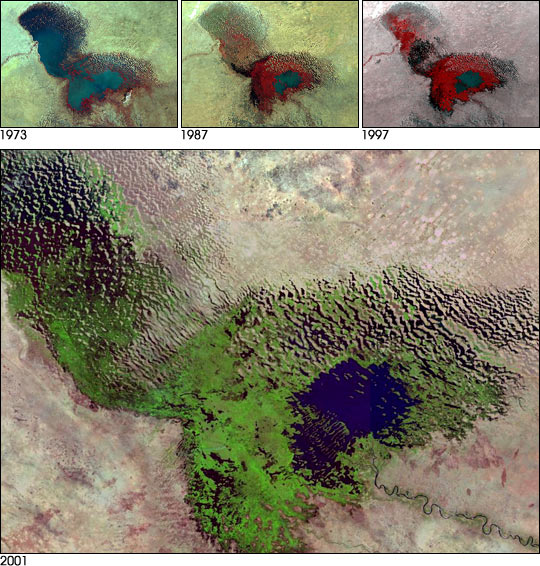
In 1870, the area of Lake Chad was about 28000 km2. The lake was able to flow out of the Bahr el-Ghazal during the rainy season. At the turn of the 20th century the area of Lake Chad shrank briefly, and reached a new high in the middle of the 20th century and overflowed from the Bahr el-Ghazal again. During this period, Lake Chad shrunk considerably and fluctuated in the range of 2000 to thereafter.
From June 1966 to January 1973, the area of Lake Chad shrank from 22772 to, further shrunk to 4398 km2 in 1975, From 1995 to 1998, it fluctuated within the range of 1200 to. The area once reached 5075 km2 in 2000, and the average area of surface water from 2013 to 2016 was about 1876 km2, with the largest area being 2231 km2 in July 2015.
Ecology

Part of the Chad Basin is located within the Chad Basin National Park in Nigeria, and the country and Cameroon have established the Lake Chad Ramsar Wetland with a total area of 8225 km2.
Plantlife
The wetland plants in the south mainly include cyperus papyrus, etc. Reeds mainly grow in the north where the salinity is high, and the floating plant pistia sometimes covers large areas of open water. Plants such as hyparrhenia rufa grow on the shores of lakes with long floods in the south. The surrounding dense woodland has been converted to open forest with acacias, baobabs, palms and Indian jujube.
Birds
The lake has been designated an Important Bird Area (IBA) by BirdLife International. It is permanently or seasonally inhabited by hundreds of species of birds such as northern shoveler, Egyptian goose and marabou stork. and more than one million ruff can be observed on the lake at one time.
Mammals
The once common large mammals include red-fronted gazelle, dama gazelle, patas monkey, striped hyena, cheetah and caracal, while African elephant, otter, hippopotamus, sitatunga and kob are distributed in the wetlands. At present, most of the large mammals have been hunted to extinction, replaced by a large number of cattle.
Fish
The entire Chad Basin has 179 species of fish, of which 127 are the same as the Niger River Basin, 85 are the same as the Nile River Basin, 47 are the same as the Congo River Basin, and 84 fish species are distributed in the lake. This makes it a rich fishing ground for communities across Nigeria, Niger, Chad, and Cameroon. The seasonal influx of floods combined with seasonal increases in air temperature leads to decreased salinity, increased turbidity, and increased trophic levels, which catalyzed a surge in the number of phytoplankton and zooplankton, allowing large fish to migrate seasonally within the watershed to feed and breed in the fertile floodplain when floods arrive.
Human activities

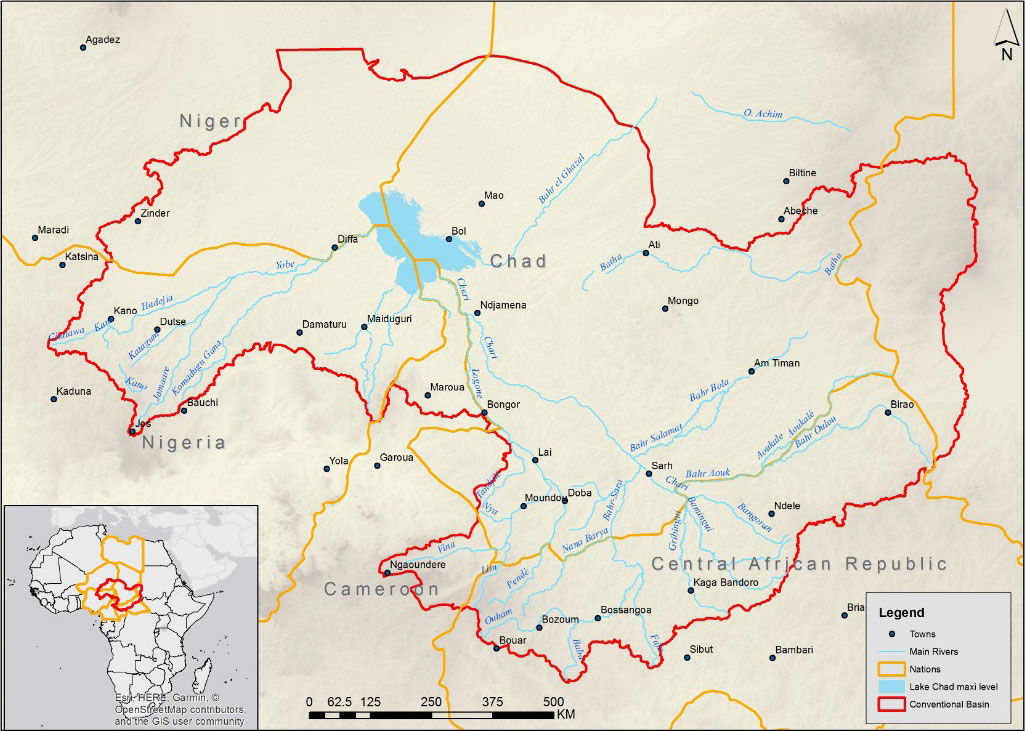
There are more than 30 million residents in the Chad Lake Basin. There are more than 70 ethnic groups around the lake, most of whom are distributed on the south bank, where the population density exceeds 100 PD/km2. They rely on the water source of Chad Lake for irrigation, breeding, animal husbandry and drinking. Local self-sufficient crops include sorghum, maize, finger millet, beans, and vegetables. Gourd is widely planted for making utensils. The collection of forest products such as gum arabic, honey, beeswax, and firewood is of great significance in the region. However, the reduction in forest area has had a negative impact on the production of these products, and the explosive growth of cattle herds has exacerbated this impact. Cattle are the most important livestock raised, as well as poultry, goats, sheep, camels, horses, and donkeys. The animal husbandry was severely affected by the droughts of the 1970s and 1980s.
Fishing has traditionally been the most important economic activity for the people of the lake area, which almost ceased during drought periods and only resumed in the mid-1990s. Most fishing products are dried, pickled, or smoked. The natron produced in the depression on the northeast bank of the lake has long been of significant economic significance. Traditionally, it has been excavated in blocks and transported across the lake to enter the Nigerian market. Farmers have shifted from planting mainly dry crops, such as wheat, to rice with high water demand, resulting in more serious soil salinization and water eutrophication. The adverse effects of reduced water sources on fishing, farming, and herding outweigh the benefits of new land from the receding waters. The surrounding residents who used to rely on lake water were forced to relocate, causing the economy of the lake area to continuously shrink.
Since 1970, five countries in the southern part of the basin have constructed numerous water conservancy projects in the upper reaches of the Chari River, Logone River, and Yobe River to intercept river water, resulting in a sharp decrease in the amount of water entering the lake. The average annual inflow of the Chari River and the Logone River from 1970 to 1990 was only 55% of that from 1950 to 1970. Since the 1980s, one-third of the water in the Chari River and the Logone River has been diverted and intercepted by the Central African Republic located upstream for agricultural irrigation and hydroelectric power generation.
Cameroon, Niger, Nigeria, and Chad established the Lake Chad Basin Commission on 22 May 1964. The Central African Republic joined in 1996, and Libya joined in 2008. The headquarters of the committee is located in N'Djamena, Chad. The commission's tasks include managing Lake Chad and its water resources, protecting the ecosystem, and promoting regional integration, peace, security, and development in the Lake Chad region. The surrounding countries' water replenishment plan for Lake Chad includes the construction of a 2400 km canal to transport 100 e9m3 of water from the Congo River Basin to the Chari River Basin every year, and use a series of dams along the route to generate electricity.
References
References
- "Lac Tchad".
- "Partie tchadienne du lac Tchad".
- "Lake Chad Wetlands in Nigeria".
- "Partie Camerounaise du Lac Tchad".
- Obaje, Nuhu George. (2009-08-12). "Geology and Mineral Resources of Nigeria". Springer.
- Wright, J.B.. (1985-11-30). "Geology and Mineral Resources of West Africa". Springer.
- (2005). "Holocene Lake Mega-Chad palaeoshorelines from space". Quaternary Science Reviews.
- Kevin Shillington. (28 August 2018). "History of Africa". Macmillan Education UK.
- Ogundiran, Akinwumi. (2005). "Four Millennia of Cultural History in Nigeria (ca. 2000 B.C.–A.D. 1900): Archaeological Perspectives". Journal of World Prehistory.
- (1999). "The Exploitation of Plant Resources in Ancient Africa".
- Decorse, Christopher R.. (2001). "West Africa During the Atlantic Slave Trade: Archaeological Perspectives". Continuum International Publishing Group.
- (2010). "Encyclopaedia of Africa". Oxford University Press.
- Lange, Dierk. (2004). "Ancient Kingdoms of West Africa: African-centred and Canaanite-Israelite Perspectives ; a Collection of Published and Unpublished Studies in English and French". J.H.Röll Verlag.
- Flynn, Sébastien. (2016-01-01). "THE RELATIONSHIP BETWEEN THE OTTOMAN EMPIRE AND KANEM- BORNU DURING THE REIGN OF SULTAN MURAD III A Master's Thesis". Bilkent Master's Thesis.
- Kevin Shillington. (28 August 2018). "History of Africa". Macmillan Education UK.
- (2021-04-08). "乍得湖:从"文明摇篮"到"死亡之心"". China Water Resources News.
- "about-map". Lake Chad Basin Commission.
- (2008). "乍得湖盆地构造特征与油气成藏规律初探". 大地构造与成矿学.
- (June 2000). "Fishing and farming at Lake Chad: Responses to lake-level fluctuations". The Geographical Journal.
- (January 2012). "Recent changes in Lake Chad: Observations, simulations and management options (1973–2011)". Global and Planetary Change.
- Wen Yunzhao. "Lake Chad". Encyclopedia of China Publishing House.
- (2016). "Implications of climate variability and change for African lake ecosystems, fisheries productivity, and livelihoods". Journal of Great Lakes Research.
- (2007). "Remote sensing for groundwater modelling in large semiarid areas:Lake Chad Basin, Africa". Hydrogeology Journal.
- (2015-12-15). "Combined effect of El Niño southern oscillation and Atlantic multidecadal oscillation on Lake Chad level variability". Cogent Geoscience.
- "Lake Chad: almost gone". [[United Nations Environment Programme]] (UNEP).
- (2013). "基于多源遥感数据的非洲乍得湖水面变化监测". 地理科学进展.
- (2018). "Recent surface water extent of Lake Chad from multispectral sensors and GRACE". Sensors.
- (2020). "The Lake Chad hydrology under current climate change". Scientific Reports.
- . (2024). ["Lake Chad"](https://datazone.birdlife.org/site/factsheet/lake-chad-iba-chad). *BirdLife International*.
- (March 1997). "Considerations of Wildlife Resources and Land Use in Chad". Office of Sustainable Development, Africa Bureau, USAID.
- (1992). "A Directory of African Wetlands". [[IUCN]] / [[UNEP]] / [[World Conservation Monitoring Centre.
- "Plan B Updates - 47: Disappearing Lakes, Shrinking Seas - EPI". earth-policy.org.
- "Shrinking African Lake Offers Lesson on Finite Resources". nationalgeographic.com.
- (2023-09-05). "The Effects of Climate Change in the Poorest Countries: Evidence from the Permanent Shrinking of Lake Chad".
- (2023). "Water and Food Sustainability in the Riparian Countries of Lake Chad in Africa". Sustainability.
- "About us".
- Ross, Will. (2018-03-31). "Can the vanishing lake be saved?". BBC.
This article was imported from Wikipedia and is available under the Creative Commons Attribution-ShareAlike 4.0 License. Content has been adapted to SurfDoc format. Original contributors can be found on the article history page.
Ask Mako anything about Lake Chad — get instant answers, deeper analysis, and related topics.
Research with MakoFree with your Surf account
Create a free account to save articles, ask Mako questions, and organize your research.
Sign up freeThis content may have been generated or modified by AI. CloudSurf Software LLC is not responsible for the accuracy, completeness, or reliability of AI-generated content. Always verify important information from primary sources.
Report