From Surf Wiki (app.surf) — the open knowledge base
Lagoa do Fogo
Lake in Azores, Portugal

Lake in Azores, Portugal
| Field | Value |
|---|---|
| name | Lagoa do Fogo |
| name_other | Lake of Fire |
| nickname | Fogo |
| image | Açores lagoa fogo-0140.tif |
| image_size | 235px |
| image_caption | A view of Lagoa do Fogo from the scenic overlook of Lagoa do Fogo III |
| map_size | 235 |
| map_caption | Location of the waterbody on the island of São Miguel, in the archipelago of the Azores |
| pushpin_map_size | 235 |
| subdivision_type1 | Country |
| subdivision_name1 | Portugal |
| subdivision_type2 | Autonomous Region |
| subdivision_name2 | Azores |
| subdivision_type3 | Group |
| subdivision_name3 | Eastern |
| subdivision_type4 | Island |
| subdivision_name4 | São Miguel |
| subdivision_type5 | Municipalities |
| subdivision_name5 | Ribeira Grande, Vila Franca do Campo, Lagoa |
| length_km | 3 |
| discharge1_location | Atlantic Ocean |
| source1 | Água de Pau Massif |
| basin_size_km2 | 21.82 |
Lagoa do Fogo ("Lake of Fire") is a crater lake within the Água de Pau Massif stratovolcano in the center of the island of São Miguel in the Portuguese archipelago of the Azores. The highest lake located on the island of São Miguel, the region is protected by governmental regulation that does not permit any constructions around the lake.
History
Since 1974, the Lagoa do Fogo had been under the administration of national legislation as a protected area, forming the Reserva da Lagoa do Fogo (Natural Reserve of Lagoa do Fogo) an area that includes approximately 2182 ha, founded by Decree-law 152/74 (15 April 1974). It was also covered under a supplementary Decree-Law 9/79.
The Reserva Natural da Lagoa do Fogo was created in 1982, under terms of Regional Decree 10/82/A on 18 June 1982. Part of the area was included in the Natura 2000 network, and classified as the Site of Communitarian Importance of Lagoa do Fogo.
The nature reserve was integrated into the Nature Park of São Miguel, under Decree-Law 19/2008A (8 July 2008), which included the entire watershed of the Laoga.
Geography
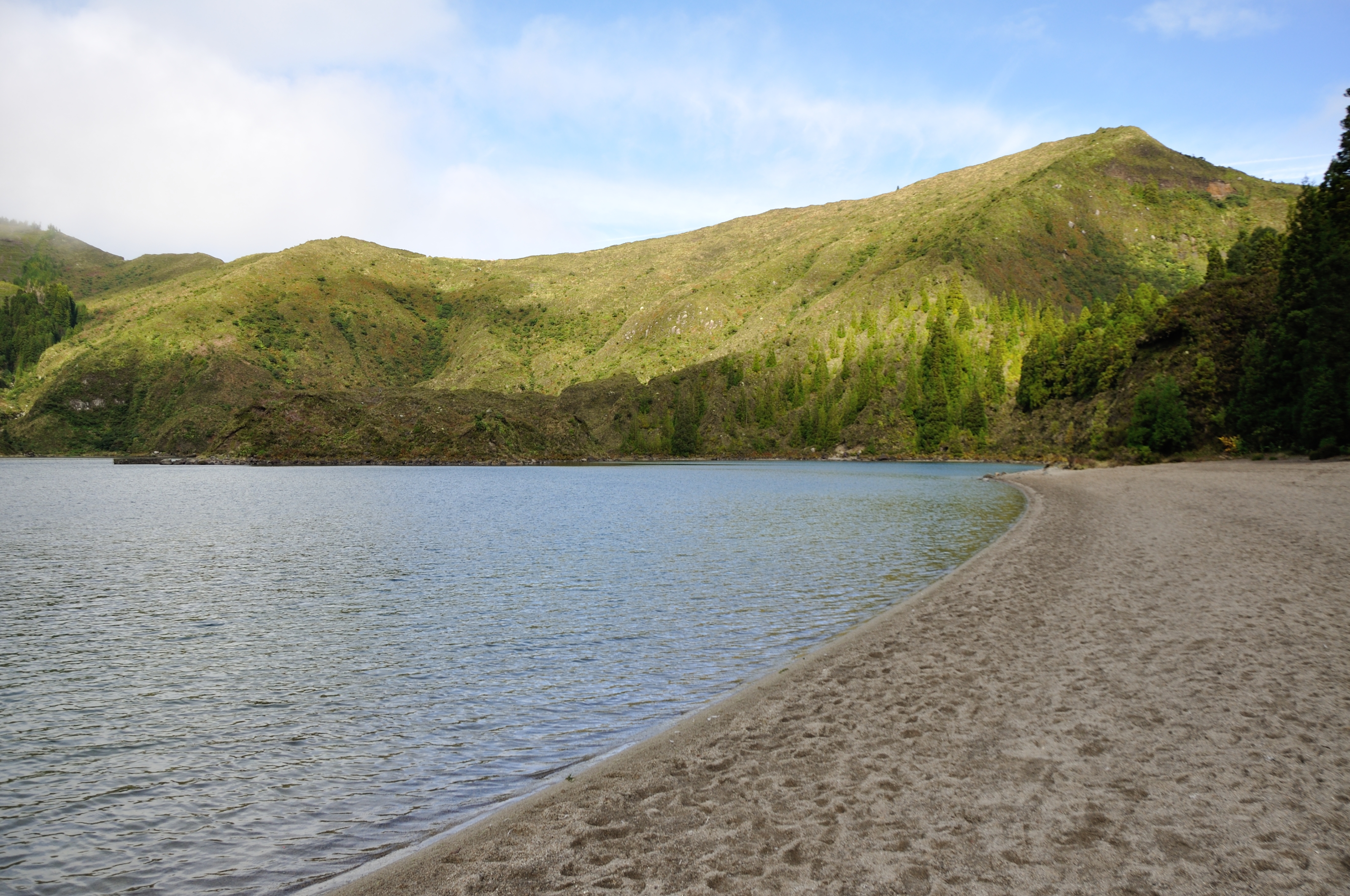
Lagoa do Fogo is one of the largest of the waterbodies in the Azores, and occupies the central caldera of the Água de Pau Massif, in the central area of the island of São Miguel.
It is part of the hydrological watershed of the same name. The margins of the lake are located 575 m above sea level, although the crater rim, which extends to Pico da Barrosa is located at approximately 949 m altitude.
The carved relief affects the course of hydrographic run-off, which is accentuated by torrential precipitation in the region, resulting in accentuated erosion and deposition along the margins. A majority of the watercourses are temporary or torrential, with the greatest run-off occurring in the winter, and little in the summer, with few permanent ravines. There are only two permanent effluents in the lake, one to the western crater rim in Barrosa, and the other in the south-southeast. The lake is maintained from mainly, direct precipitation over the caldera and from superficial run-off from the watersheds, where nutrient infiltration is common. The lake's waters support local aquifers in the lowlands and provide potable water to the settlements in the southern flanks of the caldera.
Biome
From the west to south, the crater is covered in brush and scrub, while in the east and north (where declives are minor) the vegetation is much denser and covered in some forest. Between the crater wall and lake is a northern margin/beach consisting of sedimentary, with little vegetation. There are no human settlements or operations within the crater.
Within the perimeter of the nature reserve, lake and caldera flanks, are many endemic Azorean plant species, including the Azores juniper (Juniperus brevifolia), Azores laurel (Laurus azorica) and buckthorn (Frangula azorica), in addition to St. John's wort (Hypericum foliosum), Azores heather (Erica azorica) and Mediterranean spurge (Euphorbia stygiana).
Small birds are the primary animal species within the caldera, in addition to some larger birds, such as kites or seagulls; terrestrial birds include the Azores wood pigeon (Columba palumbus azorica), Azorean buzzard (Buteo buteo rothschildi), the grey wagtail (Motocilla cinerea) and the Azorean common blackbird (Turdus merula azorensis), as well as marine birds such as yellow-legged gull (Larus cachinnans atlantis) and the common tern (Sterna hirundo).
References
Notes
Sources
References
- IGP (2005); DCA/UA (2004); DRA (2004); DROTRH/SRA et al. (2001)
- Santos et al. (1991a)
- Ana Ideias (May 2012)
- (2015). "Reserva Natural da Lagoa do Fogo". Direção Regional do Ambiente.
- Diário da República, (8 July 2008), p.4261
- civil parishes]] of [[Conceição (Ribeira Grande). Conceição]], [[Matriz (Ribeira Grande). Matriz]] and [[Água de Alto]], in the [[Concelho. municipalities]] of [[Ribeira Grande (Azores)
-
- x. 2.5. km. mi and {{convert. 30. m
- LNEC (1991)
This article was imported from Wikipedia and is available under the Creative Commons Attribution-ShareAlike 4.0 License. Content has been adapted to SurfDoc format. Original contributors can be found on the article history page.
Ask Mako anything about Lagoa do Fogo — get instant answers, deeper analysis, and related topics.
Research with MakoFree with your Surf account
Create a free account to save articles, ask Mako questions, and organize your research.
Sign up freeThis content may have been generated or modified by AI. CloudSurf Software LLC is not responsible for the accuracy, completeness, or reliability of AI-generated content. Always verify important information from primary sources.
Report