From Surf Wiki (app.surf) — the open knowledge base
Lactarius indigo
Edible fungus

Edible fungus
Lactarius canadensis Winder (1871)
Lactifluus indigo (Schwein.) Kuntze (1891)
Lactarius indigo, commonly known as the indigo milk cap, indigo milky, indigo lactarius, blue lactarius, or blue milk mushroom, is a species of agaric fungus in the family Russulaceae.
The fruit body color ranges from dark blue in fresh specimens to pale blue-gray in older ones. The "milk", or latex, that oozes when the mushroom tissue is cut or broken (a feature common to all members of the genus Lactarius) is also indigo blue, but slowly turns green upon exposure to air. The cap has a diameter of 4–15 cm, and the stem is 2–8 cm tall and 1 – thick.
It is a widely distributed species, growing in the Americas and Eurasia. L. indigo grows on the ground in both deciduous and coniferous forests, where it forms mycorrhizal associations with a broad range of trees. It is an edible mushroom and is sold in rural markets in Mexico, Guatemala, and China.
Taxonomy
Originally described in 1822 as Agaricus indigo by American mycologist Lewis David de Schweinitz, As they explained:The gradual development of blue to violet pigmentation as one progresses from species to species is an interesting phenomenon deserving further study. The climax is reached in L. indigo which is blue throughout. L. chelidonium and its variety chelidonioides, L. paradoxus, and L. hemicyaneus may be considered as mileposts along the road to L. indigo.
The specific epithet indigo is derived from the Latin word meaning 'indigo blue'. Its names in the English vernacular include the "indigo milk cap", the "indigo Lactarius", the "blue milk mushroom", and the "blue Lactarius". In central Mexico, it is known as añil, azul, hongo azul, zuin, and zuine; it is also called quexque (meaning 'blue') in Veracruz and Puebla.
Description
Like many other mushrooms, L. indigo develops from a nodule that forms within the underground mycelium, a mass of threadlike fungal cells called hyphae that make up the bulk of the organism. Under appropriate environmental conditions of temperature, humidity, and nutrient availability, the visible reproductive structures (fruit bodies) are formed. The cap of the fruit body, measuring between 4–15 cm in diameter, is initially convex and later develops a central depression; in age it becomes even more deeply depressed, becoming somewhat funnel-shaped as the edge of the cap lifts upward. The margin of the cap is rolled inwards when young, but unrolls and elevates as it matures. The cap surface is indigo blue when fresh, but fades to a paler grayish- or silvery-blue, sometimes with greenish splotches. It is often zonate: marked with concentric lines that form alternating pale and darker zones, and the cap may have dark blue spots, especially towards the edge. Young caps are sticky to the touch.
The flesh is pallid to bluish in color, slowly turning greenish after being exposed to air; its taste is mild to slightly acrid. The flesh of the entire mushroom is brittle, and the stem, if bent sufficiently, will snap open cleanly. The latex exuded from injured tissue is indigo blue, and stains the wounded tissue greenish; like the flesh, the latex has a mild taste. Lactarius indigo is noted for not producing as much latex as other Lactarius species, and older specimens in particular may be too dried out to produce any latex.
The gills of the mushroom range from adnate (squarely attached to the stem) to slightly decurrent (running down the length of the stem), and crowded close together. Their color is an indigo blue, becoming paler with age or staining green with damage. The stem is 2–8 cm tall by 1–2.5 cm thick, and the same diameter throughout or sometimes narrowed at base. Its color is indigo blue to silvery- or grayish blue. The interior of the stem is solid and firm initially, but develops a hollow with age. Fruit bodies of L. indigo have no distinguishable odor.
L. indigo var. diminutivus (the "smaller indigo milk cap") is a smaller variant of the mushroom, with a cap diameter between 3–7 cm, and a stem 1.5–4 cm long and 0.3–1 cm thick.
Microscopic features
When viewed in mass, as in a spore print, the spores appear cream to yellow colored. Viewed with a light microscope, the spores are translucent (hyaline), elliptical to nearly spherical in shape, with amyloid warts, and have dimensions of 7–9 by 5.5–7.5 μm. Cystidia are terminal cells of hyphae in the hymenium which do not produce spores, and function in aiding spore dispersal, and maintaining favorable humidity around developing spores. The pleurocystidia are cystidia that are found on the face of a gill; they are 40–56 by 6.4–8 μm, roughly spindle-shaped, and have a constricted apex. The cheilocystidia—located on the edge of a gill—are abundant, and are 40.0–45.6 by 5.6–7.2 μm.
Chemical composition
Chemical analysis of Mexican specimens has shown L. indigo to contain moisture at 951 mg/g of mushroom, fat at 4.3 mg/g, protein at 13.4 mg/g, and dietary fiber at 18.7 mg/g, much higher in comparison to the common button mushroom, which contains 6.6 mg/g. Compared to three other wild edible mushroom species also tested in the study (Amanita rubescens, Boletus frostii, and Ramaria flava), L. indigo contained the highest saturated fatty acids content, including stearic acid with 32.1 mg/g—slightly over half of the total free fatty acid content.
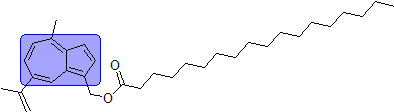
The blue color of L. indigo is due to (7-isopropenyl-4-methylazulen-1-yl)methyl stearate, an organic derivative of azulene, which is biosynthesised from a sesquiterpene very similar to matricin, the precursor for chamazulene. It is unique to this species, but similar to a compound found in L. deliciosus.
Similar species
The characteristic blue color of the fruiting body and the latex make this species easily recognizable. Other Lactarius species with some blue color include the "silver-blue milky" (L. paradoxus), found in eastern North America, which has a grayish-blue cap when young, but it has reddish-brown to purple-brown latex and gills. L. chelidonium has a yellowish to dingy yellow-brown to bluish-gray cap and yellowish to brown latex. L. quieticolor has blue-colored flesh in the cap and orange to red-orange flesh in the base of the stem. Although the blue discoloration of L. indigo is thought to be rare in the genus Lactarius, in 2007 five new species were reported from Peninsular Malaysia with bluing latex or flesh, including L. cyanescens, L. lazulinus, L. mirabilis, and two species still unnamed.
Distribution, habitat, and ecology
Lactarius indigo is distributed throughout southern and eastern North America but is most common along the Gulf Coast, Mexico, and Guatemala. Its frequency of appearance in the Appalachian Mountains of the United States has been described as "occasional to locally common". It is also found in Mexico, Guatemala, Costa Rica (in forests dominated by oak), and as far south as the Humboldt oak cloud forests of Colombia. In Europe, it has so far only been found in southern France. It has also been collected from China and India.

A study on the seasonal appearance of fruiting bodies in the subtropical forests of Xalapa, Mexico, found that maximal production of L. indigo coincided with the rainy season between June and September. It is a mycorrhizal fungus, and as such, establishes a mutualistic relationship with the roots of certain trees ("hosts"), in which the fungi exchange minerals and amino acids extracted from the soil for fixed carbon from the host. The subterranean hyphae of the fungus grow a sheath of tissue around the rootlets of a broad range of tree species, forming so-called ectomycorrhizae—an intimate association that is especially beneficial to the host, as the fungus produces enzymes that mineralize organic compounds and facilitate the transfer of nutrients to the tree.
Reflecting their close relationships with trees, the fruit bodies of L. indigo are typically found growing on the ground, scattered or in groups, in both deciduous and coniferous forests. They are also commonly found in floodplain areas that have been recently submerged. In Mexico, associations have been noted with Mexican alder, American Hornbeam, American Hophornbeam, and Liquidambar macrophylla, while in Guatemala the mushroom associates with smooth-bark Mexican pine and other pine and oak species. In Costa Rica, the species forms associations with several native oaks of the genus Quercus. Under controlled laboratory conditions, L. indigo was shown to be able to form ectomycorrhizal associations with the neotropical pine species Mexican white pine, Hartweg's pine, Mexican yellow pine, smooth-bark Mexican pine, and the Eurasian pines Aleppo pine, European black pine, maritime pine, and Scots pine.
Uses
Although L. indigo is a well-known edible species, opinions vary on its desirability. For example, American mycologist David Arora considers it a "superior edible", while a field guide on Kansas fungi rates it as "mediocre in quality". It may have a slightly bitter, or peppery taste, and has a coarse, grainy texture. The firm flesh is best prepared by cutting the mushroom in thin slices. The blue color disappears with cooking, and the mushroom becomes grayish. Because of the granular texture of the flesh, it does not lend itself well to drying. Specimens producing copious quantities of milk may be used to add color to marinades.
In Mexico, individuals harvest the wild mushrooms for sale at farmers' markets, typically from June to November; they are considered a "second class" species for consumption. L. indigo is also sold in Guatemalan markets from May to October. It is one of 13 Lactarius species sold at rural markets in Yunnan in southwestern China.
References
Cited literature
References
- Hesler]] and [[Alexander Hanchett Smith. Hesler and Smith (1979)]], p. 66.
- [[#Hesler. Hesler and Smith (1979)]], p. 7.
- [[#Hesler. Hesler and Smith (1979)]], p. 27.
- [[Audubon]]. (2023). "Mushrooms of North America". [[Knopf]].
- Hesler and Smith (1979)]], pp. 68–9.
- Hesler and Smith (1979)]], p. 70.
- Arora (1986)]], p. 69.
- (1993). "A Guide to Kansas Mushrooms". University Press of Kansas.
- Arora D.. (1991). "All that the Rain Promises and More: A Hip Pocket Guide to Western Mushrooms". Ten Speed Press.
- (1997). "Mycology in Sustainable Development: Expanding Concepts, Vanishing Borders". Parkway Publishers.
- (1992). "Edible Wild Mushrooms of North America: A Field-to-Kitchen Guide". University of Texas Press.
- (2007). "Mushrooms of the Southeastern United States". Syracuse University Press.
- (1995). "Observations on the phenology of ten fungal species in the subtropical forests at Xalapa, Mexico". Mycological Research.
- (2007). "''Lactarius indigo'' and ''L. deliciosus'' form mycorrhizae with Eurasian or Neotropical ''Pinus'' species". Sydowia.
- (2013). "Die erstaunliche Funga eines tropischen Bergnebel-Eichenwaldes in Kolumbien.". Der Tintling.
- Fergus CL.. (2003). "Common Edible and Poisonous Mushrooms of the Northeast". Stackpole Books.
- (2005). "Mycorrhizal synthesis of ''Lactarius indigo'' (Schw.) Fr. with five Neotropical pine species". Mycorrhiza.
- Fries EM.. (1836–38). "Epicrisis Systematis Mycologici". Typographia Academica.
- Hall IR.. (2003). "Edible and Poisonous Mushrooms of the World". Timber Press.
- (1979). "Preformed azulene pigments of ''Lactarius indigo'' (Schw.) Fries (Russulaceae, Basidiomycetes)". Cellular and Molecular Life Sciences.
- (2008). "Mushrooms and Other Fungi of the Midcontinental United States (Bur Oak Guide)". University of Iowa Press.
- (1960). "Studies on ''Lactarius''–I: The North American Species of Section ''Lactarius''". Brittonia.
- Kuntze O.. (1891). "Revisio Generum Plantarum". A. Felix.
- (1997). "Proximate chemical composition, free amino acid contents, and free fatty acid contents of some wild edible mushrooms from Querétaro, México". Journal of Agricultural and Food Chemistry.
- Marcel B.. (1988). "Pareys Buch der Pilze". Paul Parey.
- (1987). "A Field Guide to Mushrooms, North America". Houghton Mifflin.
- (1992). "Texas Mushrooms: A Field Guide". University of Texas Press.
- (2006). "North American Mushrooms: A Field Guide to Edible and Inedible Fungi". Falcon Guide.
- (1996). "Additional new records on ''Lactarius'' from Mexico". Mycotaxon.
- (2002). "Estudio Etnomicológico de la cabecera municipal de Tecpán Guatemala, Chimaltenango". USAC-IIQB Revista Científica Guatemala.
- (2006). "Ecology and Conservation of Neotropical Montane Oak Forests". Springer.
- Kuo M.. (March 2011). "''Lactarius indigo''". MushroomExpert.Com.
- (1998). "Boreal forest plants take up organic nitrogen". [[Nature (journal).
- Roody WC.. (2003). "Mushrooms of West Virginia and the Central Appalachians". University Press of Kentucky.
- Russell B.. (2006). "Field Guide to Wild Mushrooms of Pennsylvania and the Mid-Atlantic". Pennsylvania State University Press.
- de Schweinitz LD.. (1822). "Synopsis fungorum Carolinae superioris". Schriften der Naturforschenden Gesellschaft in Leipzig.
- (2002). "New records of Russulaceae from India". Phytotaxonomy.
- (2005). "Connaître, cueillir et cuisiner: Les champignons sauvages du Québec". Éditions Fides.
- (2007). "Blue-staining species of ''Lactarius'' subgenus ''Plinthogali'' in Malaysia". Belgian Journal of Botany.
- (2004). "Taxonomic studies on light-spored agarics new to India". Mushroom Research.
- Volk T.. (2000). "Tom Volk's Fungus of the Month for June 2000". Department of Biology, University of Wisconsin-La Crosse.
- Halling RE. "''Lactarius indigo'' (Schw.) Fries". The New York Botanical Garden.
- (2007). "Russulales News Nomenclature: ''Lactarius indigo''". The Russulales News Team.
- Wang X-H.. (2000). "A taxonomic study on some commercial species in the genus ''Lactarius'' (Agaricales) from Yunnan Province, China". Acta Botanica Yunnanica.
- (1978). "How to Identify Mushrooms to Genus III". Mad River Press.
This article was imported from Wikipedia and is available under the Creative Commons Attribution-ShareAlike 4.0 License. Content has been adapted to SurfDoc format. Original contributors can be found on the article history page.
Ask Mako anything about Lactarius indigo — get instant answers, deeper analysis, and related topics.
Research with MakoFree with your Surf account
Create a free account to save articles, ask Mako questions, and organize your research.
Sign up freeThis content may have been generated or modified by AI. CloudSurf Software LLC is not responsible for the accuracy, completeness, or reliability of AI-generated content. Always verify important information from primary sources.
Report