From Surf Wiki (app.surf) — the open knowledge base
La Perla, San Juan, Puerto Rico
Urban neighborhood in the Old San Juan Historic District in San Juan, Puerto Rico
Urban neighborhood in the Old San Juan Historic District in San Juan, Puerto Rico
La Perla is a historic neighborhood located in the northern historic city of Old San Juan, Puerto Rico, stretching about 650 yards (600 m) along the rocky Atlantic coast immediately east of the Santa Maria Magdalena de Pazzis Cemetery and down the slope from (north of) Calle Norzagaray.
La Perla was established in the 18th century. Initially, the area was the site of a slaughterhouse because the law required the homes of slaves and homeless black and coloured servants – as well as cemeteries – to be established away from the main community center: in this case, outside the city walls. Sometime after, some of the farmers and workers started living around the slaughterhouse and shortly thereafter established their houses there.
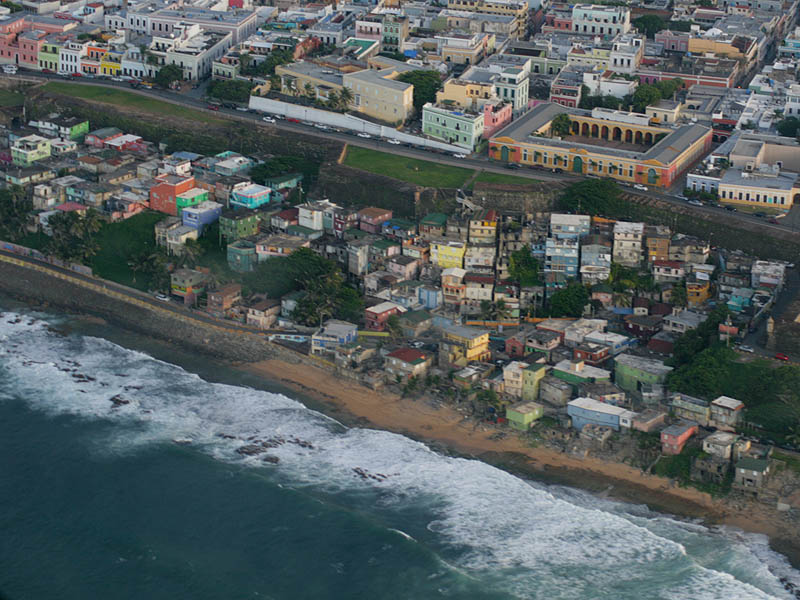
History, location and description

Located inside the Old San Juan Historic District, La Perla (The Pearl) was originally the site of a slaughterhouse, called El Matadero. It was built in the 18th century outside the walls of San Juan by slaves who were required to live outside the city. Slaves built homes and lived near the slaughterhouse and later jíbaros, (Puerto Rican farmers) who moved to San Juan, lived there.
La Perla belongs to and consists of the northernmost stretches of Mercado subbarrio (west) and San Cristóbal subbarrio in San Juan Antiguo barrio. San Juan Antiguo barrio is located on Isleta de San Juan, an island off San Juan, the capital of Puerto Rico, and it is connected to the mainland by bridges and causeways. La Perla is in the Old San Juan Historic District which is managed by US National Park Service.
La Perla has sometimes been described as a slum and a shantytown, because many homes have been built without proper permits. While tourists have normally been deterred from visiting La Perla, some entrepreneurs have tried to change its image with art galleries, cafés and restaurants. La Perla Impacto Comunitario, a local community group has coordinated tours.

Only four access points exist into La Perla: one through the Santa María Magdalena de Pazzis Cemetery, and the others from Calle Norzagaray, named after Spanish soldier and colonial governor, Fernándo Norzagaray y Escudero.
- Calle Tiburcio Reyes (western border, along the outside of the old city wall)
- Calle San Miguel (mostly in the western part, along the north)
- Calle Bajada Matadero (mostly in the western part, along the south)
- Calle Lucila Silva (mostly in the western part, east-west through the middle, too narrow for cars)
- Calle Augustín O. Aponte (eastern part)
Despite the fact that many homes in La Perla have been built without proper permits, residents of La Perla do have utility services. Garbage pickup is done regularly in the neighborhood, which in 1973 consisted of about 900 houses and 3,300 residents.
La Perla has a community-oriented music recording studio, El Estudio D' Oro, which serves as a free of cost music production workshop for all ages. El Estudio D' Oro is also home to the FM urban radio show, Hip Hop 787 La Verdadera Escuela, which is broadcast live from the studio on WVOZ Mix 107.7 FM.
In 2010, Carmelo Anthony remodeled the basketball court located to the eastern side of La Perla, with a new surface and design featuring the logo of Air Jordan’s Melo footwear line. It eventually became known by the name of the Nuyorican athlete, who also repaired several other venues throughout the island. The refurbished playing field was later included among "the most breathtaking locations for a basketball court in the world" due to its oceanside location overlooking the Atlantic.
In June 2011, the US Drug Enforcement Agency with other agencies targeted 50 properties in La Perla and indicted 114 people from La Perla for drug trafficking. The area has a reputation for being dangerous, but the popular 2017 Despacito music video filmed there made it a curiosity amongst tourists, with some wanting to venture in to see where the video was filmed.
In 2016, students of architecture at universities in Puerto Rico asked children for their ideas on how to improve their favorite areas of La Perla. El Bowl is a colorful, bowl-shaped cemented area in La Perla, used for skateboarding on weekdays, and then filled with water on weekends, to serve as a pool.
On September 20, 2017, Hurricane Maria hit Puerto Rico and La Perla "looked like it was hit by a bomb". "Despacito" (the song title that translates to "slowly") was also used to highlight and criticize the slow United States response to the destruction at La Perla caused by Hurricanes Irma and Maria, where the video was filmed. The National Park Service assisted the residents of La Perla with tarps soon afterwards.
Census
In terms of the United States 2000 Census, La Perla is composed of Census blocks 3001 through 3010 (Block group 3, Census tract 4, San Juan, Puerto Rico). A population of 338 was reported, 198 housing units (29 unoccupied), and 169 households, on an area of 80,028 square yards (16.53 acres; 66,914 m²).
La Perla belongs to and consists of the northernmost stretches of the subbarrios Mercado (west) and San Cristóbal in San Juan Antiguo barrio. The dividing line between the subbarrios is the imagined extension of Calle San Justo to the north beyond the old city wall to the Atlantic coast. The eastern part consists of Census blocks 3002, 3009 und 3010, with a population of 64, 35 housing units (4 unoccupied), and 31 households, on 41,348 square yards (8.5 acres; 34,572 m²).
Media and popular culture

La Perla was the true site of the fictional "La Esmeralda" barrio depicted in Oscar Lewis's sociological work "La vida: a Puerto Rican family in the culture of poverty--San Juan and New York", describing the lives of Puerto Rican slumdwellers and prostitutes. From La Perla, through taped interviews with dozens of intertwined family members who lived there in the 1940s-1960s, Lewis wrote an award-winning and controversial book. It was controversial because his award-winning book, written in 1967, would influence the way people viewed Puerto Rican women and Puerto Ricans, in general. "Many who read his book assumed the whores of La Perla were typical of all Puerto Rican women."
In 1978, salsa singer Ismael Rivera had a hit song, written by composer Catalino Curet Alonso, in honor of this community, and named after it. In 2009 Urban Music group Calle 13 released another tribute song, also named La Perla, in collaboration with Ruben Blades. In the song, Blades references Rivera's early effort; in the song's video, Blades pays his respects to Curet by visiting his tomb at the community's Santa María Madgalena de Pazzis cemetery.
Canadian singer Nelly Furtado along with Calle 13 band member Residente filmed the music video to the remix of Furtado's song No Hay Igual on 26 June 2006 in La Perla. Residente said he hoped that the video would help them both reach new audiences: "It's a good opportunity for us both. More than the North American market, the European market really interests me and her because her family is Portuguese." The video was directed by Israel Lugo and Gabriel Coss, photographed by Sonnel Velazquez and produced by María Estades.
In Giannina Braschi's political allegory United States of Banana (2011), the Puerto Rican prisoner Segismundo is born in the dungeon of the Statue of Liberty as the illegitimate child of a woman from La Perla and the Governor of Puerto Rico Luis Muñoz Marín.
The Puerto Rican classic play, La Carreta, (1953) by René Marqués, takes place in La Perla. A poor family moves from their farm to La Perla, and then to the Bronx for the better life that they never quite find.
The motion picture The Vessel (film), starring Martin Sheen, about a tidal wave that destroys a small town was filmed in La Perla in 2013.
With more than 8.3 billion views on YouTube, La Perla became world-known with the music video for the song Despacito being filmed there.
Gallery
La Perla Puerto Rico.jpg|2009 in La Perla La perla sign san juan puerto rico 2021-08-07 17-49-43 1.jpg|Comunidad La Perla sign Top of homes in La Perla, San Juan, Puerto Rico.jpg|Top of homes in La Perla The Streets of La Perla.jpg|Street in La Perla La Perla neighborhood in San Juan, Puerto Rico.jpg|La Perla neighborhood in San Juan La Perla of Puerto Rico coastline.jpg| La Perla coastline in 2018 San Juan, view from a ship, Puerto Rico.jpg|La Perla from the sea in 2012 Basketball court at La Perla in San Juan, Puerto Rico.jpg|Youth playing basketball at a court at La Perla
References
Bibliography
References
- "Visiting La Perla Neighborhood in Old San Juan".
- (2015-12-17). "La Perla en Puerto Rico, el renacimiento de uno de los barrios más peligrosos del Caribe".
- (6 July 2017). "40 days, $80K transform La Perla community in San Juan".
- (1973). "The Puerto Rican Experience: A Sociological Sourcebook". Rowman and Littlefield.
- (2010-07-31). "Carmelo Anthony reinaugura cancha en La Perla". Primera Hora.
- (2017-08-11). "Fundación Carmelo Anthony remodela la octava cancha de baloncesto en P. Rico". EFE.
- Filip Trivic. (2022-01-14). "The most breathtaking locations for a basketball court in the world". Basketball Network.
- (2011-06-29). "DEA Investigation Results In 114 Individuals Indicted For Drug Trafficking In Old San Juan's La Perla Ward".
- Macor, Leila. (2017-07-31). "Tourists seeking 'Despacito' discover Puerto Rico's La Perla".
- "La participación en el diseño de espacios que habitamos".
- "The Landscape of Community and Participatory Design in Puerto Rico: A Critical Examination of the Effects of Attempting to Facilitate "Listening to Their Voices," ("Escuchando las Voces") the Island's First Exhibition of Community and Participatory Design".
- (September 18, 2018). "Placemaking with Children and Youth: Participatory Practices for Planning Sustainable Communities". New Village Press.
- Lima, Lioman. (2017-09-23). ""Parece que cayó una bomba": así quedó La Perla, el popular barrio de Puerto Rico donde se filmó Despacito, tras el paso del huracán María".
- "Post-Hurricane Help Slow To Arrive In 'Despacito' Neighborhood". NPR.org.
- (2017-10-07). "NPS Incident Management Team Hurricane Update for the Caribbean Parks, Saturday, October 7, 2017 – 6pm".
- Steiner, S.. (1974). "The Islands: the worlds of the Puerto Ricans". Harper & Row.
- "Furtado films video in Puerto Rico". [[Jam!]]. [[Canoe.ca]].
- link. (2011-10-04 (Spanish). ¡Boom! Online. 26 June 2006. Retrieved 14 November 2006.)
- (2020). ""Free-dom: United States of Banana and the Limits of Sovereignty" in Poets, Philosophers, Lovers". Pittsburgh.
- Braschi, Giannina.. (2011). "United States of Banana". AmazonCrossing.
- Pethick, Kris. (10 January 2018). "The Great Works of René Marqués".
- Contreras, Felix. (December 13, 2017). "The 100 Best Songs Of 2017". [[NPR]].
- (2018-08-26). "Tourists seeking 'Despacito' discover Puerto Rico's La Perla".
This article was imported from Wikipedia and is available under the Creative Commons Attribution-ShareAlike 4.0 License. Content has been adapted to SurfDoc format. Original contributors can be found on the article history page.
Ask Mako anything about La Perla, San Juan, Puerto Rico — get instant answers, deeper analysis, and related topics.
Research with MakoFree with your Surf account
Create a free account to save articles, ask Mako questions, and organize your research.
Sign up freeThis content may have been generated or modified by AI. CloudSurf Software LLC is not responsible for the accuracy, completeness, or reliability of AI-generated content. Always verify important information from primary sources.
Report