From Surf Wiki (app.surf) — the open knowledge base
La Bombonera
Football stadium in Buenos Aires, Argentina

Football stadium in Buenos Aires, Argentina
| Field | Value | |
|---|---|---|
| name | Alberto José Armando Stadium | |
| native_name | Estadio Alberto José Armando | |
| nickname | La Bombonera (The Chocolate Box) | |
| logo_image | Boca_Juniors_logo18.svg | |
| logo_size | 30 | |
| image | Vista aérea del Estadio Alberto J. Armando "La Bombonera" 01.jpg | |
| image_size | 250 | |
| image_caption | View of the stadium in 2025 | |
| fullname | Estadio Alberto José Armando | |
| location | Brandsen 805 CP 1161, La Boca, Buenos Aires, Argentina | |
| coordinates | ||
| broke_ground | 18 February 1938 | |
| built | 1938–40 | |
| opened | ||
| renovated | 1995–96 | |
| owner | CA Boca Juniors | |
| surface | Grass | |
| architect | José Luis Delpini, Viktor Sulčič, Raúl Bes | |
| former_names | Estadio de Boca Juniors | |
| (1940–1986) | ||
| Estadio Camilo Cichero | ||
| (1986–2000) | ||
| tenants | {{plainlist | |
| seating_capacity | 58,305 | |
| record_attendance | ||
| dimensions | 105 x 68 m | |
| website |
(1940–1986) Estadio Camilo Cichero (1986–2000)
- Boca Juniors (1940–present)
- Argentina national football team (1956–1978, 1992–present)
La Bombonera (; , named after its resemblance to a chocolate box, per Viktor Sulčič), officially known as Estadio Alberto José Armando (; , named after Alberto Armando), is an association football stadium located in Buenos Aires, Argentina. Located in the La Boca neighbourhood, it is the home of Boca Juniors.
The stadium is widely regarded as one of the most iconic stadiums in the world due to its design, the club's history, intense atmosphere and has been host to many noteworthy players in football, such as Diego Maradona, Lionel Messi, Alfredo Di Stéfano, Pelé and more. It has been declared of public interest by the government of Buenos Aires, the autonomous capital city. The stadium is also used as a concert venue. Past performers at La Bombonera have included Lenny Kravitz, Elton John, James Blunt, the Bee Gees,Dua Lipa and the Backstreet Boys.
The unusual shape of the stadium has led to it having excellent acoustics and the Boca support being nicknamed La Doce.
History
Background
In 1921, following several years of financial difficulties and lack of funds, Boca Juniors put out a fundraising drive to raise money for their next stadium. The drive was successful, with Boca raising enough money to initially rent, then buy, a new stadium. The land they chose, which would become La Bombonera, was owned by Ferro Carril del Sud, which was originally used as a shunting yard, giving them a home for the foreseeable future. The land was also close to railway lines that led out of the city.
Prior to La Bombonera, Boca Juniors had used several locations before settling on their current ground on Brandsen. The club's first ground had been located in Dársena Sur of the old Buenos Aires port (currently Puerto Madero) and Isla Demarchi before moving to Brandsen and Del Crucero (currently Del Valle Iberlucea) streets in 1924. The club built a stadium there. This would be their home venue until the construction of La Bombonera at the same location.
In 1931, Boca Juniors' steering committee (led by president Ruperto Molfino) acquired the lands from the Municipality of Buenos Aires for A$ 2,200,000. Three years later, the club published a call for tenders to build its new stadium. The project was finally granted to the Delpini-Sulcic-Bes architectural office, which would also design the Mercado de Abasto, finished in 1934, later recyled in the 1990s as a shopping mall renamed Abasto Shopping.
The old stadium (still with wooden grandstands) was used for the last time on April 10, 1938, before being demolished to build the new stadium at the same location. While La Bombonera was under construction, Boca Juniors played their home games at the Ferro Carril Oeste stadium.
Opening and later refurbishments

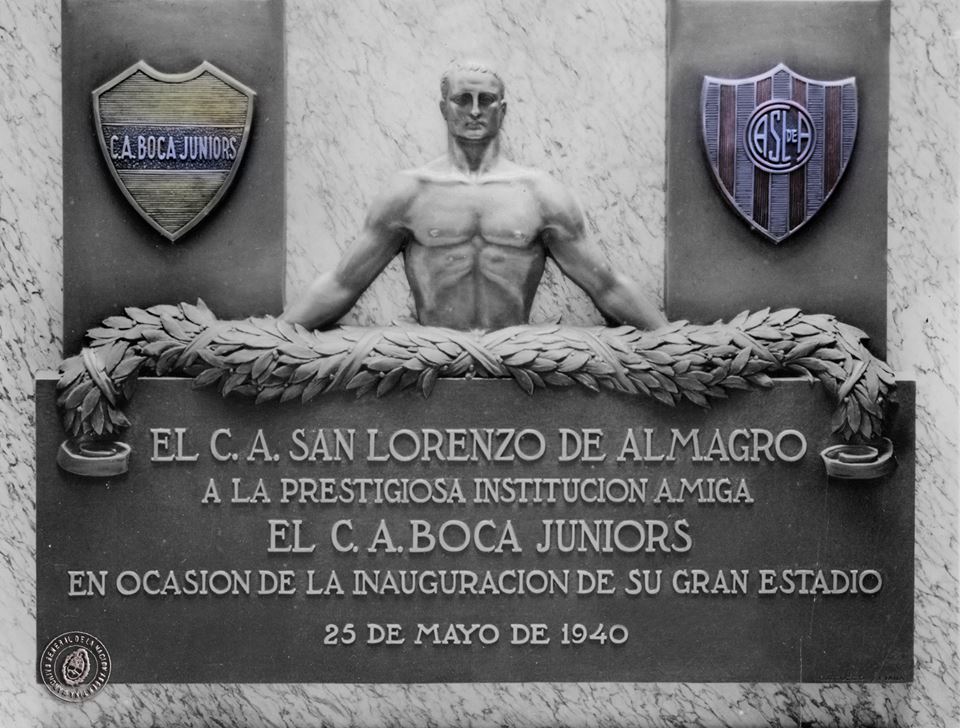
The stadium finally opened on May 25, 1940, with a friendly match between Boca and San Lorenzo, which the home side won 2–0 with both goals scored by Ricardo Alarcón. Due to the fact that the stadium did not have a lighting system, the game only lasted 70' (two halves of 35' each).
The first official game at the new stadium was on June 2, 1940, when Boca Juniors beat Newell's Old Boys 2–0. Ricardo Alarcón (who had scored in the opening game v. San Lorenzo) scored the first official goal at the new venue.
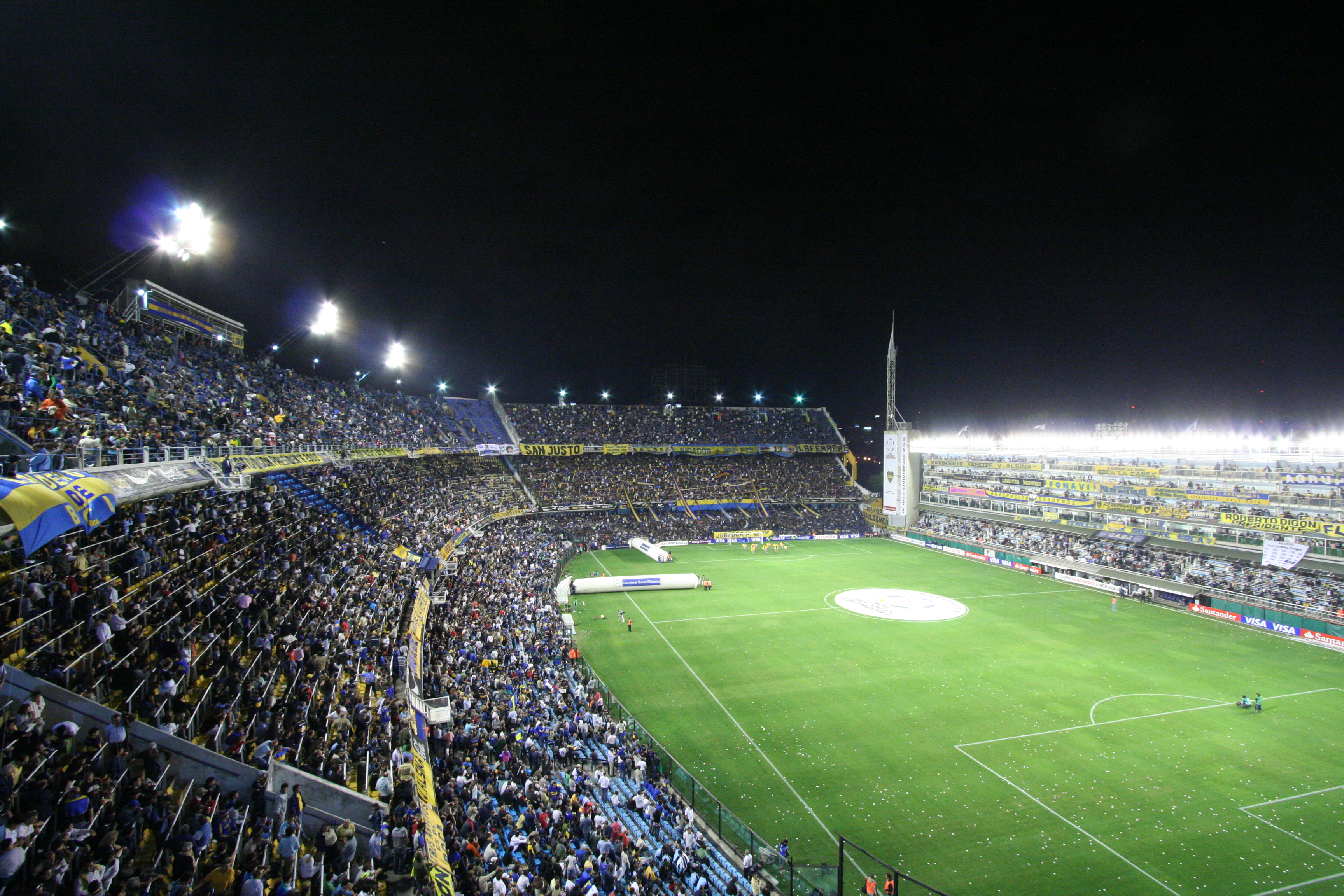
After the stadium was inaugurated, the club continued to introduce refurbishments to expand its capacity. As a result, on November 16, 1941, a second tier was opened on the north side of the stadium, near Casa Amarilla train station. The grandstand was named "Natalio Pescia" in honour of one of the key players in Boca Juniors' history. In 1949, the club decided to add a third tier, as well as a lighting system. All of those works were completed in 1953; this third tier gave the stadium its enduring nickname, La Bombonera. Boca Juniors celebrated with a friendly match vs. Yugoslav club NK Hajduk Split, which ended 1-1.
The stadium was named on April 20, 1986, by team President Antonio Alegre in honor of Camilo Cichero, a former team president under whose tenure work on La Bombonera began. It was renamed on December 27, 2000, by team President Mauricio Macri in honor of Alberto Armando, team president during its resurgence during the 1960s as well as a former business partner of his father Francisco Macri. The stadium was expanded and modernized during Macri's tenure, notably with the addition in 1996 of a fourth tier; and a wing housing a press area, VIP boxes, a museum, and offices. The stadium's exterior was later decorated with works by painters Rómulo Macció and Pérez Celis.
Since then, La Bombonera was not remodeled until 1996 when the presidency of Mauricio Macri decided to expand its capacity to 57,500 spectators. Works included the demolition of the lateral boxes on Del Valle Iberlucea street, replacing them by a small stand and new and modern boxes (with metallic structure) placed over there. The "new" Bombonera was reinaugurated with a friendly match v. Club Universidad de Chile won by Boca Juniors by 3–1.
An electronic screen was installed in 2008, making Boca Juniors' stadium the third venue in Argentina with this technology, after the stadiums of Vélez Sársfield and River Plate. At the beginning of 2012, more than 500 seats were replaced and other 500 were added, part of the building of four additional boxes.
Character
The stadium is notable for the artwork and murals both inside and around the stadium. One of the murals inside the stadium honors the different divisions within the club and many of the clubs legendary players and figures, including Diego Maradona. The mural is made of tile painted blue and yellow and metal busts and sculptures. Several murals outside the stadium depict the lives of residents of La Boca, usually dockworkers, and people wearing Boca Juniors jerseys and apparel.
The stadium is noted for its tendency to shake with heavy fan activity during matches. According to writer Christopher Thomas Gaffney, “La Bombonera does not shake, it beats.” The stadium is also renowned for its location within La Boca, with spectators able to see the dockyards on the Atlantic coast from the highest reaches of the stadium. The stadium is one of many in the city proper of Buenos Aires, with football stadiums far outnumbering other sporting grounds, such as polo grounds and race tracks.
Origin of the name
The stadium is popularly known as La Bombonera. It is said that the nickname came about while architect Viktor Sulčič was designing the stadium. On occasion of Sulčič's birthday, a friend gave him a box of chocolates as a gift. After that, Sulčič used to take the box to project meetings with engineer Delpine and other persons that he collaborated with the project to show them that the box shape was very like the stadium they were designing. Since then, the stadium would be known as La Bombonera ("box of chocolates" in Spanish) and that name has remained to present days. In fact, the opening day (May 25, 1940) the stadium was named that way even by the club executives.
There are other stories or myths about the origin of the nickname. One of them tells that Delpini projected the stands with a highly vertical grade of inclination to host 100,000 persons (which was the first project). The shape of the stands looked like the carts used to collect horses dung in the streets of Buenos Aires. Other version credits journalist Hugo Marini or broadcaster Joaquín Carballo Serantes (aka) "Fioravanti" for the Bombonera nickname.
Despite its distinguished nickname, the first official denomination came on April 20, 1986, when it was named "Camilo Cichero" in commemoration of the president under whose tenure the stadium was projected and built. That same day Boca Juniors defeated Talleres de Córdoba by 4–2. Nevertheless, president Mauricio Macri decided to change the stadium's name to "Alberto J. Armando", honoring long-time president of the club during two periods (1954–55, 1960–80).
Facilities
La Bombonera currently has a gross capacity of 58,305, which results in around 57,200 seats being available for games,. The club's popularity makes tickets hard to get, especially for the Superclásico derby against River Plate.
Out of its capacity of 49,000, there are 37,538 seats, 2,780 in boxes, and 8,682 standing. Both its interior and exterior are lined with a number of murals painted by the artist Pérez Celis depicting many of the club's legendary players and aspects of the district's culture, such as the lives of Italian immigrants.
In 1996, a small stand was built on the 4th side, which had been largely open until then, except for some VIP boxes.
Diego Maradona, who played for and supported Boca Juniors, had his own executive box at the stadium.
There are three parking lots at the stadium for members.
Argentina national team on La Bombonera
The national team has played several games in La Bombonera, including qualifying matches to the FIFA World Cup. The squad played the most games since the 1920s to the mid-1970s. Since the Estadio Monumental of River Plate was completely refurbished for the 1978 WC, the Argentine Football Association fixtured the majority of Argentina's home games at that venue. That decision was based on the Monumental higher capacity and modern facilities in comparison with La Bombonera.
Playing at Boca Juniors Stadium, Argentina was only defeated in two games, having played a total of 27 matches, winning 18 and losing 2 with 7 ties. The squad scored 67 goals and only conceded 27. Some of the official and friendly games played by Argentina at the stadium (as of 14 November 2024) are listed below:
| Game status | Date | Opponent | Score |
|---|---|---|---|
| Copa Lipton | 14 Nov 1956 | 1–1 | |
| 1958 FIFA WCQ | 20 Oct 1957 | 4–0 | |
| 1970 FIFA WCQ | 24 Aug 1969 | 1–0 | |
| 1970 FIFA WCQ | 31 Aug 1969 | 2–2 | |
| Friendly | 8 Jan 1971 | 3–4 | |
| Copa R. Castilla | 27 Jul 1973 | 3–1 | |
| 1974 FIFA WCQ | 9 Sep 1973 | 4–0 | |
| 1974 FIFA WCQ | 7 Oct 1973 | 3–1 | |
| Friendly | 27 Feb 1977 | 5–1 | |
| Friendly | 29 May 1977 | 3–1 | |
| Friendly | 5 Jun 1977 | 1–3 | |
| Friendly | 12 June 1977 | 1–1 | |
| Friendly | 18 Jun 1977 | 1–1 | |
| Friendly | 26 Jun 1977 | 0–0 | |
| Copa F. Bogado | 24 Aug 1977 | 2–1 | |
| Copa R. Castilla | 19 Mar 1978 | 2–1 | |
| Friendly | 29 Mar 1978 | 3–1 | |
| Friendly | 5 Apr 1978 | 2–0 | |
| Friendly | 19 Apr 1978 | 3–1 | |
| Friendly | 3 May 1978 | 3–0 | |
| Friendly | 26 Nov 1992 | 2–0 | |
| 1998 FIFA WCQ | 16 Nov 1997 | 1–1 | |
| 2012 SA | 21 Nov 2012 | 2–1 | |
| 2018 FIFA WCQ | 5 Oct 2017 | 0–0 | |
| Friendly | 29 May 2018 | 4–0 | |
| 2022 FIFA WCQ | 8 Oct 2020 | 1–0 | |
| 2022 FIFA WCQ | 25 Mar 2022 | 3–0 | |
| 2026 FIFA WCQ | 16 Nov 2023 | 0–2 | |
| 2026 FIFA WCQ | 19 Nov 2024 | 1–0 |
Boca Museum
_-_panoramio_(154).jpg)
The Passion of Boca Juniors Museum () was opened in 2001 during Mauricio Macri's administration. It is located within the stadium, just below the grandstands. The museum was built on two floors and chronicles the club's rise from 1905 (the year the club was established) to the present day.
One of the exhibits in the museum is a giant football with 360-degree footage of the club's fans and players at a match. The museum also includes a Hall of fame and a large mural of Diego Maradona. Also included are non-football items, such as the specially commissioned blue and gold guitar played by Lenny Kravitz when he performed at La Bombonera in 2005.
A giant statue of Boca Juniors' all-time top scorer, Martín Palermo, was unveiled in 2011. Other former players who have statues honoring them are Diego Maradona and Román Riquelme A total of seven Boca Juniors idols have been honored by the club with their respective monuments; they are Guillermo Barros Schelotto, Angel Clemente Rojas, Silvio Marzolini and Antonio Rattín, apart from Maradona, Palermo, and Riquelme.
Carlos Bianchi was the first Boca Juniors manager to be honored with a statue when a monument to his figure was unveiled in October 2016. Bianchi won nine titles during his two tenures at the club (1998–2003), becoming the most winning manager in Boca Juniors' history. Under Bianchi's coaching, the team also set a record of 40 matches unbeaten, the biggest since Argentine football became professional in 1931.
Redevelopment
There are planned improvements for the stadium, including measures to ease crowd congestion, the use of new technology in the stadium, and improved corporate facilities. These include:
- Main gate, museum, and megastore: Work is planned to be done on the main access to the stadium at 805 Brandsen, which will include the construction of a megastore, and to then connect the main access with the store and the club's museum.
- Third tier: remodeling work to install further seating and improve spectator comfort.
- Stadium gates: Building work to improve access and prevent crowd congestion is underway. The first phase focuses on improving access to the executive boxes and premium seats. In addition, new software and hardware will improve access control with regard to safety and quickness to prevent crowd congestion.
- Creation of a corporate area: Businesses will have an area in the stadium with VIP service. One section in the second tier is being redesigned with two executive boxes and more comfortable seating. The service will also provide businesses with season tickets to allow them to invite clients. It also includes transportation, museum visits, and catering services.
In film
- Some scenes of the 1969 film Invasión were shot in the deserted stadium.
- The Danish film SuperClásico, has a part filmed in the stadium.
- The Hong Kong film Happy Together, has a part filmed in the stadium.
References
References
- "La Bombonera {{!}} El club". CA Boca Juniors.
- (14 March 2025). "Anuario Conmebol Sudamericana 2024". CONMEBOL.
- "Estadio Alberto J. Armando (La Bombonera) – StadiumDB.com".
- (2020-05-25). "Tuvo el nombre de dos presidentes, pero la pasión la reconoce como la Bombonera".
- Ben Groundwater. (20 September 2010). "Want to get to know a country? Head for the stadium". Fairfax Media.
- (9 November 2018). "Some of the world's scariest places to play or watch football". BBC News.
- "Brazil's Flamengo has most fans in world {{!}} The World Game".
- [http://bleacherreport.com/articles/1060108-50-sports-venues-to-visit-before-you-die/page/5 50 Sports Venues to Visit Before You Die], Bleacher Report, 26 Sep 2012
- (April 2025)
- [https://web.archive.org/web/20150402112020/http://www.pagina12.com.ar/diario/deportes/8-120059.html «La Bombonera» inspira temor], ''Página/12''
- [http://www.marca.com/2014/11/30/futbol/futbol_internacional/argentina/1417382527.html Un día en el fútbol argentino], Diario Marca
- [http://www.marca.com/2014/09/09/futbol/futbol_internacional/argentina/1410214277.html Marca y un día con la Doce]
- [http://www.infobae.com/2014/03/28/1553461-la-mitica-bombonera-como-nunca-antes-la-habias-visto La mítica Bombonera, como nunca antes la habías visto]
- "España, rendida a los pies de La Bombonera".
- "Así es La Bombonera, Liga BBVA".
- "Estadio copero, una fortaleza".
- [http://www.ole.com.ar/futbol-internacional/Vuelta-Boca_0_1327067550.html Vuelta por la Boca] {{Webarchive. link. (2018-03-05 , ''Olé'', 26 Mar 2015)
- [http://www.parlamentario.com/noticia-74878.html "La Bombonera" fue declarada de interés deportivo, turístico y cultural de la Ciudad]{{Dead link. (April 2025)
- Orton, Mark. (2020-12-01). "La Nuestra: Football and National Identity in Argentina 1913–1978".
- 9789505565405
- [http://blogs.lanacion.com.ar/historia-argentina/personalidades/breve-historia-de-la-isla-demarchi/ "Breve historia de la isla Demarchi" on ''La Nación''] {{Webarchive. link. (2014-12-30 , 30 Ago 2012)
- "La Pasion Boca-Boca and their stadiums". Lapasiondeboca.com.
- ""La Bombonera" on Planeta Boca Juniors".
- "AFA Memorias y Balance General 1934". [[Argentine Football Association.
- [http://www.pagina12.com.ar/diario/sociedad/3-143667-2010-04-11.html El arquitecto olvidado], ''Página/12'', 11 Apr 2010
- "Boca Juniors 2 - San Lorenzo de Almagro 0 - Amistosos 1940 - Historia de Boca Juniors".
- "Boca Juniors 2 - Newell´s Old Boys 0 - Campeonato 1940 - Historia de Boca Juniors".
- link. (2009-02-16 on Museo Boquense)
- "The Stadium". [[Club Atlético Boca Juniors]].
- "10 Intimidating Stadiums (Worldwide)". mifielddynamo.com.
- link. (2012-01-19 on Historia de Boca)
- "Boca Juniors y sus estadios". Club Atlético Boca Juniors.
- "Boca Juniors 3 –– Universidad (Chi) 1".
- [http://edant.ole.com.ar/notas/2008/01/29/01595690.html Lo miran por TV] {{Webarchive. link. (2012-01-27 by Horacio García on ''Olé'', 21 Jan 2008)
- "Murals in Boca Juniors Stadium".
- Gaffnet, Christopher Thomas. (2008). "Temples of the Earthbound Gods : Stadiums in the Cultural Landscapes of Rio de Janeiro and Buenos Aires". University of Texas Press.
- [https://www.pagina12.com.ar/diario/sociedad/subnotas/143667-46175-2010-04-11.html Una caja de bombones de regalo], ''Página/12'', 26 Apr 2010
- ''La vida color de Boca, 100 años de una pasión argentina'', vol. 1, [http://www.lanacion.com.ar/691785-la-vida-color-de-boca published by ''La Nación''] {{Webarchive. link. (2017-02-02 , March 2005)
- [http://conexion2000.com.ar/bomboneraabbatangelo.htm LA BOMBONERA. UNA HISTORIA DE IDENTIDAD Y MISTICA] {{Webarchive. link. (2013-08-20 by Arq. Pablo F. Abbátangelo on Conexion2000.com.ar)
- [http://www.infobae.com/2015/11/23/1771739-los-momentos-mauricio-macri-boca-que-marcaron-su-perfil-politico/ Los momentos de Mauricio Macri en Boca que marcaron su perfil político], Infobae.com, 23 Nov 2015
- (18 August 2023). "El retoque en el aforo de La Bombonera que se estrenará en Boca-Platense".
- (27 January 2007). "Buenos Aires: In a liga of its own". [[The Independent]].
- (September 2010). "Fochada de la Bombonera". Bocacampeonweb.
- "La Bombonera". The Stadium Guide.
- "El Estadio: Alberto J. Armando". Agrupación Nuevo Boca.
- [https://www.rsssf.org/tablesa/arg-intres.html ARGENTINA NATIONAL TEAM ARCHIVE] by Héctor D. Pelayes on [[RSSSF]]
- Neumann, Jeannette. (1 May 2008). "In Argentina, fans go wild for Boca Juniors". [[USA Today]].
- "Buenos Aires Attractions – Boca Juniors Stadium and Museum". [[New York Times]].
- "Estadio Boca Juniors Review". [[Fodor's]].
- "El Museo de la Pasión Bocquense". [[Club Atlético Boca Juniors]].
- [http://www.larazon.com.ar/deportes/Palermo-estatua-gigante_0_269700091.html "Palermo ya tiene su estatua gigante"] {{Webarchive. link. (2016-03-04 ''Diario La Razón'', Fecha: 20/08/2011)
- [http://www.lanacion.com.ar/1945044-la-estatua-de-bianchi-la-manera-mas-simbolica-de-inmortalizarse-en-la-familia-xeneize El DT más ganador de la historia de Boca fue homenajeado con una pieza que se ubicará en el Museo del club; además, se llevó una réplica en miniatura] {{Webarchive. link. (2017-02-02 by Patricio Insúa, ''La Nación'', 7 Oct 2016)
- "First in the World – Processes that have been certified with the maximum distinction". [[Club Atlético Boca Juniors]].
This article was imported from Wikipedia and is available under the Creative Commons Attribution-ShareAlike 4.0 License. Content has been adapted to SurfDoc format. Original contributors can be found on the article history page.
Ask Mako anything about La Bombonera — get instant answers, deeper analysis, and related topics.
Research with MakoFree with your Surf account
Create a free account to save articles, ask Mako questions, and organize your research.
Sign up freeThis content may have been generated or modified by AI. CloudSurf Software LLC is not responsible for the accuracy, completeness, or reliability of AI-generated content. Always verify important information from primary sources.
Report