From Surf Wiki (app.surf) — the open knowledge base
L'Hospitalet de Llobregat
| Field | Value | ||
|---|---|---|---|
| name | L'Hospitalet de Llobregat | ||
| settlement_type | Municipality | ||
| official_name | |||
| image_skyline | L'Hospitalet de Llobregat.jpg | ||
| image_flag | Bandera de l'Hospitalet de Llobregat.svg | ||
| image_shield | Escut de L'Hospitalet de Llobregat.svg | ||
| mapframe | yes | ||
| mapframe-zoom | 4 | ||
| mapframe-marker | city | ||
| image_map1 | [[File:Localització de l'Hospitalet de Llobregat respecte del Barcelonès.svg | 150px]] | |
| map_caption1 | Location in Barcelonès county | ||
| map_caption | Location of L'Hospitalet de Llobregat | ||
| pushpin_map | Spain Catalonia vegueries#Spain | ||
| pushpin_map_caption | Location within Catalonia##Location within Spain | ||
| coordinates | |||
| subdivision_type | Country | ||
| subdivision_name | Spain | ||
| subdivision_type1 | Autonomous community | ||
| subdivision_name1 | Catalonia | ||
| subdivision_type2 | Region | ||
| subdivision_name2 | Barcelona | ||
| subdivision_type3 | County | ||
| subdivision_name3 | Barcelonès | ||
| subdivision_type4 | Province | ||
| subdivision_name4 | Barcelona | ||
| <!-- established ---------------> | established_title | Founded | |
| established_date | 12th century | ||
| <!-- seat, smaller parts -------> | seat_type | ||
| seat | |||
| government_type | Ajuntament | ||
| governing_body | Ajuntament de L'Hospitalet | ||
| leader_title | Mayor | ||
| leader_name | David Quirós (2024) | ||
| leader_party | PSC | ||
| <!-- area ----------------------> | area_footnotes | ||
| total_type | Municipality | ||
| area_total_km2 | 12.40 | ||
| elevation_footnotes | (AMSL) | ||
| elevation_m | 8 | ||
| elevation_max_m | |||
| population_as_of | 2024 | ||
| population_footnotes | |||
| population_total | 282299 | ||
| population_demonyms | hospitalenc, -ca (ca) | ||
| hospitalense (es) | |||
| population_rank | 15th in Spain | ||
| population_density_km2 | auto | ||
| timezone | CET | ||
| utc_offset | +1 | ||
| timezone_DST | CEST | ||
| utc_offset_DST | +2 | ||
| postal_code_type | Postal code | ||
| <!-- postal codes, area code ---> | postal_code | 0890x | |
| area_code_type | Dialing code | ||
| area_code | +34 (E) 93 (B) | ||
| <!-- INE code, city budget -----------> | blank_name_sec1 | INE code | |
| blank_info_sec1 | 08 1017 | ||
| blank1_name_sec1 | City budget (2014) | ||
| blank1_info_sec1 | €200 million | ||
| <!-- language(s), patron saint(s), main festivity ---------------> | blank1_name_sec2 | Main festitivity | |
| blank1_info_sec2 | ? | ||
| blank2_name_sec2 | Patron saint | ||
| blank2_info_sec2 | Saint Eulalia | ||
| <!-- website, footnotes --------> | website |
| mapframe-zoom = 4 | mapframe-marker = city hospitalense (es)
L'Hospitalet de Llobregat (; ), often shortened to L'Hospitalet or just L'H, is a city and municipality in the autonomous community of Catalonia in Spain. It is part of the Barcelona metropolitan area, the Barcelona province, the Barcelonès comarca and of the Barcelona conurbation. With a population of 282,299 as of 2024, it is the 15th-largest city in Spain and the 2nd-largest city in Catalonia.
By population, it is the second largest municipality in Catalonia and the sixteenth in Spain. It is one of the most densely populated cities in the European Union.
Etymology
The name of L'Hospitalet (literally, 'the small hospital' in Catalan) makes reference to a hostel.
History
The first records of the settlement date to the Neolithic era with artefacts showing human habitation in the Llobregat river area. Roman artefacts have been found dating to the 2nd century BC such as a funeral decoration representing the head of Medusa, now in the Archaeological Museum of Catalonia. However it is not until the 10th century that written references to Provençana (the city's original name) appear.
The place had about 5,000 inhabitants by the turn of the 20th century. Throughout the early 20th century, it consisted of three different urban settlements, Centre, Sta. Eulàlia and Collblanc. Local agricultural output and profitability experienced a peak in this period. A chunk of the municipality (900 ha) was lost to the municipality of Barcelona in 1920. L'Hospitalet then became a primarily industrial municipality, focused on textile, metalworking, ceramic and building materials industries.
The 1960s and 1970s saw a second population boom, caused by immigration from poorer regions of Spain: however this was not matched by construction of the necessary amenities and it was only in the 1990s that public investment resulted in additional schools, leisure facilities and housing.
Geography
L'Hospitalet's surface is 12.40 km2. The area on which the city is constructed may be divided in two different geological areas. One of them follows the coast typology and is called La Marina, similarly to two coast areas of neighbouring Barcelona's Zona Franca: La Marina del Prat Vermell and La Marina de Port. The latter half of L'Hospitalet is called El Samontà, which consists of hills and a more elevated area.
Demographics
As of 2020, the registered population stands at 274,320, of which 126,237 were born in Catalonia, 54,098 were born in other Spanish regions, 93,984 were born abroad and 1 person was born in former Spanish territories.
As of 2024, the foreign-born population of the city is 107,950, equal to 38.2% of the total population. The 5 largest foreign nationalities are Ecuadorians (12,970), Peruvians (10,905), Dominicans (9,605), Bolivians (9,332) and Colombians (8,891).
| Country | Population |
|---|---|
| Ecuador | 12,970 |
| Peru | 10,905 |
| Dominican Republic | 9,605 |
| Bolivia | 9,332 |
| Colombia | 8,891 |
| Morocco | 7,687 |
| Honduras | 6,288 |
| Pakistan | 5,315 |
| India | 4,678 |
| Venezuela | 4,055 |
| China | 3,225 |
| Argentina | 2,605 |
| Paraguay | 2,387 |
| Romania | 1,373 |
| Brazil | 1,205 |
Economy
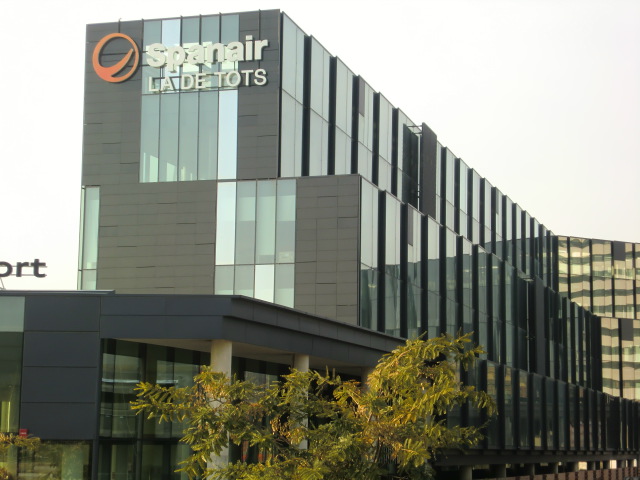
The city's reputation is largely still that of a depressed suburb, drawing on its proletarian origins and its reliance on Barcelona. But its economy has improved recently, as can be seen from the city's new skyline and relocation of companies to the city's new financial centre. Urban regeneration and construction took place during the 2000s, as well as ongoing work on improving public transportation in the second municipality of the Barcelona metropolitan area. The former airline Spanair's headquarters were in L'Hospitalet. Former mayor Celestino Corbacho campaigned to improve the city's infrastructure from his position in the Ministry of Work.
Skyscrapers
- Hotel Porta Fira (2010) – 113 m– Completed
- Torre Realia BCN (2009) – 112 m – Completed
- Hotel Catalonia Plaza Europa (2011) – 105 m – Completed
- Hesperia Tower (2006) – 106 m – Completed
- Tower Caixa Catalunya (?) – 106 m – Planned
- Torre Inbisa (2010) – 104 m – Completed
- Torre Zenit (2009) – 104 m – Completed
- Hospital de Bellvitge (1972) – 82 m – Completed
- Tower Colonial (?) – 75 m – Under Construction (on hold)
- Tower Fadesa I (2009) – 65 m – Completed
- Tower Fadesa II (2009) – 65 m – Completed
- Tower Fadesa III (2009) – 65 m – Completed
- City Judicial Building A (2008) – 62 m – Completed
- City Judicial Building C (2008) – 58 m – Completed
- Torre Melina (Hotel Rey Juan Carlos) (1992) – 60 m – Completed
File:Spain.Catalonia.Hospitalet.Hospital.de.Bellvitge.1.JPG|Hospital de Bellvitge File:Hesperia Tower.jpg|Hesperia Tower File:Barcelona 2010 August 005 Hotel.JPG|Toyo Ito Towers
Administrative units
District I
;El Centre

El Centre is the historical centre of the city, the oldest neighbourhood, where the City Council is, as well as the centre of activities such as La Farga and many of the cultural buildings, such as the History Museum, the Can Sumarro library, the cultural centre Barradas or the Sala Alexandre Cirici. It borders the district of Sanfeliu and Can Serra to the north, Bellvitge to the south, Sant Josep to the east, and the city of Cornellà de Llobregat to the west.
;Sant Josep Sant Josep remains framed by the square that is formed by the avenue of the Fabregada and that of Isabella The Catholic (Isabel la Catòlica) to the west, the Torrent Gornal to the east, the railroad on the north side Carrilet to the south. In this area, all the industrial activities that Hospitalet had through the ages left their mark: from the flour mills and the distilleries, up to the different energetic exploitation of the waterfalls of the Canal de la Infanta or the ceramic, textile, metallurgical and chemical industries. In fact, Sant Josep was originally an industrial suburb, but the subsequent disappearance of many factories, as well as the population increase, have given it a residential character.
;Sanfeliu Civic life in this quarter centres on the avenue of the Cirerers and the Communities Square (Plaça de les Comunitats). This public space is the scene of the greatest holiday celebrations, such as the festival of Sant Joan, the Carnival, and many other popular events. The cultural centre is also at the heart of many of the activities.
District II
;Collblanc This ward has a marked commercial character, centred near the Collblanc Metro stop. The Market Square (Plaça del Mercat) and the surroundings are the main centre of cultural life.
;La Torrassa Its origins has been linked to Collblanc. Today, the Spanish Square (Plaça Espanyola) and the new park of La Torrassa are at the heart of this neighbourhood and is where the holiday celebrations at the beginning of every summer are largest.
District III
;Santa Eulàlia
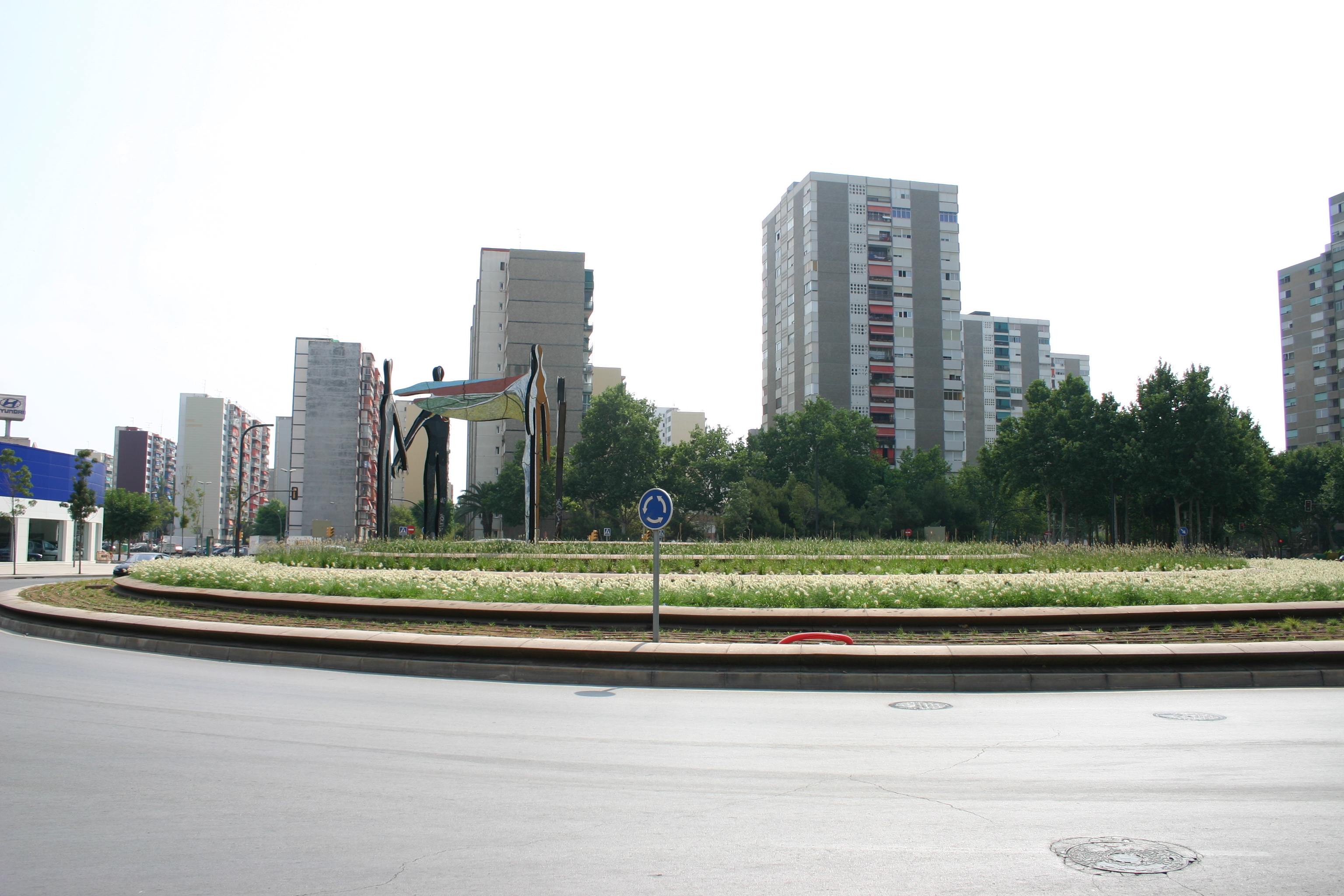
Its origins are dated back to Medieval times thanks to the presence of the Santa Eulàlia de Provençana hermitage (dated in the 12th century thanks to an inscription in the façade). Also it was very important during the Industrial Revolution thanks to the presence of many industries in the quarter, such as Can Trinxet, L'Aprestadora or Can Pareto. ;Gran Via Sud It is the smallest quarter in the town.
District IV
;La Florida
La Florida is a majority-immigrant neighborhood that is the densest neighborhood in Europe.
;Les Planes
District V
;Pubilla Casas ;Can Serra
District VI
.jpg)
;Bellvitge In 1964 the Inmobiliaria Ciudad Condal S.A. (ICC) company initiated the construction of this neighbourhood as it stands nowadays, beside the hermitage, on land which had been bought from local farmers. It was designed as a residential area to house the large number of immigrants who came to Catalonia from elsewhere in Spain – more than 126,000 people in 1964 – in search of work.
;Gornal
District VII
;Granvia l'Hospitalet
Transport
Main article: Transport in L'Hospitalet de Llobregat
International relations
Twin towns and sister cities
L'Hospitalet is twinned with the following cities:
- Bayonne, France
- Tuzla, Bosnia and Herzegovina
Notes
References
References
- "El municipi en xifres: L'Hospitalet de Llobregat". [[Institut d'Estadística de Catalunya.
- Rae, Alasdair. (2018-03-22). "Europe's most densely populated square kilometres – mapped". The Guardian.
- García Sánchez, Jairo J.. (13 September 2005). "Cataluña y sus topónimos (y V)". [[Centro Virtual Cervantes]].
- Domínguez, Manuel. (2014). "El patrimoni de l'Hospitalet: una història i algunes propostes". Quaderns d'Estudi.
- Domínguez, Manuel. (2011). "El pistolerisme a l'Hospitalet". Quaderns d'Estudi.
- "INEbase. Alterations to the municipalities in the Population Censuses since 1842". [[National Institute of Statistics (Spain).
- "Demografia". Ajuntament de L'Hospitalet.
- "Annual population census 2021-2024". [[National Statistics Institute (Spain).
- Lonely Planet Barcelona, p8, Damien Simonis
- [http://www.urbanity.es/foro/viajes-ciudades-y-naturaleza-cat/7240-lhospitalet-de-llobregat-bcn.html L'Hospitalet de Llobregat] (in Spanish), www.urbanity.es
- "[http://www.spanair.com/web/en-gb/Contacts/ Contacts]." [[Spanair]]. Retrieved on 29 December 2009.
- "Ser joven en la Florida, el barrio con más densidad de población de Europa".
- "National Commission for Decentralized Cooperation". Délégation pour l'Action Extérieure des Collectivités Territoriales (Ministère des Affaires étrangères).
This article was imported from Wikipedia and is available under the Creative Commons Attribution-ShareAlike 4.0 License. Content has been adapted to SurfDoc format. Original contributors can be found on the article history page.
Ask Mako anything about L'Hospitalet de Llobregat — get instant answers, deeper analysis, and related topics.
Research with MakoFree with your Surf account
Create a free account to save articles, ask Mako questions, and organize your research.
Sign up freeThis content may have been generated or modified by AI. CloudSurf Software LLC is not responsible for the accuracy, completeness, or reliability of AI-generated content. Always verify important information from primary sources.
Report