From Surf Wiki (app.surf) — the open knowledge base
Kyushu
Island and region of Japan

Island and region of Japan
| Field | Value |
|---|---|
| name | Kyushu |
| image_name | Terra Kyushu 20091028.jpg |
| image_caption | October 2009 NASA satellite image of Kyushu |
| image_map | Kyushu_Region_in_Japan_(extended).svg |
| map_caption | Kyushu region of Japan and the current prefectures on the island of Kyushu |
| native_name | 九州 |
| native_name_lang | ja |
| native_name_link | Japanese language |
| location | East Asia |
| coordinates | |
| archipelago | Japanese Archipelago |
| area_km2 | 36782.37 |
| rank | 37th |
| coastline_km | 12221 |
| highest_mount | Mount Kujū |
| elevation_m | 1791 |
| country | Japan |
| country_admin_divisions_title | Prefectures |
| country_admin_divisions | |
| country_largest_city | Fukuoka |
| population | 12,650,847 (as of June 2022) |
| density_km2 | 307.13 |
| ethnic_groups | Japanese |
| timezone1 | Japan Standard Time (UTC+9) |
| module |
the location in Japan
Kyushu is the third-largest and most southerly of Japan's four main islands. In the past, it has been known as , and . The historical regional name Saikaidō referred to Kyushu and its surrounding islands. Kyushu has a land area of 36782 km2 and a population of 14,311,224 in 2018.
There is a theory that Kyushu was in ancient times home to its own independent dynasty, where a unique, southern-influenced culture and tradition distinct from that of Honshu flourished.
In the 8th-century Taihō Code reforms, Dazaifu was established as a special administrative term for the region.
Geography
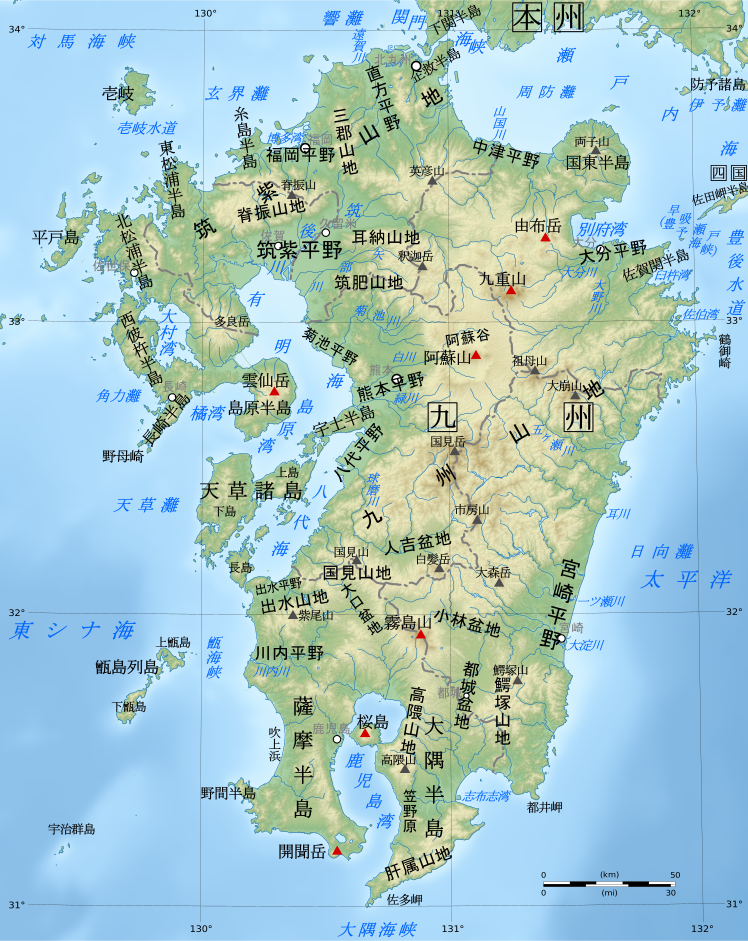
The island is mountainous, and Japan's largest active volcano, Mount Aso at 1591 m, is on Kyushu. There are many other signs of tectonic activity, including numerous areas of hot springs. The most famous of these are in Beppu, on the east shore, and around Mt. Aso in central Kyushu. The island is separated from Honshu by the Kanmon Straits. Being the nearest island to the Asian continent,Nussbaum, Louis-Frédéric and Käthe Roth (2005). Japan Encyclopedia. Cambridge, Mass.: Harvard University Press. . . historically it is the gateway to Japan.
The total area is 36,782.37 km² which makes it the 37th largest island in the world. It is slightly larger than Taiwan's total area of 35,808 km2. The highest elevation is 1791 m on Mount Kujū.
The name Kyūshū comes from the nine ancient provinces of Saikaidō situated on the island: Chikuzen, Chikugo, Hizen, Higo, Buzen, Bungo, Hyūga, Ōsumi, and Satsuma.
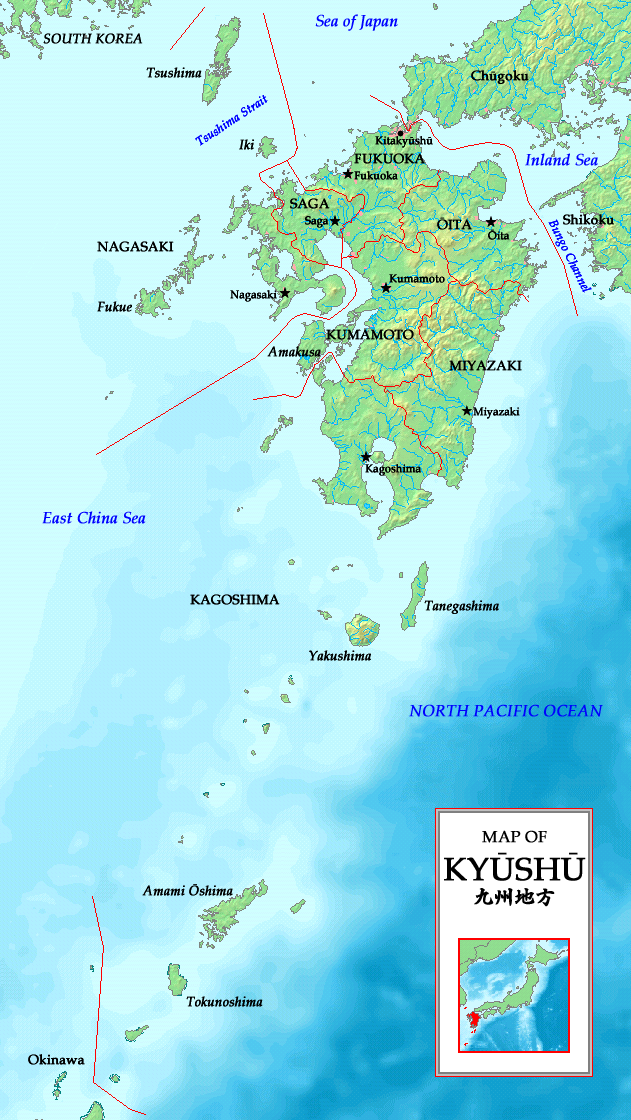
Today's Kyushu Region is a politically defined region that consists of the seven prefectures on the island of Kyushu (which also includes the former Tsushima and Iki as part of Nagasaki), plus Okinawa Prefecture to the south:
- Northern Kyushu
- Fukuoka Prefecture
- Kumamoto Prefecture
- Nagasaki Prefecture
- Ōita Prefecture
- Saga Prefecture
- Southern Kyushu
- Kagoshima Prefecture
- Miyazaki Prefecture
- Okinawa
- Okinawa Prefecture
Population
Kyushu has 10.3percent of the population of Japan. Most of Kyushu's population is concentrated along the northwest, in the cities of Fukuoka and Kitakyushu, with population corridors stretching southwest into Sasebo and Nagasaki and south into Kumamoto and Kagoshima. Except for Oita and Miyazaki, the eastern seaboard shows a general decline in population.
Politically, Kyushu is described as a stronghold of the Liberal Democratic Party.
Per Japanese census data, the Kyushu region's population with Ryukyu Islands (Okinawa and Kagoshima Prefectures) has experienced a large decline since around 2000. However, the population decline in total is mild because of the relatively high birth rate of Ryukyuans both within the Ryukyuan lands (Okinawa and Kagoshima) and throughout the Kyushu region. In addition, the other prefectures in Kyushu also have exceptionally high TFRs compared to the rest of Japan.
| Including Ryukyu Islands | 1873 | 5,163,730 | 1920 | 8,730,000 | 1930 | 9,647,000 | 1940 | 10,511,000 | 1950 | 13,011,000 | 1960 | 13,787,000 | 1970 | 13,016,000 | 1980 | 14,073,000 | 1990 | 14,518,000 | 2000 | 14,763,781 | 2010 | 14,596,783 | 2018 | 14,311,224 | align = none | footnote = Includes Okinawa and Kagoshima prefecture populations. | Excluding Ryukyu Islands | 1873 | 4,776,363 | 1920 | 6,742,000 | 1930 | 7,512,000 | 1940 | 8,347,000 | 1950 | 10,292,000 | 1960 | 10,941,000 | 1970 | 10,342,000 | 1980 | 11,181,000 | 1990 | 11,498,000 | 2000 | 11,659,367 | 2010 | 11,497,723 | 2018 | 11,249,154 | align = none | footnote = In 1873, Ōsumi Province represents portion of Kagoshima with Ryukyu islands |
|---|
Designated cities
- Fukuoka (population: 1,588,924)
- Kitakyushu (population: 940,978)
- Kumamoto (population: 738,907)
Core cities
- Kagoshima
- Kurume
- Miyazaki
- Naha
- Nagasaki
- Ōita
- Saga
- Sasebo
Environment and agriculture
Parts of Kyushu have a subtropical climate, particularly Miyazaki Prefecture and Kagoshima Prefecture. Major agricultural products are rice, tea, tobacco, sweet potatoes, and soy; silk is also widely produced.
Besides the volcanic area of the south, there are significant mud hot springs in the northern part of the island, around Beppu. The springs are the site of occurrence of certain extremophile microorganisms, which are capable of surviving in extremely hot environments.
There are two World Natural Heritage sites in Kyushu: Yakushima (registered in 1993) and Amami-Ōshima Island, Tokunoshima Island, northern part of Okinawa Island, and Iriomote Island (registered in 2021).
Economy
Main article: Economy of Japan

Kyushu's economy accounts for approximately 10% of Japan's total economic output, making it comparable to countries such as Iran, Norway, Austria, the United Arab Emirates, and Thailand. It is the fourth largest economic region in Japan, following the three major metropolitan areas of Tokyo, Osaka, and Nagoya.
Kyushu's economy has a well-balanced industrial structure, ranging from primary industries such as agriculture, to secondary industries such as manufacturing, and tertiary industries such as retail, services, and tourism. Agricultural output in the region amounts to 1.8 trillion yen (20% share of the national total), and the region is a major domestic production center for the automobile and semiconductor industries. Kyushu also has a thriving healthcare industry, including medical and nursing care, and numerous research and manufacturing facilities in the fields of hydrogen, solar power, and other renewable energies. Furthermore, Fukuoka City, Kitakyushu City and Okinawa Prefecture have been designated as National Strategic Special Zones, which are expected to have an economic ripple effect on the entire Kyushu region through the creation of innovation in industry and the promotion of new entrepreneurship and start-ups.
Kyushu is a region with strong economic ties to Asia. For example, Asia accounted for 420 (77.9%) of the 539 overseas expansion cases of Kyushu-Yamaguchi companies from 2010 to 2019, and Asia accounted for 61.1% of Kyushu-Yamaguchi's total exports in 2019, 7.4 percentage points higher than the nation as a whole. As the logistics node between Japan and Asia, the ports of Hakata and Kitakyushu handle a large number of international containers. In addition, the number of cruise ship calls in 2019 was 772, with Kyushu accounting for 26.9% of the nation's total.
Kyushu is noted for various types of porcelain, including Arita, Imari, Satsuma, and Karatsu. Heavy industry is concentrated in the north around Fukuoka, Kitakyushu, Nagasaki, and Oita and includes chemicals, automobiles, semiconductors, metal processing, shipbuilding, etc. The island of Tanegashima hosts the Tanegashima Space Center, which is the largest rocket-launch complex in Japan.
Transportation
Kyushu is linked to the larger island of Honshu by the Kanmon Railway Tunnel, which carries the non-Shinkansen trains of the Kyushu Railway Company, and the newer Shin-Kanmon Tunnel carrying the San'yō Shinkansen. Railways on the island are operated by the Kyushu Railway Company and West Japan Railway Company, as well as a variety of smaller companies such as Amagi Railway and Nishitetsu Railway. Kyushu Shinkansen trains operate between major cities on the island, such as Fukuoka and Kagoshima, with an additional route between and Nagasaki which has been in operation since September 2022. Kyushu is also known for its scenic train services, such as the Limited Express Yufuin no Mori and Limited Express Kawasemi Yamasemi.
The Kanmon Bridge and Kanmon Roadway Tunnel also connect the island with Honshu, allowing for vehicular transport between the two. The Kyushu Expressway spans the length of the island, linking the Higashikyushu Expressway and Ibusuki Skyline, connecting major cities such as Fukuoka and Kumamoto along the way. There are also many quiet country roads, including popular tourist routes such as the Nichinan coast road and the Aso Panorama Line in Kumamoto Prefecture. Bus services are available and cover 2,400 routes within Kyushu's cities, connecting many other destinations.
Several passenger and car ferry services connect both northern and southern Kyushu with main port cities on the main island of Honshu (Kobe, Osaka, Tokyo) and Shikoku.
The island's main larger airport is served by Fukuoka Airport which provides most domestic and internationals flights. There are also smaller airports across island including Kumamoto Airport, Miyazaki Airport, Oita Airport, Saga Airport, Nagasaki Airport Kitakyushu Airport and Kagoshima Airport.
Education

Major universities and colleges in Kyushu:
- National universities
- Fukuoka University of Education
- Kagoshima University
- Kumamoto University
- Kyushu Institute of Technology
- Kyushu University – One of seven former "Imperial Universities"
- Miyazaki University
- Nagasaki University
- National Institute of Fitness and Sports in Kanoya
- Oita University
- Saga University
- University of the Ryukyus
- Universities run by local governments
- Fukuoka Prefectural University
- Fukuoka Women's University
- Kyushu Dental College
- Miyazaki Municipal University
- Miyazaki Prefectural Nursing University
- Nagasaki Prefectural University
- Oita University of Nursing and Health Sciences
- Okinawa Prefectural University of Arts
- Prefectural University of Kumamoto
- University of Kitakyushu
- Major private universities
- Fukuoka University – University with the largest number of students in Kyushu
- Kumamoto Gakuen University
- Kurume University
- Kyushu Sangyo University – Baseball team won the Japanese National Championship in 2005
- Ritsumeikan Asia Pacific University
- Seinan Gakuin University
- University of Occupational and Environmental Health
Culture
Kyushu has maintained the strongest economic and cultural ties with Okinawa (Ryukyu) from ancient times to the present. Traces of Okinawan culture can be seen throughout Kyushu, and vice versa. Okinawan musical scales are often found in local folk songs, and there are many similarities in cuisine and language. Kyushu is also home to a unique traditional instrument called the gottan, which resembles the sanshin and shamisen. The region boasts a rich tradition of craftsmanship, with numerous traditional crafts such as Hakata-ori (博多織), Beppu bamboo crafts(別府竹細工), Kurume Kasuri (久留米絣), and Sathuma Kiriko.
People
People in Kyushu are known for being conservative even within Japan. In particular, men from Kyushu are often referred to as "Kyushu danji" (九州男児), evoking an image of being wild and strong. It is said that this term has existed since ancient times, originally used to inspire and encourage soldiers. Being from Kyushu is a source of great pride for its people. Thanks to this cultural spirit, Kyushu has preserved a rich variety of unique traditional cultures that continue to thrive today.
Food

The main features of Kyushu cuisine are the use of fresh ingredients nurtured by the region's geography, which is surrounded by the sea and blessed with rich nature, along with distinctive seasonings such as sweet soy sauce (Kyushu soy sauce) and barley miso, which differ from those used in Honshu.
Each region has its own culinary characteristics: seafood-based dishes are prominent in the north, while meat dishes are more common in the south.
- Fukuoka – Hakata ramen (博多ラーメン), gameni (がめ煮, 筑前煮), motsunabe (もつ鍋), kashiwa-meshi (かしわ飯), okyu-to (おきゅうと)
- Saga – Tsunkī dago jiru (つんきーだご汁), noppe jiru (のっぺ汁), funanko-gui (ふなんこぐい), noppe jiru (のっぺ汁)
- Nagasaki – Nagasaki champon (長崎ちゃんぽん), sara udon (皿うどん), rokube (ろくべえ), Omura-zushi (大村寿司)
- Oita – dango jiru (だんご汁), ami-meshi (あみめし), kirasu-meshi (きらすまめし), toriten (とり天), hocho (鮑腸)
- Kumamoto – Nankan-age maki-zushi (南関あげ巻き寿司), takana zuke (高菜漬け), karashi renkon (からし蓮根), dago jiru (だご汁)
- Miyazaki – nishime (煮しめ), chicken nanban (鶏南蛮), na-dōfu (菜豆腐), hiyajiru (冷や汁), hie-zushi (稗ずーしー)
- Kagoshima – keihan (鶏飯), abura-zōmen (油ゾーメン), satsuma-sumoji (さつますもじ), buri-daikon (ぶり大根), gane(がね)
- Okinawa – goyā champurū (ゴーヤーチャンプルー), Okinawa soba (沖縄そば), rafutē (ラフテー), kufājiushi (クファジューシー)
Sweets
.jpg)
Confectionery in Kyushu tends to use more sugar compared to other regions of Japan. This is because Kyushu has historically had close ties with Okinawa (Ryukyu), a major producer of sugar. As a result, many traditional sweets from Kyushu incorporate characteristics of Ryukyuan culture.
- Karukan (かるかん)
- Umegae Mochi (梅ヶ枝餅)
- Ikinari Dango (いきなり団子)
- Jiriyaki (じり焼き)
- Ogi Yōkan *(*小城羊羹)
- Kurobo (黒棒)
- Kashamochi (かしゃもち)
- Imo manju (いも饅頭)
- Akumaki (あくまき)
- Yubeshi(柚餅子)
- Sake Manjū (酒まんじゅう)
Musical instruments

In Kyushu, there exists a traditional stringed instrument known as the gottan (ゴッタン), which developed independently within the region's unique cultural and geographic context. The instrument is considered to be a midpoint between the shamisen of mainland Japan and the sanshin of Okinawa, incorporating characteristics of both. Structurally, it resembles the sanshin more closely—for example, it lacks the sawari, a buzzing mechanism found in the shamisen. This absence, along with its simplified wooden box construction and single string, aligns it with the more minimalistic design typical of southern instruments.
Musically, the gottan is sometimes used to perform melodies that reflect the Ryukyuan pentatonic scale, suggesting a subtle but notable influence from Okinawan musical traditions. While it remains a distinct and localized folk instrument of Kyushu, its sound and structure reveal traces of a broader cultural exchange within the southern Japanese archipelago, embodying a hybrid identity between the mainland and the Ryukyus.
- Gottan (ゴッタン)
- Sanshin (三線)
- Chikuzen Biwa (筑前琵琶)
- Sathuma Biwa (薩摩琵琶)
- Thuchibue (土笛)
- Iwabue (石笛)
World Heritage Sites
- Gusuku Sites and Related Properties of the Kingdom of Ryukyu, registered in 2000
- Sites of Japan's Meiji Industrial Revolution: Iron and Steel, Shipbuilding and Coal Mining, registered in 2015
- Sacred Island of Okinoshima and Associated Sites in the Munakata Region, registered in 2017
- Hidden Christian Sites in the Nagasaki Region, registered in 2018
Sports
Historically some Kyushu-based sports team has competed in the top Japanese division of baseball (NPB), football (soccer) (J.League), basketball (B.League) or even rugby union (League One). Currently the major teams competing in Kyushu's major cities include:
- Fukuoka: Fukuoka SoftBank Hawks (baseball); Avispa Fukuoka, Giravanz Kitakyushu (football); Rizing Zephyr Fukuoka (basketball); Kyuden Voltex (Rugby)
- Saga: Sagan Tosu (football); Saga Ballooners (basketball)
- Nagasaki: V-Varen Nagasaki (football); Nagasaki Velca (basketball)
- Kumamoto: Roasso Kumamoto (football); Kumamoto Volters (basketball)
- Ōita: Oita Trinita (football)
- Miyazaki: Tegevajaro Miyazaki (football)
- Kagoshima: Kagoshima United FC (football); Kagoshima Rebnise (basketball)
- Okinawa: FC Ryukyu (football); Ryukyu Golden Kings (basketball)
References
References
- {{cite peakbagger
- (22 August 2015). "離島とは(島の基礎知識) (what is a remote island?)". [[Ministry of Land, Infrastructure, Transport and Tourism]].
- Nussbaum, Louis-Frédéric. (2005). "Kyūshū" in {{Google books. p2QnPijAEmEC. ''Japan Encyclopedia'', p. 588
- (1991-02-09). "大嘗祭と九州王朝の系図". 市民の古代第13集 1991年 市民の古代研究会編.
- "伝統芸能・工芸|九州への旅行や観光情報は九州旅ネット".
- Nussbaum, "Dazaifu" in {{Google books. p2QnPijAEmEC. p. 150
- Cobbing, Andrew. (2009). "Kyushu, gateway to Japan : a concise history". Global Oriental.
- (2016-10-01). "平成28年全国都道府県市区町村別面積調 島面積". [[国土地理院]].
- "Discover the Geography of the 4 Main Islands of Japan". ThoughtCo.
- "Japan Ultra-Prominences". Peaklist.org.
- Cobbing, Andrew. (2009). "Kyushu, Gateway to Japan: A Concise History". Global Oriental.
- Boquet, Yves. (2017). "The Philippine Archipelago". Springer.
- (5 October 2017). "Japanese voters want a plan to handle a declining population". [[The Economist]].
- "Fukuoka (Japan): Prefecture, Major Cities & Towns - Population Statistics, Maps, Charts, Weather and Web Information".
- "Japan Prefectures Population from 1920 and Area".
- "「都市と地方における子育て環境の違いから得られた知見」".
- "令和2年(2020)人口動態統計月報年計(概数)の概況".
- C. Michael Hogan. 2010. [http://www.eoearth.org/article/Extremophile?topic=49540 ''Extremophile'']. eds. E. Monosson and C. Cleveland. Encyclopedia of Earth. National Council for Science and the Environment, Washington DC
- "日本の世界遺産一覧".
- "potential of Kyūshū".
- "はじめての九州経済".
- "JAPAN PRODUCTS: Business Directory of Japanese Companies.".
- "Kanmon Tunnel {{!}} Description, History, Construction, & Facts".
- "Railways in Kyushu".
- (July 2025). "Railways in Northern Kyūshū".
- (July 2025). "Getting Around {{!}} Kyūshū Tourism Promotion Organization".
- "Kyūshū Shinkansen".
- (2020-07-10). "Fukuoka to Nagasaki: How to go from Fukuoka to Nagasaki? {{!}} Japan-Rail-Pass".
- MATCHA. "Walk From Honshu To Kyūshū! 4 Ways To Cross Between The Two Islands".
- "Kyūshū Expy · Japan".
- (May 2022). "Domestic Ferries".
- "Getting to Kyushu".
- Shimbun, Minami-Nippon. "「九州男児」は兵士を勇気づける言葉だった? 歴史をたどり"起源"に迫る 薩摩の方言「おい、こら」にヒントも".
- "うちの郷土料理:農林水産省".
- "菓子 {{!}} うちの郷土料理:農林水産省".
- (2025-05-17). "鹿児島県・上甑島。島の小さな集落で、幻の楽器の音色に浸る {{!}} ブルータス".
- "ゴッタン甑の会".
This article was imported from Wikipedia and is available under the Creative Commons Attribution-ShareAlike 4.0 License. Content has been adapted to SurfDoc format. Original contributors can be found on the article history page.
Ask Mako anything about Kyushu — get instant answers, deeper analysis, and related topics.
Research with MakoFree with your Surf account
Create a free account to save articles, ask Mako questions, and organize your research.
Sign up freeThis content may have been generated or modified by AI. CloudSurf Software LLC is not responsible for the accuracy, completeness, or reliability of AI-generated content. Always verify important information from primary sources.
Report