From Surf Wiki (app.surf) — the open knowledge base
Kuwait Liberation Medal (Saudi Arabia)
| Field | Value | ||
|---|---|---|---|
| name | Kuwait Liberation Medal | ||
| image | Kuwait Liberation Medal (Saudi Arabia).png | ||
| image_size | 135px | ||
| caption | Kuwait Liberation Medal (Saudi Arabia) | ||
| presenter | [[Image:Royal Standard of Saudi Arabia.svg | 18px]] The King of Saudi Arabia | |
| eligibility | Participation in the Persian Gulf War | ||
| campaign | Persian Gulf War | ||
| status | No longer awarded | ||
| established | 1991 | ||
| firstawarded | January 17, 1991 | ||
| lastawarded | February 28, 1991 | ||
| lower | Kuwait Liberation Medal (Kuwait) | ||
| image2 | [[Image:Kuwait Liberation Medal (Saudi Arabia) ribbon.svg | border | 106px]] |
| caption2 | Service ribbon with device |
The Naut Tahrir al-Kuwait () (Medal for the Liberation of Kuwait) was instituted by King Fahd ibn Abdulaziz of Saudi Arabia for service during the Liberation of Kuwait campaign.
Background
The Saudi Arabian version of the Kuwait Liberation Medal is awarded to members of the Coalition Forces who participated in Operation Desert Storm and the liberation of Kuwait between January 17, 1991 and February 28, 1991.
It is considered rarer than the Kuwaiti version of the medal, because it recognizes service in a relatively short period of time (only a few weeks) whereas the Kuwaiti version of the medal is granted for service over three years. The Saudi Arabian version is also senior in U.S. precedence, owing to its having been authorized for several years before the Kuwaiti version was offered.
Description
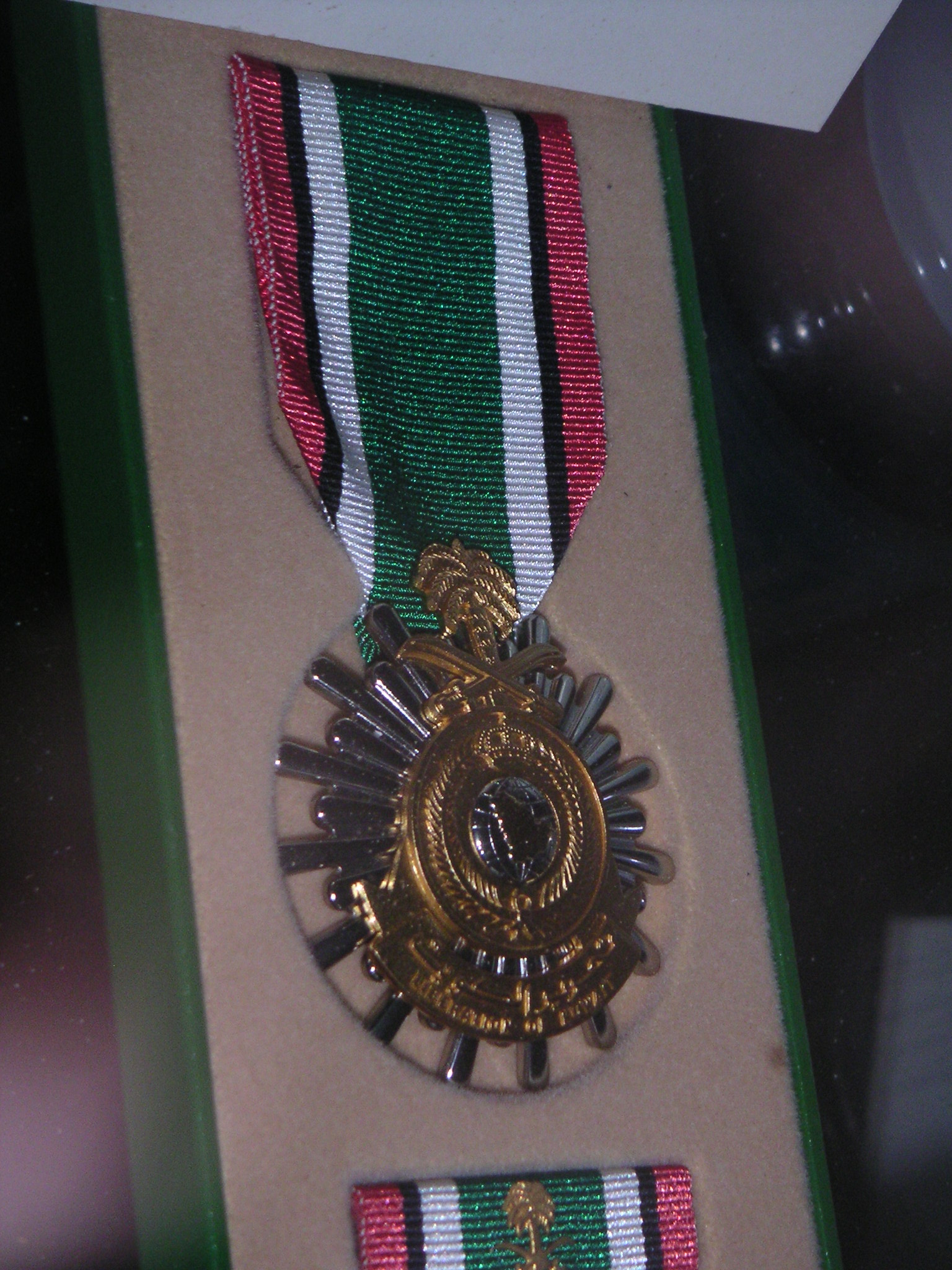
The Saudi version of the Kuwait Liberation Medal consists of a silver star of fifteen rounded points (with shorter rounded points between them) surmounted by a gilt medallion which contains a wreath tied at its base and a crown at its top. In the center of the gilt medallion is a silver representation of the Earth, over which is superimposed a gilt representation of the Kingdom of Saudi Arabia. Above the gilt medallion are the crossed swords and palm tree taken from the Royal Cypher. Beneath the gilt medallion is a swallow-tailed scroll with its ends folded back and point upward so they follow the contour of the gilt medallion. On the scroll are the words, LIBERATION OF KUWAIT in English, and the same inscription above it in Arabic.
Ribbon device
The service ribbon for the Kuwait Liberation Medal bears a gold-gilt device consisting of crossed swords (point up) superimposed over a palm tree. This device is taken from the Royal Cypher. The device is not used on the suspension ribbon of the medal.
Acceptance and wear
Australia
The Australian Government has authorised the medal to be worn with other international honours and awards after all other Australian medals.
Belgium
Belgium has authorised the medal to be worn on military uniform with other international honours and awards after all Belgian medals.
Canada
The Canadian Government has decreed that the Canadian personnel may accept their medals as a keepsake but permission to wear them in uniform has so far been refused.
France
France accepted the medal for their personnel; permission to wear them in uniform has been granted.
United Kingdom
British servicemen have not been given permission by the Foreign and Commonwealth Office to wear this medal since a UK campaign medal, the Gulf Medal, was issued. The wearing in uniform of the Kuwait Liberation Medal or its ribbon is therefore forbidden and it is accepted only as a keepsake.
United States
Service must have been performed in support of Operation Desert Storm and the liberation of Kuwait, between 17 January 1991 to 28 February 1991. Eligible areas include:
- The Persian Gulf
- The Red Sea
- That portion of the Arabian Sea that lies north of 10 degrees north latitude and west of 68 degrees east longitude
- The Gulf of Aden
- The total areas of Iraq, Kuwait, Saudi Arabia, Oman, Bahrain, Qatar, and the United Arab Emirates
In addition, those personnel must have:
- Been attached to or regularly serving for one or more days with an organization participating in ground and/or shore operations;
- Been attached to or regularly serving for one or more days aboard a naval vessel directly supporting military operations;
- Actually participated as a crew member in one or more aerial flights supporting military operations in the areas designated above; or,
- Served on temporary duty for 30 consecutive days during the qualifying period. Note: That time limitation may be waived for personnel who actually participated in combat operations.
References
References
- "Kuwait Liberation Medal FAQ".
- "Medals: campaigns, descriptions and eligibility". Ministry of Defence Medal Office.
- [http://edocket.access.gpo.gov/cfr_2008/julqtr/32cfr578.130.htm 578.130 Kuwait Liberation Medal--Saudi Arabia]
- link. (2011-06-19)
This article was imported from Wikipedia and is available under the Creative Commons Attribution-ShareAlike 4.0 License. Content has been adapted to SurfDoc format. Original contributors can be found on the article history page.
Ask Mako anything about Kuwait Liberation Medal (Saudi Arabia) — get instant answers, deeper analysis, and related topics.
Research with MakoFree with your Surf account
Create a free account to save articles, ask Mako questions, and organize your research.
Sign up freeThis content may have been generated or modified by AI. CloudSurf Software LLC is not responsible for the accuracy, completeness, or reliability of AI-generated content. Always verify important information from primary sources.
Report