From Surf Wiki (app.surf) — the open knowledge base
Kurta
Loose shirt or tunic worn traditionally in South Asia

Loose shirt or tunic worn traditionally in South Asia
the item of clothing
A kurta is a loose collarless shirt or tunic worn in many regions of South Asia, and now also worn around the world. Tracing its roots to Central Asian nomadic tunics, or upper body garments, of the late-ancient- or early-medieval era, the kurta has evolved stylistically over the centuries, especially in South Asia, as a garment for everyday wear as well as for formal occasions.
The kurta is traditionally made of cotton or silk. It is worn plain or with embroidered decoration, such as chikan; and it can be loose or tight in the torso, typically falling either just above or somewhere below the knees of the wearer. The front and back of a traditional kurta are made of rectangular pieces, and its side-seams are left open at the bottom, up to varying lengths, to enable ease of movement.
The sleeves of a traditional kurta fall to the wrist without narrowing, the ends hemmed but not cuffed; the kurta can be worn by both men and women; it is traditionally collarless, though standing collars are increasingly popular. Kurtas are traditionally worn over ordinary pajamas, loose shalwars, or churidars. Among urban youth, kurtas are being increasingly worn over jeans, not only in South Asia, but also in the South Asian diaspora, both the recently established, and the longstanding. Young women and girls in urban areas are increasingly wearing kurtis, which are short hip-length kurtas, with jeans or leggings, in addition to more traditional lower-body garments.
Etymology

- According to the Oxford Dictionary of English,kurta (n): A loose collarless shirt worn by people from South Asia, usually with a salwar, churidars, or pyjama. From Urdu and Persian kurtah.
- According to the Oxford English Dictionary (online, subscription required), the first use of kurta in English is attributed to W.G. Lawrence in T. E. Lawrence, Home Letters, 1913, "Me in a dhoti khurta, White Indian clothes."
- According to Cannon and Kay's The Persian Contributions to the English Language: A Historical Dictionary, 2001, kurta, n. (Ogilby 1673: 50) Cloth., var. khurta, kurtha + 1 [Persian. a tunic, waistcoat, jacket & Hindi & Urdu (
- According to Platt's A Dictionary of Urdu, Classical Hindi, and English, 1884, online, updated 2015, Persian کرته kurta , s.m. A shirt worn outside the drawers; a frock, a kind of tunic; a waistcoat or jacket.
- According to McGregor's Oxford Hindi-English Dictionary: कुरता kurtā: (Persian. masculine), a collarless shirt
- According to Winer's Dictionary of the English/Creole of Trinidad & Tobago: On Historical Principles, 2009, kurti, kurtee n A traditional form of Indian woman's long loose-fitting tunic, with long sleeves. /kurti/ * Usually the Kurti was longer than men's Kurta, for sometimes it reached down [past] the knees. (Raghoo 1984:3) * She used to wear long dress and kurtee and tie a handkerchief on her head. (Deen 1994:167)
- According to Steingass's A Comprehensive Persian-English Dictionary, 1892 (updated 2007) کرته kurta, A tunic, waistcoat, jacket; a long loose-skirted under-gown or shirt; a shirt. کرتی kurtī, A waistcoat for women, a short bodice reaching to the hips, with very short, if any sleeves, open under the throat; a soldier's jacket. Arabic قرطق qurt̤aq (Persian. كرته kurta), A kind of garment. Arabic قرطقة qartaqat (v.n. of قرطق), Putting the garment qurt̤aq on (any person).
History
According to author Roshen Alkazi, stitched (i.e. cut and sewn) attire came to South Asia from Central Asia. There was a trickle during the Scythian/Parthian/Kushan invasions of the late ancient period. with Mahmud of Ghazni, the floodgates opening with the Muslim conquests of the late 12th century, until the kurta became an item of common attire during the early modern era.
According to Alkazi: ...In the Ghaznavid period, we have only one clear visual reference to their actual costume, those worn by the Mamluk (slave) palace guards of Mahmud of Ghazni, in the wall paintings of Lashkari Bazaar in Afghanistan. They wear the qaba made of rich patterned textiles. This was a mid-calf length tunic with long narrow sleeves and tiraz. The opening is from right to left and has a small loop for closing it higher at the left shoulder. This closing at the left shoulder was one of the earliest forms of neck closing and a relic of this is still seen in the Russian tunic and in the contemporary kurtas used in certain parts of India, both of which close at the left shoulder. (p 467)
Styles


A traditional kurta is composed of rectangular fabric pieces with perhaps a few gusset inserts, and is cut so as to leave no waste fabric. The cut is usually simple, although decorative treatments can be elaborate.
The sleeves of a traditional kurta fall straight to the wrist; they do not narrow, as do many Western-cut sleeves. Sleeves are not cuffed, just hemmed and decorated.
The front and back pieces of a simple kurta are also rectangular. The side seams are left open for 6-12 inches above the hem, also referred to as the chāk, which gives the wearer some ease of movement. (Note: chāk derives from the Persian "چاك ćāk, Fissure, cleft, rent, slit, a narrow opening intentionally left in clothes)."
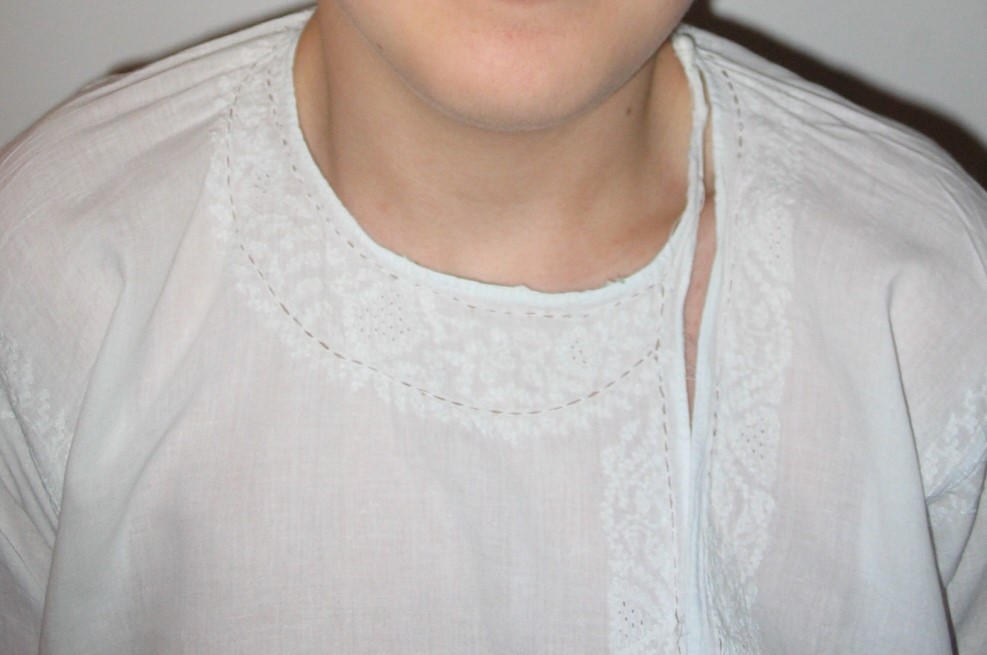
The kurta usually opens in the front; some styles, however, button at the shoulder seam. The front opening is often a hemmed slit in the fabric, tied or buttoned at the top; some kurtas, however, have plackets rather than slits. The opening may be centered on the chest, or positioned off center.
A traditional kurta does not have a collar. Modern variants may feature stand-up collars of the type known to tailors and seamstresses as "mandarin" collars. These are the same sort of collars seen on achkans, sherwanis, and Nehru jackets.
Material

Kurtas worn in the summer months are usually made of thin silk or cotton fabrics; winter season kurtas are made of thicker fabric such as wool or "Khadi silk", a thick, coarse, handspun and handwoven silk that may be mixed with other fibers. A very common fabric for the kurta pajama is linen, or a linen-cotton mix ideal for both summers and winters.
Kurtas are typically fastened with tasselled ties, cloth balls, and loops, or buttons. Buttons are often wood or plastic. Kurtas worn on formal occasions might feature decorative metal buttons, which are not sewn to the fabric, but, like cufflinks, are fastened into the cloth when needed. Such buttons can be decorated with jewels, enameling, and other traditional jewelers' techniques.
Decoration
Tailors from the South Asia command a vast repertoire of methods, traditional and modern, for decorating fabric. It is likely that all of them have been used, at one time or another, to decorate kurtas. However, the most common decoration is embroidery. Many light summer kurtas feature Chikan embroidery, a specialty of Lucknow, around the hems and front opening. This embroidery is typically executed on light, semi-transparent fabric in a matching thread.
Regional variants
Regional styles include the Bhopali, Hyderabadi, Lucknowi and straight-cut kurtas. The Bhopali kurta (taking its name from Bhopal) is a loose kurta with pleats at the waist, flowing like a skirt reaching midway between the knees and the ankles. The Hyderabadi kurta is named after the former royal state of Hyderabad and is a short top which sits around the waist, with a keyhole neck opening. It was popular with the local royal households. Traditionally, the Hyderabadi kurta was of white material, but modern versions can be of any colour. Over the kurta, some versions have net material, the combination of which is called jaali karga, worn by men and women. The traditional Lucknowi kurta can either be short or long, using as much as 12 yards of cloth. The traditional Lucknowi kurta styles have an overlapping panel. However, the term "Lucknowi kurta" now applies to the straight-cut kurta embroidered using local Chikan embroidery. Another style is the kali or kalidar kurta which is similar to a frock and has many panels. The kalidar kurta is made up of several geometrical pieces. It has two rectangular central panels in the back and the front. The kali kurta is worn by men and women.
The straight-cut traditional kurta is known as a panjabi in Bangladesh, West Bengal and Assam. Local embroidery designs give a regional outlook to the traditional kurta. In Assam, the Panjabi is worn with a scarf (Gamosa) using local prints. Other designs include Bengali Kantha embroidery; Multani crocheted designs of Multan (Punjab, Pakistan); the Phulkari kurta using the Phulkari embroidery of the Punjab region; Bandhani tye-dyeing of the Cholistan Desert; Delhi style kurtas which include the wooden beaded kurta and a kurta heavily laden with embroidery;
Sindhi kurtas called Pehran/Pehriyan in Sindhi are made out of many Sindhi embroideries like Kacha, Pakka, Hurmuch, Muka, Pani etc, Sindhi kurtas are also made of applique called "Tuk ja Kurta" Sindhi kurtas utilise mirrors and the local art of bandhani (creating patterned textiles by resisting parts of a fabric by tying knots on it before it is dyed). Sindhi kurtas are worn by both men and women, the female kurtas are called "Padhri" which are tied at either side of shoulder are heavily embroidered with heavy embellishments like mirrorwork, pompoms (phundra), sequins, cowries, shells, beads and buttons, the male kurtas are called Pehran or Pehriyan which are embroidered as well, and are collarless having either side neck or center necks.
Traditional Punjabi kurta of the Punjab region is wide and falls to the knees and is cut straight. The modern version of the regional kurta is the Muktsari kurta which originates from Muktsar in Punjab. This modern Punjabi kurta is famous for its slim-fitting cuts and smart fit designs. It is very popular among young politicians.
| File:Dom man2 kurta eastbengal1860.jpg | A Dom man, East Bengal (Bangladesh), 1860 | File:Muslim scholar2 in kurta1860eastbengal.jpg | Muslim scholar, East Bengal (Bangladesh), 1860 | File:Punjabi Sikh woman in Amritsar Punjabi suthan and short kurta 1874.jpg | Punjabi woman in short kurta 1874 | File:Punjabi kurta Ferozepur 1845.jpg | Man in kurta, Ferozepur, 1845 | File:Pahari women kashmir3.jpg | Pahari (Hill) women, Kashmir, 1890 | File:Blue_khadi_kurta.jpg | A blue khadi kurta | File:Kurta - Mens.jpg | Men's kurta | File:Man in Dhoti Kurta.JPG | Man in dhoti kurta | File:Kurta, India, 20th century, cotton blend - Saint Ignatius Church, San Francisco, CA - DSC02637.JPG | Kurta, India, 20th century, cotton blend - Saint Ignatius Church, San Francisco, CA
Jeans and straight-cut kurta
Kurtas are often worn with jeans. Women sometimes wear kurtas as blouses, usually over jeans pants. Jeans are sometimes preferred over pajamas or leggings as they are more durable for rough use. Most colours of kurtas match with blue jeans. In 2014, an Indian family court in Mumbai ruled that a husband objecting to his wife wearing a kurta and jeans and forcing her to wear a sari amounts to cruelty inflicted by the husband and can be a ground to seek divorce. The wife was thus granted a divorce on the ground of cruelty as defined under section 27(1)(d) of Special Marriage Act, 1954.
Leggings and straight cut kurta
Ladies' kurtas/blouses, along with leggings, are most popular in South Asia, and the community from South Asia in Singapore and Malaysia.
Kurti
In modern usage, a short kurta for women is referred to as the kurti. However, traditionally, the kurti refers to waistcoats, jackets and blouses which sit above the waist without side slits, and are believed to have descended from the tunic of the Shunga period (2nd century B.C.). Kurtis are typically much shorter than the traditional garments and made with lighter materials, like those used in sewing kameez.
Explanatory notes
Citations
General and cited references
- 192 pages.
- 382 pages.
References
- (September 2022). "OED Online". Oxford University Press.
- Stevenson, Angus. (2010). "Oxford Dictionary of English". Oxford University Press.
- (2013). "Cambridge Advanced Learner's Dictionary and Thesaurus". Cambridge University Press.
- Shukla, Pravina. (2015). "The Grace of Four Moons: Dress, Adornment, and the Art of the Body in Modern India". Indiana University Press.
- Alkazi, Roshen. (2002). "India's Interaction with China, Central and West Asia". Oxford University Press.
- Kapadia, Shagufa. (2017). "Adolescence in Urban India: Cultural Construction in a Society in Transition". Springer.
- Khaire, Mukti. (2021). "Culture, Innovation and Entrepreneurship, New Directions in Theory and Research". Routledge.
- Perkins, Mitali. (2007). "First Daughter: Extreme American Makeover". Penguin.
- Kloß, Sinah Theres. (2016). "Fabrics of Indianness: The Exchange and Consumption of Clothing in Transnational Guyanese Hindu Communities". Palgrave Macmillan.
- Parameswaran, Ambi. (April 2015). "For God's Sake: An Adman on the Business of Religion". Penguin UK.
- Oxford English Dictionary, Second Edition. 1989.
- (2001). "The Persian Contributions to the English Language: A Historical Dictionary". Otto Harrassowitz Verlag.
- Platts, John T. (John Thompson). (1884). "A dictionary of Urdu, classical Hindi, and English". W. H. Allen & Co..
- McGregor, Ronald Stuart. (1993). "The Oxford Hindi-English Dictionary". Oxford University Press.
- Winer, Lise. (2009). "Dictionary of the English/Creole of Trinidad & Tobago: On Historical Principles".
- Steingass, Francis Joseph. (1892). "A Comprehensive Persian-English dictionary, including the Arabic words and phrases to be met with in Persian literature". Routledge & K. Paul.
- Steingass, Francis Joseph. (2000). "A Comprehensive Persian-English dictionary, including the Arabic words and phrases to be met with in Persian literature". Munshiram Manoharlal Publishers.
- Alkazi, Roshen. (2002). "India's Interaction with China, Central an-5d West Asia". Oxford University Press.
- Alkazi, Roshen. (2002). "India's Interaction with China, Central and West Asia". Oxford University Press.
- Alkazi, Roshen. (2002). "India's Interaction with China, Central and West Asia". Oxford University Press.
- Alkazi, Roshen. (2002). "India's Interaction with China, Central and West Asia". Oxford University Press.
- Platts, John T. (John Thompson). (1884). "A dictionary of Urdu, classical Hindi, and English". W. H. Allen & Co..
- [https://books.google.com/books?id=h9-BAAAAMAAJ&q=punjabi+lucknowi+bhopali+hyderabadi+kurta Jamila Brij Bhushan (1958), ''The Costumes and Textiles of India'']
- [https://books.google.com/books?id=4yMqAAAAYAAJ&q=bhopali+kurta+from+turkey ''Cine Blitz'', Volume 29, Issue 1 (2003)]
- [https://books.google.com/books?id=ZZKOBF2ST-0C&dq=Sultan+Jehan+Begum&pg=PA340 S.R. Bakshi and O.P. Ralha (2008), ''Madhya Pradesh Through the Ages'']
- [https://books.google.com/books?id=qYK1AAAAIAAJ&q=hyderabadi+kurta Kumar, Ritu (2006), ''Costumes and Textiles of Royal India'']
- [https://books.google.com/books?id=TS1uAAAAMAAJ&q=kurta- Mohan Lal Nigam, Anupama Bhatnagar (1997), ''Romance of Hyderabad Culture'']
- [https://books.google.com/books?id=ag1uAAAAMAAJ&q=kurta Javed, Arifa Kulsoom (1990), ''Muslim Society in Transition'']
- Aslan, Reza (2011), ''Tablet & Pen: Literary Landscapes from the Modern Middle East'' (Words Without Borders): Literary Landscapes from the Modern Middle East [https://books.google.com/books?id=ZQXGAgAAQBAJ&dq=jaali+karga&pg=PA148]
- [https://books.google.com/books?id=7RCe2E5ch80C&q=+kurta&pg=PA119 Mukherji, P. C., ''The Pictorial Lucknow'' (1883)]
- [https://books.google.com/books?id=F4x9oVY-KoYC&q=kurti Ravi Bhatt. ''The Life and Times of the Nawabs of Lucknow'']
- [https://books.google.com/books?id=Bfmxx6m0hqEC&dq=kali+kurta&pg=PA38 Karampuri, Aradhana (2005), ''Punjabi Dress Drafting and Cutting'']
- Bhandari, Vandana (2005), ''Costume, Textiles and Jewellery of India: Traditions in Rajasthan'' [https://books.google.com/books?id=nckSAQAAIAAJ&q=kalidar]
- [https://books.google.com/books?id=ihtuAAAAMAAJ&q=kalidar+mens+kurta Rashtriya, ''Sahara'', Volume 2, Issue 2 (1991)]
- Fraser, Bashabi. (2008). "Bengal Partition Stories: An Unclosed Chapter". Anthem Press.
- Redclift, Victoria. (2013). "Statelessness and Citizenship: Camps and the Creation of Political Space". Routledge.
- [https://books.google.com/books?id=moVlXosSoJQC&q=assam+panjabi+shirt Census of India, 1971: Series 3: Assam, Volume 6, Part 3]
- [https://books.google.com/books?id=oNAwl-jS3gwC&dq=bengal+embroidery+kantha&pg=PA1 Naik, Shailaja D. (1996), ''Traditional Embroideries of India'']
- ''Official Journal of the European Communities: Legislation'', Volume 30, Issues 248-256 (1987) [https://books.google.com/books?id=AWcNAQAAMAAJ&q=sindhi+kurta+multani+kurta]
- The Journal of industry and trade, Volume 21. Ministry of Commerce & Industry, Government of India., 1971 [https://books.google.com/books?id=zBQoAAAAMAAJ&q=phulkaria]
- [https://books.google.com/books?id=oNAwl-jS3gwC&dq=punjabi+phulkari&pg=PA103 Naik, Shailaja D. (1996), ''Traditional Embroideries of India'']
- Nasreen Askari, Liz Arthur, Paisley Museum and Art Galleries Merrell Holberton, (1999) Uncut cloth [https://books.google.com/books?id=FBJPAAAAMAAJ&q=origins+of+bandhani+dyeing+sindh]
- ''United States Treaties and Other International Agreements'', Volume 21, Part 3 (1971) [https://books.google.com/books?id=2JjIE5x0uggC&dq=hyderabad+kurta&pg=PA2171]
- [https://books.google.com/books?id=EjTVAAAAMAAJ&q=Rilli+Kurta Pakistan Exports, Volume 28 (1977)]
- (c. 1855). "Tunic".
- (c. 1900). "Pehran".
- (c. 1855). "Shirt".
- [https://books.google.com/books?id=3MNFAQAAIAAJ&q=kurta+mens+punjab ''Punjab District Gazetteers: Attock district, 1930''. Printed 1932]
- Asoke Kumar Bhattacharyya, Pradip Kumar Sengupta (1991), ''Foundations of Indian Musicology: Perspectives in the Philosophy of Art and Culture'' [https://books.google.com/books?id=JMjpz-lAm0sC&dq=kurta+maharashtra&pg=PA113]
- Puneet Pal Singh Gill (04.01.2012) ''The Chandigarh Tribune''. "Muktsari-style kurta pyjama a fad" [http://www.tribuneindia.com/2012/20120105/ldh1.htm]
- [https://archive.today/20121216133710/http://www.telegraphindia.com/1040417/asp/calcutta/story_3131072.asp "Regal chic"], ''The Telegraph''k, [[Calcutta]], April 24, 2004. Quote: "The first sequence was a range of traditional [[sari]]s in silk and cotton, moving on to kurtis and jeans and short kurtas in silk and [[georgette (fabric). georgette]]."
- [Yet, jeans are among the most comfortable outfits as they can go with just about anything, a short top or even a kurta.]
- (2010-11-17). "Comfort dressing is their mantra". Deccan Herald.
- (2014-06-28). "Wife's jeans ban is grounds for divorce, India court rules". Gulf News.
- Jaime Koh, Stephanie Ho Ph.D (2009), ''Culture and Customs of Singapore and Malaysia'' [https://books.google.com/books?id=MWlFCQAAQBAJ&dq=kurta+malaysia&pg=PA109]
- [https://books.google.com/books?id=WfYCAAAAQAAJ&dq=kurti+waistcoat&pg=PA260 Forbes, Duncan (1861), ''A Smaller Hindustani and English Dictionary'']
- [https://books.google.com/books?id=debQiFq5jjgC&dq=kurti+waistcoat&pg=PA368 Bahri, Hardev (2006), ''Advanced Learner's Hindi English Dictionary'']
- Panjab University Research Bulletin: ''Arts'', Volume 13, Issue 1 - Volume 14, Issue (1982) [https://books.google.com/books?id=nvE7AQAAIAAJ&q=Shunga]
This article was imported from Wikipedia and is available under the Creative Commons Attribution-ShareAlike 4.0 License. Content has been adapted to SurfDoc format. Original contributors can be found on the article history page.
Ask Mako anything about Kurta — get instant answers, deeper analysis, and related topics.
Research with MakoFree with your Surf account
Create a free account to save articles, ask Mako questions, and organize your research.
Sign up freeThis content may have been generated or modified by AI. CloudSurf Software LLC is not responsible for the accuracy, completeness, or reliability of AI-generated content. Always verify important information from primary sources.
Report