From Surf Wiki (app.surf) — the open knowledge base
Kuria (atoll)
Atoll in Central Gilbert Islands, Kiribati
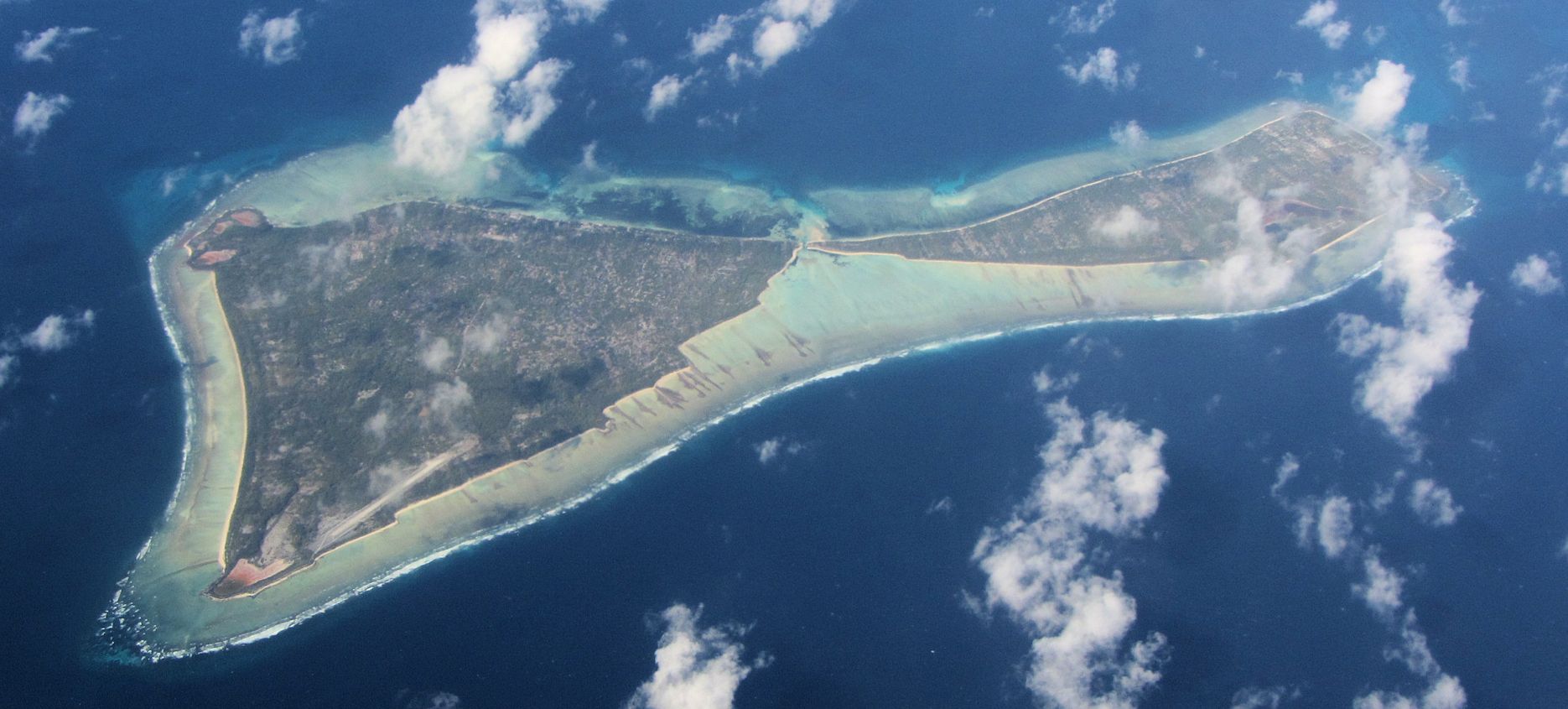
Atoll in Central Gilbert Islands, Kiribati
| Field | Value |
|---|---|
| name | Kuria |
| image_name | 9 Map of Kuria, Kiribati.jpg |
| image_caption | Map of Kuria |
| map_image | GilbertIslandsPos.png |
| location | Pacific Ocean |
| pushpin_map | Kiribati#Micronesia#Oceania#Pacific Ocean |
| coordinates | |
| archipelago | Gilbert Islands |
| area_km2 | 15.48 |
| elevation_m | 3 |
| country | Kiribati |
| population | 1,046 |
| population_as_of | 2015 Census |
| density_km2 | 63 |
| ethnic_groups | I-Kiribati 100% |
Main article: Kiribati, Gilbert Islands
Kuria is an atoll, formed by a pair of islets, in the Central Gilbert Islands in Kiribati, northwest of Aranuka. The two islets, Buariki and Oneeke, are separated by a 20 metre wide channel on a shallow water platform (Te buriiti), which is crossed by a bridge of the connecting road. The islands are surrounded by fringing reef which is broadest on the eastern side of Kuria. The population of Kuria was 1,046 in 2015.
Geography
Kuria is made up of two islets, which are reef islands as they do not have a lagoon. The main islet, Buariki, has five villages; Marenaua, Bouatoa, Buariki, Tabontebike and Norauea. These villages are connected to the smaller islet of Oneeke by a 10 m bridge replacing the old causeway that ran across the former reef passage between the two islets. The two islets are relatively wide as compared to most islands in the Gilbert group. The widest portion measures 4.26 km from lagoon to the ocean side and the length from north to south is 8.94 km. There are two natural brackish-water ponds at east-southern tip of the main islet. The total land area of Kuria is of 15.48 km2, which is close to the average size for an island of Kiribati, but the population in 2010 was only 980 people, making Kuria one of the least densely populated islands in Kiribati.
The main administration center is located at Buariki, and the airport, police headquarters, guest house and Junior Secondary School are also located here.
Villages
| Census Area | Population 2010 | Land area by islet | Density (people per hectare) | Kuria total | align=right | 980 | align=right | 1547.7 ha | align=center | 0.6 | |||
|---|---|---|---|---|---|---|---|---|---|---|---|---|---|
| Oneeke | 154 | 525 ha | 0.3 | ||||||||||
| Manenaua | 191 | 1022.7 ha | 0.8 | ||||||||||
| Tabontebike | 91 | ||||||||||||
| Buariki | 169 | ||||||||||||
| Norauea | 247 | ||||||||||||
| Bouatoa | 128 |
History

Kuria means 'almost seen on the horizon'. Thomas Gilbert and John Marshall, sailing in the merchant ships and , were the first Europeans to describe visiting Kuria, in June 1788. | author-link=Samuel Eliot Morison | access-date=2009-10-14
The islands were surveyed in 1841 by the US Exploring Expedition.
In the 1840s, the islands of Kuria and Aranuka were conquered by Tenkoruti or Karotu, the paramount chief or the Uea (king) of Abemama, when a former ruler (Ten Temea) of Kuria and Aranuka gave up these two islands to King Karotu from Abemama and left for Maiana, another of the Gilbert group. In 1878 Tenkoruti's nephew, Tembinok' or Tem Binoka became the Uea. He acquired firearms and manufactured goods from traders and he purchased a ship. To pay for his acquisitions he tightened his control over the 3 islands in order to increase his supply of coconuts and other produce, which he sold to the traders. Tembinok' was immortalised by Robert Louis Stevenson's description of him in his book In the South Seas. Robert Louis Stevenson spent two months on Abemama in 1889. Stevenson described Tembinok' as the "one great personage in the Gilberts … and the last tyrant".
In early European times, animals in Kuria were not considered a welcome addition to the ecosystem. As a result, introduced animals were considered a subject of supernatural fears and were slaughtered and thrown into the lagoon.
Kuria Post Office opened around 1912.
Tourism
Air Kiribati operates two flights per week from South Tarawa, linking with neighbouring Aranuka Airport. Boat charters are also available.
The Island Council operates a guest house, where tourists are welcome, although it is advisable to be prepared as the island is very isolated.
Dress code is restricted on Kuria. Casual wear is preferable and women are not allowed to walk around with bikinis, mini skirts or shorts. A skirt/short covered down to your knees or wrapped around lava-lava and T-shirts are preferable.
Notes
References
- Exhibit: The Alfred Agate Collection: The United States Exploring Expedition, 1838-1842 from the Navy Art Gallery
References
- (2012). "9. Kuria". Office of Te Beretitent - Republic of Kiribati Island Report Series.
- "Kiribati Census Report 2010 Volume 1". National Statistics Office, Ministry of Finance and Economic Development, Government of Kiribati.
- Dr Temakei Tebano & others. (August 2008). "Island/atoll climate change profiles - Kuria Atoll". Office of Te Beretitent - Republic of Kiribati Island Report Series (for KAP II (Phase 2).
- Grimble, Arthur. (1981). "A Pattern of Islands". Penguin Books.
- Grimble, Arthur. (1989). "Tungaru traditions: writings on the atoll culture of the Gilbert Islands". University of Hawaii Press.
- (1975). "The Great United States Exploring Expedition". University of California Press.
- Cahoon, Ben. [http://www.worldstatesmen.org/Kiribati.htm Kiribati]. World Statesmen.org.
- Robert Louis Stevenson. (1896). "In the South Seas, Part V, Chapter 1". Chatto & Windus; republished by The Hogarth Press.
- (February 2020). "Kuria factsheet". Kiribati Tourism, Government of Kiribati}}{{Dead link.
- Premier Postal History. "Post Office List". Premier Postal Auctions.
This article was imported from Wikipedia and is available under the Creative Commons Attribution-ShareAlike 4.0 License. Content has been adapted to SurfDoc format. Original contributors can be found on the article history page.
Ask Mako anything about Kuria (atoll) — get instant answers, deeper analysis, and related topics.
Research with MakoFree with your Surf account
Create a free account to save articles, ask Mako questions, and organize your research.
Sign up freeThis content may have been generated or modified by AI. CloudSurf Software LLC is not responsible for the accuracy, completeness, or reliability of AI-generated content. Always verify important information from primary sources.
Report