From Surf Wiki (app.surf) — the open knowledge base
Kurds in Germany
Ethnic group in Germany
Ethnic group in Germany
| Field | Value |
|---|---|
| population | Over 1,000,000 (Kurdish Institute of Paris) |
| langs | Mostly: |
| KurdishGerman | |
| Others: | |
| rels | IslamYazidism (minority) |
| native_name | ku-Latn |
| native_name_lang | ku |
| related | Other Iranic peoples |
KurdishGerman Others:
Kurds in Germany () are residents or citizens of Germany of full or partial Kurdish origin. There is a large Kurdish community in Germany. The number of Kurds living in Germany is unknown. Many estimates assume that the number is in the million range. In February 2000, the Federal Government of Germany (Die Bundesregierung) estimated that approximately 500,000 Kurds lived in Germany at that time.
Immigration history of Kurds in Germany
1919 & 1920s
The first Kurds migrated to Imperial Germany in 1919 and the years following, most came for diplomatic reasons related to the Ottoman Empire and later Turkey.
1961-1973 (First wave)
The first wave of Kurdish immigrant workers from Turkey arrived after Germany and Turkey signed an economic treaty which allowed Turkish citizens (mostly men) to immigrate to West Germany as Gastarbeiter (English: "guest workers") in October 1961. This immigration officially stopped in 1973. By then, the number of immigrants had reached 867,000 (1.5 million in 1980 and 2.1 million in 1998). The percentage of Kurds in this immigrant diaspora is unknown but is speculated to be in the high hundreds of thousands.
1980-2003 (Second wave)
The oppression of Kurds in the 1980s under the then-newly formed Islamic republic of Iran and the then following Iran–Iraq War (1980–1988) kickstarted the second wave of Kurdish migration to Germany and other countries. This second wave only increased in scale after the Gulf War (1990–1991) and later invasion of Iraq by the United States (2003).
2011-2025 (Third wave)
Since the beginning of the Syrian Civil War in 2011, many of the Syrian refugees who have come to Germany are Kurds. The later War against ISIL also created a wave of immigrants from Iraq and Kurdistan Region.
Impact of Kurdish immigration to Germany
Integration of Kurdish immigrants to Germany
According to the Bundesamt für Migration und Flüchtlinge (BAMF) (English: "Federal Office for Migration and Refugees") most Germans with ancestry going back to Turkey (thus including Kurds from Turkey) speak fluent German. Notably, gender roles in second generation immigrants resemble that of native Germans (i.e women are seen as equal). Overall the "BAMF" concludes that immigrants with German citizenship are more integrated in German society than those without.
Religion of Kurds in Germany
Islam
Sunnism
Most Kurdish immigrants in Germany follow the Sunni branch of Islam, who are often from Iraq, Syria, and Turkey. Around 40 mosques in Germany are part of the umbrella association Islamische Gesellschaft Kurdistans (English: "Islamic society of Kurdistan"; Kurdish: Civaka Îslamiya Kurdistan (CÎK)).
Alevism
The number of Alevis in Germany is between 450,000 and 800,000 (mostly from Turkey), a high percentage of which are Kurds.
Yazidism
According to the German public-broadcasting radio station Deutschlandfunk, 190,000 Yazidis lived in Germany in 2018. 7,000 live in Celle and 1,300 in Oldenburg.
Cities
German Kurds live spread throughout Germany, especially in cities with a large proportion of Turkish people. Examples are Berlin, Hamburg, Munich, Frankfurt, Stuttgart, Hannover, Kiel, and Essen.
Political representation
There have been several politicians in German political parties with a Kurdish origin and who also openly demand an embetterment of the situation for the Kurds. Prominent names are the Members of the Bundestag Gökay Akbulut, Evrim Sommer, and Sevim Dagdelen, all members of the Die Linke. Muhterem Aras of the Green Party is the president of the State legislature of Baden-Württemberg.
Political activism
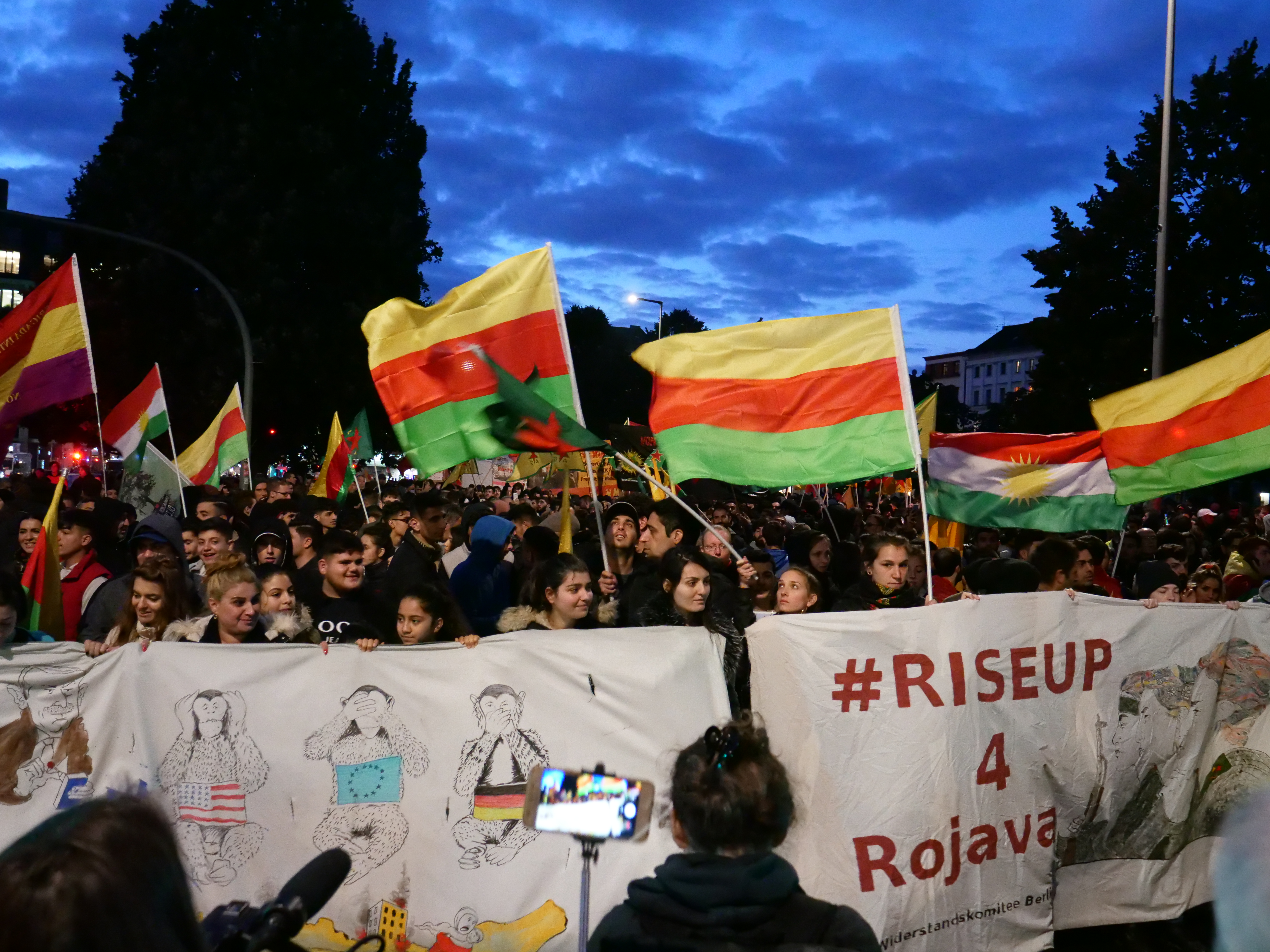
In 2014, Kurds in Germany marched in protest over the siege of Kobani by ISIL.
In 2015, thousands of Kurds in Germany marched against Turkish Air Force air strikes on Kurdish civilians.
In October 2019, thousands of German Kurds protested against the 2019 Turkish offensive into north-eastern Syria.
In November 2023, around 4.100 people (mostly Germans of Kurdish origin) protested against the ban of the Kurdistan Workers' Party (PKK) and against the politics of Recep Tayyip Erdoğan.
In January 2026, thousands of Kurds in Germany demonstrated against the Syrian transitional government’s offensive targeting Kurdish-controlled regions in northeastern Syria.
Gangs
According to the German authorities tin 2013. The Swiss newspapers Blick and Neue Zürcher Zeitung claimed that the Kurdish gang/motorcycle club "Sondame", allegedly "fighting" for a free Kurdistan, was formed in Stuttgart, and in 2015, it had about 1,000 members in Germany and Switzerland. The group is not well known and its existence is controversial. Other Kurdish motorcycle club and gangs include Median Empire and Red Legion.
Women's rights
_Hatun_Sürücü.JPG)
Some cases of honour killing have been reported among the Kurdish diaspora in Germany. In March 2009, a Kurdish immigrant from Turkey, Gülsüm S., was killed for a relationship not in keeping with her family's plan for an arranged marriage. In 2016 a Kurdish woman was shot dead at her wedding in Hannover after refusing to marry her cousin.
Notable people
:See List of German people of Kurdish descent
References
References
- "Who is the Kurdish Institute ?".
- "Geschenk an Erdogan? Kurdisches Kulturfestival verboten". heise.de.
- (11 October 2014). "Islamisten und Kurden: Brutale Gruppen in Deutschland - WELT".
- https://kurdische-gemeinde.de/zahl-der-kurden-in-deutschland-sprunghaft-angestiegen/ {{Webarchive. link. (24 August 2018 This source says that the Kurdish population in Germany increased to 1.15 million in 2015.)
- "Deutscher Bundestag: ETWA 500.000 KURDEN LEBEN IN DEUTSCHLAND (ANTWORT)".
- sagt, Valentin. (23 January 2020). "100 Jahre kurdische Einwanderung nach Deutschland".
- "Studie: Integration von Türkeistämmigen in Deutschland".
- deutschlandfunk.de. "Jesiden in Deutschland - Abschied von Afrin".
- deutschlandfunk.de. "Jesidin in Deutschland - "Es ist Angst, Angst, Angst"".
- (23 February 2010). "Die Yeziden in Deutschland - Religion und Leben".
- "Tensions between Germany's Turks and Kurds boil over with Syria offensive".
- (7 April 2017). "Stellungnahme von Stadträtin Gökay Akbulut (DIE LINKE) zum Verbot der Demonstration "Weg mit dem Verbot der PKK" in Mannheim".
- Ekinci, Burhan. (7 January 2021). "German Kurdish MP says Erdoğan government 'serious threat' to EU, calls for sanctions".
- (21 November 2017). "Abgeordnete zeigt verbotene Kurdenflagge im Bundestag".
- Crolly, Hannelore. (2 January 2017). "Muslimische Landtagspräsidentin: Frauen am Steuer – das machte Muhterem Aras sprachlos". [[Die Welt]].
- "Kurds protested in Germany over 'IS' attacks on the Syrian town of Kobani". Deutsche Welle.
- (12 October 2014). "Thousands march in France, Germany, Austria to support Kobane Kurds". Radio France Internationale.
- "Thousands of Kurds in Germany march against Turkish air strikes".
- "Germany: Thousands protest Turkish operation in Syria | DW | 12.10.2019".
- (19 November 2023). "Rund 4.100 Teilnehmer bei Kurden-Demonstration gegen Erdogan".
- (21 January 2026). "Germany sees thousands join pro-Kurdish protests". Deutsche Welle.
- Blick. (4 May 2015). ""Der Auftritt ist sehr aggressiv": Wie gefährlich sind die Kurden-Rocker Sondame?".
- Baumgartner, Fabian. (17 May 2015). "Rivalisierende Banden in Zürich: Machtkampf zwischen kurdischen "Brüdern" und Rockern". Neue Zürcher Zeitung.
- MEYER, MEHMET ATA und OLIVER. ""Median Empire": Kurden-Rocker drohen den Hells Angels".
- Rocker-Info.net. (2 April 2015). "Stuttgarter Kurden drohen weiter den United Tribuns".
- Germany. "Red Legion - aktuelle Themen, Nachrichten & Bilder". [[Stuttgarter Zeitung]].
- (17 October 2014). "German motorcycle gang joins Isis fight".
- Palash R. Ghosh. "Honor Crimes in Britain Far More Prevalent than Formerly Thought". International Business Times.
- (3 April 2009}}{{Dead link). "Erschlagen, weil sie schwanger war? – Killed, because she was pregnant?". Der Bild.
- (17 March 2016). "Kurdish woman shot dead at wedding for refusing to marry her cousin". The Telegraph.
This article was imported from Wikipedia and is available under the Creative Commons Attribution-ShareAlike 4.0 License. Content has been adapted to SurfDoc format. Original contributors can be found on the article history page.
Ask Mako anything about Kurds in Germany — get instant answers, deeper analysis, and related topics.
Research with MakoFree with your Surf account
Create a free account to save articles, ask Mako questions, and organize your research.
Sign up freeThis content may have been generated or modified by AI. CloudSurf Software LLC is not responsible for the accuracy, completeness, or reliability of AI-generated content. Always verify important information from primary sources.
Report