From Surf Wiki (app.surf) — the open knowledge base
Kurdistan Region
Federal region of the Republic of Iraq
Federal region of the Republic of Iraq
| Field | Value | ||
|---|---|---|---|
| native_name | {{small | {{UBL | |
| official_name | Kurdistan Region | ||
| settlement_type | Federal region of Iraq | ||
| image_flag | Flag of Kurdistan.svg | ||
| flag_size | 120px | ||
| flag_link | Flag of Kurdistan | ||
| image_seal | Coat of arms of Kurdistan Regional Government.svg | ||
| seal_link | Emblem of Kurdistan | ||
| seal_type | Emblem | ||
| seal_size | 100px | ||
| blank_emblem_size | 120px | ||
| blank_emblem_type | Flag | ||
| blank_emblem_link | Flag of Kurdistan | ||
| anthem | ئەی ڕەقیب | ||
| Ey Reqîb | |||
| "Oh, enemy!" | |||
| <div style | "display:inline-block;margin-top:0.4em;" | ||
| image_map | |||
| coordinates | |||
| established_title1 | Autonomy founded | ||
| established_date1 | 19 May 1992 | ||
| established_title2 | Federal region established | ||
| established_date2 | 15 October 2005 | ||
| subdivision_type | Country | ||
| subdivision_name | Iraq Iraq | ||
| capital | Erbil | ||
| official_languages | |||
| languages2_type | Recognized languages “Along with Kurdish and Arabic, Turkman and Assyrian shall be official languages in administrative districts that are densely populated by speakers of Turkmen and Assyrian. This shall be regulated by law.” | ||
| ethnic_groups | Predominantly Kurds | ||
| Minorities of Arabs, Iraqi Turkmens, Assyrians and Armenians | |||
| religion | Majority: Islam | ||
| Large minority: Yazidism, Yarsanism, Christianity | |||
| other | |||
| government_type | Semi-autonomous parliamentary federal region | ||
| legislature | Kurdistan Parliament | ||
| leader_title1 | President | ||
| leader_name1 | Nechirvan Barzani | ||
| leader_title2 | Vice President | ||
| leader_name2 | Jaafar Sheikh Mustafa | ||
| Mustafa Said Qadir | |||
| leader_title3 | Prime Minister | ||
| leader_name3 | Masrour Barzani | ||
| leader_title4 | Deputy Prime Minister | ||
| leader_name4 | Qubad Talabani | ||
| HDI_year | 2014 | ||
| HDI | 0.750 | ||
| HDI_ref | |||
| Gini | 32 | ||
| Gini_year | 2012 | ||
| Gini_ref | |||
| area_km2 | 46862 | ||
| population_census | 6,370,668 | ||
| population_census_year | 2024 | ||
| demonym | |||
| timezone | AST | ||
| utc_offset | +3 | ||
| date_format | dd/mm/yyyy | ||
| currency | Iraqi dinar | ||
| GDP_PPP_year | 2022 | ||
| GDP_PPP | $66 billion | ||
| GDP_PPP_per_capita | $7,038 | ||
| cctld | .krd | ||
| drives_on | right | ||
| calling_code | +964 | ||
| iso_code | |||
| languages2 |
the sub-national federal region in the Republic of Iraq
- Sorani Kurdish: هەرێمی کوردستان, romanized: Herêmî Kurdistan
- Kurmanji Kurdish: هەرێما کوردستانێ, romanized: Herêma Kurdistanê
- }} Ey Reqîb "Oh, enemy!"
Minorities of Arabs, Iraqi Turkmens, Assyrians and Armenians Large minority: Yazidism, Yarsanism, Christianity other Mustafa Said Qadir
The Kurdistan Region (KRI) is a semi-autonomous federal region of the Republic of Iraq. It comprises four Kurdish-majority governorates of Arab-majority Iraq: Erbil Governorate, Sulaymaniyah Governorate, Duhok Governorate, and Halabja Governorate. It is located in northern Iraq, which shares borders with Iran to the east, Turkey to the north, and Syria to the west.
It does not govern all of Iraqi Kurdistan and lays claim to the disputed territories of northern Iraq; these territories have a predominantly non-Arab population and were subject to the Ba'athist Arabization campaigns throughout the late 20th century. Though the KRI's autonomy was realized in 1992, one year after Iraq's defeat in the Gulf War, these northern territories remain contested between the Kurdistan Regional Government (in Erbil) and the Government of Iraq (in Baghdad) to the present day. The Kurdistan Region Parliament is based in Erbil, the capital of KRI.
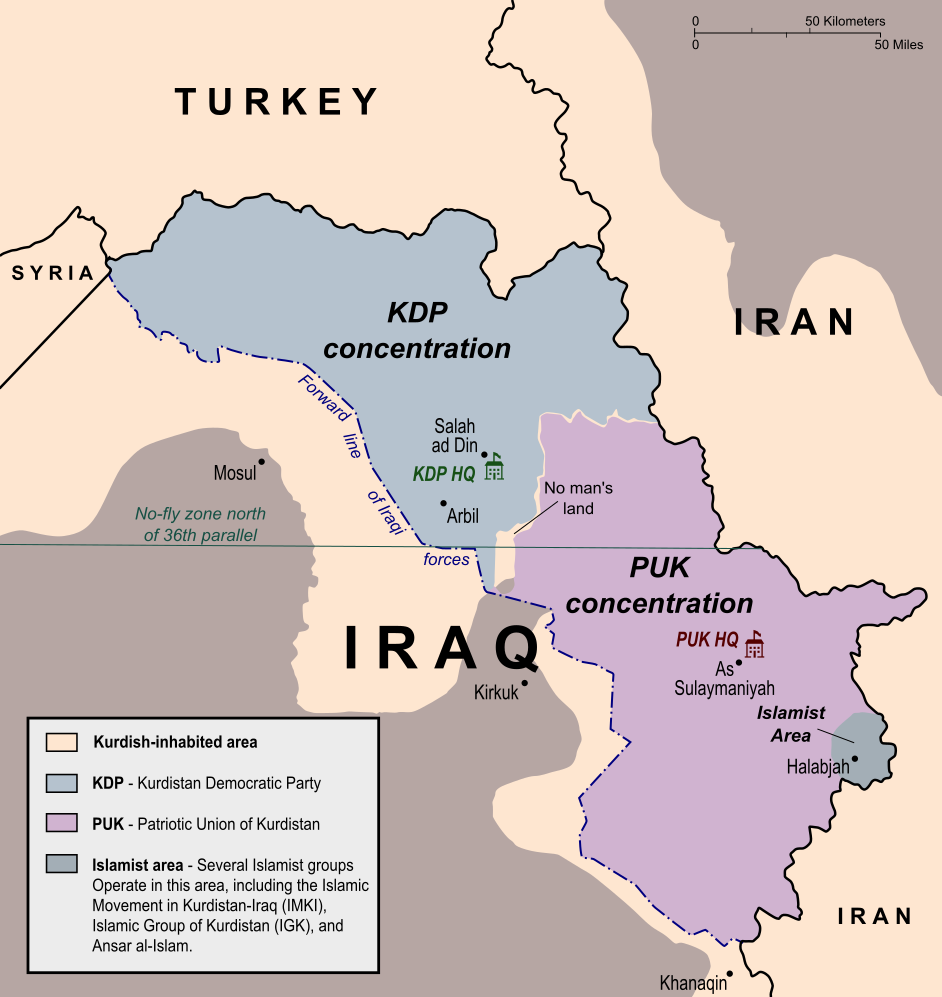
Throughout the 20th century, Iraqi Kurds oscillated between fighting for autonomy and for full independence. Under the Ba'athist regime, the Kurds experienced Arabization and genocidal campaigns at the hands of the federal government in Baghdad. However, when the United States, the United Kingdom, and France established the Iraqi no-fly zones, which restricted the federal government's power in the country's northern and southern areas following the Gulf War, the Kurds were given a chance to experiment with self-governance and the autonomous region was established. The Iraqi government only recognized the Kurdistan Region as a 'federal region' in 2005, after the American-led 2003 invasion of Iraq overthrew Saddam Hussein. In September 2017, the KRI passed a non-binding independence referendum, inviting mixed reactions internationally. The KRI largely escaped the privations that afflicted other parts of Iraq in the last years of Saddam Hussein's rule as well as the chaos that followed his ousting during the Iraq War (2003–2011), and built a parliamentary democracy with a growing economy. In 2014, when the Syria-based Islamic State invaded the north of the county, the Iraqi Armed Forces retreated from most of the disputed territories. The KRI's Peshmerga then entered and took control of them for the duration of the War in Iraq (2013–2017). In October 2017, following the defeat of the Islamic State, the Iraqi Armed Forces attacked the Peshmerga and reasserted control over the disputed territories.
History
Main article: Iraqi Kurdistan#History
Early struggle for independence (1923–1975)
Before Iraq became an independent state in 1923, the Iraqi Kurds had already begun their independence struggle from the British Mandatory Iraq with the Mahmud Barzanji revolts, which were subsequently crushed by the United Kingdom after a bombing campaign against Kurdish civilians by the Royal Air Force. Nonetheless, the Kurdish struggle persisted and the Barzani tribe had by the early 1920s gained momentum for the Kurdish nationalist cause and would become pivotal in the Kurdish-Iraqi wars throughout the 20th century. In 1943, the Barzani chief Mustafa Barzani began raiding Iraqi police stations in Kurdistan, which led the Baghdad government to deploy 30,000 troops to the region. The Iraqi Kurdish leadership fled to Iran in 1945. There, Mustafa Barzani founded the Kurdistan Democratic Party, and Iran and the Soviet Union began assisting the Kurdish rebels with arms. Israel began assisting the Kurdish rebels in the early 1960s.
From 1961 to 1970, the Kurds fought the Iraqi government in the First Iraqi–Kurdish War, which resulted in the Iraqi–Kurdish Autonomy Agreement. But simultaneously with its promise of Kurdish autonomy, the Iraqi government began ethnic cleansing Kurdish-populated areas, to reduce the size of the autonomous entity which a census would determine. This mistrust provoked the Second Iraqi–Kurdish War between 1974 and 1975, which resulted in a serious defeat for the Iraqi Kurds (see Algiers Accord) and forced all of the rebels to flee once more to Iran.

- ]]
Insurgency and first elections (1975–1992)
The Patriotic Union of Kurdistan (PUK) was founded in 1975 by Jalal Talabani while the Kurdistan Democratic Party (KDP) was slowly recovering from their defeat. The PUK was more popular among left-wing Sorani speakers, while the KDP was more popular among right-wing Kurmanji speakers. The PUK leadership adhered to the Qadiri sect while the KDP leadership adhered to the Naqshbandi. The Kurdish insurgency became entangled in the Iran–Iraq War from 1980 onwards. During the first years of the war in the early 1980s, the Iraqi government tried to accommodate the Kurds in order to focus on the war against Iran. In 1983, the Patriotic Union of Kurdistan agreed to cooperate with Baghdad, but the Kurdistan Democratic Party remained opposed. In 1983, Saddam Hussein signed an autonomy agreement with Jalal Talabani of the PUK, though Saddam later reneged on the agreement.
By 1985, the PUK and KDP had joined forces, and Iraqi Kurdistan saw widespread guerrilla warfare up to the end of the war. On 15 March 1988, PUK forces captured the town of Halabja near the Iranian border and inflicted heavy losses among Iraqi soldiers. The Iraqis retaliated the following day by chemically bombing the town, killing about 5,000 civilians. This led the Americans and the Europeans to implement the Iraqi no-fly zones in March 1991 to protect the Kurds, thereby facilitating Kurdish autonomy amid the vacuum and the first Kurdish elections were consequently held in May 1992, wherein the Kurdistan Democratic Party secured 45.3% of the vote and a majority of seats.
Nascent autonomy, war and political turmoil (1992–2009)
Main article: Iraqi Kurdish Civil War
The two parties agreed to form the first Kurdish cabinet led by PUK politician Fuad Masum as Prime Minister in July 1992 and the main focus of the new cabinet was to mitigate the effect of the American-led sanctions on Iraq and to prevent internal Kurdish skirmishes. Nonetheless, the cabinet broke down due to plagues of embattlement and technocracy which disenfranchised the Patriotic Union of Kurdistan and a new more partisan cabinet was formed and led by PUK politician Kosrat Rasul Ali in April 1993. The KDP-PUK relations quickly deteriorated and the first clashes in the civil war took place in May 1994 when PUK captured the towns of Shaqlawa and Chamchamal from KDP, which in turn pushed PUK out of Salahaddin (near Erbil). In September 1998, the United States mediated a ceasefire and the two warring parties signed the Washington Agreement deal, where in it was stipulated that the two parties would agree on revenue-sharing, power-sharing and security arrangements.
The anarchy in Kurdistan during the war created an opportunity for the Kurdistan Workers' Party (PKK), which created bases in the northern mountainous areas of the Kurdistan Region, which still operates in the Region in the 2010s with frequent calls for withdrawal.
In advance of the Iraq war in 2003, the two parties united in the negotiations with the Arab opposition to Saddam Hussein and succeeded in harvesting political, economic, and security gains and the Arab opposition agreed to recognize Kurdish autonomy in the case that Saddam Hussein was removed from power. America and Kurdistan also jointly rooted out the Islamist Ansar al-Islam group in Halabja area as Kurdistan hosted thousands of soldiers. The Kurdish autonomy which had existed since 1992 was formally recognized by the new Iraqi government in 2005 in the new Iraqi constitution and the KDP- and PUK-administered areas reunified in 2006, making the Kurdistan Region into one single administration. This reunification prompted Kurdish leaders and the Kurdish President Masoud Barzani to focus on bringing the Kurdish areas outside of the Kurdistan Region into the region and building healthy institutions.
In 2009, Kurdistan saw the birth of a new major party, the Gorran Movement, which was founded because of tensions in PUK and would subsequently weaken the party profoundly. The second most important political PUK figure, Nawshirwan Mustafa, was the founder of Gorran, who took advantage of sentiments among many PUK politicians critical of the cooperation with the KDP. Gorran would subsequently win 25 seats (or 23.7% of the votes) in the 2009 parliamentary elections to the detriment of the Kurdistan List. In the aftermath of the elections, Gorran failed at its attempts to persuade the Kurdistan Islamic Group and Kurdistan Islamic Union to leave the Kurdistan List, provoking both KDP and PUK. Gorran also attempted to create goodwill with the Iraqi Prime Minister Nouri al-Maliki, which only aggravated the situation in Kurdistan, and the KDP and PUK chose to boycott Gorran from politics.
Conflict with the Islamic State and Iraq (2014–)
In the period leading up to the Islamic State invasion of Iraq in June 2014, the Iraqi-Kurdish relations were in a decline that the war against the Islamic State only worsened. When Iraqi forces withdrew from the Syrian-Iraqi border and away from the disputed areas, the Kurdistan Region consequently had a 1,000 km front with the Islamic State, which put the region into an economic stalemate. However, Kurdistan did not compromise on their stance regarding financial independence from Baghdad. Due to the Iraqi withdrawal, Kurdish Peshmerga took control of most disputed areas, including Kirkuk, Khanaqin, Jalawla, Bashiqa, Sinjar and Makhmur. The strategically important Mosul Dam was also captured by Kurdish forces. However, the control was only temporary as, following the 2017 Kurdistan Region independence referendum, the 2017 Iraqi–Kurdish conflict and decisive Battle of Kirkuk resulted in the central government regaining most of the disputed areas in October 2017.
As of 2019, the Kurdistan Region and the Federal Government in Baghdad are negotiating joint control over the disputed areas as their relations have become more cordial in the aftermath of the Islamic State's defeat.
Geography

The Kurdistan region of Iraq is an autonomous region in northern Iraq. It borders Iran in the east, Turkey in the north, and Syria in the west. The region encompasses most of Iraqi Kurdistan, which is the southern part of the greater geographical region of Kurdistan. The region lies between latitudes 34° and 38°N, and longitudes 41° and 47°E. Most of the northern and northeastern parts of the region are mountainous, especially those bordering Turkey and Iran. The region has several high mountains and mountain ranges. Other areas of the region are hills and plains, which make up the central and most southern parts of the region.
Most of the precipitation there falls as rain or snow between November and April, annual precipitation ranges from about 375 to 724 mm. From ancient times this has made cultivation of winter crops (and vegetables and fruit in the summer) and the raising of livestock possible.

Around 1,368,388 hectares (33%) of the land is rainfed arable agricultural land and 328,428 hectares (8%) is Irrigated arable agricultural land.
Climate
The climate of the Kurdistan Region is semi-arid continental; hot and dry in summer, and cold and wet in winter. The region is cooler compared to the central and southern parts of Iraq.
Summers are hot and dry, with high average temperatures ranging from 35 °C (95 °F) in the cooler northernmost areas to blistering 40 °C (104 °F) in the southwest, with lows around 21 °C (70 °F) to 24 °C (75 °F). Winter is dramatically cooler than the rest of Iraq, with highs averaging between 9 °C (48 °F) and 11 °C (52 °F) and with lows hovering around 3 °C (37 °F) in some areas and freezing in others, dipping to −2 °C (28 °F) and 0 °C (32 °F) on average.
|Jan record high C = 20 |Feb record high C = 27 |Mar record high C = 30 |Apr record high C = 34 |May record high C = 42 |Jun record high C = 44 |Jul record high C = 48 |Aug record high C = 49 |Sep record high C = 45 |Oct record high C = 39 |Nov record high C = 31 |Dec record high C = 24 |Jan record low C = −4 |Feb record low C = −6 |Mar record low C = −1 |Apr record low C = 3 |May record low C = 6 |Jun record low C = 10 |Jul record low C = 13 |Aug record low C = 17 |Sep record low C = 11 |Oct record low C = 4 |Nov record low C = −2 |Dec record low C = −2
Biodiversity
Vegetation in the region includes Abies cilicica, Quercus calliprinos, Quercus brantii, Quercus infectoria, Quercus ithaburensis, Quercus macranthera, Cupressus sempervirens, Platanus orientalis, Pinus brutia, Juniperus foetidissima, Juniperus excelsa, Juniperus oxycedrus, Salix alba, Olea europaea, Ficus carica, Populus euphratica, Populus nigra, Crataegus monogyna, Crataegus azarolus, cherry plum, rose hips, pistachio trees, pear and Sorbus graeca. The desert in the south is mostly steppe and would feature xeric plants such as palm trees, tamarix, date palm, fraxinus, poa, white wormwood and chenopodiaceae.
Animals found in the region include the Syrian brown bear, wild boar, gray wolf, golden jackal, Indian crested porcupine, red fox, goitered gazelle, Eurasian otter, striped hyena, Persian fallow deer, onager, mangar and the Euphrates softshell turtle.
Bird species include, the see-see partridge, Menetries's warbler, western jackdaw, Red-billed chough, hooded crow, European nightjar, rufous-tailed scrub robin, masked shrike and the pale rockfinch.
Government and politics
Main article: Politics of Kurdistan
The Kurdistan Region is a multi-party, democratic and parliamentary republic and has a president that is elected by Parliament for a four-year term. In case of extensions of parliament's term, the president's term is also automatically extended. The current President is Nechirvan Barzani, who assumed office on 1 June 2019. The Kurdistan Parliament has 111 seats and are held every fifth year. Traditionally, the two major parties in Kurdistan Region are Kurdistan Democratic Party (KDP) and the Patriotic Union of Kurdistan (PUK).
The Carnegie Middle East Center wrote in August 2015 that:
Disputed areas
Main article: Disputed territories of Northern Iraq
.svg)
The Committee for implementing article 140 defines the disputed territories as those areas Arabised and whose border modified between 17 July 1968 and 9 April 2003. Those areas include parts of four governorates of pre-1968 borders.
Disputed internal Kurdish–Iraqi boundaries have been a core concern for Arabs and Kurds, especially since US invasion and political restructuring in 2003. Kurds gained territory to the south of Iraqi Kurdistan after the US-led invasion in 2003 to regain what land they considered historically theirs.
Foreign relations
Main article: Foreign relations of Kurdistan Region
Despite being landlocked, the Kurdistan Region pursues a proactive foreign policy, which includes strengthening diplomatic relations with Iran, Russia, United States and Turkey. Twenty nine countries have a diplomatic presence in the Kurdistan Region, while the Kurdistan Region has representative offices in 14 countries.
Administrative divisions

The Kurdistan Region is divided into four governorates (, Parêzga): the governorates of Erbil, Sulaymaniyah, Duhok, and Halabja. Each of these governorates is divided into districts, for a total of 26 districts. Each district is also divided into sub-districts. Each governorate has a capital city, while districts and sub-districts have 'district centers'.
| Governorate | Population | |||||||||||
|---|---|---|---|---|---|---|---|---|---|---|---|---|
| (2020) | Area | |||||||||||
| (km2) | Area | |||||||||||
| (mi2) | Total | align="right" | 6,584,335 | align="right" | 46,862 | align="right" | 18,094 | |||||
| Erbil | هەولێر | 2,932,800 | 14,873 | 5,743 | ||||||||
| Sulaymaniyah | سلێمانی | 2,250,000 | 20,144 | 7,778 | ||||||||
| Duhok | دهۆک | 1,292,535 | 10,956 | 4,230 | ||||||||
| Halabja | هەڵەبجە | 109,000 | 889 | 343 |
Economy
Main article: Economy of Kurdistan Region
The Kurdistan Region has the lowest poverty rates in Iraq and the stronger economy of the Kurdistan Region attracted around 20,000 workers from other parts of Iraq between 2003 and 2005. The number of millionaires in the city of Sulaymaniyah grew from 12 to 2,000 in 2003, reflecting the economic growth. According to some estimates, the debt of the Kurdish government reached $18 billion by January 2016. In 2022 the International Labour Organization published a report called the Iraqi Labour Force Survey, according to which the unemployment rates in Kurdistan Region's three governorates: Erbil, Sulaymaniyah (including Halabjah), and Duhok stood at 17.7%, 11.9% and 24.1%, respectively. According to news reports citing official statistics, the unemployment rate in Kurdistan Region surged to over 24% in 2024.
The economy of Kurdistan is dominated by the oil industry. However, Kurdish officials have since the late 2010s attempted to diversify the economy to mitigate a new economic crisis like the one which hit the region during the fight against ISIL. In 2015, major oil export partners included Israel, Italy, France and Greece.
Petroleum and mineral resources
KRG-controlled parts of Iraqi Kurdistan contain 4 billion barrels of proven oil reserves. However, the KRG has estimated that the region contains around 45 Goilbbl of unproven oil resource. Extraction of these reserves began in 2007.
In November 2011, Exxon challenged the Iraqi central government's authority with the signing of oil and gas contracts for exploration rights to six parcels of land in Kurdistan, including one contract in the disputed territories, just east of the Kirkuk mega-field. This act caused Baghdad to threaten to revoke Exxon's contract in its southern fields, most notably the West-Qurna Phase 1 project. Exxon responded by announcing its intention to leave the West-Qurna project.
As of July 2007, the Kurdish government solicited foreign companies to invest in 40 new oil sites, with the hope of increasing regional oil production over the following 5 years by a factor of five, to about 1 Moilbbl/d. Notable companies active in Kurdistan include Exxon, TotalEnergies, Chevron, Talisman Energy, DNO, MOL Group, Genel Energy, Hunt Oil, Gulf Keystone Petroleum, and Marathon Oil.
Other mineral resources that exist in significant quantities in the region include coal, copper, gold, iron, limestone (which is used to produce cement), marble, and zinc. The world's largest deposit of rock sulfur is located just southwest of Erbil.
In July 2012, Turkey and the Kurdistan Regional Government signed an agreement by which Turkey would supply the KRG with refined petroleum products in exchange for crude oil.
Cessation of oil exports
In March 2023 the International Chamber of Commerce ruled that the oil export agreement between KRI and Turkey was illegal. According to the verdict, only the Iraqi central government can sign international trade agreements regarding oil exports, and Turkey was found guilty of violating the Iraq–Turkey Pipeline Agreement of 1973, causing the pumping of petroleum products through the Kirkuk–Ceyhan Oil Pipeline between the Kurdistan Region and Turkey to cease. The closure of the pipeline left much of the Kurdistan Region's petroleum output with no legal outlet, causing a rise in illegal smuggling of oil to Iran via tanker trucks.
Resumption of oil exports by SOMO
On 25 September 2025, the Iraqi federal government announced that it had reached a multilateral deal with the Kurdistan Regional Government and international oil companies (IOCs) operating in the KRI wherein precise technical guidelines and conditions of payment for crude oil production and transportation are set out. The deal is in line with the 2023-2025 Federal Budget Law approved by the Iraqi Council of Representatives.
Under the deal, the Federal Government will receive at least 230 000 barrels per day of oil produced in KRI and delivered directly to the Iraqi State Organization for Marketing of Oil (SOMO), which will in turn independently conduct the sale of these barrels through the Kirkuk–Ceyhan pipeline. Conditional on SOMO receiving at least 230 000 barrels daily, the Federal Ministry of Finance will in turn pay the KRG its annual share of the federal budget according to the Federal Budget Law. The IOCs on the other hand, will be reimbursed for production and transportation costs of the amount received by SOMO (USD 14$ per barrel) paid through an escrow account directly.
The deal stipulates that KRG and IOCs will be completely excluded from the export process, and won’t directly receive revenues from exports of oil barrels produced in KRI. Instead, the Iraqi government will allocate the revenues gained from independently exporting at least 230 000 barrels per day produced in the KRI to the central government budget, from which the KRG will receive its share proportional to its population, a mechanism identical to that used with other Iraqi oil-producing governorates, such as Basrah. Of the amount produced by the international oil companies —that is, at least 280 000 barrels per day— an amount no more than 50 000 barrels will be allocated for KRI domestic consumption. The IOCs will be allowed to sell this amount to domestic buyers and receive the revenues of this amount only.{{cite web|url= https://www.reuters.com/business/energy/iraqi-pm-confirms-agreement-with-kurdish-region-resume-oil-exports-2025-09-25/ |title= Iraqi PM confirms agreement with Kurdish region to resume oil exports
The Iraqi Ministry of Oil reiterated its "firm commitment to managing oil resources in accordance with the principle of national sovereignty and the supreme interest of the state, in order to ensure a fair distribution of wealth among all the Iraqi people, in accordance with the constitution". The Iraqi minister of oil, Hayan Abdul-Ghani stated that the deal guarantees that the Iraqi government controls all revenues of the country.
Demographics
Main article: Demographics of Kurdistan Region
Due to the lack of a proper census, the exact population and demographics of Kurdistan Region are unknown, but the government has started to publish more detailed figures. The population of the region is notoriously difficult to ascertain, as the Iraqi government has historically sought to minimize the importance of the Kurdish minority while Kurdish groups have had a tendency to exaggerate the numbers. Based on available data, Kurdistan has a young population with an estimated 36% of the population being under the age of 15.
Ethnic data (1917–1947)
| Ethnic | |||||||||||||||||
|---|---|---|---|---|---|---|---|---|---|---|---|---|---|---|---|---|---|
| group | British data 1917 | British data 1921 | British data 1930 | British data 1947 | Number | % | Number | % | Number | % | Number | % | Total | 737,026 | 785,468 | 714,430 | 1,274,290 |
| Kurds | |||||||||||||||||
| Arabs | – | – | – | – | – | – | |||||||||||
| Turkmens | – | – | – | – | – | – | |||||||||||
| Assyrians, Armenians | – | – | – | – | – | – | |||||||||||
| Jews | – | – | – | – | – | – | |||||||||||
| Other, unknown, not stated | – | – |
Religion
Kurdistan has a religiously diverse population. The dominant religion is Islam, which is professed by the majority of Kurdistan Region's inhabitants. These include Kurds, Iraqi Turkmen, and Arabs, belonging mostly to the Shafi'i school of Sunni Islam. There is also a small number of Shia Feyli Kurds.
In 2015, the Kurdistan Regional Government enacted a law to formally protect religious minorities. Christianity is professed by Assyrians and Armenians.
Yazidis make up a significant minority, with some 650,000 in 2005, or 560,000 as of 2013, The Yarsan (Ahl-e Haqq or Kakai) religion numbers around 200,000 adherents respectively. The first Zoroastrian temple was opened in the city of Sulaymaniyah (Silêmanî) in September 2016.
A tiny ethno-religious community of Mandaeans also exists within the semi-autonomous region. The National Association of Jews from Kurdistan in Israel stated there is a small number of expatriate Jews in the Kurdistan Region, but no Jews remaining from original Jewish communities.
File:Hewler Old Minaret.jpg|Mudhafaria Minaret in the Minare Park, Erbil File:Chaldean Catholic Cathedral of Saint Joseph 2005 (Ankawa, Erbil, Iraq).jpg|Chaldean Catholic Mar Yousif Cathedral in Ankawa File:مطحنة قرية عزة في أربيل.jpg|Azza village mill in Erbil
Immigration
Widespread economic activity between the Kurdistan Region and Turkey has given the opportunity for Kurds in Turkey to seek jobs in the Kurdistan Region. A Kurdish newspaper based in the Kurdish capital estimates that around 50,000 Kurds from Turkey are now living in the Kurdistan Region.
Refugees
The Kurdistan Region is hosting 1.2 million displaced Iraqis who have been displaced by the ISIS war, as of early December 2017. There were about 335,000 in the area prior to 2014 with the rest arriving in 2014 as a result of unrest in Syria and attacks by the Islamic State.
Education
Before the establishment of the Kurdistan Regional Government, primary and secondary education was almost entirely taught in Arabic. Higher education was always taught in Arabic. This however changed with the establishment of the Kurdistan Autonomous Region. The first international school, the International School of Choueifat opened its branch in the Kurdistan Region in 2006. Other international schools have opened and British International Schools in Kurdistan is the latest with a planned opening in Suleimaniah in September 2011.
The Kurdistan Region's official universities are listed below, followed by their English acronym (if commonly used), internet domain, establishment date and latest data about the number of students.
| Institute | Internet domain | Established | Students |
|---|---|---|---|
| University of Sulaimani (UOS) | univsul.edu.iq | 1968 | 25,900 (2013) |
| Salahaddin University (SU) | www.su.edu.krd | 1970 | 20,000 (2013) |
| University of Duhok | www.uod.ac | 1992 | 19,615 (2017) |
| University of Zakho | www.uoz.edu.krd | 2010 | 2,600 (2011) |
| University of Koya (KU) | www.koyauniversity.org | 2003 | 4260 (2014) |
| University of Kurdistan Hewler (UKH) | www.ukh.edu.krd | 2006 | 400 (2006) |
| The American University of Iraq – Sulaimani (AUIS) | www.auis.edu.krd | 2007 | 1100 (2014) |
| American University Duhok Kurdistan (AUDK) | www.audk.edu.krd | 2014 | |
| Hawler Medical University (HMU) | www.hmu.edu.krd | 2006 | (3400) (2018) |
| Business & Management University (BMU) | www.lfu.edu.krd/index.php | 2007 | |
| Lebanese French University | www.lfu.edu.krd | 2007 | 2,600 (2022) |
| Cihan University | www.cihanuniversity.edu.iq | 2007 | |
| Komar University of Science and Technology (KUST) | www.komar.edu.iq | 2012 | |
| Ishik University (IU) | www.ishik.edu.krd | 2008 | 1,700 (2012) |
| Soran University | www.soran.edu.iq | 2009 | 2200 (2011) |
| Nawroz University | web.nawroz.edu.krd/ | 2004 | |
| University of Human Development (UHD/Qaradax) | www.uhd.edu.iq | 2008 | |
| Sulaimani Polytechnic University (SPU) | www.http://spu.edu.iq | 1996 | 13000 (2013) |
| Knowledge University (KNU) | knu.edu.iq | 2009 | 2800 (2021) |
| Catholic University in Erbil (CUE) | cue.edu.krd | 2015 | 271 (2022) |
Human resources
Iraqi Kurdistan has been investing in the growth of its human capital in general. Public sector employees are often enrolled in local training programmes or sent overseas to participate in training courses, technical classes, and professional development programmes. However, factors such as the lack of a practical and formal HRD framework specific to the KRG's public sector, the absence of evaluation process, inadequate civil service training institutions, and corruption have hampered effective and efficient professional development and training in the public sector. Therefore, an assessment of such programmes and their outcomes is needed to identify any misuse of public funds, as well as to assist in the reducing of administrative and political corruption and to make policy recommendations. The government's policies for the public sector have also had an impact on the private sector. However, the government has played a much smaller role in the private sector. In Iraqi Kurdistan, the Ministry of Planning has primarily concentrated on activating training in the public sector, with the goal of expanding opportunities and improving the efficiency of the training process. In the long run, this will have an effect on private sector training and growth.
According to the 2024 nationwide population census conducted by the Iraqi Ministry of Planning, Kurdistan Region's illiteracy rate was 16.23%, higher than the rest of Iraq (15.31%).
Human rights
In 2010 Human Rights Watch reported that journalists in the Kurdistan Region who criticize the regional government have faced substantial violence, threats, and lawsuits, and some have fled the country. Some journalists faced trial and threats of imprisonment for their reports about corruption in the region.
In 2009 Human Rights Watch found that some health providers in Iraqi Kurdistan had been involved in both performing and promoting misinformation about the practice of female genital mutilation. Girls and women receive conflicting and inaccurate messages from media campaigns and medical personnel on its consequences. The Kurdistan parliament in 2008 passed a draft law outlawing the practice, but the ministerial decree necessary to implement it, expected in February 2009, was cancelled. As reported to the Centre for Islamic Pluralism by the non-governmental organization, called as Stop FGM in Kurdistan, the Kurdistan Regional Government in northern Iraq, on 25 November, officially admitted the wide prevalence in the territory of female genital mutilation (FGM). Recognition by the KRG of the frequency of this custom among Kurds came during a conference program commemorating the International Day for the Elimination of Violence Against Women. On 27 November 2010, the Kurdish government officially admitted to violence against women in Kurdistan and began taking serious measures. 21 June 2011 The Family Violence Bill was approved by the Kurdistan Parliament, it includes several provisions criminalizing the practice. A 2011 Kurdish law criminalized FGM practice in Iraqi Kurdistan and law was accepted four years later. The studies have shown that there is a trend of general decline of FGM.
British lawmaker Robert Halfon sees the Kurdistan Region as a more progressive Muslim region than the other Muslim countries in the Middle East.
Although the Kurdish regional parliament has officially recognized ethnic minorities such as Assyrians, Turkmen, Arabs, Armenians, Mandaeans, Shabaks and Yazidis, there have been accusations of Kurdish discrimination against those groups. The Assyrians have reported Kurdish officials' reluctance in rebuilding Assyrian villages in their region while constructing more settlements for the Kurds affected during the Anfal campaign. After his visit to the region, Dutch politician Joël Voordewind noted that the positions reserved for minorities in the Kurdish parliament were appointed by Kurds as the Assyrians for example had no possibility to nominate their own candidates.
The Kurdish regional government has also been accused of trying to Kurdify other regions such as the Nineveh Plains and Kirkuk by providing financial support for Kurds who want to settle in those areas.
While Kurdish forces held the city of Kirkuk, Kurdish authorities attempted to Kurdify the city. Turkmen and Arab residents in Kirkuk experienced intimidation, harassment and were forced to leave their homes, in order to increase the Kurdish demographic in Kirkuk and bolster their claims to the city. Multiple Human Rights Watch reports detail the confiscation of Turkmen and Arab families' documents, preventing them from voting, buying property and travelling. Turkmen residents of Kirkuk were detained by Kurdish forces and compelled to leave the city. Kurdish authorities expelled hundreds of Arab families from the city, demolishing their homes in the process.
United Nations reports since 2006 have documented that Kurdish authorities and Peshmerga militia forces were illegally policing Kirkuk and other disputed areas, and that these militia have abducted Turkmen and Arabs, subjecting them to torture.
In April 2016, Human Rights Watch wrote that the Kurdish security force of KRG, the Asayish, blocked the roads to Erbil to prevent Assyrians from holding a protest. According to demonstrators, the reason for the blocked protest was that Kurds in the Nahla Valley, mainly populated by Assyrians, encroached on land owned by Assyrians, without any action by courts or officials to remove the structures the Kurds built there.
In February 2017, Human Rights Watch said Kurdistan Regional Government (KRG) forces are detaining men and boys who have fled the fighting in Mosul even after they have passed security checks. Detainees were held for up to four months without any communication with their families. Relatives of these men and boys said that KRG and Iraqi forces didn't inform them of the places of their detained relatives and didn't facilitate any contact with them.
Human Rights Watch reported that Kurdistan Regional Government security forces and local police detained 32 unarmed protesters in Erbil on March 4, 2017, at a peaceful demonstration against recent clashes in Sinjar. 23 of them were released at the same day and 3 more within four days, but 6, all foreign nationals, are still being held. A police chief ordered one protester who was released to permanently leave Erbil, where he was living. While in detention, protesters were not allowed to contact with anyone or have access to a lawyer.
In 2017, Assyrian activists Juliana Taimoorazy and Matthew Joseph accused the Kurdistan Regional Government of issuing threats of violence against Assyrians living in the area who protested its independence referendum. These accusations were later confirmed when the KDP-controlled provincial council of Alqosh issued a statement warning residents that they would face consequences for protesting the referendum.
In 2010, it was reported that passing of a new law in Iraqi Kurdistan, guaranteeing “gender equality”, has deeply outraged some local religious community, including the minister of endowments and religious affairs and prominent imams, who interpreted the phrase as "legitimizing homosexuality in Kurdistan". Kamil Haji Ali, the minister of endowments and religious affairs, said in this regard that the new law would “spread immorality” and “distort” Kurdish society. Following an outrage of religious movements, the KRG held a press conference, where the public were assured that gender equality did not include giving marriage rights to homosexuals, whose existence is effectively invisible in Iraq due to restrictive traditional rules.
In the disputed areas of Sinjar and the Nineveh Plains, the Kurdistan Regional Government has been accused by the native Assyrian and Yazidi inhabitants of forcefully disarming them with the guarantee of protection in order to justify the Peshmerga's presence in those regions. In 2014, when the Islamic State invaded Northern Iraq, the Peshmerga abandoned their posts in these areas without notifying the locals.
Infrastructure and transportation
Infrastructure
Due to the devastation of the campaigns of the Iraqi army under Saddam Hussein and other former Iraqi regimes, the Kurdistan Region's infrastructure was never able to modernize. After the 1991 safe haven was established, the Kurdistan Regional Government began projects to reconstruct the Kurdistan Region. Since then, of all the 4,500 villages that were destroyed by Saddam Husseins' regime, 65% have been reconstructed by the KRG.
Transportation
Iraqi Kurdistan can be reached by land and air. By land, Iraqi Kurdistan can be reached most easily by Turkey through the Habur Border Gate which is the only border gate between Iraqi Kurdistan and Turkey. This border gate can be reached by bus or taxi from airports in Turkey as close as the Mardin or Diyarbakir airports, as well as from Istanbul or Ankara. Iraqi Kurdistan has two border gates with Iran, the Haji Omaran border gate and the Bashmeg border gate near the city of Sulaymaniyah. Iraqi Kurdistan has also a border gate with Syria known as the Faysh Khabur border gate. From within Iraq, the Kurdistan Region can be reached by land from multiple roads.
Two international airports are located in the region; Erbil International Airport and Sulaimaniyah International Airport, which both operate flights to Middle Eastern and European destinations. The KRG spent millions of dollars on the airports to attract international carriers, and currently Turkish Airlines, Austrian Airlines, Lufthansa, Etihad, Royal Jordanian, Emirates, Gulf Air, Pegasus Airlines, Egyptair, Middle East Airlines, Fly Baghdad, Atlas Jet, Iraqi Airways, Wizz Air, Flynas and Flydubai all service the region. There are at least 2 military airfields in Iraqi Kurdistan.
Geography
Languages
Kurdistan Region is a multilingual region with several languages and dialects. The majority of the people speak Kurdish in its various dialects. The two main Kurdish dialects in the region are Central Kurdish (Sorani) and Northern Kurdish (Kurmanji), other Kurdish dialects and languages spoken in the region by small communities are Hawrami Kurdish, Southern Kurdish, Arabic, Assyrian, Armenian, and Turkmen.
Notes
References
References
- "Constitution of Iraq". ACE Project.
- (2015). "Encyclopedia of Modern Ethnic Conflicts, 2nd Edition".
- "Kurdistan Region Constitution". Kurdistan Tribune.
- "Constitution of Iraq". [[ACE Electoral Knowledge Network.
- "Kurdistan Region Constitution". Kurdistan Tribune.
- "Iraq Human Development Report 2014".
- "Kurdistan Region Area". Kurdistan Region Statistics Office.
- "Kurdistan Region accounts for 14% of Iraq's population, census shows". Kurdistan24.
- "Erbil International Fair".
- kurdistanchronicle. "Invest Kurdistan: An Emerging, Multi-Sector Business Hub".
- Saatçi, Suphi. (2018). "Linguistic Minorities in Turkey and Turkic-Speaking Minorities of the Periphery". [[Harrassowitz Verlag]].
- "Şandeke Herêma Kurdistanê serdana Bexdayê dike". Rûdaw.
- "حکومەتی هەرێمی كوردستان".
- "Iraq". CIA.gov.
- (2005). "Iraq's Constitution of 2005".
- (2016). "Iraqi Kurdistan in Middle Eastern politics". Taylor & Francis.
- (December 1997). "The United States and the Kurds: case studies in United States engagement". Calhoun – Institutional Archive of the Naval Postgraduate School.
- (September 2015). "Iraq Timeline: Since the 2003 War". United States Institute of Peace.
- (25 April 2018). "Iraqi Kurdistan profile". BBC News.
- (18 October 2017). "Iraqi Kurds 'withdraw to 2014 lines'".
- (2019). "Kurdish Nationalism on Stage: Performance, Politics and Resistance in Iraq". Bloomsbury Publishing.
- (1995). "The Kurdish Struggle, 1920-94". Palgrave.
- (2005). "Iraq in the Twenty-First Century: Regime Change and the Making of a Failed State". Routledge.
- (2004). "Humanitarian Intervention – Assisting the Iraqi Kurds in Operation PROVIDE COMFORT, 1991". [[Department of the Army]].
- (2018). "The Shah of Iran, the Iraqi Kurds, and the Lebanese Shia". Springer.
- (2018). "Kurdistan in Iraq: The Evolution of a Quasi-State". Routledge.
- Oil and Gas in the Disputed Kurdish Territories: Jurisprudence, Regional Minorities and Natural Resources in a Federal System, Rex J. Zedalis, 2012, pp. 12
- Katzman, Kenneth. (1 October 2010). "The Kurds in Post-Saddam Iraq". Congressional Research Service.
- (2002). "The Iran-Iraq War, 1980–1988". Osprey Pub.
- (2004). "A modern history of the Kurds". I.B. Tauris.
- (2003). "Iraqi Kurdistan – Political development and emergent democracy". RoutledgeCurzon.
- (29 September 1998). "Kurdish Agreement Signals New U.S. Commitment". Washington Institute.
- (1996). "The Kurdish nationalist movement in the 1990s: its impact on Turkey and the Middle East".
- (1998). "Republic of Fear: The Politics of Modern Iraq, Updated Edition". University of California Press.
- (1 August 2015). "Barzani: PKK Rebels Should Leave Northern Iraq". RadioFreeEurope/RadioLiberty.
- Mohammed M. A. Ahmed. (2012). "Iraqi Kurds and nation-building". Palgrave Macmillan.
- (20 March 2013). "The Iraq War Was a Good Idea, If You Ask the Kurds". The Atlantic.
- (15 June 2009). "Appendix B – Statement of Reasons – Ansar al-Islam (formerly Ansar al-Sunna)". [[Parliament of Australia]].
- (27 July 2009). "Kurdish opposition makes strong showing in Iraq regional elections". Los Angeles Times.
- (2018). "Kurdistan in Iraq: The Evolution of a Quasi-State". Routledge.
- "Infographic: Control Over Iraq's Disputed Territories".
- (25 June 2019). "Kurdish leaders discuss disputed areas, Erbil-Baghdad ties with US delegation". Kurdistan24.
- (10 July 2019). "Exclusive: New Kurdish PM says priority is stronger Baghdad ties, rather than independence". Reuters.
- "Kurdistan Region Geography". www.krgspain.org.
- "Geography of Iraq".
- "Agricultural lands". Kurdistan Region Statistics Office.
- "Kurdistan Region – Geographical characteristics and climate". Kurdistan Region Presidency.
- "Climate: Arbil – Climate graph, Temperature graph, Climate table". Climate-Data.org.
- "Irbil, Iraq Climate". My Forecast.
- "Erbil climate info". What's the Weather Like.org.
- "Erbil Weather Forecast and Climate Information". Erbilia.
- Village on the Euphrates: From Foraging to Farming at Abu Hureyra, by A. M. T Moore, G. C. Hillman and A. J. Legge, Published 2000, Oxford University Press
- A Dictionary of Scripture Geography, p 57, by John Miles, 486 pages, Published 1846, Original from Harvard University
- Al-Sheikhly, O.F.; and Nader, I.A. (2013). ''[http://www.otterspecialistgroup.org/Bulletin/Volume30/AlSheikhly_Nadar_2013.pdf The Status of the Iraq Smooth-coated Otter Lutrogale perspicillata maxwelli Hayman 1956 and Eurasian Otter Lutra lutra Linnaeus 1758 in Iraq.] {{Webarchive. link. (2017-08-07'' IUCN Otter Spec. Group Bull. 30(1).)
- link. (2010-11-26 ed. N.Stromberg)
- "Iraq's Marshes Show Progress toward Recovery". Wildlife Extra.
- [https://web.archive.org/web/20220310133518/https://unpo.org/article/538?id=538 Constitution of Kurdistan Region–Article 1]
- (11 September 2020). "Amendment of Presidency Law, 2019".
- (28 May 2019). "Nechirvan Barzani elected president of Kurdistan Region of Iraq". Reuters.
- (2015-08-18). "Kurdistan's Politicized Society Confronts a Sultanistic System". Carnegie Middle East Center.
- "نبذة عن اللجنة". com140.com.
- Bartu, Peter. (2010). "Wrestling With the Integrity of A Nation: The Disputed Internal Boundaries in Iraq". International Affairs.
- "Department of Foreign Relations Kurdistan Regional Government".
- "Map of area of Kurdistan Region & its Governorates". www.krso.net.
- (2009-05-20). "Nearly 25 percent of Iraqis live in poverty". NBC News.
- (2005). "Iraqi Kurds And Iraq's Future". Middle East Policy.
- (22 September 2006). "Iraqi President Talabani's Letter to America".
- (20 January 2016). "Is the KRG heading for bankruptcy?". Al-Monitor.
- . (2022). ["Iraq Labour Force Survey"](https://www.ilo.org/sites/default/files/wcmsp5/groups/public/@arabstates/@ro-beirut/documents/publication/wcms_850359.pdf). *International Labour Organisation*.
- (24 December 2024). "Iraqi Kurdistan unemployment hits 25% amid ongoing salary crisis: data". The Insight International.
- "نزیکەى ٢٥٪ى خەڵکى هەرێمى کوردستان بێکارن". [[NRT News]].
- (2012-11-03). "The Kurdish opening". The Economist.
- (22 January 2019). "Diversification Of Economy–An Insight into Economic Development with Special Reference to Kurdistan" s Oil Economy and Agriculture Economy". Russian Journal of Agricultural and Socio-Economic Sciences.
- (23 August 2015). "Israel turns to Kurds for three-quarters of its oil supplies". Financial Times.
- link. (2014-12-23 Retrieved 2014-12-23.)
- [https://www.bloomberg.com/news/2014-11-13/iraq-kurds-cabinet-approves-plan-for-starting-oil-company.html Bloomberg] {{Webarchive. link. (2015-01-11 Retrieved 2014-12-23.)
- [https://www.washingtonpost.com/business/new-oil-pipeline-boosts-iraqi-kurdistan-the-region-made-of-three-northern-provinces/2014/06/12/50635600-ef30-11e3-bf76-447a5df6411f_story.html New oil pipeline boosts Iraqi Kurdistan] {{Webarchive. link. (2017-10-12 , Washingtonpost. Retrieved 2014-12-23)
- [https://edition.cnn.com/2014/06/24/world/meast/iraq-kurds-oil-sale/ Will Kurds use oil to break free from Iraq?] , CNN. Retrieved 2014-12-23
- "westernzagros.com Oil Map".
- (3 April 2012). "Exxon's Kurdistan". Zawya.
- (June 2016). "Iraq says expects Exxon to finish West Qurna Sale by December".
- (2007-07-09). "Iraqi Kurds open 40 new oil sites to foreign investors". Iraq Updates.
- "Kurdistan Oil and Gas Activity Map". Western Zagros.
- {{usurped
- "First Shipment of Kurdistan Crude Arrives in Turkey". BrightWire.
- (2023-03-25). "Iraq halts northern crude exports after winning arbitration case against Turkey". Reuters.
- Azhari, Timour. (2024-07-11). "Kurdish oil smuggling to Iran flourishes". Reuters.
- "Iraqi Cabinet Approves Measures on Kurdish Oil Delivery".
- "النفط: الاتفاق مع إقليم كردستان وضع آليات فنية وتنظيمية واضحة تضمن انسيابية التصدير".
- "وزير النفط: اتفاق ضخ النفط مع الإقليم يهدف للسيطرة على جميع الواردات".
- (29 August 2003). "Iraqi Kurdistan: Political Development and Emergent Democracy". Routledge.
- "The people of the Kurdistan Region".
- (2012). "British Use of Statistics in the Iraqi Kurdish Question (1919–1932)".
- (September 25, 2005). "Iraq's Yezidis: A Religious and Ethnic Minority Group Faces Repression and Assimilation".
- (2013). "Minorities in Iraq: Memory, Identity and Challenges".
- "Kurdistan welcomes US State Department report on religious freedom".
- (21 September 2016). "Hopes for Zoroastrianism revival in Kurdistan as first temple opens its doors".
- (17 November 2020). "Regarding Jewish status, and lack of populations in the Kurdistan Region". National Association of Jews from Kurdistan in Israel.
- Ben Solomon, Ariel. (7 December 2015). "Publicity seeking Kurdish official brings back memories of Jewish Kurd aliya fiasco". The Jerusalem Post.
- (February 19, 2009). "An unusual new friendship". The Economist.
- (February 22, 2018). "Urgent reconstruction needed for returning Iraqi refugees: IOM". Rudaw.
- "About The University of Duhok".
- "Opening Ceremony of The 1st International Scientific Conference – UOZ 2013".
- (30 June 2017). "Trends in human capital formation in the Kurdistan Region – Iraq". Journal of University of Human Development.
- (December 2013). "International briefing 30: training and development in Iraqi Kurdistan". International Journal of Training and Development.
- (2016). "The rise of private higher education in Kurdistan". Chandos Publishing.
- "Illiteracy Rate in Kurdistan Region is Higher Than in Iraq, Statistics Show". PUKmedia.
- "Planning Ministry Announces Key Census Results". Iraqi News Agency.
- (29 October 2010). "Iraqi Kurdistan: Journalists Under Threat". Human Rights Watch.
- (20 January 2010). "Abusing Patients | Human Rights Watch (Female Genital Mutilation (FGM) section)".
- (20 January 2010). "Iraq". Human Right Watch.
- "IRAQ: Iraqi Kurdistan Confronts Female Genital Mutilation".
- [http://www.rudaw.net/english/kurds/3318.html Rudaw in English The Happening: Latest News and Multimedia about Kurdistan, Iraq and the World – Kurdistan Takes Measures Against Gender-Based Violence] {{webarchive. link. (2011-09-02)
- "Human Rights Watch lauds FGM law in Iraqi Kurdistan".
- "KRG looks to enhance protection of women, children".
- "Human Rights Watch lauds FGM law in Iraqi Kurdistan".
- [https://www.hrw.org/news/2012/08/29/iraqi-kurdistan-law-banning-fgm-not-being-enforced Iraqi Kurdistan: Law Banning FGM Not Being Enforced] {{Webarchive. link. (2017-04-09 Human Rights Watch, August 29, 2012)
- "Stop FGM in Kurdistan".
- "British MP hails Iraqi Kurdistan as regional leader in religioustolerance".
- (2009). "What kind of liberation?: women and the occupation of Iraq". University of California Press.
- Voordewind, Joël. (2008). "Religious Cleansing in Iraq". nowords, ChristenUnie.
- Hashim, Ahmed. (2005). "Insurgency and counter-insurgency in Iraq". Cornell University Press.
- Taneja, Preti. (2007). "Assimilation, exodus, eradication: Iraq's minority communities since 2003". Minority Rights Group International.
- (7 May 2017). "Iraq: Kirkuk Security Forces Expel Displaced Turkmen".
- (3 November 2016). "KRG: Kurdish Forces Ejecting Arabs In Kirkuk".
- (2 November 2016). "Iraq: Arab's homes destroyed in Kirkuk".
- "Uncertain Refuge, Dangerous Return: Iraq's Uprooted Minorities".
- "Iraqi Kurdistan: Christian Demonstration Blocked". Human Rights Watch.
- (2017-02-26). "Iraq/Kurdistan Region: Men, Boys Who Fled ISIS Detained". Human Rights Watch.
- (2017-03-16). "Kurdistan Region of Iraq: 32 Arrested at Peaceful Protest". Human Rights Watch.
- Smith, Jesserer. (October 3, 2017). "Kurdish Referendum May Imperil Christian and Minority Safe Haven in Iraq".
- [http://www.rudaw.net/english/culture_art/3374.html ''Homosexuality Fears Over Gender Equality in Iraqi Kurdistan''] {{webarchive. link. (2012-01-24)
- Hanna, Reine. (September 26, 2019). "Testimony for the U.S. Commission on International Religious Freedom Religious Minorities' Fight to Remain in Iraq".
- (June 15, 2016). ""They came to destroy": ISIS Crimes Against the Yazidis".
- van den Toorn, Christine. (August 17, 2014). "How the U.S.-Favored Kurds Abandoned the Yazidis when ISIS Attacked".
- "Kurdistan Regional Government". KRG.
- "Iraq federal, Kurd region oil chiefs informally agree on exports". UPI.com.
- "Wizzair Flights to Erbil".
- flynas. "Office Locations {{!}} flynas".
- "Military Comms Monitoring. HF VHF UHF". Milaircomms.com.
- "Gobierno Regional del Kurdistán {{!}} Language".
This article was imported from Wikipedia and is available under the Creative Commons Attribution-ShareAlike 4.0 License. Content has been adapted to SurfDoc format. Original contributors can be found on the article history page.
Ask Mako anything about Kurdistan Region — get instant answers, deeper analysis, and related topics.
Research with MakoFree with your Surf account
Create a free account to save articles, ask Mako questions, and organize your research.
Sign up freeThis content may have been generated or modified by AI. CloudSurf Software LLC is not responsible for the accuracy, completeness, or reliability of AI-generated content. Always verify important information from primary sources.
Report