From Surf Wiki (app.surf) — the open knowledge base
Kungur
Town in Perm Krai, Russia

Town in Perm Krai, Russia
| Field | Value |
|---|---|
| en_name | Kungur |
| ru_name | Кунгур |
| image_skyline | Kungur asv2019-05 img79 Sylva River.jpg |
| image_caption | Sylva River and Kungur |
| coordinates | |
| map_label_position | top |
| image_coa | Kungur COA (1994).gif |
| image_flag | Flag of Kungur (Perm krai).png |
| federal_subject | Perm Krai |
| federal_subject_ref | |
| adm_city_jur | town of krai significance of Kungur |
| adm_city_jur_ref | |
| adm_ctr_of1 | Kungursky District |
| adm_ctr_of1_ref | |
| adm_ctr_of2 | town of krai significance of Kungur |
| adm_ctr_of2_ref | |
| inhabloc_cat | Town |
| inhabloc_cat_ref | |
| urban_okrug_jur | Kungur Urban Okrug |
| urban_okrug_jur_ref | |
| mun_admctr_of1 | Kungur Urban Okrug |
| mun_admctr_of1_ref | |
| mun_admctr_of2 | Kungursky Municipal District |
| mun_admctr_of2_ref | |
| pop_2010census | 66074 |
| pop_2010census_rank | 236th |
| pop_2010census_ref | |
| established_date | 1648 |
| website | http://www.kungur-adm.ru/ |
Kungur () is a town in the southeast of Perm Krai, Russia, located in the Ural Mountains at the confluence of the rivers Iren and Shakva with the Sylva (Kama's basin). Population: 62,173 (2023 Estimate).
History
Kungur was founded 17 km above the Iren's mouth on the banks of the Kungurka in 1648. In 1662, it was burnt by Bashkirs. In 1663, it was rebuilt as a fortress on the place of the village of Mysovskoye. In the beginning of the 18th century, leather and footwear industries started to develop here, and in 1724, a tannery was built. By the mid-18th century, Kungur became one of the most populated areas in the Urals.
In 1759, Perm administration of mining plants was moved to Kungur. By the end of the 18th century, Kungur was an important transit trade center of the Siberian road, as well as the center of leather manufacture in Perm Governorate. Kungur rope and linseed oil were widely known. In 1774, the town withstood a siege by Yemelyan Pugachev's Cossack forces. By the end of the 19th century, Kungur had become a significant industrial (including manufacture of leather footwear, gloves, and mittens) and cultural center.
In 1890 the Kungurian Age of the Permian Period of geological time was named for Kungur.
Kungur was the seat of the 1411th Artillery Ammunition Depot from 11 August 1941, the day of its establishment, to July 1945.
Coat of arms
_(1972).png)
The town's original coat of arms became official according with the Highest Law of Empress Anna Ioannovna in 1737. The current coat of arms was adopted in 1994.
Etymology
The name of the city was given by the Kungur River, which flows into the Iren at the site of the construction of the first fort. The hydronym arose under the influence of the Volga Bulgars (Ogur and Hungarian tribes) who came to the Volga-Kama territory in the 7th century, from them the name Kungur
Administrative and municipal status
Within the framework of administrative divisions, Kungur serves as the administrative center of Kungursky District, even though it is not a part of it. As an administrative division, it is incorporated separately as the town of krai significance of Kungur—an administrative unit with the status equal to that of the districts. As a municipal division, the town of krai significance of Kungur is incorporated as Kungur Urban Okrug.
Economy
Major industries are SIA Turbobur and JSK "Kungur-footwear" (leather including army footwear). The town produces art goods (souvenirs from stone, maiolica), musical instrument (guitars) factories, repair-mechanical plant, clothing and knitting mills, and food industry companies. Rye, wheat, oats, barley, potatoes, vegetables are grown in Kungur, and the town also has meat-dairy cattle husbandry and aviculture.
Transportation
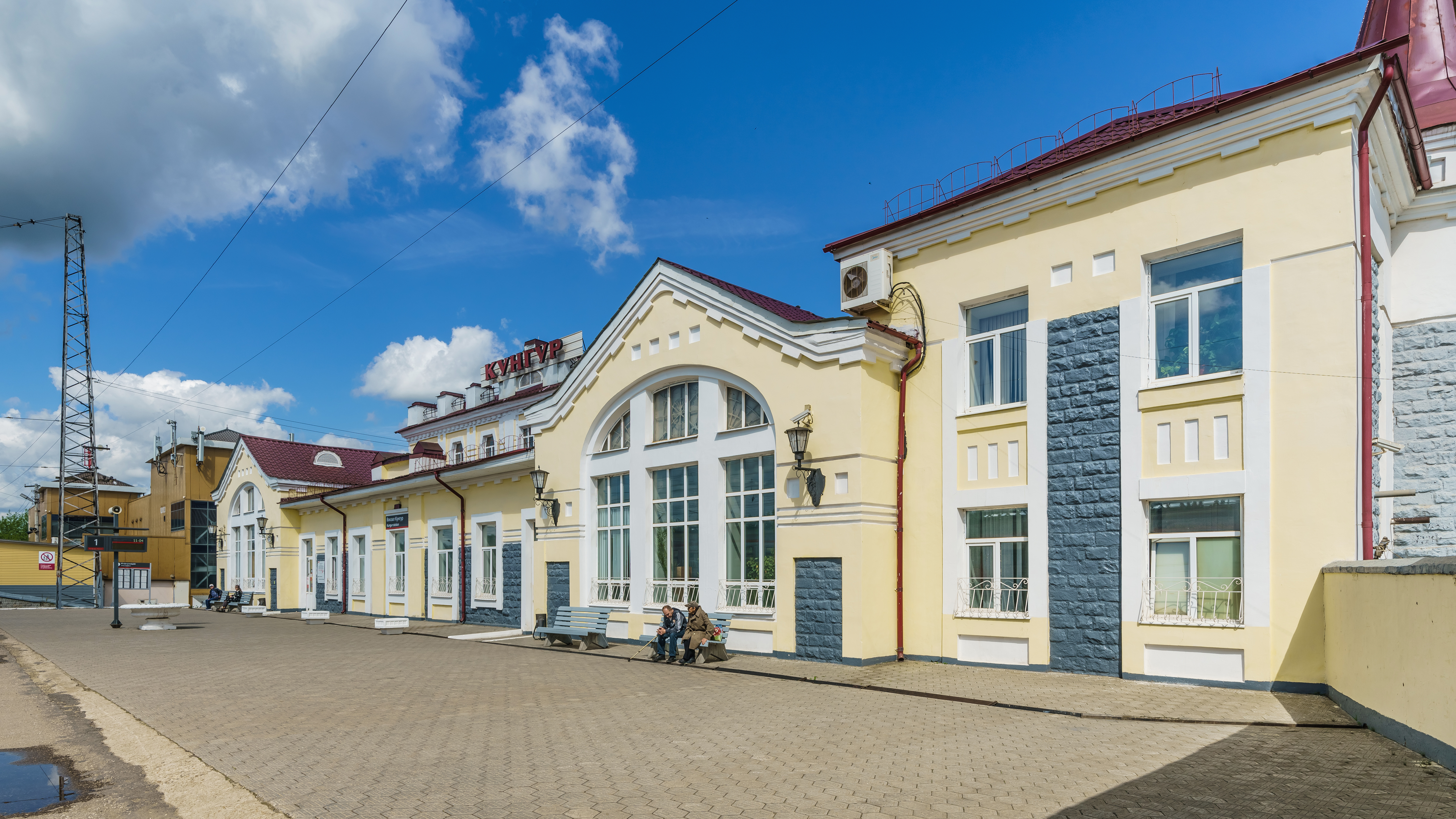
Kungur is located at the crossing of the Solikamsk route, the Siberian path, and the Trans-Siberian Highway.
Architecture
Among the notable buildings in Kungur are the Transfiguration Church (1781), Nikola Cathedral, former Guest courtyard with the Burse (1865–76, architect R. O. Karvovsky), the Zyryanov Hospice (1881, now the surgical department of a hospital), the 19th century storehouses of the Kopakov merchants (now a culture center).
The Tikhvinsky Temple was built in 1763 and got its name from the holy icon of Tikhvinskaya Bogomater. Now the movie theater "Oktyabr" is located in the building.
In the lower part of the town, on Kittarskaya street, is the Uspenskaya Church, built in 1761. On the opposite bank of the Sylva river stands the Preobrazhensky Temple.
Tourism and attractions
Kungur Ice Cave
Main article: Kungur Ice Cave
The Kungur Ice Cave is located in the vicinity of Kungur, on the right bank of the Sylva River. Ramified passages stretch under the ground for over 6,000 meters, and only a small part has already been explored. To this day, old slides and crumblings do not allow to determine the total length of the passages. In the explored part of the cave there are several dozens of grottoes; the largest one, which is called the Druzhba (Friendship) Grotto, was given its name in honor of the participants of the International Geological Congress who visited the cave in 1937. Inside this grotto there is a lake with the area of 750 m2.
The grottoes are "adorned" with columns of stalagmites and icicles of stalactites up to two meters in height. Over millennia, limestone bearing water has created an infinite variety of forms in the cave, like snowflakes which change in size during the year and reach the size of a maple leaf during late winter. The cave is filled with water from the Sylva River twice a year, in spring and in fall, when it is not accessible to tourists.
Sky Fair and Сity Day
KungurAir2006.jpg Triptych. Land, Sea and Sky by Russian Beauties. Sky Fair 2006 in Kungur.jpg Triptych. Three Kingdoms of Nature. Sky Fair 2006 in Kungur.jpg Triptych. Three Sisters. Sky Fair 2006 in Kungur.jpg
Education
Educational facilities in the town include:
- Kungur Lyceum
- Kungur College of Woodwork
- Kungur Professional Art Lyceum
- School of Arts
- Kungur Pedagogical College
- Kungur Agricultural College
- Kungur College of Autotransport
Sister city
- South Korea Samcheok, South Korea
References
Notes
Sources
References
- Law #1987-436
- "Bul_MO_2023".
- (10 December 2008). "На российском военном складе в Приднестровье ежедневно проводится инвентаризация и проверка безопасности". [[REGNUM News Agency]].
- Law #416-67
- Law #1769-367
This article was imported from Wikipedia and is available under the Creative Commons Attribution-ShareAlike 4.0 License. Content has been adapted to SurfDoc format. Original contributors can be found on the article history page.
Ask Mako anything about Kungur — get instant answers, deeper analysis, and related topics.
Research with MakoFree with your Surf account
Create a free account to save articles, ask Mako questions, and organize your research.
Sign up freeThis content may have been generated or modified by AI. CloudSurf Software LLC is not responsible for the accuracy, completeness, or reliability of AI-generated content. Always verify important information from primary sources.
Report