From Surf Wiki (app.surf) — the open knowledge base
Kulitan
Brahmic script
Brahmic script
| Field | Value |
|---|---|
| name | Kulitan |
| type | Abugida |
| caption | Modern Kulitan script |
| languages | Kapampangan |
| fam1 | Proto-Sinaitic alphabet |
| fam2 | Phoenician alphabet |
| fam3 | Aramaic alphabet |
| fam4 | Brāhmī |
| fam5 | Tamil |
| fam6 | Pallava |
| fam7 | Old Kawi |
| fam8 | Baybayin |
| sisters | In the Philippines: |
| Baybayin | |
| Buhid | |
| Hanunó'o | |
| Tagbanwa script | |
| time | 1900s – present |
| sample | Kulitan.svg |
| imagesize | 200px |
Baybayin Buhid Hanunó'o Tagbanwa script
In other countries: Balinese Batak Javanese Lontara Sundanese Rencong Rejang Kulitan is a reconstructed writing system in the Philippines based on baybayin, referred to as culit in the Kapampangan language of Central Luzon. Culit was used to write the language until it was gradually replaced by the Latin alphabet.
Kulitan is an abugida, or an alphasyllabary — a segmental writing system in which consonant–vowel sequences are written as a unit and possess an inherent vowel sound that can be altered with use of diacritical marks. There is a proposal to encode the script in Unicode by Anshuman Pandey, from the Department of Linguistics at UC Berkeley. There are also proposals to revive the script by teaching it in Kapampangan-majority public and private schools.
History
While the precise origins of kulitan are uncertain, it ultimately derives from the South Asian Brāhmī script. Pampanga had already developed special shapes for four letters by the early 1600s, different from the ones used elsewhere in the Spanish colony. What is used today, however, is a modernized version of the ancient script that employs consonant stacking, bringing it closer to other Brahmic scripts such as Burmese, Khmer and Tibetan.
Philippine nationalists of Pampangan ethnicity, such as Aurelio Tolentino and Zoilo Hilario, had employed kulitan in their writings in their efforts to expel the Spaniards and repel the invading Americans.
Structure
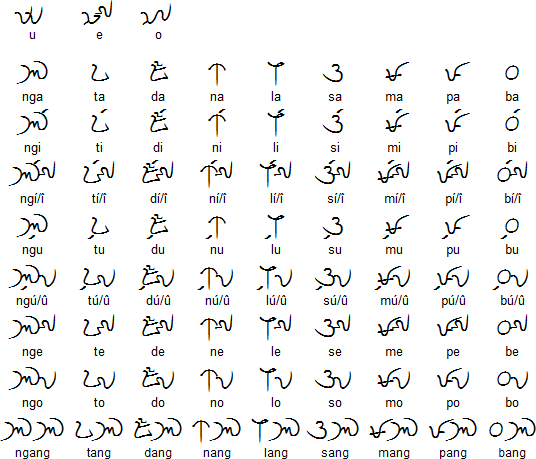
The indigenous characters were recorded as culit by the early 17th and 18th century Spanish lexicographers (Benavente, 1699 and Bergaño, 1732).{{cite journal
Kulitan is made up of Indûng Súlat, or the "progenitor" (literally "mother") characters, and the Anak Súlat, or the "offspring" (literally "child") characters. The Indûng Súlat are the base characters with the unaltered inherent vowel sounds. They are the building blocks of Súlat Kapampángan. Indûng súlat gives birth to Anak Súlat or "offspring" characters whenever their inherent vowel sound has been altered by a ligature or a diacritical mark.
The siuálâ or vowels in Kulitan are usually written as garlit{{cite journal
The recital order of the Indûng Súlat characters are A, I, U, E, O, GA, KA, NGA, TA, DA, NA, LA, SA, MA, PA, BA.{{cite journal
Direction of writing
Kulitan is currently the only indigenous script in the Philippines that is written and read vertically from top to bottom and from right to left. In contrast, the Surat Mangyan, Hanunóo and Buhid scripts are written vertically from bottom to top and from left to right but read in any orientation.
Handwritten samples and signatures found in 17th century land deeds at the University of Santo Tomas Archives indicate that Kulitan was rarely written vertically.{{cite journal
References
References
- "Baybayin Styles & Their Sources".
- Mallari, Joel Pabustan. (December 2006). "Documenting Philippine pre-Hispanic scripts: the case of the Kapampangan baybayin.". Alaya: The Kapampangan Research Journal.
- Pandey, Anshuman. (October 5, 2015). "Towards an encoding for Kulitan in Unicode".
- Orejas, Tonette. (27 April 2018). "Protect all PH writing systems, heritage advocates urge Congress".
- "Kulitan alphabet and Kapampangan language and pronunciation".
- Modern derivations of historical scripts are not unusual, with two of the latest being the [[Saurashtra script. Saurashtra]] and [[New Tai Lue alphabet. New Tai Lü]] scripts. The [[Latin script. Latin]] and [[Cyrillic script. Cyrillic]] scripts themselves had been derived from the [[Greek script. Greek]].
- (12 January 2019). "Should Kapampángan Millennials Learn Kulitan?".
This article was imported from Wikipedia and is available under the Creative Commons Attribution-ShareAlike 4.0 License. Content has been adapted to SurfDoc format. Original contributors can be found on the article history page.
Ask Mako anything about Kulitan — get instant answers, deeper analysis, and related topics.
Research with MakoFree with your Surf account
Create a free account to save articles, ask Mako questions, and organize your research.
Sign up freeThis content may have been generated or modified by AI. CloudSurf Software LLC is not responsible for the accuracy, completeness, or reliability of AI-generated content. Always verify important information from primary sources.
Report