From Surf Wiki (app.surf) — the open knowledge base
Kulin nation
Indigenous Australian ethnic group
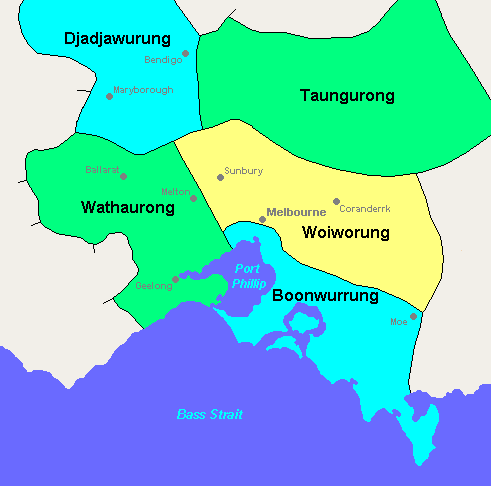
Indigenous Australian ethnic group
The Kulin nation is an alliance of five Aboriginal nations in the south of Australia - up into the Great Dividing Range and the Loddon and Goulburn River valleys - which shares Culture and Language.
History
Before British colonisation, the tribes spoke five related languages. These languages are spoken by two groups: the eastern Kulin group of Woiwurrung–Taungurung, Boonwurrung and Ngurai-illam-wurrung; and the western language group of just Wadawurrung.
The central Victoria area has been inhabited for an estimated 42,000 years before European settlement. At the time of British settlement in the 1830s, the collective populations of the Woiwurrung, Boonwurrung and Wadawurrung tribes of the Kulin nation was estimated to be approximately 725. The Kulin lived by fishing, cultivating murnong (also called yam daisy; Microseris) as well as hunting and gathering, and made a sustainable living from the rich food sources of Port Phillip and the surrounding grasslands.
Due to the upheaval and disturbances from British settlement from the 1830s on, there is limited physical evidence of the Kulin peoples' collective past. However, there are a small number of registered sites of cultural and spiritual significance in the Melbourne area.
People
- Woiwurrung (Woy-wur-rung) – the Wurundjeri people
- Boonwurrung – the Boonwurrung people
- Wathaurong (Wath-er-rung) – the Wathaurong people
- Taungurung (Tung-ger-rung) – the Taungurung people
- Dja Dja Wurrung (Jar-Jar-Wur-rung) – the Djadjawurrung or Djaara people
At certain times of the year, these nations would meet at Yarra Falls to settle disputes, to trade, and to hold corroborees.
Diplomacy
When foreign people passed through or were invited onto tribal lands, the ceremony of tanderrum – freedom of the bush – was performed. This was intended to allow for safe passage and temporary access and use of land and resources by foreign people. It was a diplomatic rite involving the landholder's hospitality and a ritual exchange of gifts.
Notes
Citations
Bibliography
- {{cite web|author=Anon.|date=n.d.|title = Indigenous connections to the site | archive-date = 31 August 2007
- {{Cite book| title = The Melbourne Dreaming. A Guide to the Aboriginal Places of Melbourne
- {{Cite book| chapter = The Footballer, First in the league (about James Wandin)|pages=35–37 | archive-url = https://web.archive.org/web/20081030133601/http://home.vicnet.net.au/~hsosk/downloads/ppwalks.pdf | archive-date = 30 October 2008
- {{Cite book| title = Aboriginal Melbourne: The Lost Land of the Kulin People | edition = Second | orig-year = First published 1985
- {{Cite book| title = The First Residents of Melbourne's Western Region
This article was imported from Wikipedia and is available under the Creative Commons Attribution-ShareAlike 4.0 License. Content has been adapted to SurfDoc format. Original contributors can be found on the article history page.
Ask Mako anything about Kulin nation — get instant answers, deeper analysis, and related topics.
Research with MakoFree with your Surf account
Create a free account to save articles, ask Mako questions, and organize your research.
Sign up freeThis content may have been generated or modified by AI. CloudSurf Software LLC is not responsible for the accuracy, completeness, or reliability of AI-generated content. Always verify important information from primary sources.
Report