From Surf Wiki (app.surf) — the open knowledge base
KSV Hessen Kassel
German football club
German football club
| Field | Value |
|---|---|
| clubname | KSV Hessen Kassel |
| image | KSV Hessen Kassel logo.svg |
| upright | 0.8 |
| fullname | Kasseler Sport-Verein Hessen Kassel e. V. |
| nickname | Die Löwen |
| founded | |
| ground | Auestadion |
| capacity | 18,737 |
| chairman | Jens Rose |
| manager | René Klingbeil |
| league | Regionalliga Südwest (IV) |
| season | 2024–25 |
| position | Regionalliga Südwest, 9th of 18 |
| website | https://www.ksvhessen.de |
| pattern_b1 | _kassel2021h |
| leftarm1 | ffffff |
| body1 | ffffff |
| rightarm1 | ffffff |
| shorts1 | ffffff |
| socks1 | ffffff |
| pattern_b2 | _kassel2021a |
| leftarm2 | dd0000 |
| body2 | dd0000 |
| rightarm2 | dd0000 |
| shorts2 | dd0000 |
| socks2 | dd0000 |
KSV Hessen Kassel is a semi-professional German football club based in Kassel, Hesse. KSV competes in the German Regionalliga Südwest, the fourth tier of German football. Nicknamed "Die Löwen" (the lions), the club was founded as FC Union 93 Kassel in 1893. A series of mergers, insolvency and re-starts led to the club known today being re-formed on 3 February 1998. The club's colours are red and white and their home ground since 1953 has been the Auestadion, located in the southwest of the city of Kassel next to the historic Karlsaue park.
History
The club was founded as FC Union 93 Kassel in 1893 and just two years later joined FC Hassia 93 Cassel to form Casseler FV 95. In 1919, fusion with VfK Kassel created SV Kurhessen Kassel. It was as Kurhessen that the club joined the Gauliga Hessen, one of sixteen top flight divisions established in the re-organization of German football in 1933 under the Third Reich. They were relegated at the end of the 1935–36 season and made their way back in 1938, but continued to perform poorly, narrowly missing relegation in subsequent seasons. They earned their best result in 1942 in the newly formed Gauliga Kurhessen, finishing just two points shy of division winners 1. SV Borussia 04 Fulda. In 1944, they joined CSC 03 Kassel to form the combined wartime side KSG SV Kurhessen/CSC 03 Kassel and again finished two points behind the division leaders, this time in third place on goal difference. The Gauliga Kurhessen was re-organized into three groups for the following season, and the club was assigned to the Gruppe Kassel, but the region was overtaken by World War II, bringing a stop to league play.
After the war, SVKK was one of a number of clubs merged to form the Gründung der Sportgruppe Süd, an association active in a number of sports. This club became VfL Kassel in 1946, and finally, merged with Kasseler SV Kassel in November 1947 to become today's KSV Hessen Kassel.
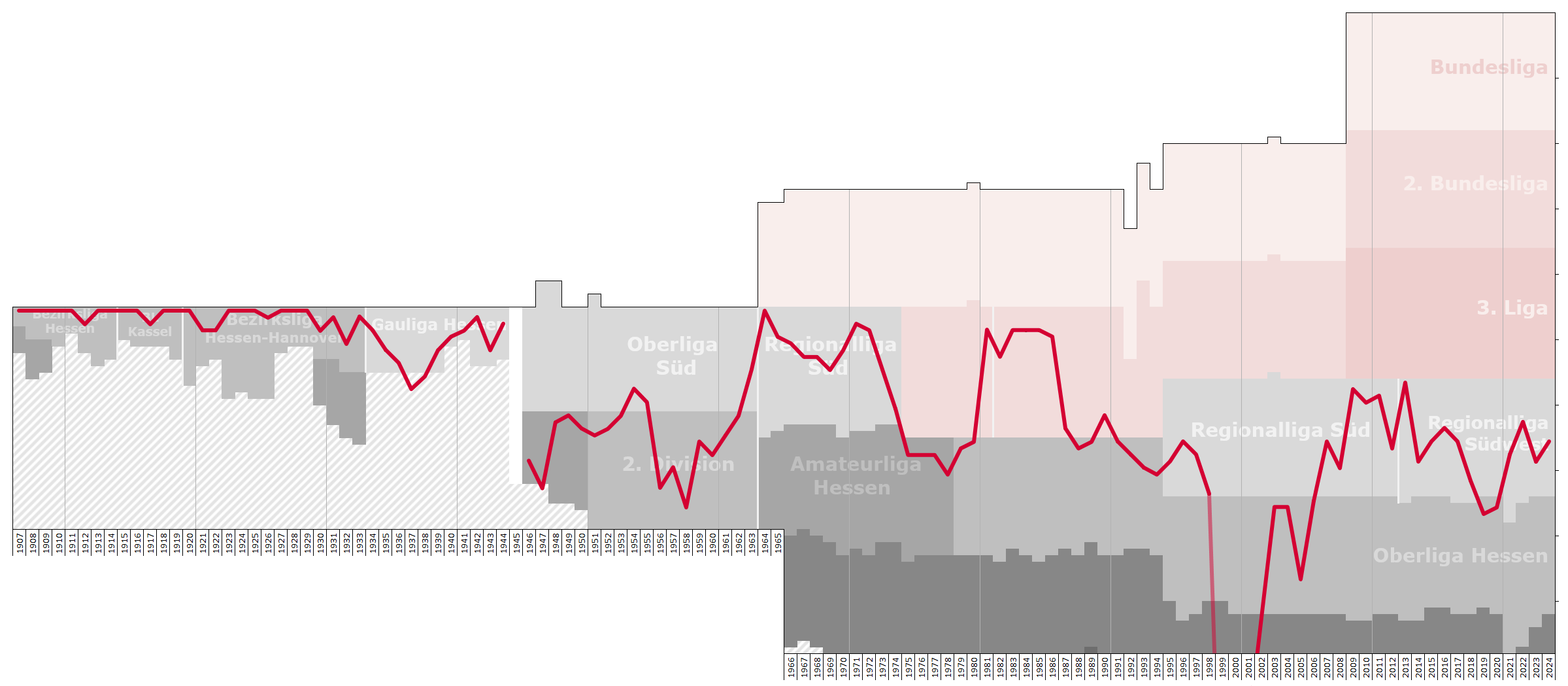
Kassel quickly established themselves as a stolid, but largely unremarked, second-tier side. They played their way into what was at the time the first tier Oberliga Süd and then found themselves in the Regionalliga Süd (II) after the formation in 1963 of Germany's new premier level professional league, the Bundesliga. A first place Regionalliga finish in 1964 saw them compete unsuccessfully in the promotion rounds for the Bundesliga . The club continued to play tier II ball until the mid 70s when their performance dropped them to Amateur Oberliga Hessen (III) until the start of the next decade brought an advance to the 2. Bundesliga. Through the 80s, the team flirted with promotion to the senior circuit, but could never quite put themselves over the top. In 1985 the club just missed being promoted: a loss to Nurenburg (0–2) in the last game of the season against wins by three other clubs in the hunt saw Kassel left behind.
Those runs at the Bundesliga in the 80s, alongside an advance to the quarter-final of the DFB-Pokal in 1991, represent the apex of the team's achievement. The club was bankrupted in 1993 and the football side set off on its own as FC Hessen Kassel. They too had financial problems and in 1998 also found themselves bankrupt, but this time plunged all the way down to Kreisliga Hessen A (VIII). Kassel began their recovery by going unbeaten over the course of the next two seasons and advanced to the Oberliga Hessen (IV) which they won in 2005–06 to earn a promotion to the Regionalliga (III). In 2007–08, they failed to qualify for the new 3. Liga, remaining in the Regionaliga Süd, now tier four. They came close to promotion once more in 2010–11 but narrowly failed finishing third.
At the end of the 2011–12 season the club was grouped into the new Regionalliga Südwest, which replaced the Regionalliga Süd in the region. In 2012–13 the club won the inaugural championship of the new league and qualified for the promotion play-off to the 3. Liga.
Die Löwen lost their play-off tie for promotion to the 3. Liga over two legs to Holstein Kiel who finished the 2012–13 season as champions of Regionalliga Nord. Kassel lost the first game of the tie away at the Holstein-Stadion in Kiel 2–0. In the return leg in Kassel, the club lost 2–1 at the Auestadion in front of 17,000 fans. The following season the club was not able to challenge for the championship, only finishing 13th.
Players
Current squad
Out on loan
Reserve team
Main article: KSV Hessen Kassel II
The club's reserve team, KSV Hessen Kassel II, has played in the Verbandsliga Hessen-Nord since 2009. The team's greatest success has been to win the Hesse Cup in 1961 and finish runners-up in the Amateurliga Hessen in 1968.
International footballers
Below is a list of former and current international footballers who have played at least 1 match for a FIFA recognised country at senior or U21 level while contracted to the club.
| Player | Country | Caps | Goals | Active |
|---|---|---|---|---|
| Gustav Hensel | GER Germany | 1 | 0 | 1908 |
| Heinrich 'Heini' Weber | GER Germany | 12 | 0 | 1928–31 |
| Karl-Heinz Metzner | GER West Germany | 2 | 0 | 1952–53 |
| Dieter Hecking | GER West Germany U21 | 12 | 8 | 1985–86 |
| Harez Arian Habib | AFG Afghanistan | 13 | 4 | 2007–12 |
| Alban Meha | ALBKOS Albania/Kosovo | 9 | 2 | 2005–2024 |
| Faton Xhemaili | ALB Albania U21 | 1 | 0 | 2018–present |
Staff
Current staff

For 2024/25 season
| Role | Staff |
|---|---|
| Head coach | GER René Klingbeil |
| Assistant coach | GER Sebastian Busch |
| Assistant coach | GER Mirko Dickhaut |
| Goalkeeper coach | GER Christoph Wiegand |
| Goalkeeper coach | GER Michael Gibhardt |
| Role | Staff |
|---|---|
| Director of football | GER Jörg Müller |
| Team manager | GER Michael Voss |
| Team official | GER Alfred Gäßler |
| Kit manager | GER Uwe Heller |
| Role | Staff |
|---|---|
| Club doctor | GER Thomas Krause |
| Club doctor | GER Markus Schott |
| Physiotherapist | GER Christian Bielert |
| Physiotherapist | GER Nina Klaus |
|}
Club managers
All managers of the club since 1946:

| Manager | Term |
|---|---|
| GER Fritz Kleim | 1946–1947 |
| GER Ernst Paulus | 1947–1949 |
| GER Karl Höger | 1949–1950 |
| GER Lothar Schröder | 1950–1952 |
| GER Rudi Gellesch | 1952–1955 |
| GER Walter Koch | 1955–1956 |
| GER Hans Carl | 1956–1958 |
| GER Jupp Kratz | 1958–1960 |
| AUT Willibald Hahn | 1960–1962 |
| GER Walter Müller | 1962–1964 |
| GER Herbert Widmayer | 1964–1966 |
| GER Toni Hellwig | 1966–1968 |
| GER Willy Kurrat | 1968–1969 |
| GER Heinz Baas | 1969–1971 |
| GER Toni Hellwig | 1971 |
| GER Hans-Wilhelm Loßmann | 1971–1972 |
| GER Toni Hellwig | 1972–1973 |
| GER Heinz Baas | 1973–1974 |
| GER Klaus Kuhnert | 1974 |
| GER Robert Gebhardt | 1974–1976 |
| Manager | Term |
|---|---|
| GER Walter Müller | 1976 |
| HUN Gyula Tóth | 1976–1978 |
| GER Rudi Kröner | 1978–1982 |
| GER Timo Konietzka | 1982–1983 |
| GER Jörg Berger | 1983–1986 |
| GER Rudi Kröner | 1986 |
| GER Jürgen Nehme | 1986 |
| GER Elmar Müller | 1986 |
| GER Werner Biskup | 1987 |
| GER Holger Brück | 1987 |
| GER Franz Brungs | 1987–1989 |
| GER Lorenz-Günther Köstner | 1989–1990 |
| GER Hans-Ulrich Thomale | 1990–1992 |
| GER Karl-Heinz Wolf | 1992–1993 |
| GER Franz Brungs | 1993–1995 |
| GER Holger Brück | 1995–1996 |
| GER Hans-Jürgen Gede | 1996 |
| GER Hans-Werner Moors | 1997 |
| GER Horst Schmidt | 1997 |
| GER Jörg Müller | 1998–2000 |
| Manager | Term |
|---|---|
| GER Holger Brück | 2000–2001 |
| UK Terry Scott | 2001 |
| GER Holger Brück | 2001 |
| GER Oliver Roggensack | 2001–2003 |
| GER Thomas Freudenstein | 2003–2004 |
| GER Hans-Ulrich Thomale | 2004 |
| GER Bernd Sturm | 2004–2005 |
| GER Matthias Hamann | 2005–2008 |
| GER Mirko Dickhaut | 2008–2011 |
| GER Christian Hock | 2011 |
| GER Holger Brück | 2011 |
| GER Uwe Wolf | 2012–2013 |
| GER Jörn Großkopf | 2013 |
| GER Sven Hoffmeister | 2013 |
| GER Matthias Mink | 2014–2016 |
| GER Tobias Cramer | 2016–2019 |
| GER Dietmar Hirsch | 2019 |
| GER Tobias Damm | 2019–2023 |
| GER Alexander Kiene | 2023–2024 |
| GER André Schubert | 2024 |
| GER René Klingbeil | 2024–Present |
|} Notes:
Club identity
Supporters

KSV Hessen Kassel has a number of organised and un-organised fan groups, ultras and blocks. Most notably, Block 30, Huddich Bande Ultras and Block 36.
Named after the block affiliated members meet and watch KSV in the Auestadion, Block 30 is organised and represents an array of different kinds of fans. Its purpose is to support KSV Hessen Kassel, promote German football supporter culture and connect with other supporter groups in Germany on important regional football issues. In March 2019 it joined with twelve other clubs ranging from 3.Liga (III) to Oberliga (V) level to establish a working group to determine a unified position and list of recommendations to take to the DFB on proposed reforms to the regional football structure in Germany.
Block 36 is not organised and consists of fans both affiliated with organised fan groups and not. Block 36 looks to ensure KSV Hessen Kassel is run openly and transparently with a culture of appreciation and respect. Block 36's stated value is honest regional football with the aspiration of seeing KSV getting back to a professional football level in Germany.
Since 2008 there has been an unofficial friendship formed between Kassel's Block 30 and Huddich Bande Ultras and Holstein Kiel’s supporter group Block 501. In 2018, to celebrate ten years of friendship, the two sets of fans combined and attended one KSV Hessen Kassel match and one Holstein Kiel match together. They dubbed the weekend the brothers for life celebration.
Facilities

KSV Hessen Kassel's current home ground is the 18,737 capacity Auestadion. The stadium has predominantly been the club's home ground since being built in 1953. Hessen Kassel inaugurated Auestadion on the stadium's opening on 23 August 1953. KSV played a football match against Bavarian team Viktoria Aschaffenburg in front of 20,000 spectators. Kassel lost the match two goals to one. The Auestadion is a multi-purpose facility with a 106 × 65 m football pitch located in the middle of a full athletic running track. The stadium has 8,700 seats and terracing that can accommodate for a little over 10,000 spectators standing. Auestadion has had three major renovations since being built, the last being a new grandstand, forecourt and video wall constructed between 2009 and 2011. The ground is located in the Southwest of the city near the historic Karlsaue park and Eissporthalle Kassel ice sports stadium. It can be reached by both local and regional Kassel tram lines: 5, 6 and RT5.
KSV Hessen Kassel holds the attendance record for the Auestadion. The official record stands at 37,000 attendance at the 1964 Bundesliga promotion play-off match between KSV Hessen Kassel and Hannover 96. Kassel lost to the match 2–1. There was however a report of 40,000 people attending a DFB-Pokal match in January 1965 at the stadium. KSV played Bundesliga club Hamburger SV (HSV, Hamburg) and lost 2–0 with goals to Uwe Seeler (12th minute) and Charly Dörfel (57th minute). The official crowd number was 33,000 but Kassel police reported there was 40,000 spectators in attendance. The number of fans buckled the railings in the standing areas. Children were passed down onto the playing ground to ensure their safety. The right hand side gate of the grandstand was pushed down and fans flooded into the playing area. The stewards and the police were powerless, and spectators were standing all around the corner flags. The referee, Wilfried Hilker, delayed the start of the match so authorities could regain control and push the fans back from the edge of the field but eventually he got the match underway when it became apparent this was impossible to do.
Prior to the Auestadion construction in the 1950s, KSV played at the A-Platz. Known officially as the Kurhessen sports facility, the A-Platz was inaugurated in 1922 with a capacity of 16,000 spectators. The A-Platz was demolished after the completion of the Auestadion.
Following the club's insolvency in 1998 and relegation from the third division to the eighth division, KSV relocated to one of the outfields within the Auestadion precinct. The G-Platz had a capacity of 2,000 spectators and was affectionately known as the “lion cage” by the Hessen Kassel fans.
Other sporting departments
Until 1993 KSV Hessen Kassel was a multi-sport club with sporting departments in football, athletics, badminton, tennis and table tennis among others. Hessen Kassel had a total of twenty three amateur departments. KSV produced a number of German champions and Olympians throughout these different disciplines. The club's bankruptcy in 1993 brought an end to KSV continuing as a multi-sport club. When the club was re-established it was brought back as a purely football club, FC Hessen Kassel. When the club re-emerged as KSV Hessen Kassel in 1998 it remained just a football club.

Athletics department
The club was used as the performance centre for athletics for the state of Hesse until 1993. During this time, KSV produced nine German champions, one European champion, one Commonwealth Games gold medallist and four Olympians from within its athletics department. These included:
- Anna Klooss (née Hagemann), represented Germany at the 1936 Olympic Games in discus throwing. She was ranked as one of the top three discus throwers in German championships between 1936 and 1948 and she became German champion in 1946.
- Irmgard Schmelzer (née Kirchhoff), represented Germany at the 1952 Olympic Games in long jump. She finished fourth in the event with a distance of 5.9m. Irmgard also became the 1952 German champion in long jump.
- Ludwig Müller, represented Germany at the 1960 Olympic Games in the men's 3000 metres steeplechase. Ludwig qualified for the final second from his heat before finishing sixth in the final. Müller was a middle-distance runner who became German champion in 1963.
- Josef Klik, represented West Germany in the 1962 European Athletics Championships in discus throwing. He finished 18th in the qualification event, missing out on a spot in the final. Josef became German champion in 1964.
- Horst Flosbach, represented Germany at the 1960 Olympic Games in the men's 5000 metres running race. Horst won his heat to advance to the final and finished eighth in the final. Flosbach was a long-distance runner who then became German champion in the 10,000 metres in 1964.
- Gerd Loßdörfer, represented West Germany at the 1966 European Athletics Championships in 400 metres hurdles. Gerd won the silver medal in the event, finishing 0.5 seconds behind world number one Roberto Frinolli. Loßdörfer became German champion in hurdles in 1966.
- Klaus Lehnertz, represented Germany at the 1964 Olympic Games in pole vaulting. Lehnertz won the bronze medal in the event with 5.00 metres best mark. Klaus also represented West Germany at the European Championships in 1962 and 1966 as well as the European Cup in 1965 and 1967. He won silver in 1965 and bronze in 1967. Lehnertz was also the German champion in pole vaulting for three straight years between 1966 and 1968.
- Hans-Jürgen Ziegler, represented West Germany at the 1971 European Championships and 1973 European indoor championships in pole vaulting. Ziegler finished eleventh in 1971 but won silver in 1973. He was also German pole vaulting champion in 1971 as well as German indoor champion in 1971 and 1972.
- Don Baird, represented Australia at the 1974 and 1978 Commonwealth Games in pole vaulting. Baird won the gold medal in 1974 and silver in 1978. Don also represented Australia at the 1977 IAAF World Cup. He finished fourth at the World Cup. Baird was also the German champion at pole vaulting in 1974. Badminton department
KSV's badminton department produced successful individual players during its time of operation. Most notable was Maren Schröder, who won thirteen Hesse and three Southwest German titles. Anke Jaskolla and Ulrich Schaper also won Hesse championships. The department was dissolved in 1993 and the players left and started the independent Badminton Club Kassel e. V (BV Kassel) on 7 July 1993.
Tennis department
KSV Hessen Kassel's tennis department was established in 1978 and remained operational until 1993. The club originally built three clay tennis courts and a small wooden clubhouse, adding a fourth later on, to the south of the Auestadion. In 1990 with increased members the club built a new large modern clubhouse. Once KSV declared bankruptcy in 1993, the tennis department and the majority of its member players broke away from KSV and founded a new independent club named Tennis-Club-Auepark Kassel eV (TC-Auepark Kassel eV).
Table tennis department
The table tennis department was founded as CT Hessen-Prussia in 1936 as the first table tennis department of any Kassel sports club. The department ceased operating during the Second World War but restarted on 17 November 1945 following the conclusion of the war. In 1946 it merged into the singular club name of KSV Hessen Kassel. It was one of the leading table tennis clubs in Northern Hesse at the time. KSV, in particular, excelled in women's table tennis. In 1967 KSV Hessen Kassel was promoted to the top division in the region, Oberliga Südwest. Kassel remained in the top division for four years before being relegated in 1971. In 1972 the women's Bundesliga was introduced in table tennis, KSV now found themselves in the third division. After eight seasons, Hessen Kassel got promoted to the second division in 1979, which was now called Regionalliga Südwest. In 1981 the division was renamed 2.Bundesliga. Kassel was again relegated in 1982 but was swiftly promoted again and remained in 2.Bundasliga for the rest of the 1980s. In 1993. Following the club's bankruptcy, the table tennis department left KSV and established its own independent club, TTC Kassel. The new club played in the first division for two years but withdrew from the second division and folded in 1997.
Honours
League
- 2. Oberliga Süd (II)
- Champions: 1962
- Runners-up: 1953
- Regionalliga Süd (II)
- Champions: 1964
- Regionalliga Süd (IV)
- Runners-up: 2009
- Regionalliga Südwest (IV)
- Champions: 2013
- Oberliga Hessen (III–V)
- Champions: 1949, 1980, 1989, 1991, 2006
- Runners-up: 1968‡, 1988, 2003, 2004, 2020
- Landesliga Hessen-Nord (IV/V)
- Champions: 1967‡, 1971‡, 1984‡, 1989‡, 1995‡, 2002
- Runners-up: 2011‡
Cup
-
Hesse Cup (Tiers III–VII)
- Winners: 1961‡, 2015
- Runners-up: 1948, 1968‡, 1975, 2010, 2011, 2018, 2025
-
‡ Won by reserve team
Season-by-season record
The season-by-season performance of the club since re-establishment in February 1998:
| Season | Division | Tier | Position |
|---|---|---|---|
| 1998–99 | Kreisliga A | VIII | 1st ↑ |
| 1999–00 | Bezirksliga | VII | 1st ↑ |
| 2000–01 | Bezirksoberliga | VI | 1st ↑ |
| 2001–02 | Landesliga Hessen-Nord | V | 1st ↑ |
| 2002–03 | Oberliga Hessen | IV | 2nd |
| 2003–04 | Oberliga Hessen | 2nd | |
| 2004–05 | Oberliga Hessen | 13th | |
| 2005–06 | Oberliga Hessen | 1st ↑ | |
| 2006–07 | Regionalliga Süd | III | 10th |
| 2007–08 | Regionalliga Süd | 14th | |
| 2008–09 | Regionalliga Süd | IV | 2nd |
| 2009–10 | Regionalliga Süd | 4th | |
| 2010–11 | Regionalliga Süd | 3rd | |
| 2011–12 | Regionalliga Süd | 11th | |
| 2012–13 | Regionalliga Südwest | 1st | |
| 2013–14 | Regionalliga Südwest | 13th | |
| 2014–15 | Regionalliga Südwest | 10th | |
| 2015–16 | Regionalliga Südwest | 8th | |
| 2016–17 | Regionalliga Südwest | 10th | |
| 2017–18 | Regionalliga Südwest | 16th ↓ | |
| 2018–19 | Hessenliga | V | 3rd |
| 2019–20 | Hessenliga | 2nd ↑ | |
| 2020–21 | Regionalliga Südwest | IV | 12th |
| 2021–22 | Regionalliga Südwest | 7th | |
| 2022–23 | Regionalliga Südwest | 13th | |
| 2023–24 | Regionalliga Südwest | 10th | |
| 2024–25 | Regionalliga Südwest | 9th | |
| 2025–26 | Regionalliga Südwest |
- With the introduction of the Regionalligas in 1994 and the 3. Liga in 2008 as the new third tier, below the 2. Bundesliga, all leagues below dropped one tier. Also in 2008, the majority of football leagues in Hesse were renamed, with the Oberliga Hessen becoming the Hessenliga, the Landesliga becoming the Verbandsliga, the Bezirksoberliga becoming the Gruppenliga and the Bezirksliga becoming the Kreisoberliga. In 2012, the number of Regionalligas was increased from three to five with all Regionalliga Süd clubs except the Bavarian ones entering the new Regionalliga Südwest.
| ↑ Promoted | ↓ Relegated |
|---|
References
References
- (29 May 2013). "Match Statistics: Holstein Kiel vs Hessen Kassel". [[Kicker (sports magazine).
- (2 June 2013). "Match Statistics: Hessen Kassel vs Holstein Kiel". [[Kicker (sports magazine).
- "Mannschaft 2024/25". www.ksvhessen.de.
- "Mannschaft 2024/25". www.ksvhessen.de.
- [http://www.weltfussball.de/teams/hessen-kassel/9/ KSV Hessen Kassel Trainer von A-Z] {{Webarchive. link. (24 March 2016 {{in lang). de weltfussball.de, accessed: 7 December 2011
- (March 2019). "Regionalliga Reformder "Fanszenen Deutschland"". The fan scenes in Germany.
- (26 June 2016). "Über uns". Block 36.
- (21 November 2018). "Kassel & Kiel Wochenende". Block 30.
- (23 August 2013). "Auestadion: Vor 60 Jahren das erste Spiel". www.hna.de.
- "Auestadion Kassel". www.stadiumdb.com.
- "Liniennetzpläne für Kassel und Nordhessen". Nordhessischer VerkehrsVerbund.
- "1 Bundesliga 1963-1964 gruppe 2 Hessen Kassel-Hannover 96". www.weltfussball.de.
- Fritschler, Peter. (8 April 2020). "Mit 40 000 im Auestadion: Fans wollten KSV und Uwe Seeler sehen". www.hna.de.
- (2009). "Das große Buch der deutschen Fußballvereine: Die besten Fußballklubs Deuschlands". AGON Sportverlag.
- Kohlhaase, Torsten. (18 June 2017). "Zwei Pleiten in vier Jahren". www.hna.de.
- "Vereinshistorie". www.bv-kassel.de.
- "Die Geschichte". www.tc-auepark-kassel.de.
- Eckehard, Meyer. (August 1994). "TTC Kassel – Mit dem Rücken zur Wand". Deutscher Tischtennis-Sport (DTS).
- [http://www.f-archiv.de/ Das deutsche Fußball-Archiv] {{Webarchive. link. (22 February 2018 {{in lang). de Historical German domestic league tables
- [http://www.fussball.de/fussball-ergebnisse-die-top-ligen-bei-fussball-de/id_45692854/index Fussball.de – Ergebnisse] {{webarchive. link. (7 December 2011 {{in lang). de Tables and results of all German football leagues
This article was imported from Wikipedia and is available under the Creative Commons Attribution-ShareAlike 4.0 License. Content has been adapted to SurfDoc format. Original contributors can be found on the article history page.
Ask Mako anything about KSV Hessen Kassel — get instant answers, deeper analysis, and related topics.
Research with MakoFree with your Surf account
Create a free account to save articles, ask Mako questions, and organize your research.
Sign up freeThis content may have been generated or modified by AI. CloudSurf Software LLC is not responsible for the accuracy, completeness, or reliability of AI-generated content. Always verify important information from primary sources.
Report