From Surf Wiki (app.surf) — the open knowledge base
Kshatriya
Ruling and warrior class of the Hindu varna system
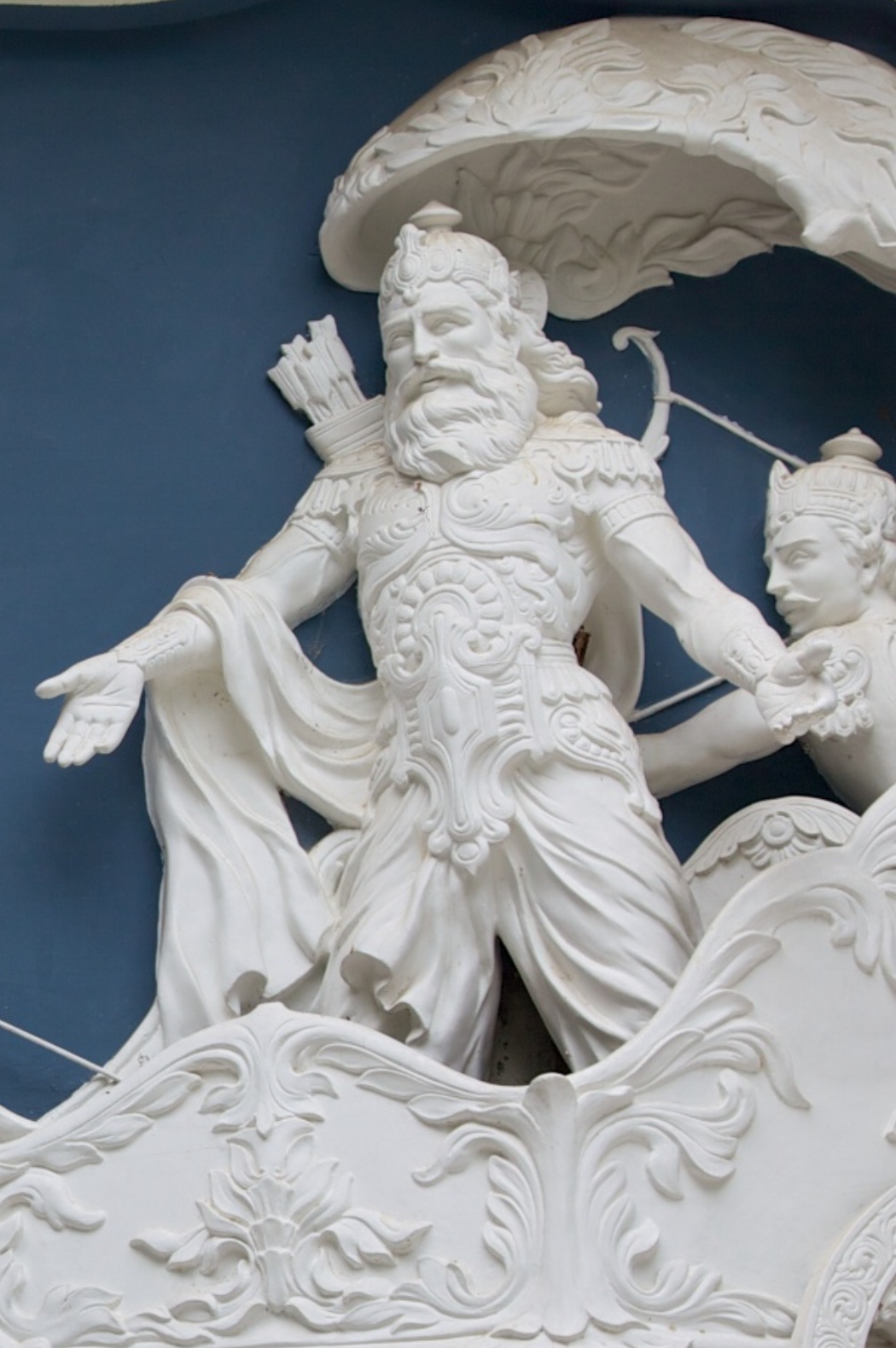
Ruling and warrior class of the Hindu varna system
Kshatriya () (from Sanskrit kṣatra, "rule, authority"; also called Rajanya)
- {{cite book|title=The History of India|url= https://books.google.com/books?id=DAwmUphO6eAC&dq=Kshatriya+formerly+known+as+rajanya&pg=PA207|page=207|author=John McLeod|publisher=Greenwood Publishing Group|year=2002| isbn=9780313314599 }} is one of the four varnas (social orders) of Hindu society and is associated with the warrior aristocracy. The Sanskrit term kṣatriyaḥ is used in the context of later Vedic society wherein members were organised into four classes: brahmin, kshatriya, vaishya, and shudra.
History
Early Rigvedic tribal monarchy
The administrative machinery in Vedic India was headed by a tribal king called a Rajan whose position may or may not have been hereditary. The king may have been elected in a tribal assembly (called a Samiti), which included women. The Rajan protected the tribe and cattle; was assisted by a priest; and did not maintain a standing army, though in the later period the rulership appears to have risen as a social class. The concept of the fourfold varna system is not yet recorded.
Later Vedic period
The hymn Purusha Sukta in the Rigveda describes the symbolic creation of the four varnas through cosmic sacrifice (yajña). Some scholars consider the Purusha Sukta to be a late interpolation into the Rigveda based on the neological character of the composition, as compared to the more archaic style of the Vedic literature. Since not all Indians were fully regulated under varna paradigm in Vedic society, the Purusha Sukta was supposedly composed to secure Vedic sanction for the hereditary caste scheme. An alternate explanation is that the word Shudra does not occur anywhere else in the Rigveda except the Purusha Sukta, leading some scholars to believe the Purusha Sukta was a composition of the later Rigvedic period itself to denote, legitimise and sanctify an oppressive and exploitative class structure that had already come into existence. Jayantanuja Bandyopadhyaya (2007). Class and Religion in Ancient India, pp. 37–47. Anthem Press.
Although the Purusha Sukta uses the term rajanya, not Kshatriya, it is considered the first instance in the extant Vedic texts where four social classes are mentioned for the first time together. Usage of the term Rajanya possibly indicates the 'kinsmen of the Rajan' (i.e., kinsmen of the ruler) had emerged as a distinct social group then, such that by the end of the Vedic period, the term rajanya was replaced by Kshatriya; where rajanya stresses kinship with the Rajan and Kshatriya denotes power over a specific domain. The term rajanya unlike the word Kshatriya essentially denoted the status within a lineage. Whereas Kshatra, means "ruling; one of the ruling order".{{cite book |author-link = Ralph Lilley Turner |archive-url = https://archive.today/20130825205232/http://dsalsrv02.uchicago.edu/cgi-bin/philologic/getobject.pl?c.1:1:81.soas |url-status = dead |archive-date = 25 August 2013 |access-date = 23 October 2011 |orig-year = 1962 Jaiswal points out the term Brahman rarely occurs in the Rigveda with the exception of the Purusha Sukta and may not have been used for the priestly class. Based on the authority of Pāṇini, Patanjali, Kātyāyana and the Mahabharata, Jayaswal believes that Rajanya was the name of political people and that the Rajanyas were, therefore, a democracy (with an elected ruler). Radhakrishna Choudhary (1964). The Vrātyas in Ancient India, Volume 38 of Chowkhamba Sanskrit studies, p. 125. Sanskrit Series Office. Some examples were the Andhaka and Vrsni Rajanyas who followed the system of elected rulers. Ram Sharan Sharma details how the central chief was elected by various clan chiefs or lineage chiefs with increasing polarisation between the rajanya (aristocracy helping the ruler) and the vis (peasants) leading to a distinction between the chiefs as a separate class (raja, rajanya, kshatra, kshatriya) on one hand and vis (clan peasantry) on the other hand.
The term kshatriya comes from kshatra and implies temporal authority and power which was based less on being a successful leader in battle and more on the tangible power of laying claim to sovereignty over a territory, and symbolising ownership over clan lands. This later gave rise to the idea of kingship.
In the period of the Brahmanas (800 BCE to 700 BCE) there was ambiguity in the position of the varna. In the Panchavimsha Brahmana (13,4,7), the Rajanya are placed first, followed by Brahmana then Vaishya. In Shatapatha Brahmana 13.8.3.11, the Rajanya are placed second. In Shatapatha Brahmana 1.1.4.12 the order is—Brahmana, Vaishya, Rajanya, Shudra. The order of the Brahmanical tradition—Brahmana, Kshatriya, Vaishya, Shudra—became fixed from the time of dharmasutras (450 BCE to 100 BCE). The kshatriya were often considered pre-eminent in Buddhist circles. Even among Hindu societies they were sometimes at rivalry with the Brahmins, but they generally acknowledged the superiority of the priestly class. The Kshatriyas also began to question the yajnas of the historical Vedic religion, which led to religious ideas developed in the Upanishads.
Hindu ritual duties
The Kshatriyas studied Vedas, gave gifts and performed fire sacrifice.
| Adhyayan | |||||
|---|---|---|---|---|---|
| (Study Vedas) | Yajana | ||||
| (performing sacrifice for | |||||
| one's own benefit) | Dana | ||||
| (Giving Gifts) | Adhyapana | ||||
| (Teaching Vedas) | Yaajana | ||||
| (Acting as Priest | |||||
| for sacrifice) | Pratigraha (accepting gifts) | ||||
| Brahmin | ✓ | ✓ | ✓ | ✓ | ✓ |
| Kshatriya | ✓ | ✓ | ✓ | No | No |
| Vaishya | ✓ | ✓ | ✓ | No | No |
Mahajanapadas
The gaṇa sangha form of government was an oligarchic republic during the period of the Mahajanapadas (c. 600–300 BCE), that was ruled by Kshatriya clans. However, these kshatriyas did not follow the Vedic religion, and were sometimes called degenerate Kshatriyas or Shudras by Brahmanical sources. The kshatriyas served as representatives in the assembly at the capital, debated various issues put before the assembly. Due to the lack of patronage of Vedic Brahmanism, the kshatriyas of the gana sanghas were often patrons of Buddhism and Jainism. In the Pali canon, Kshatriya is referred as khattiya.
In the kingdoms of the Mahajanapadas, the king claimed kshatriya status through the Vedic religion. While kings claimed to be kshatriya, some kings came from non-kshatriya origins.
After the Mahajanapada period, most of the prominent royal dynasties in northern India were not kshatriyas. The Nanda Empire, whose rulers were stated to be shudras, destroyed many kshatriya lineages.
Post-Mauryan Kshatriyas
After the collapse of the Maurya Empire, numerous clan-based polities in Punjab, Haryana, and Rajasthan claimed kshatriya status.
The Shakas and Yavanas were considered to be low-status kshatriyas by Brahmin authors.
In the third to fourth centuries CE, kingdoms in the Krishna and Godavari rivers claimed kshatriya status and performed Vedic rituals to legitimate themselves as rulers. During his visit to India in the 7th century, Hieun Tsang noted that kshatriya rulers were ruling the kingdoms like Kabul, Kosala, Bhillamala, Maharashtra and Vallabhi.
Emergence of "Puranic" Kshatriyas
In the era from 300 to 700 CE, new royal dynasties were bestowed kshatriya status by Brahmins by linking them to the kshatriyas of the epics and Puranas. Dynasties began affiliating themselves with the Solar and Lunar dynasties and this gave them legitimation as rulers. In return the newly christened kshatriyas would patronize and reward the Brahmins. The Sanskritic culture of the kshatriyas of this period was heavily influential for later periods and set the style that kshatriyas of later periods appealed to. This process took place both in North India and the Deccan.
Modern era
Writing in the context of how the jajmani system operated in the 1960s, Pauline Kolenda noted that the "caste function of the Kshatriya is to lead and protect the village, and with conquest to manage their conquered lands. The Kshatriyas do perform these functions today to the extent possible, by distributing food as payments to kamins and providing leadership."
Symbols
In rituals, the nyagrodha (Ficus indica or India fig or banyan tree) danda, or staff, is assigned to the kshatriya class, along with a mantra, intended to impart physical vitality or 'ojas'.
Lineage
The Vedas do not mention kshatriya (or varna) of any vamsha (lineage). The lineages of the Itihasa-Purana tradition are: the Solar dynasty (Suryavamsha); and the Lunar dynasty (Chandravamsha/Somavamsha).
There are other lineages, such as Agnivanshi ("fire lineage"), in which an eponymous ancestor is claimed from Agni (fire), and Nagavanshi (snake-born), claiming descent from the Nāgas, whose description can be found in scriptures such as Mahabharata.
References
Citations
Bibliography
References
- Bujor Avari (2007). ''[https://books.google.com/books?id=Y1e2V_4Um10C&dq=indo-aryan+society+kshatriya&pg=PA74 India: The Ancient Past: A History of the Indian Sub-Continent from c. 7000 BC to AD 1200]'', p. 89
- Renou, Louis. (1957). "Vedic India".
- Shori, Maj Gen A. K.. "Seven Shades of Rama". Notion Press.
- Sharma, Ram Sharan. (2005). "India's ancient past". Oxford University Press.
- (2014). "The Rigveda: The Earliest Religious Poetry of India". Oxford University Press.
- David Kean (2007). [https://books.google.com/books?id=beJP_BOIhEcC&pg=PA26 Caste-based Discrimination in International Human Rights Law], p. 26. Ashgate Publishing Ltd.
- Kumkum Roy (2011). [https://books.google.com/books?id=TGzbPNdtJGsC&pg=PA148 Insights and Interventions: Essays in Honour of Uma Chakravarti], p. 148. Primus Books.
- Ram Sharan Sharma (1991). [https://books.google.com/books?id=9_E3K8fQoDgC&pg=PA172 Aspects of Political Ideas and Institutions in Ancient India, p. 172]. Motilal Banarsidass Publications.
- Reddy. (2005). "General Studies History 4 Upsc". Tata McGraw-Hill Education.
- Upinder Singh (2008). [https://books.google.com/books?id=GW5Gx0HSXKUC&pg=PA202 A History of Ancient and Early Medieval India: From the Stone Age to the 12th Century, p. 202]. Pearson Education India.
- Jeanne Auboyer. (1965). "Daily Life in Ancient India". Phoenix Press.
- Ludo Rocher. (2014). "Studies in Hindu Law and Dharmaśāstra". Anthem Press.
- (2011). "Gautama Buddha: The Life and Teachings of The Awakened One". Hachette UK.
- Devi Dayal Aggarwal. (2017). "India Ever Independent". Balboa Press.
- Mishra, Patit Paban. (2005). "Cultural rapprochement between India and Southeast Asia". National Book Organisation.
- K.K Sehgal. (1973). "Rajasthan District Gazetteers: Jalor".
- K.A Acharya. (1978). "Maratha-Rajput Relations from 1720 to 1795 A.D.". University of California.
- Vincent A. Smith. (1999). "The Early History of India". Atlantic Publishers & Dist.
- Kolenda, Pauline Mahar. (Spring 1963). "Toward a Model of the Hindu Jajmani System". Human Organization.
- Brian K. Smith. [https://books.google.com/books?id=nkruE6UCz54C ''Reflections on Resemblance, Ritual, and Religion''], Motilal Banarsidass Publishers, 1998
- Indian History: Ancient and medieval, p. 22. Volume 1 of Indian History, Encyclopædia Britannica (India) Pvt. Ltd, 2003.
- Omacanda Hāṇḍā. Naga Cults and Traditions in the Western Himalaya, p. 251. [https://books.google.com/books?id=Xd50t19YpJEC&pg=PA251]
This article was imported from Wikipedia and is available under the Creative Commons Attribution-ShareAlike 4.0 License. Content has been adapted to SurfDoc format. Original contributors can be found on the article history page.
Ask Mako anything about Kshatriya — get instant answers, deeper analysis, and related topics.
Research with MakoFree with your Surf account
Create a free account to save articles, ask Mako questions, and organize your research.
Sign up freeThis content may have been generated or modified by AI. CloudSurf Software LLC is not responsible for the accuracy, completeness, or reliability of AI-generated content. Always verify important information from primary sources.
Report