From Surf Wiki (app.surf) — the open knowledge base
Kraton Ngayogyakarta Hadiningrat
Royal palace complex in Yogyakarta, Indonesia
Royal palace complex in Yogyakarta, Indonesia
| Field | Value |
|---|---|
| name | Royal Palace of Yogyakarta |
| native_name | Keraton Ngayogyakarta Hadiningrat |
| ꦏꦿꦠꦺꦴꦤ꧀ꦔꦪꦺꦴꦒꦾꦏꦂꦠꦲꦢꦶꦤꦶꦔꦿꦠ꧀ | |
| alternate_names | Kraton Jogja |
| image | Jogja - Kraton Yogyakarta - Donopratono gate (2025) - img 02.jpg |
| caption | Donopratono Gate with two Dvarapalas of Kraton Yogyakarta |
| location | Jl. Rotowijayan 1 55133, Yogyakarta |
| location_country | |
| completion_date | 1756 |
| architect | Hamengkubuwono I |
| owner | Sultan of Yogyakarta |
| floor_area | |
| website | http://www.kratonjogja.id |
| Official_name | The Cosmological Axis of Yogyakarta and its Historic Landmarks |
| Image | The Yogyakarta Palace is the palace of the Ngayogyakarta.jpg |
| Caption | Pagelaran hall of Kraton Yogyakarta |
| image_size | 275 |
| Criteria | Cultural: ii, iii |
| ID | 1671 |
| Year | 2023 |
| child | yes |
| building_type | Royal palace |
| client | [File:Yogyakarta_Sultanate_Hamengkubhuwono_X_Emblem.svg |
| current_tenants | [Hamengkubuwono X |
| construction_start_date | 1755 |
| style | Javanese Architecture |
| size | 1.4 ha |
| coordinates | |
| map_type | Indonesia_Yogyakarta |
| map_caption | Location in Yogyakarta |
ꦏꦿꦠꦺꦴꦤ꧀ꦔꦪꦺꦴꦒꦾꦏꦂꦠꦲꦢꦶꦤꦶꦔꦿꦠ꧀ The Royal Palace of Yogyakarta (, ) is a palace complex in the city of Yogyakarta, Yogyakarta Special Region, Indonesia. It is the seat of the reigning Sultan of Yogyakarta and his family. The complex is a center of Javanese culture and contains a museum displaying royal artifacts. It is guarded by the Yogyakarta Kraton Guards (Indonesian: Prajurit Keraton Ngayogyakarta Hadiningrat).
History
The complex was built in 1755–1756 (AJ 1682) for Hamengkubuwono I, the first Sultan of Yogyakarta. It was one of the monarch's first acts after the signing of the Treaty of Giyanti, which recognized the creation of the Sultanate of Yogyakarta under the Dutch East India Company. A banyan forest, protected from flooding due to its location between two rivers, was chosen as the site for the palace.
On 20 June 1812, Sir Stamford Raffles led a 1,200-strong British and Irish force to attack the walled royal city of Yogyakarta. Although they outnumbered the British, the Javanese were unprepared for the attack. Yogyakarta fell in one day, and the palace was sacked and burnt. The attack was the first of its kind on a Javanese court, and the Sultanate briefly became subject to British authority before the British government returned control of Indonesia to the Dutch. Most of the current palace was built by Sultan Hamengkubuwono VIII (who reigned from 1921 to 1939) and was rebuilt after earthquakes in 1876 and 2006.
Architecture
The palace's chief architect was Sultan Hamengkubuwono I, who founded the Yogyakarta Sultanate. His architectural expertise was appreciated by the Dutch scientist Theodoor Gautier Thomas Pigeaud and Lucien Adam, who considered him a worthy successor of Pakubuwono II (founder of the Surakarta Sunanate). The palace layout, which followed the basic design of the old city of Yogyakarta, was completed in 1755–1756; another building was added by a later Sultan of Yogyakarta.
Javanese Architecture
The complex consists of a courtyard covered with sand from the south coast, a main building, and a secondary building. The buildings are separated by a wall with a regol in semar tinandu style. The palace door is made of thick teak. Behind (or in front of) a gate in Javanese architecture is usually an insulating wall (Renteng or Baturono), sometimes with a distinctive, traditional ornament.
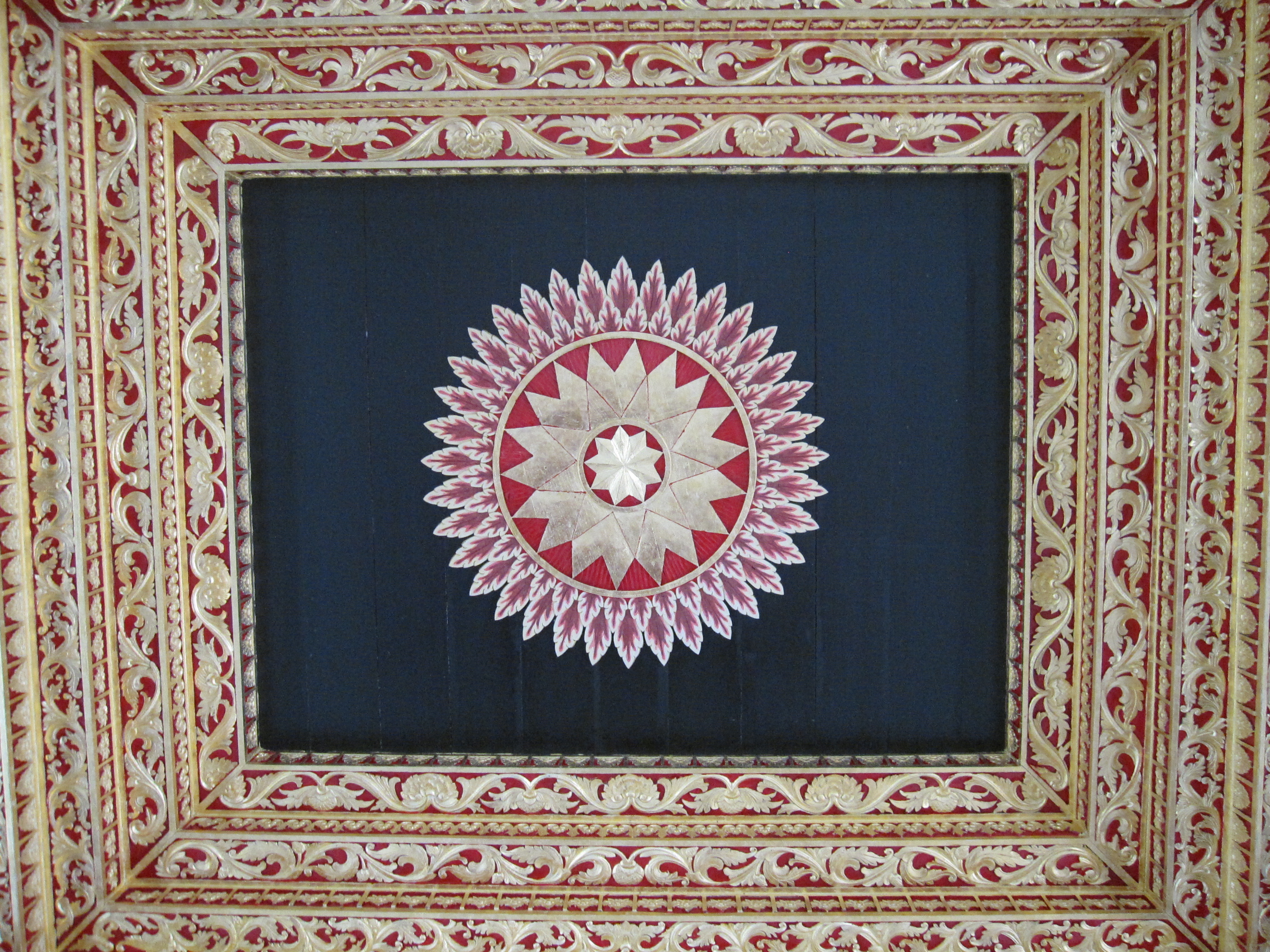
The wooden buildings of the complex have a traditional Javanese architectural style, decorated with flora, fauna, or nature motifs. Foreign influences (Portuguese, Dutch, and Chinese) are also seen. The buildings are of joglo construction.
The trapezoidal joglo roof is usually covered with red or gray shingles, tiles, or zinc. It is supported by a central pillar (soko guru) and secondary pillars. Pillars are usually dark green or black, with yellow, light green red or gold highlights. Other wooden building elements match the pillars in color.
The stone pedestal (Ompak), the black color is combined with gold ornamentation. White dominates the walls of the building and the complex. The floor, usually white marble or patterned tiles, is higher than the sandy courtyard. Some buildings have a higher main floor. Other buildings have a square stone (Selo Gilang) for the sultan's throne.
Each building is classified by use. The main-class building (used by the sultan) has more ornamentation than the lower-class buildings, which have little or no ornamentation.
{{anchor|Philosophy}}Symbolism
A kraton is a palace. Keraton is the living quarters of the royal family. Tamarind and Spanish cherry trees line the road from Krapyak Hunting House to the palace, which runs from Tugu Yogyakarta to the palace.
Tugu Yogyakarta (the Gilig golong monument), on the north side of the old city, symbolizes "unification between the king (golong) and the people (gilig)" (Javanese: manunggaling kawulo gusti). It also symbolizes the final unity of the creator (Khalik) and his subjects. The Gate Donopratoro (gate to the Kedaton quarter) represents "a good person is someone who is generous and knows how to control his lust", and the two Dwarapala statues (Balabuta and Cinkarabala) represent good and evil. The palace's artifacts are believed to have the power to repulse evil.
{{anchor|Cultural Performances}}Performances
The palace hosts gamelan (music), Javanese dance, macapat (poetry), and wayang (shadow puppetry) performances.
In popular culture
The Kraton Ngayogyakarta Hadiningrat was the second Pit Stop in The Amazing Race 19.
Gallery
File:Bandstand "Bangsal Mandalasana" in Kraton Yogyakarta (2025) - img 03.jpg|Bangsal Mandalasana or the bandstand File:Bangsal Manis - Kraton Yogyakarta (2025) - img 16.jpg|Bangsal Manis File:Bangsal Manis - Kraton Yogyakarta (2025) - img 18.jpg|A railing in Bangsal Manis with Javanese Kāla File:Kraton of Yogyakarta 02.jpg|Bangsal Pagelaran File:Jogja - Kraton Yogyakarta - Donopratono gate (2025) - img 01.jpg|* Donopratono *Gate with the two Dvarapala File:Gedhong Jene "Yellow Building" in Kraton Yogyakarta (2025) - img 01.jpg|Gedhog Jene or the Yellow Building File:Kraton Yogyakarta 31.JPG|alt=Elephant statue|A Ganesha statue File:Kraton Jogja-Gamelan.jpg|alt=Five men playing percussion instruments|Gamelan performance File:COLLECTIE TROPENMUSEUM R.M. Djajadipoera architect van de kraton van Djogjakarta TMnr 10001904.jpg|R.M. Djajadipoera architect of the Keraton of Yogyakarta
References
References
- [http://elib.unikom.ac.id/files/disk1/529/jbptunikompp-gdl-dwiagustin-26401-6-unikom_d-i.pdf OBYEK PENELITIAN], http://elib.unikom.ac.id/
- [http://www.historytoday.com/tim-hannigan/when-raffles-ran-java When Raffles ran Java], Tim Hanningan, historytoday.com
- [http://www.yogyes.com/en/yogyakarta-tourism-object/arts-and-culture/kraton/ Kraton], yogyes.com
- Tulisan awal
- Kota ini memiliki batas utara Tugu Yogyakarta, timur Sungai Code, selatan Panggung Krapyak, dan barat Sungai Winongo.
- In Javanese, a ''regol'' is a large door or gate.
- ''Semar tinandu'' is a gate with a trapezoidal roof, like a ''joglo''.
- ''Bangsal Witono'' and ''Bangsal Kencono''
- Chamamah Soeratno et al. and the book ''Murdani Hadiatmadja''
- "Ragam {{!}} Karaton Ngayogyakarta Hadiningrat - Kraton Jogja".
- "'The Amazing Race' ousts two teams in special double elimination".
This article was imported from Wikipedia and is available under the Creative Commons Attribution-ShareAlike 4.0 License. Content has been adapted to SurfDoc format. Original contributors can be found on the article history page.
Ask Mako anything about Kraton Ngayogyakarta Hadiningrat — get instant answers, deeper analysis, and related topics.
Research with MakoFree with your Surf account
Create a free account to save articles, ask Mako questions, and organize your research.
Sign up freeThis content may have been generated or modified by AI. CloudSurf Software LLC is not responsible for the accuracy, completeness, or reliability of AI-generated content. Always verify important information from primary sources.
Report