From Surf Wiki (app.surf) — the open knowledge base
Krafla
Volcano in north of Iceland
Volcano in north of Iceland
| Field | Value | ||||||||
|---|---|---|---|---|---|---|---|---|---|
| name | Krafla | ||||||||
| photo | Aerial View of Krafla and Leirhnjúkur 21.05.2008 16-08-27.JPG | ||||||||
| photo_caption | Aerial view of Krafla (mountain) and Krafla caldera with Leirhnjúkur in 2008 | ||||||||
| elevation_m | 800 | ||||||||
| location | Iceland | ||||||||
| map | Iceland | ||||||||
| map_caption | Location in Iceland | ||||||||
| label_position | bottom | ||||||||
| coordinates | |||||||||
| type | Caldera | ||||||||
| last_eruption | September 1984 | ||||||||
| map_image | {{maplink | frame=yes | frame-align=center | frame-width=270 | frame-height=330 | frame-long=-16.9 | frame-lat=65.9 | zoom=7 | raw=[,,,,,,] |
| text | Geological features near the Krafla volcanic system (red outlines). |
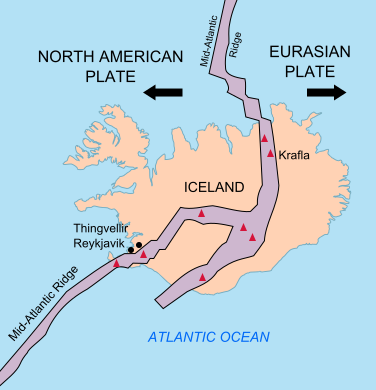
Krafla () is a volcanic caldera of about 10 km in diameter with a 90 km long fissure zone. It is located in the north of Iceland in the Mývatn region and is situated on the Iceland hotspot atop the Mid-Atlantic Ridge, which forms the divergent boundary between the North American Plate and the Eurasian Plate. Its highest peak reaches up to 818 m and it is 2 km in depth. There have been 29 reported eruptions in recorded history.
Overview
Iceland sits astride the Mid-Atlantic Ridge; the western part of the island nation is part of the roughly westward-moving North American plate, while the eastern part of the island is part of the roughly eastward-moving Eurasian Plate. The north–south axis of the Mid-Atlantic Ridge splits Iceland in two, roughly north to south. Along this ridge many of Iceland's most active volcanoes are located; Krafla is one of these.
Krafla includes the crater Víti , which contains a green lake. South of the Krafla area is Námafjall , a mountain, at the foot of which is Hverir , a geothermal area with boiling mudpools and steaming fumaroles.
History

The Mývatn fires occurred between 1724 and 1729, when many of the fissure vents opened up. The lava fountains could be seen in the south of the island, and a lava flow destroyed three farms near the village of Reykjahlíð, although nobody was harmed.
Between 1975 and 1984, a series of volcanic events known as the Krafla fires took place within the Krafla caldera. There were nine volcanic eruptions and fifteen uplift and subsidence events. During these events a large magma chamber was identified at depth by analysing the seismic activity. Some of the lava fountaining during these eruptions was caught on film by Maurice and Katia Krafft, and features in the 2022 film, Fire of Love.
Since 1977 the Krafla area has been the source of the geothermal energy used by a 60 MWe power station. A survey undertaken in 2006 indicated very high temperatures at depths of between 3 and, and these favourable conditions led to the development of the first well from the Iceland Deep Drilling Project, IDDP-1, that found molten rhyolite magma 2.1 km deep beneath the surface in 2009. The Krafla fires interrupted some of the geothermal drilling work in the area.
Krafla magma testbed
Following on from the encounter with molten rock during the drilling of IDDP-1, the Krafla Magma Testbed (KMT) concept has been developed, which envisages the creation of an 'international magma observatory' and further scientific drilling at Krafla in order to deliberately drill into the magma body.
References
References
- "Krafla - Global Volcanism Program".
- Kious, W. Jacquelyne. (February 1996). "This Dynamic Earth: The Story of Plate Tectonics. Chapter 3: Understanding plate motions - Divergent boundaries". USGS.
- "The Krafla fires: One of the largest volcanic eruptions of Iceland's modern history".
- (January 9, 2023). "She fell in love with the majesty of volcanoes—and changed how science sees them".
- http://www.iddp.is/ Iceland Deep Drilling Project
- (May 19, 2021). "Surprise magma pocket found in Iceland hints at more 'ticking time bombs'".
- "Krafla Magma Testbed – Oficial Website – Krafla Magma Testbed".
- Eichelberger, J.. (June 25, 2019). "Planning an International Magma Observatory".
- "Magma-Sourced Geothermal Energy and Plans for Krafla Magma Testbed, Iceland".
This article was imported from Wikipedia and is available under the Creative Commons Attribution-ShareAlike 4.0 License. Content has been adapted to SurfDoc format. Original contributors can be found on the article history page.
Ask Mako anything about Krafla — get instant answers, deeper analysis, and related topics.
Research with MakoFree with your Surf account
Create a free account to save articles, ask Mako questions, and organize your research.
Sign up freeThis content may have been generated or modified by AI. CloudSurf Software LLC is not responsible for the accuracy, completeness, or reliability of AI-generated content. Always verify important information from primary sources.
Report