From Surf Wiki (app.surf) — the open knowledge base
Konotop
City in Sumy Oblast, Ukraine
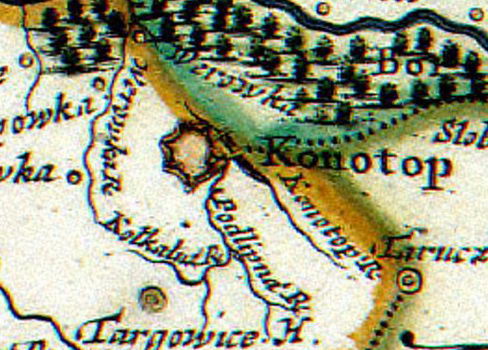
City in Sumy Oblast, Ukraine
| Field | Value |
|---|---|
| settlement_type | City |
| image_skyline | Konotop Montage 2017.png |
| imagesize | 270px |
| image_caption | Counterclockwise (from upper right): Shukhov Tower, Myr Cinema, Ascension Cathedral, Konotop City Council Building, Konotop railway station and tram, Monument of Horse |
| subdivision_type | Country |
| official_name | Konotop |
| native_name | Конотоп |
| subdivision_name | Ukraine |
| image_shield | Coat of arms of Konotop.svg |
| image_flag | Flag of Konotop.svg |
| subdivision_type1 | Oblast |
| subdivision_type2 | Raion |
| subdivision_name1 | Sumy Oblast |
| subdivision_name2 | Konotop Raion |
| population_total | 83543 |
| population_as_of | 2022 |
| area_total_km2 | 43.78 |
| established_date | 1634 |
| established_title | Founded |
| elevation_m | 142 |
| timezone | EET |
| utc_offset | +2 |
| timezone_DST | EEST |
| utc_offset_DST | +3 |
| coordinates | |
| leader_title | Mayor |
| leader_name | Artem Semenikhin (Svoboda) |
| website | Official website |
| pushpin_map | Ukraine Sumy Oblast#Ukraine |
| postal_code_type | Postal codes |
| postal_code | 41600–41615 |
| area_code | +380 5447 |
| subdivision_type3 | Hromada |
| subdivision_name3 | Konotop urban hromada |
| mapframe | yes |
| mapframe-zoom | 10 |
| mapframe-wikidata | yes |
| mapframe-zoom = 10 | mapframe-wikidata = yes
Konotop ( ; ) is a city in Sumy Oblast, northeastern Ukraine. Konotop serves as the administrative center of Konotop Raion within the oblast. Konotop is located about 129 km from Sumy, the administrative center of the oblast. It is host to Konotop Air Base. The population is
Name
The word konotop denotes a place where horses drowned, that is, any swampy, impassable place. The word itself comes from "horses stomp", which was transformed into a noun with the help of the word-forming method of baseline. Konotop is a common Slavic toponym; settlements with this name exist not only in Ukraine, but also in Poland, Belarus and Russia. In several dialects of Ukrainian, the konotop () also refers to the herbaceous plant, common knotweed.
Some historians believe that Konotop as a settlement existed even before the Mongol-Tatar invasion. According to legend, during the passage of the Tatar cavalry in the area, many horses and riders died in impassable swamps, leading to the area being called konotop — a swampy place where horses drowned.
Geography
The city is located in northeastern Ukraine within the Dnieper Lowland on the border of Polesia and the forest-steppe and on both banks of the , which flows into the Seim River 12 km north of the city. The Lypka River also flows through the city and the flows nearby. There are several large dams on the rivers. The area of the city is 43.78 km².
Konotop belongs to the North Poltava highland region of the Left Bank-Dnieper forest-steppe province within Ukraine's forest-steppe zone. Geostructurally, Konotop is located on the northeastern slope of the Dnieper-Donetsk depression. The surface is a lowland loess plain which is flat, gently undulating, and dissected by passage valleys, ravines, and gullies. It is composed mainly of the Dnieper moraine, water-glacial sandy-loamy formations. Forest-steppe pine landscapes and upland landscapes prevail in combination with meadow-steppe lowlands. Paleogene rocks are represented by sands, sandstones and marls. The cadastral score of the local soil is, on average, 64 points.
Konotop administratively borders in the northwest, with the village of Raky in the northeast, with the villages of Pidlypne and Pryvokzalne in the south, with the village of Popivka in the west.
Climate
Konotop has a warm-summer humid continental climate (Köppen Dfb). Sitting in the mid latitudes, it is continental with moderate precipitation. More continental climates at the same latitude – such as Regina, Saskatchewan in Canada – have much colder winters than Konotop, suggesting that there is still significant moderation from the Atlantic Ocean. | Jan record high C = 10.4 | Feb record high C = 14.0 | Mar record high C = 22.5 | Apr record high C = 29.9 | May record high C = 33.1 | Jun record high C = 35.8 | Jul record high C = 35.9 | Aug record high C = 39.0 | Sep record high C = 35.0 | Oct record high C = 27.2 | Nov record high C = 18.0 | Dec record high C = 12.6 | year record high C = 39.0 | Jan record low C = -32.9 | Feb record low C = -32.2 | Mar record low C = -26.1 | Apr record low C = -12.2 | May record low C = -3.7 | Jun record low C = 2.8 | Jul record low C = 6.1 | Aug record low C = 3.8 | Sep record low C = -4.1 | Oct record low C = -9.2 | Nov record low C = -22.8 | Dec record low C = -28.9 | year record low C = -32.9 | Jan snow depth cm = 10 | Feb snow depth cm = 13 | Mar snow depth cm = 8 | Apr snow depth cm = 0 | May snow depth cm = 0 | Jun snow depth cm = 0 | Jul snow depth cm = 0 | Aug snow depth cm = 0 | Sep snow depth cm = 0 | Oct snow depth cm = 0 | Nov snow depth cm = 2 | Dec snow depth cm = 6 | year snow depth cm = 13 | archive-url = https://web.archive.org/web/20191214004202/http://www.pogodaiklimat.ru/climate/33261.htm | archive-date = 14 December 2019 | access-date = 8 November 2021}} | archive-url = https://web.archive.org/web/20210717143555/https://www.ncei.noaa.gov/pub/data/normals/WMO/1981-2010/RA-VI/Ukraine/12.6.%20WMO_Normals_Excel_Template%20%282%29.xls | archive-date = 17 July 2021 | access-date = 17 July 2021}}
History
In the beginning of the 17th century, Cossacks were first based in the area. The settlement was first mentioned in 1634 in various documents as Novoselytsia. In 1642 a Polish fortress was built in the area, named after the river Konotopka. It is likely that the river disappeared before another one, Yezuch, was formed. The fortification became a key point in the struggle against Muscovy.
Another hypothesis is that the name of the city originated from the name of the ancient Warmian knyaz Christopher of Kononowitz of the noble Polish-Lithuanian family Kononowicz-Piłsudski which exists to this day and uses the Polish coat of arms of Radwan. The name "Konotop" would then mean “the place of Kono(nowitz)” from adjoining the suffix topos (cf. Ancient Greek τόπος) meaning place or location.
In 1659 the Battle of Konotop took place near the city, in which Cossacks led by Ivan Vyhovsky (allied with Poles and Crimean Tatars) defeated Muscovite forces. In 1782 Konotop was granted municipal rights. Three annual fairs were held in Konotop in the late 19th century.
During World War II, Konotop was occupied by the German Army from 3 September 1941 to 6 September 1943. Details of this are recounted in the book The Forgotten Soldier by Guy Sajer. The Germans operated a Nazi prison in the city. The Stalag 310 prisoner-of-war camp was based in the city from July 1942 until May 1943, when it was moved to Zaporizhzhia.
2022 Russian invasion of Ukraine

Main article: Northern front of the Russian invasion of Ukraine
On 25 February 2022, during the 2022 Russian invasion of Ukraine, the city was reported to be under siege by Russian forces on their way to Kyiv. Some Ukrainian officials later reportedly claimed that the city had fallen, but according to sources published later, the Russian military failed in its attempt to take Konotop on 25 February. Mayor Artem Seminikhin stated on 2 March that Russian troops who had entered the city had warned him that they would destroy the city by shelling if the residents resisted them. Russian vehicles deployed outside the city council were surrounded by locals. Seminikhin asked the residents of the city whether they wanted to fight or surrender; the residents "overwhelmingly" refused to surrender. Later in the day, an agreement was reached under which Russian forces accepted not to change the city's government or deploy troops, in return for which the residents would not attack them. On 3 April, Ukrainian MP Oleksandr Kachura stated on Twitter that all Russian forces had left Konotop Raion. On 4 April 2022 Sumy Oblast's Governor Dmytro Zhyvytskyi stated that Russian troops no longer occupied any towns or villages in Sumy Oblast and had mostly withdrawn, while Ukrainian troops were working to push out the remaining units.
Demographics
Ethnicity
As of the 2001 Ukrainian census, Konotop had a population of 93,365 inhabitants. The ethnic and linguistic population was reported as follows:
Economy
The main industrial enterprises of the city include the Konotop Casting and Mechanical Plant, the Motordetal Plant, the Konotop Fittings Plant, the Konotop Car Repair Plant, the Aviakon Aircraft Repair Plant, a mechanical plant, a garment factory, a meat processing plant (Konotopmyaso OJSC), a dairy plant, and a bakery plant. Konotop is an important mechanical engineering and food production center.
Transport
The city is an important transportation center. Various railroad connections from Konotop include: Moscow–Kyiv, Simferopol–Minsk, Bakhmach–Kyiv, Bryansk–Sumy/Belgorod. Furthermore, Konotop is one of the smallest cities in the country with its own tram system.
Notable people
- Bernard Meninsky, artist
- Yuriy Musatov, ceramic artist
Gallery
Konotop Mykolayivs'ka Tserkva 02 Petrovs'kogo 61 (YDS 4541).JPG|St. Nikolas wooden church Вознесенська церква Конотоп.JPG|Ascension Church Konotop Sadyba Generala Dragomyrova Golovniy Budynok 01 Dragomyrova 18 (YDS 4528).JPG|Mansion of General Mikhail Dragomirov Скульптура Коня на вул Бр. Радченків у Конотопі.jpg|Horse statue in the downtown Konotop Myru 10 01 (YDS 4450).JPG|Old town Konotop Likarnya Zaliznychnykiv Golovniy Korpus 04 Sadova 98 (YDS 4437).JPG|Konotop Railway Hospital Buildings in Konotop (5).JPG|School in Konotop Konotop Shkola 11 Svobody 8 (YDS 4411).JPG|Old school in Konotop Trams in Konotop (11).JPG|Konotop tram Вокзал Конотоп 003.jpeg|Railway station
References
References
- Янко Микола Тимофійович. Топонімічний словник України: словник-довідник / М. Т. Янко; Міжнар. фонд «Відродження». — Київ: Знання, 1998. — С. 186
- Мурзаєв Е. М. К // Словарь народных географических терминов : [рос.]. — М. : Мысль, 1984. — 656 с. — 50 000 екз.
- Коното́п // Кругляк Ю. М. Ім'я вашого міста : Походження назв міст і селищ міського типу Української РСР. — К. : Наукова думка, 1978. — 152 с.
- Фізико-географічне районування України. Архів оригіналу за 29 березня 2019. Процитовано 22 жовтня 2019.
- Географіка. Фізико-географічні області лісостепової зони. Ч.3. http://geografica.net.ua/. Архів оригіналу за 10 квітня 2019. Процитовано 18 жовтня 2019.
- "Въ лЂто 6478 [970] - 6494 [986]. Лаврентіївський літопис".
- "Nazwiska".
- . (1883). "Słownik geograficzny Królestwa Polskiego i innych krajów słowiańskich".
- "Gefängnis Konotop".
- (2022). "The United States Holocaust Memorial Museum Encyclopedia of Camps and Ghettos 1933–1945. Volume IV". Indiana University Press, United States Holocaust Memorial Museum.
- (24 February 2022). "Russian Military Moves Towards Ukraine Capital".
- Ward, Alexander. "'Almost not possible' for Ukraine to win without West's help, Ukraine official says". Politico.
- (2 March 2022). "As Russian invaders demand that Konotop surrender, mayor explicitly defies threats".
- Valeria Polischuk. "Мер Конотопа: місту поставили ультиматум – за опір накриють артилерією". RBC Ukraine.
- (2 March 2022). "Mayor in Ukraine asks his city's residents whether they wish to fight or surrender.". The New York Times.
- Natalia Gurkovskaya. "Бої на Сумщині – влада Конотопа провела переговори з окупантами після ультиматуму". RBC Ukraine.
- (3 April 2022). "⚡️Конотопский район освобожден от российских оккупантов. Об этом сообщил нардеп Александр Качура.Еще вчера глава…".
- [https://nationalpost.com/pmn/news-pmn/russian-troops-no-longer-hold-any-settlements-in-ukraines-sumy-region-says-governor Russian troops no longer hold any settlements in Ukraine's Sumy region, says governor], [[National Post]] (4 April 2022)
- "Національний склад міст".
- "Рідні мови в об'єднаних територіальних громадах України".
This article was imported from Wikipedia and is available under the Creative Commons Attribution-ShareAlike 4.0 License. Content has been adapted to SurfDoc format. Original contributors can be found on the article history page.
Ask Mako anything about Konotop — get instant answers, deeper analysis, and related topics.
Research with MakoFree with your Surf account
Create a free account to save articles, ask Mako questions, and organize your research.
Sign up freeThis content may have been generated or modified by AI. CloudSurf Software LLC is not responsible for the accuracy, completeness, or reliability of AI-generated content. Always verify important information from primary sources.
Report