From Surf Wiki (app.surf) — the open knowledge base
Komitadji
1870s–1900s anti-Ottoman rebels in the Balkans
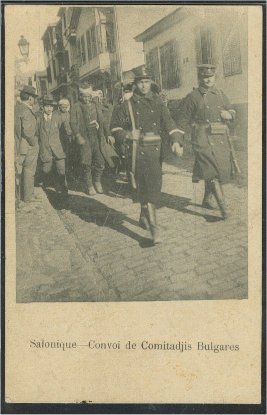
1870s–1900s anti-Ottoman rebels in the Balkans

Komitadji, Comitadji, or Komita (plural: Komitadjis, Comitadjis, or Komitas) (Bulgarian, Macedonian and , Komiti, , , pl. Komitatzḗdes, , ) was a collective name for members of various rebel bands (chetas) operating in the Balkans during the final period of the Ottoman Empire. The name itself originates from Turkish and translates as "committee members". Komitadjis fought against the Turkish authorities and were supported by the governments of the neighbouring states, especially Bulgaria.
Komitadji was used to describe the members of the Bulgarian Revolutionary Central Committee during the April Uprising of 1876, and Bulgarian bands during the following Russo-Turkish War. The term is often employed to refer later to groups of rebels associated with the Bulgarian Macedonian-Adrianople Revolutionary Committees and the Supreme Macedonian-Adrianople Committee called by the Turks simply the Bulgarian Committees.
In interwar Greece and Yugoslavia, the term was used to refer to bands organized by the pro-Bulgarian Internal Macedonian Revolutionary Organisation and Internal Thracian Revolutionary Organisation, which operated in Vardar and Aegean Macedonia and Western Thrace. In interwar Romania, the term was used to refer to bands organized by the pro-Bulgarian Internal Dobrujan Revolutionary Organisation, which attacked the Romanian outposts and the Aromanian colonists in Southern Dobruja. During the Second World War this name was used to designate the members of the pro-Bulgarian Ohrana active in Northern Greece.
Other uses
- The name of FK Vardar and RK Vardar's main ultras group is Komiti.
- Komitadji was the name given to a space-travelling warship of the Earth-based Pax Empire in the science-fiction novel Angelmass (TOR Books, 2001) by Timothy Zahn.
References
References
- ''The Making of a New Europe: R.W. Seton-Watson and the Last Years of Austria-Hungary'', Hugh Seton-Watson, Christopher Seton-Watson, Methuen, 1981, {{ISBN. 0416747302, p. 71.
The word komitadji is Turkish, meaning literally "committee man". It came to be used for the guerilla bands, which, subsidized by the governments of the Christian Balkan states, especially of Bulgaria.
- Salâhi Sonyel, Minorities and the Destruction of the Ottoman Empire; Turkish Historical Society Printing House, 1993; {{ISBN
- Христо Марков Йонков, Числен, социален и класов състав на революционерите в Априлското възстание 1876: Историко-социологическо изследване на ІV революционен окръг. Изд. на Българската академия на науките, 1993, стр. 34.
- 1462838111, p. 20.
- Paul Mojzes, Balkan Genocides: Holocaust and Ethnic Cleansing in the Twentieth Century, Rowman & Littlefield, 2011, {{ISBN. 1442206632, p. 11.
- 0810862956, p. Ivii.
- ''The Comitadji Question in Southern Serbia'', Rodolphe Archibald Reiss, Hazell, 1924.
- 185065381X, p. 69.
- [http://www.footballderbies.com/fans/index.php?id=110 FootballDerbies.com - Komiti]
This article was imported from Wikipedia and is available under the Creative Commons Attribution-ShareAlike 4.0 License. Content has been adapted to SurfDoc format. Original contributors can be found on the article history page.
Ask Mako anything about Komitadji — get instant answers, deeper analysis, and related topics.
Research with MakoFree with your Surf account
Create a free account to save articles, ask Mako questions, and organize your research.
Sign up freeThis content may have been generated or modified by AI. CloudSurf Software LLC is not responsible for the accuracy, completeness, or reliability of AI-generated content. Always verify important information from primary sources.
Report