From Surf Wiki (app.surf) — the open knowledge base
Kolkata Metro
Rapid transit system in Kolkata, West Bengal, India

Rapid transit system in Kolkata, West Bengal, India
| Field | Value | ||||
|---|---|---|---|---|---|
| name | Kolkata Metro | ||||
| image | Kolkata_Metro_System_Logo.svg | ||||
| imagesize | 150px | ||||
| image2 | The metro of Orange line of Kolkata (3).jpg | ||||
| caption2 | The Orange line of Kolkata Metro | ||||
| imagesize2 | 300px | ||||
| locale | Kolkata, West Bengal, India | ||||
| transit_type | Rapid transit | ||||
| lines | 6 | ||||
| stations | Operational: 58 | ||||
| Under construction: 22 | |||||
| Proposed/ approved: 26 | |||||
| line_number | |||||
| website | {{plainlist | ||||
| ridership | (2024–25) | ||||
| annual_ridership | (218.1 million, 2024–25) | ||||
| began_operation | |||||
| operator | Metro Railway, Kolkata; | ||||
| Kolkata Metro Rail Corporation | |||||
| train_length | 6 to 8 coaches | ||||
| headway | 6 to 24 minutes | ||||
| system_length | 73.42 km (operational) | ||||
| {{convert | 138.82 | km | mi | abbr | on}} (Total proposed) |
| track_gauge | {{plainlist | ||||
| * {{track gauge | 1,676 mm | lk | on}}(Broad Gauge) | ||
| (Blue, Purple, Orange & Yellow Lines) | |||||
| * {{track gauge | 1,435mm | lk | on}}(Standard Gauge) | ||
| (Green Line) | |||||
| el | |||||
| average_speed | 30 km/h | ||||
| top_speed | 80 km/h | ||||
| map_name | Route Map | ||||
| map | [[File:Kolkata Metro Network.png | 300px]] | |||
| map_state | show | ||||
| owner | Indian Railways | ||||
| area served | Kolkata metropolitan region | ||||
| character | Elevated, At-grade, Underground | ||||
| host | Indian Railways |
Under construction: 22 Proposed/ approved: 26
Kolkata Metro Rail Corporation
138.82 km (Total proposed)
- (Broad Gauge) (Blue, Purple, Orange & Yellow Lines)
- (Standard Gauge) (Green Line) The Kolkata Metro is a rapid transit system serving the city of Kolkata and the Kolkata Metropolitan Region in West Bengal, India. Opened in 1984, it is the first rapid transit system in South Asia. It has 5 color-coded lines with 58 operational stations with a total length of 73.42 km, making it India's fourth largest and fourth busiest metro rail system. The system has a mix of underground, at-grade, and elevated stations using both broad-gauge and standard-gauge tracks. It operates on a 750 V DC Third rail system. Trains operate between 06:30 and 22:44 IST.
The Kolkata Metro was initially planned in the 1920s, but construction started in the 1970s. The first underground stretch, from Bhawanipore (now Netaji Bhawan) to Esplanade, opened in 1984. A truncated section of Green Line, or the East–West Corridor, from Salt Lake Sector V to Howrah Maidan, was opened in 2020. Purple Line, or the Joka–Eden Gardens Corridor (currently truncated in Majerhat), opened in 2022, Orange Line, from Kavi Subhash to Beleghata, opened in 2024. The Yellow Line, from Noapara to Jai Hind, opened in 2025.
As of 2025, Kolkata metro has the deepest metro station and largest underground metro station in India. Howrah metro station of Green Line is the deepest metro station in India with depth of 34 m. Also at the time of inauguration, it was the largest metro station of India. In August 2025, Jai Hind metro station of Yellow Line became the largest metro station in India, as well as one of largest in Asia.
Metro Railway, Kolkata and Kolkata Metro Rail Corporation are the owners and operator of the system. On 29 December 2010, Metro Railway, Kolkata, became the 17th zone of the Indian Railways, completely owned and funded by the Ministry of Railways. It is the only metro system in the country to be controlled entirely by Indian Railways. Around 300 daily train trips carry more than passengers.
History
Early attempts
In the September 1919 session of the Imperial Legislative Council at Shimla, a committee was set up by W. E. Crum that recommended a metro line for Kolkata (formerly Calcutta). This line was supposed to connect Bagmari in the east to Benaras Road, Salkia, in Howrah in the west via a tunnel beneath Hooghly River. The estimated construction costs were £3,526,154, about based on current exchange rates, and the proposed deadline was 1925–1926. The proposed line was 10.4 km long, about 4 km shorter than the current Green Line, which would connect East Bengal Railway in Bagmari and East Indian Railway in Benaras Road. The tickets were priced at 3 annas ( 0.1875) for the full trip. Crum also mentioned a north–south corridor back then. An east–west metro railway connection, named the "East–West Tube Railway", was proposed for Kolkata in 1921 by Harley Dalrymple-Hay. All the reports can be found in his 1921 book Calcutta Tube Railways. However, in 1923, the proposal was not undertaken due to a lack of funds.
Planning
Then the Chief Minister of West Bengal, Bidhan Chandra Roy, reconceived the idea of an underground railway for Kolkata from 1949 to 1950. A team of French experts conducted a survey, but nothing concrete materialized. Efforts to solve the traffic problem by augmenting the existing fleet of public transport vehicles hardly helped, since roads accounted for only 4.2 percent of the surface area in Kolkata, compared with 25 percent in Delhi and 30 percent in other cities. To find alternative solutions, the Metropolitan Transport Project (MTP) was set up in 1969. The MTP, with the help of Soviet specialists, Lenmetroproekt and East German engineers, prepared a master plan to provide five rapid-transit (metro) lines for the city of Kolkata, totaling a length of 97.5 km, in 1971. Three were selected for construction. These were:
- Dum Dum – Tollygunge (Blue Line. Presently operates from Dakshineswar to New Garia)
- Bidhannagar – Ramrajatala (Green Line. Presently truncated till Howrah Maidan)
- Dakshineswar – Thakurpukur (Divided into Blue Line: Noapara to Dakshineswar and Purple Line: Joka to Eden Gardens)
The highest priority was given to the busy north–south corridor between Dum Dum and Tollygunge over a length of 16.45 km; work on this project was approved on 1 June 1972. A tentative deadline was fixed to complete all the corridors by 1991.
Construction
North-South Metro

Since it was India's first metro and was constructed as a completely indigenous process, a traditional cut-and-cover method and driven shield tunneling was chosen and the Kolkata Metro was more of a trial-and-error affair, in contrast to the Delhi Metro, which saw the involvement of multiple international consultants. As a result, it took nearly 23 years to completely construct the 17 km underground railway.
The foundation stone of the project was laid by Indira Gandhi, the Prime Minister of India, on 29 December 1972, and construction work started in 1973–74. Initially, cut and cover along with slurry wall construction to handle soft ground, was recommended by the Soviet Union consultants. Later, in 1977, it was decided to adopt both shield tunneling and cut and cover methods for the construction of underpopulated areas, sewer lines, water mains, electrical cables, telephone cables, tram lines, canals, etc. The technology was provided by M/s NIKEX Hungarian Co., Budapest. In the early days, the project was led by the Union Railway Minister from West Bengal, A. B. A. Ghani Khan Choudhury, often against the prevailing socio-political stance of his contemporaries in the West Bengal government. From the start of construction, the project had to contend with several problems including insufficient funds (until 1977–1978), a shifting of underground utilities, court injunctions, and an irregular supply of vital materials. In 1977, an injunction for the allocation of new funding was passed by the newly elected Jyoti Basu government.
Despite all the hurdles, services began on 24 October 1984, with the commissioning of a partial commercial service covering a distance of 3.40 km with five stations served between Esplanade and Bhowanipur (currently Netaji Bhavan). The first metro was driven by Tapan Kumar Nath and Sanjoy Kumar Sil. The service was quickly followed by commuter services on another 2.15 km stretch in the north between Dum Dum and Belgachhia on 12 November 1984. The commuter service was extended to Tollygunge on 29 April 1986, covering a further distance of 4.24 km, making the service available over a distance of 9.79 km and covering 11 stations. However, the services on the north section were suspended starting 26 October 1992, as this small, isolated section was little used. The Blue Line was almost entirely built by cut and cover method, while a small 1.09 km stretch between Belgachia and Shyambazar was built using shield tunneling with compressed air and air locks, since the alignment crossed a railway yard (now Kolkata railway station) and Circular Canal.
After more than eight years, the 1.62 km Belgachhia–Shyambazaar section, along with the Dum Dum–Belgachhia stretch, was opened on 13 August 1994. Another 0.71 km stretch from Esplanade to Chandni Chowk was commissioned shortly afterward, on 2 October 1994. The Shyambazaar-Shobhabazar–Girish Park (1.93 km) and Chandni Chowk–Central (0.60 km) sections were opened on 19 February 1995. Services on the entire stretch of the Metro were introduced from 27 September 1995 by bridging the 1.80 km gap with Mahatma Gandhi Road metro station in the middle.
In 1999–2000, the extension of Blue Line along an elevated corridor from Tollygunge to New Garia, with six stations, was sanctioned at a cost of . The section was constructed and opened in two phases, Mahanayak Uttam Kumar to Kavi Nazrul in 2009 and Kavi Nazrul to Kavi Subhash in 2010. In the north, the line was extended till Noapara from Dum Dum on 10 July 2013. The latest extension opened was the 4.1 km stretch from Noapara to Dakshineswar on 23 February 2021.
East-West Metro
.jpg)
The master plan of the metro corridor was made in 1971 along with the North–South Corridor, connecting the office district of Bidhannagar with the twin city and transportation hub Howrah via another transport hub of the city, Sealdah, and the central business district Esplanade by an underwater metro line. It is a project, sanctioned in 2008 by Prime Minister Manmohan Singh. The foundation stone was laid on 22 February 2009 and construction started in March 2009. The autonomous Kolkata Metro Rail Corporation (KMRC) was formed to implement the project. The Government of India (Ministry of Urban Development) and Government of West Bengal each had a half-share in it. Later, the Government of West Bengal pulled out from it, and the shares were transferred to the Ministry of Railways.
The realignment led to many other issues and delays. Some of the biggest issues were the H-piles under the Esplanade metro station and the Bowbazar mishap. Per the 1971 master plan, the East-West Corridor was supposed to pass under Central metro station, so the square foundational beams in Esplanade were not removed. Since the tunnel boring machines cannot cut through steel, another small tunnel was dug using New Austrian tunneling method (NATM) and the H-piles were cut manually. This extended the tunneling process by one and a half months. In September 2019, during the construction of the eastbound tunnel (from Esplanade to Sealdah), a machine hit an aquifer under Bowbazar, causing a major collapse in the area, delaying work in that section for several months. Around 80 houses were damaged and many buildings were declared unsafe, affecting more than 600 people. Later subsidence in the area was checked using grouting.
Expansion planning
By 2011–2012, the Railway Ministry had announced plans for the construction of five new metro lines and an extension of the existing north–south corridor. These were:
- Salt Lake – Howrah Maidan (Green Line or East–West Metro Corridor)
- Joka – B.B.D. Bagh (Purple Line. To be extended till Eden Gardens)
- Noapara – Barasat (Yellow Line, via airport)
- Baranagar – Barrackpore (Pink Line)
- New Garia – Dum Dum Airport (Orange Line)
Major modification and interchanges
A new four-platform interchange station was constructed at Noapara and Kavi Subhash. This acts as an interchange station for Blue Line with Yellow Line and Orange Line respectively. After opening of Yellow Line , all four platforms are now operational, whereas, from 6 March 2024, all four platforms of Kavi Subhash were in operation, until 28 July 2025, when the Blue Line platforms were temporarily closed for reconstruction.
.jpg)
The existing Esplanade metro station was upgraded and a subway was constructed to the new metro station to provide an interchange among Blue Line, Green Line and future Purple Line. Additional interchanges were built at Salt Lake Sector-V (green line)-IT Centre (orange line) and Jai Hind (Yellow line-Orange line) metro stations. In 2009–2010, Blue Line underwent upgrades of services and amenities and many stations were renamed after famous personalities by then Minister of Railways Mamata Banerjee. Interchanges
Network
Summary
| Operational | Line | First run | Last extension | Number of stations | Length (km) | Terminals | Rolling stock | Track gauge (mm) | Headway (min) | Total | style="text-align:center;" | style="text-align:center;" | 58 | 73.42 | ||||
|---|---|---|---|---|---|---|---|---|---|---|---|---|---|---|---|---|---|---|
| Kolkata Metro | Blue}}; text-align: center;" | Blue Line | 24 Oct 1984 | 22 Feb 2021 | 26 | 32.13 | Dakshineswar | Kavi Subhash | ICF, CRRC Dalian | [](5-ft-6-in-gauge-railway) | 6 – 15 | |||||||
| Kolkata Metro | Green}}; text-align: center;" | Green Line | 13 Feb 2020 | 22 August 2025 | 12 | 16.6 | Salt Lake Sector-V | Howrah Maidan | BEML | 8 – 15 | ||||||||
| Kolkata Metro | Purple}}; text-align: center;" | Purple Line | 30 Dec 2022 | 6 March 2024 | 7 | 7.75 | Majerhat | Joka | ICF | [](5-ft-6-in-gauge-railway) | 21 | |||||||
| Kolkata Metro | Yellow}}; text-align: center;" | Yellow Line | 22 August 2025 | – | 4 | 7.04 | Noapara | Jai Hind | ICF, CRRC Dalian | 12 – 20 | ||||||||
| Kolkata Metro | Orange}}; text-align: center;" | Orange Line | 6 March 2024 | 22 August 2025 | 9 | 9.9 | Kavi Subhash | Beleghata | ICF | 25 |
| Under construction | Line | Segment | Number of stations | Length | ||||||||
|---|---|---|---|---|---|---|---|---|---|---|---|---|
| (km) | Tentative completion | Total | style="text-align:center;" | 22 | style="text-align:center;" | 28.53 | ||||||
| Kolkata Metro | Purple}}; text-align: center;" | Purple Line | Majerhat to Esplanade | 5 | 6.5 | 2028 | ||||||
| Kolkata Metro | Yellow}}; text-align: center;" | Yellow Line | Jai Hind to Michael Nagar | 2 | 2.06 | 2027 | ||||||
| Kolkata Metro | Orange}}; text-align: center;" | Orange Line | Beleghata to Jai Hind | 15 | 19.97 | 2026 |
| Approved | Line | Segment | Number of stations | Length | ||||||||
|---|---|---|---|---|---|---|---|---|---|---|---|---|
| (km) | Tentative completion | Total | style="text-align:center;" | 22 | style="text-align:center;" | 31.74 | ||||||
| Kolkata Metro | Green}}; text-align: center;" | Green Line (Extension) | Salt Lake Sector-V to Teghoria | 5 | 6.65 | |||||||
| Kolkata Metro | Purple}}; text-align: center;" | Purple Line | Eden Gardens to Esplanade | 1 | 1.6 | |||||||
| IIM-Joka to Joka | 1 | 1.7 | ||||||||||
| Kolkata Metro | Purple}}; text-align: center;" | Purple Line (Branch) | IIM-Joka to Diamond Park | 1 | 1.69 | |||||||
| Kolkata Metro | Yellow}}; text-align: center;" | Yellow Line | Michael Nagar to Barasat | 4 | 7.6 | |||||||
| Kolkata Metro | Pink}}; text-align: center;" | Pink Line | Baranagar to Barrackpore | 10 | 12.50 |
| Proposed | Line | Segment | Number of stations | Length | ||||||||
|---|---|---|---|---|---|---|---|---|---|---|---|---|
| (km) | Tentative completion | Total | style="text-align:center;" | 12 | style="text-align:center;" | 20.4 | ||||||
| Kolkata Metro | Purple}}; text-align: center;" | Purple Line (Branch) | Mahanayak Uttam Kumar to Diamond Park | 4 | 8.5 | |||||||
| Kolkata Metro | Yellow}}; text-align: center;" | Yellow Line (Revision) | Michael Nagar to Suripukur | 8 | 11.9 |
| Total network (combined) | Line | Number of station | Length (km) | Total | style="text-align:center;" | 106 | style="text-align:center;" | 138.82 | ||
|---|---|---|---|---|---|---|---|---|---|---|
| Kolkata Metro | Blue}}; text-align: center;" | Blue Line | 26 | 32.13 | ||||||
| Kolkata Metro | Green}}; text-align: center;" | Green Line | 17 | 23.25 | ||||||
| Kolkata Metro | Purple}}; text-align: center;" | Purple Line | 15 | 20.07 | ||||||
| Kolkata Metro | Yellow}}; text-align: center;" | Yellow Line | 14 | 21 | ||||||
| Kolkata Metro | Pink}}; text-align: center;" | Pink Line | 10 | 12.50 | ||||||
| Kolkata Metro | Orange}}; text-align: center;" | Orange Line | 24 | 29.87 |
Lines
Blue Line
Main article: Blue Line (Kolkata Metro)

Blue Line has a total length of 32.13 km serving 26 Kolkata Metro stations, of which 15 are underground, 9 are elevated and 2 at-grade. It uses the broad gauge tracks. It was the first underground railway to be built in India, with the first trains running in October 1984 and the full stretch that had been initially planned completed and operational by February 1995. The southward extension of the Blue Line to an elevated corridor from Tollygunge to New Garia was constructed and opened in two phases, Mahanayak Uttam Kumar to Kavi Nazrul in 2009 and Kavi Nazrul to Kavi Subhash in 2010. Another extension constructed was the 2.59 km elevated corridor from Dum Dum to Noapara in 2013. The last 4.13 km extension from Noapara to Dakshineswar opened in 2021, thus completing the Blue line.
A northward extension from Dum Dum to Dakshineswar (6.20 km) was sanctioned and included in the 2010–2011 budget at a cost of . The commercial operations for Dum Dum to Noapara (2.09 km) were commissioned in March 2013, and construction from Noapara to Dakshineswar with an interchange with Pink Line at Baranagar (2.38 km) is being executed by RVNL. This section is opened on 23 February 2021 for general public.
An upgrade of the existing signaling system from Indian Railways Signalling to Communication Based Train Control was proposed by Metro Railway, Kolkata, at a cost of , and was sent to Indian Railways. Work is also ongoing to upgrade its old stainless steel third rail to more modern and sustainable aluminium third rail. This could help reduce energy loss by about 84% and solve the problem of voltage drops. This also decrease the time interval between trains to just 90 seconds from 5 minutes. Indian Railways approved the proposal, installation work of Communication Based Train Control signal is expected to be started after conversation of third rail (which is expected to be completed within 2 years) and will be completed within 2–3 years.
On July 28, 2025, cracks were detected in the last four columns of the Line-1 Up platform at Kavi Subhash station. So, the Line-1 platforms of the station were closed to passengers as a safety measure and the trains are being terminated Shahid Khudiram station. However, the empty rakes would continue to run up to the station for reversal and maintenance at its depot. On investigation, it was found that the damage on the columns supporting the platforms were weakened beyond repair. So, Metro Authorities decided to raze the entire Line-1 complex of the station (keeping the tracks intact) and rebuild it. E-tenders were floated and the work is expected to be completed within ten months.
Green Line
Main article: Green Line (Kolkata Metro)

Green Line, is the metro corridor to connect Kolkata with Howrah by an underwater tunnel below the Hooghly River. The length was supposed to be 14.67 km, 8.9 km underground and 5.77 km elevated. However, the project was stalled several times due to land acquisition and slum relocation issues. A major route realignment in 2013 increased the length to 16.55 km. The elevated stretch is 5.77 km long while the underground stretch is 10.81 km. The planned intersection with the Blue Line at Central was re-aligned to Esplanade (interchanges with Blue Line and Purple Line). In September 2019, during the construction of the eastbound tunnel between Sealdah metro station and Esplanade metro station, a tunnel boring machine hit an aquifer at Bowbazar, causing a major collapse in the area, delaying work on that section for several months. These issues have caused massive delays to the project, and foreign currency losses had led to an 80 percent cost escalation of the project to nearly .
Between Mahakaran and Howrah, the metro runs under the Hooghly River– the biggest and the only underwater metro tunnel in India. Transfer stations with railways are located at two major railway stations, Sealdah and Howrah. A new elevated extension from Sector-V to Teghoria was sanctioned a distance of 5.5 km at a budget of in 2016. From Teghoria, passengers can take the Orange Line metro.
The line from Sector-V to Salt Lake Stadium was inaugurated on 13 February 2020 by the then Minister of Railways Piyush Goyal after 11 years of construction. Services were extended on 4 October 2020 to Phoolbagan metro station, the first underground station of the line. The extension added 1.66 km to the existing line. On July 11, 2022, this line was extended till Sealdah. On 6 March 2024, the Esplanade - Howrah Maidan section was inaugurated by Prime Minister Narendra Modi, leaving only 2.9 km between the two functional stations to be joined.
On 13 January 2025, the remaining 2.9 km between the two functional stations, Esplanade and Sealdah were successfully connected; but the separate signalling systems for the two operating parts of the line had not been unified. With the whole connection open for traffic,the travel time between the two railway stations was brought down to just 11 minutes. The remaining Sealdah–Esplanade stretch opened on 22 August 2025.
Purple Line
Main article: Purple Line (Kolkata Metro)

Previously, the stretch from Thakurpukur to Majerhat was surveyed as a branch line of the circular railway, and a metro line from Majerhat to Dakshineswar via Sealdah (interchange with Green Line) was planned. This plan was scrapped and a new metro line from further south in Joka to BBD Bagh was sanctioned in 2010–2011 with a total length of 17.22 km at an anticipated cost of . Later the route was truncated to Esplanade. The corridor runs along Diamond Harbour Road, Khidirpur Road, and Jawaharlal Nehru Road, major arterial roads of Kolkata, and has passenger interchange facilities with the Blue Line and Green line at Esplanade and Blue line at Park street. The proposed Esplanade station will not be the same as that of the Blue Line and Green Line but a different station that will be built at B.C. Roy market ground. The line now has a new depot in Joka. Due to land acquisition problems and objections from the Ministry of Defence, construction has been delayed several times since the beginning. Defence Ministry objected that the elevated corridor would overlook the Eastern Command headquarters at Fort William, Ordinance Depot at Mominpore. The change in alignment from elevated to underground increased the construction cost of the stretch from to . The work resumed in several phases and new bids were invited by Rail Vikas Nigam Limited (RVNL) in April 2020. It is India's first metro line to run on indigenous head hardened rails, manufactured by Jindal Steel & Power. The extension of this line to IIM and Diamond Park for 2 km was sanctioned in the 2012–2013 Budget at a cost of . The work is being executed by RVNL.
The line has 3 phases:
- Joka to Majerhat (Phase 1) (Operational)
- Majerhat to Eden Gardens (Phase 2) (Under Construction)
- Joka to Diamond Park (Phase 3) (Planned)
The Mominpur metro station was planned to be built across a 2500 sq. m area. However, the Ministry of Defence objected to the elevated structure, saying that it would overlook the Ordnance depot. This forced RVNL to stall the entire project, and RVNL almost dropped the station from the plan even though it alone would have a projected 20,000 passengers during peak hours. Underground Mominpur station was also not possible due to the sharp gradient from Taratala metro station. After a series of discussions and consultations with the Ministry of Defence and Government of West Bengal in 2016, it was decided to shift the station around 1 km northward, near the Alipore Bodyguard Lines. But, after a year Defence Ministry approved the Mominpur metro station in its original location as the change in alignment would have delayed the project and budget overrun. It will be the last elevated station of the corridor. Now, the proposed underground Khidirpur metro station is planned at the Alipore Bodyguard Lines. There were also hurdles regarding clearance for tunneling under defence lands. In 2020, the Defence Ministry eased out the process as lease rent wasn't required anymore for tunneling as long the overground ownership of the land did not change. On 30 December 2022 the Joka - Taratala section and on 6 March 2024, the Taratala - Majerhat section was inaugurated remotely by Honourable Prime Minister Narendra Modi, completing the 7.75 km Phase 1 stretch. On 12 January 2025, it was reported that Metro authorities decided to extend the line to Eden Gardens instead of Esplanade to facilitate commuters and connect Strand Road, BBD Bag and Calcutta High Court. Subsequently, in March 2025 railways sanctioned for the extension.
Yellow Line
Main article: Yellow Line (Kolkata Metro)
.png)
The work of integrating the Circular Railway from Dum Dum Cantonment to Biman Bandar into a 6.249 km new metro line from Noapara to Netaji Subhash Chandra Bose International Airport was sanctioned in the 2010–2011 budget. The cost of the project is . An eastward extension from Biman Bandar to Barasat over 10.627 km was also sanctioned and included in the 2010–2011 budget. The cost of the project is . The work on this project from Noapara to Barasat is being executed by Metro Railway, Kolkata. Due to multiple delays and hurdles, the total cost of the project had grown to .
Following an objection from the Airports Authority of India (AAI), the route was further reworked. Instead of using the Circular Line's Jessore Road and Biman Bandar railway station, Jessore Road and Jai Hind metro station were planned at-grade and underground, respectively. This stretch will continue underground till Barasat after Prime Minister Narendra Modi's approval which was till New Barrackpore earlier. As of 2024, the construction work has started from the airport to New Barrackpore underground link, and the bidding for the New Barrackpore to Barasat line extension is expected to start.
The first phase of work from Noapara to Jai Hind opened on 22 August 2025.
Pink Line
Main article: Pink Line (Kolkata Metro)

The Pink Line is the northward extension from Baranagar to Barrackpore [12.45 km]. It was sanctioned at a cost of in the 2010–2011 budget. This line was meant to enable a quick commute from the northernmost suburbs to South Kolkata. The work corridor is being executed by RVNL. As of October 2025, no physical construction has commenced, and the project has been stalled as metro construction would affect the water pipelines along Barrackpore Trunk Road. To avoid this, another proposal was made to continue this line through the Kalyani Expressway. Eleven metro stations were planned on this route.
Orange Line
Main article: Orange Line (Kolkata Metro)
.png)
A connection between New Garia and Netaji Subhas Chandra Bose International Airport (29.87 km) via EM Bypass, Salt Lake and Rajarhat-New Town was sanctioned to reduce travel time between the southern fringes of Kolkata and the airport. Work on this line was inaugurated by the then Railway Minister Mamata Banerjee on 7 February 2011 with a project deadline of six years. The link between Kavi Subhash and Jai Hind, to be set up at a cost of , will have 24 stations with the terminal Jai Hind metro station being an underground one. The work is executed by Rail Vikas Nigam Limited. Jai Hind metro station will also have a stabling yard, and will be the largest underground facility in the country. This line will have interchanges at Kavi Subhash (with Blue line); Salt Lake Sector V (with Green line) and Teghoria/VIP Road (again with Green line). In July 2020, bids were invited by RVNL to complete the sections left due to various reasons and hurdles.
Initially, the Jai Hind metro station was planned to be elevated. However, the AAI objected that the elevated stretch up to the airport might pose a threat to aircraft, so the route was further reworked and the station was shifted underground, 150 m from the Airport terminal building. As per another revised plan, this line will continue till Barasat and the Yellow line would terminate at Jai Hind. There are also possibilities that Jai Hind metro station would serve as a junction of three lines, i.e. Noapara–Jai Hind, Kavi Subhash–Jai Hind, and Jai Hind–Barasat.
On 6 March 2024, the Kavi Subhash-Hemanta Mukhopadhyay was inaugurated while the Hemanta Mukhopadhyay-Beleghata section was inaugurated on 22 August 2025, completing the 5.4 km Phase 1 and 4.1 km Phase 2A stretches respectively.
Proposed expansions
In 2012, RITES surveyed 16 new routes for connecting the suburban areas to the city. The key routes were:
- Majerhat to Ruby via Kalighat and Ballygunge
- Basirhat to Tollygunge
- New Garia to Haroa via Bhangar
- Joka to Mahanayak Uttam Kumar via Thakurpukur
- New Garia to Canning via Baruipur along with EM Bypass
- Joka to Diamond Harbour along Diamond Harbour Road (Purple Line extension)
- Barasat to Barrackpore via SH-2 (Yellow Line extension)
- Barrackpore to Kalyani via Kalyani Expressway (Yellow Line/ Pink Line extension)
- Madhyamgram to Barrackpore via Sodepur Road and Kalyani Expressway
- Branch line of Green Line from Karunamoyee to Kolkata station
- Howrah Maidan – Shalimar – Santragachi (Green Line extension)
- Santragachi to Dhulagarh (Green Line extension)
- Howrah Maidan to Dankuni via Ichapur Road and Benaras Road
- Howrah Maidan to Srirampore and Chandannagar via Dankuni, National Highway 2
- Howrah Maidan to Belur
Owners and operators
Since the formation of the Metropolitan Transport Project (MTP) in 1969, Kolkata Metro has always been under the Indian Railways, directly or indirectly. It is the only metro in the country to be controlled by Indian Railways. On 29 December 2010, Metro Railway, Kolkata, became the 17th zone of the Indian Railways, completely owned and funded by the Ministry of Railways. Although Kolkata Metro Rail Corporation was formed with 50-50 shares of the Government of West Bengal and the Government of India, as the implementing agency of the East–West Corridor, later majority shares were transferred to Indian Railways. In July 2019, the operation of Green line was handed over to Metro Railway, Kolkata.
| Operator | Owner | Line(s) |
|---|---|---|
| Metro Railway, Kolkata | Ministry of Railways (India) | Blue Line, Purple line, Orange Line, Yellow Line |
| Kolkata Metro Rail Corporation | Green Line |
Services
Operations
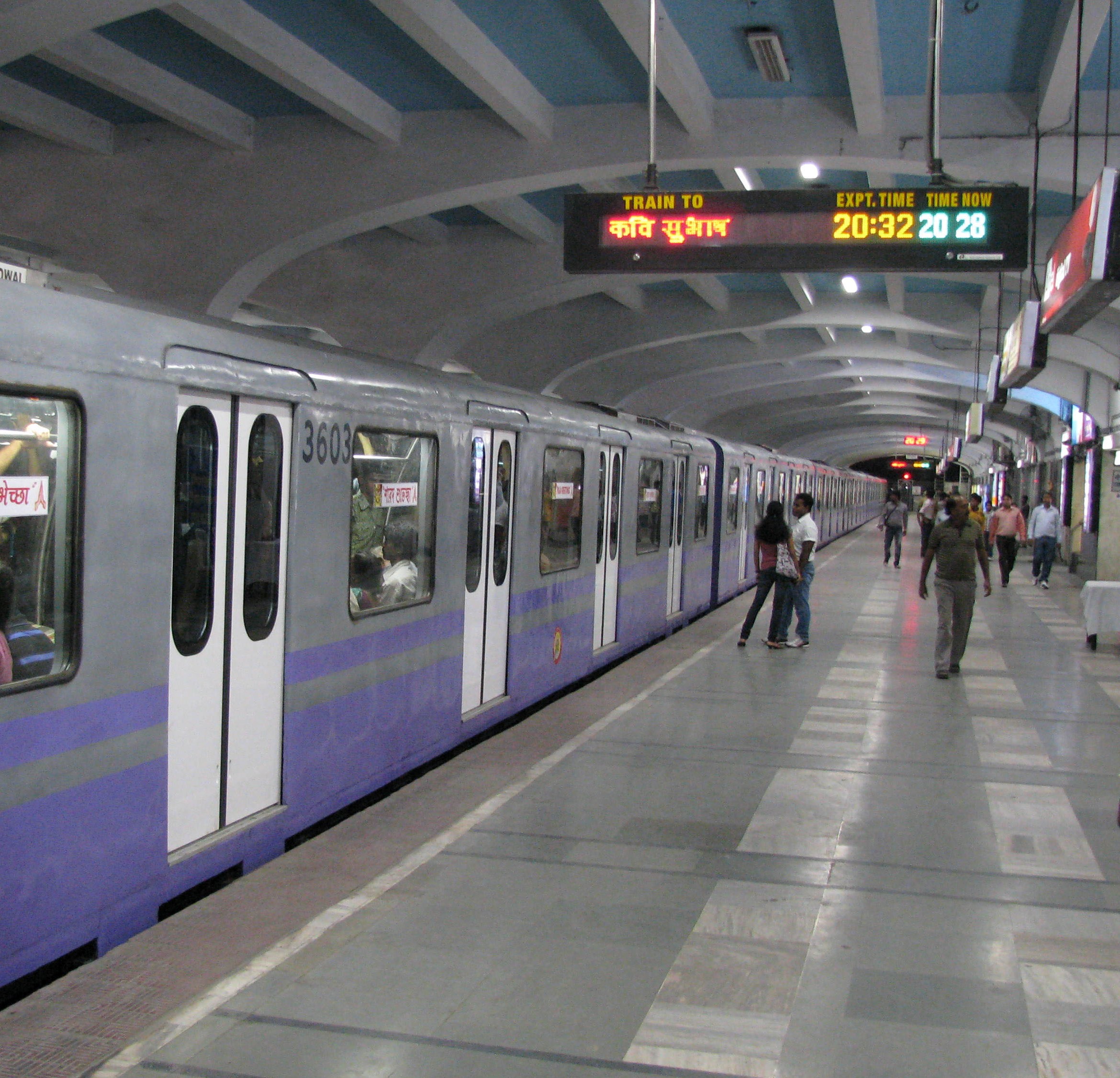
Originally, There are a total of 358 services every day. But, the services and timings were changed due to the COVID-19 pandemic and as of November 2024, it operates between 06:50 and 22:40 IST. Trains operate at an average speed of 23 km/h and stop for about 10 to 20 seconds at each station, depending on the crowd. All stations have display boards showing the terminating station, current time, scheduled time of arrival and estimated time of arrival of trains in Bengali, Hindi and English. Digital countdown clocks are also present in the stations. The coaches of blue and green line have line route-maps and all line have speakers and displays, which provide details of upcoming stations in the three languages. Navigation information is available on Google Maps. Kolkata Metro has launched its own official mobile app 'Amar Kolkata Metro' (initially released as 'Metro Ride Kolkata') for android & iOS smartphone users which provides information regarding station, train timing, fare and has online smart card recharge facility along with mobile QR code ticketing.
Station premises
Most stations have ticket counters and installed ATMs. Some stations have food outlets, and chemist stalls. To ease crowding for recharging smart cards, Automatic Card recharge machines are installed. On account of the Swacchota–i–Seba (in English, Cleanliness is service), a nationwide awareness and mobilization campaign on cleanliness, plastic bottle crushers were placed at multiple stations.
Fare

The fare is based on the predetermined distance formulas. Kolkata Metro has the lowest starting fare in the country of .
Blue Line
| Distance (km) | Fare (₹) |
|---|---|
| 0–2 | 5 |
| 2–5 | 10 |
| 5–10 | 15 |
| 10–20 | 20 |
| More than 20 | 25 |
Other Lines
| Distance (km) | Fare (₹) |
|---|---|
| 0–2 | 5 |
| 2–5 | 10 |
| 5–10 | 20 |
| More than 10 | 30 |
Ticketing system
Kolkata meto uses AFC gates for fare collection monitoring entry and exits. Commuters can enter the metro station and travel through three ways:
- Paper QR code: Paper QR code ticketing system is used on all five operational lines: Blue Line, Green Line, Orange Line, Yellow Line and Purple Line.
- Mobile QR code: Commuters can opt for mobile QR code tickets via the "Aamar Kolkata Metro app" (formerly "Metro Ride Kolkata", which is available on both Google Play Store and iOS App Store). This system allows commuters to purchase and use mobile QR code tickets online for seamless travel. Tickets for multiple people can be purchased on a single device. Users have to scan the QR code each time to let one member pass in multi user tickets. Users have the option to take a screenshot of the QR code ticket for easy access during travel.
- Smart card: Smart Cards are provided by Kolkata metro, which are helpful for daily commuters. Earlier, four different types of smart cards were used: Minimum Multi Ride (MMR), Limited Multi Ride (LMR), General Multi Ride (GMR) and Extended Multi Ride (EMR). They were withdrawn on 7 November 2013 and a single type of Smart Card (General Smart Card) was introduced. There is a compulsory refundable security deposit of . The card is common for the Blue line, the Green line and the Orange line. Online smart card recharge facility was launched on 1 July 2020. These smart cards are not required to be submitted to the AFC gates at the arriving station and are to be carried by the passengers. These cards are required to be recharged if the previously recharged money is already spent. Recharge can be done by "Aamar metro" app or at any Add Value Machine (AVM) located in metro stations. Two new types of Tourist Smart Cards were also introduced (Tourist Smart Card – I and Tourist Smart Card – II). This type of smart card is for tourists and has unlimited rides. They cost , valid for a day and , valid for three days. A security deposit of is also charged.
Before these methods, from 2011 to January 2025, only tokens and smart cards were used as tickets. These tokens are touched on the machine to enter the station, while to exit from the destination station, it is required to submit the token into the machine. The current tokens are coin-shaped and made of plastic. From January 2025, ticket counters stopped giving token to passenger, as it was getting stolen.

Before this, magnetic ticketing strip system was used from 1984 to 2011, After introducing Radio-Frequency Identification (RFID) tokens by Centre for Railway Information Systems (CRIS) in partnership with Keltron in August 2011, the old magnetic strip reader gates were replaced with new RFID readers.
Durga Puja special services
The metro railway runs special night-long services during Durga Puja (Maha Saptami to Maha Navami) to help people travel faster and more conveniently for pandal-hopping. The services start at 13:00 and operate till 04:00 the next day. Pre-puja services are also run.
Security

All stations are equipped with closed-circuit cameras, metal detectors and baggage scanners. The Railway Protection Force provides security on the premises. Smoking is strictly prohibited in the metro premises. All stations in the Green Line have half-height and full-height platform screen doors for elevated and underground stations, respectively.
Seat reservation
In 2008, the Kolkata Metro Railway experimented with the practice of reserving two entire compartments for women. This system was found to be ineffective and caused inconvenience for a lot of commuters (including women) and the plan was dropped. Instead, certain sections of seats in each compartment are reserved for women, senior citizens and the physically challenged. The four-seat sections at each end of a coach are reserved for senior citizens and the physically challenged, and the two middle seat sections, between the general seat sections on each side, are reserved for women.
Other facilities
All stations have televisions that broadcast news and songs. WiFi was introduced at Park Street and Maidan metro station in 2016. Gradually, it was expanded to all the stations. The service is provided by Reliance Jio.
Ridership
Kolkata Metro is the 4th busiest metro system in India as of 2024. 2,465 people travel by every Metro train in Kolkata against 1,110 in Delhi metro. Kolkata Metro carries around 700,000 people daily. The daily and annual ridership has consistently risen since 1984. Low fares and fast and convenient travel have contributed to the high ridership figures. During the 2019 Durga Puja, there was a record ridership of .
| Year | Annual Passengers (in lakhs) | Approximate Daily Ridership |
|---|---|---|
| 1984 - 1985 | 14.66 | 4,016 |
| 1985 - 1986 | 27.58 | 7,556 |
| 1986 - 1987 | 98.41 | 26,962 |
| 1987 - 1988 | 157.84 | 43,244 |
| 1988 - 1989 | 169.57 | 46,458 |
| 1989 - 1990 | 197.51 | 54,112 |
| 1990 - 1991 | 226.17 | 61,964 |
| 1991 - 1992 | 241.44 | 66,148 |
| 1992 - 1993 | 154.57 | 42,348 |
| 1993 - 1994 | 158.62 | 43,458 |
| 1994 - 1995 | 194.86 | 53,386 |
| 1995 - 1996 | 432.76 | 1,18,564 |
| 1996 - 1997 | 625.86 | 1,71,468 |
| 1997 - 1998 | 691.35 | 1,89,411 |
| 1998 - 1999 | 580.26 | 1,58,975 |
| 1999 - 2000 | 557.83 | 1,52,830 |
| 2000 - 2001 | 706.06 | 1,93,441 |
| 2001 - 2002 | 766.57 | 2,10,019 |
| 2002 - 2003 | 773.53 | 2,11,926 |
| 2003 - 2004 | 905.53 | 2,48,090 |
| 2004 - 2005 | 975.62 | 2,67,293 |
| 2005 - 2006 | 1078.73 | 2,95,542 |
| 2006 - 2007 | 1148.53 | 3,14,666 |
| 2007 - 2008 | 1206.22 | 3,30,471 |
| 2008 - 2009 | 1265.37 | 3,46,677 |
| 2009 - 2010 | 1369.74 | 3,75,271 |
| 2010 - 2011 | 1590.64 | 4,35,792 |
| 2011 - 2012 | 1674.48 | 4,58,762 |
| 2012 - 2013 | 1882.98 | 5,15,885 |
| 2013 - 2014 | 1948.37 | 5,33,800 |
| 2014 - 2015 | 1831.41 | 5,01,756 |
| 2015 - 2016 | 1916.37 | 5,25,033 |
| 2016 - 2017 | 1972.13 | 5,40,310 |
| 2017 - 2018 | 2061.38 | 5,64,762 |
| 2018 - 2019 | 2133.04 | 5,84,395 |
| 2019 - 2020 | 2043.19 | 5,59,778 |
| 2020 - 2021 | 265.21 | 72,660 |
| 2021 - 2022 | 765.41 | 2,09,701 |
| 2022 - 2023 | 1769.16 | 4,84,701 |
| 2023 - 2024 | 1925.23 | 5,27,460 |
| 2024 - 2025 | 2181 | 5,97,534 |
| 2025 - 2026 | 2956 | 8,10,000 |
Infrastructure
Rolling stock
Main article: Kolkata Metro rolling stock


.jpg)
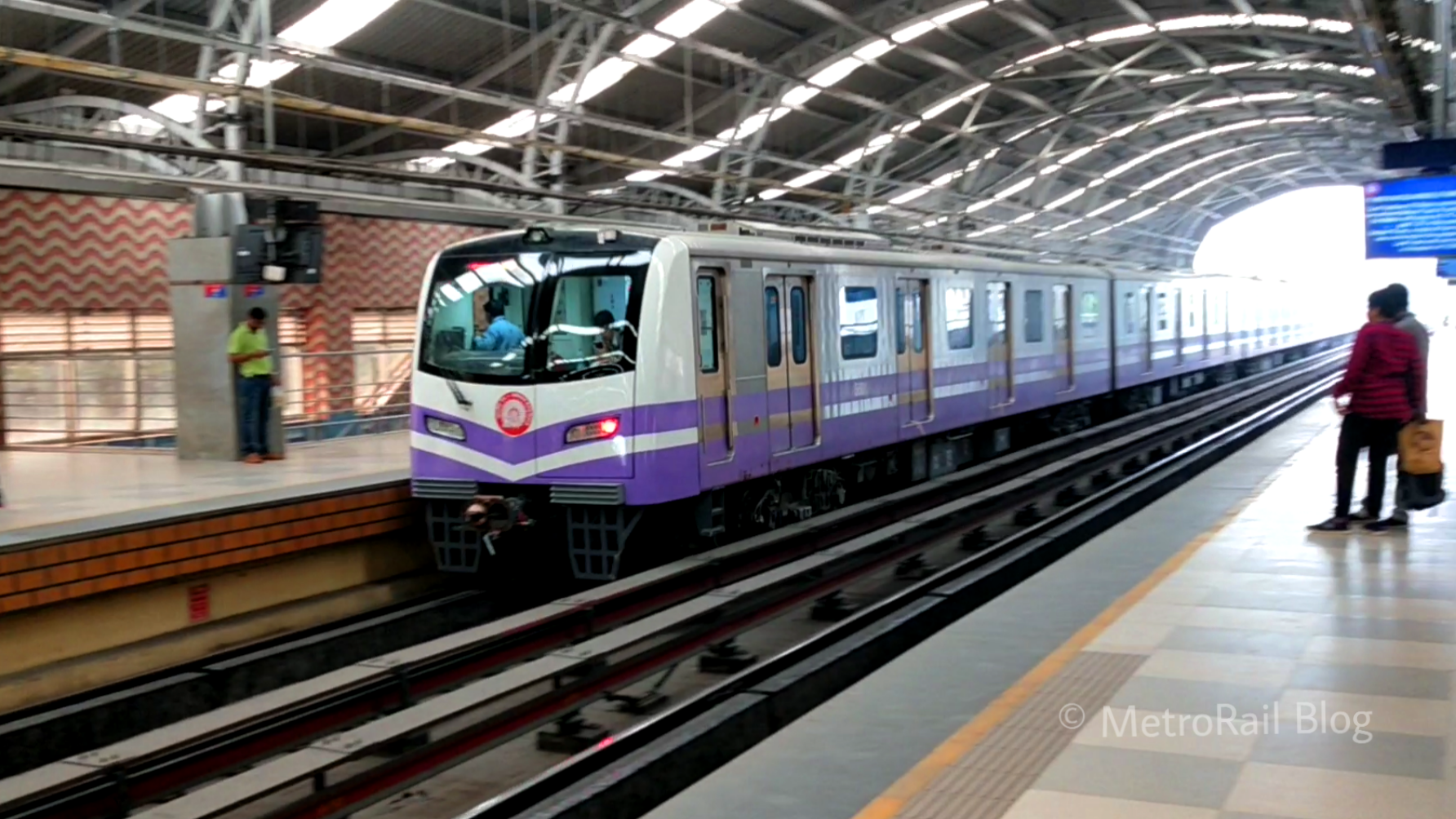
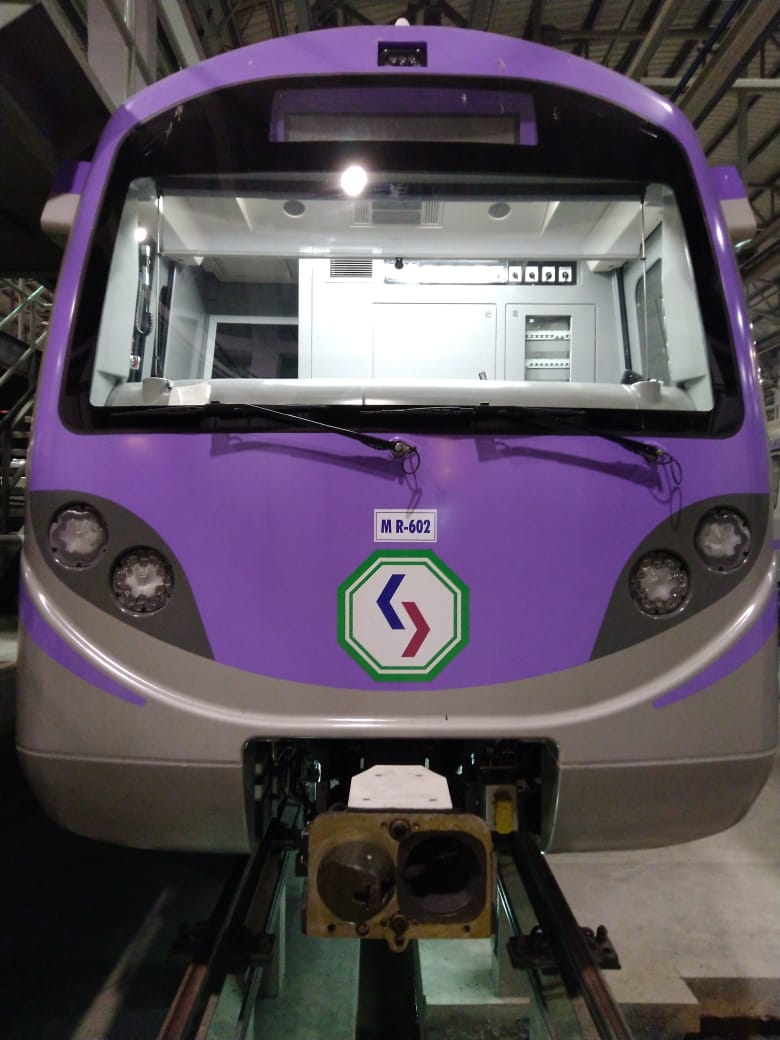
Kolkata Metro rolling stock consists of five main classes spread across its different lines, all powered by 750 V DC third-rail electrification. The Blue, Purple, Orange, and Yellow Lines run on broad gauge while the Green Line uses standard gauge. Early non-AC rakes (1000 and 2000 series) have been retired, replaced by modern AC stock. The ICF/BHEL 3000 series remains in service, while the ICF/MEDHA 4000 series introduced stainless steel bodies and regenerative braking, serving multiple lines. CRRC Dalian trains (MR-50) from China is used in the Blue and Yellow Lines. On the Green Line, BEML MR-60 rakes run on standard gauge with 6-coach formations. Many of the newer trains support both CBTC and older signalling systems.
Depots and yards
Main article: List of Kolkata Metro depots and yards
There are 5 operational depots now. The Noapara, Tollygunge and New Garia depots serve the Blue Line, the New Garia depot also serve the Orange Line, while the Central Park depot serves the Green Line and the Joka depot serves the Purple Line. A depot at New Town for Orange Line is under construction. An underground yard was made at Airport.
Stations and electrification
As of 2025, Kolkata metro has the deepest metro station and largest underground metro station in India. Howrah metro station of Green Line is the deepest metro station in India with depth of 34 m. Also at the time of inauguration, it was the largest metro station of India. In August 2025, Jai Hind metro station of Yellow Line became the largest metro station in India, as well as one of largest in Asia.
The standard length of platforms in Kolkata Metro is 170 m. The metro stations of Gitanjali and Netaji have the shortest platforms of 163 m. The average length between any two stations is 1.14 km. The shortest distance is 0.597 km between Central and Chandni Chowk, and the longest distance is 2.45 km between Sealdah and Esplanade. Since the Kolkata Metro has electrification, electricity substations were built in Jatin Das Park, Central and Shyambazar.
Signalling and telecommunication
Blue Line
Trains operate on typical Indian Railways automatic signaling technology. A Route Relay Interlocking System has been provided at New Garia depot and Tollygunge depot and Electronic Interlocking has been provided at Noapara depot to facilitate the prompt withdrawal and injection of rakes and to perform shunting operations inside the car shed for maintenance purposes. The Train Protection and Warning System (TPWS) is provided throughout the Metro Railway. It is designed to prevent collisions caused by human (operator) error. A Train Describer System and Auto Train Charting are utilized to assist the operation control center in monitoring and planning train movements in real-time. An Integrated Power Supply System and microprocessor-based Data Logger System have also been provided. An integrated system of STM-1 and STM-4 optical fibre cable is used for all telecommunication, signaling, SCADA and other circuits in Blue line. The service is provided by RailTel.
An upgrade of the existing signaling system of the Blue Line from Indian Railways signalling to Communications-based train control (CBTC) was planned by Metro Railway, Kolkata at and the proposal was sent to Indian Railways, so that time interval between trains can be decreased to just 90 seconds from 5 minutes. In August 2019, Indian Railways gave the go-ahead to the proposal, and installation work is supposed to be complete within 2–3 years.
Green Line
Unlike the previous line, the Green line adopted a more advanced CBTC system. It has cab signalling and a centralised automatic train control system consisting of automatic operation, protection, and signaling modules. The signaling system is provided by Italy-based company Ansaldo STS. The other signalling equipment includes an integrated system with fibre optic cable, SCADA, radios, and a public-address system.
Purple and Orange Line
CBTC system on Purple and Orange Lines are currently in activated mode.
Yellow Line
Indian railways signalling system, Kavach with ATP and ATO, is planned to be used on Yellow Line.
Public address system

PA systems are present at all stations and their premises. A station master can make a necessary announcement to the passengers and staff, overriding the ongoing local announcement. Train PA systems are controlled by the motormen for announcements to passengers on the particular train.
Issues
Since the Kolkata Metro was constructed in the 1970s, there were some technical limitations. Due to the tunnel dimensions, and being under Indian Railways, Kolkata Metro opted for an Indian metre gauge shell (2.7 m width) mounted upon broad gauge bogies. The rakes have to be custom built and require a special assembly line involving additional costs thus limiting the options for rake manufacturers for Blue Line. From its inception, the coaches were manufactured by ICF, which lacked the prerequisite knowledge for manufactured non-air-conditioning rakes. The 3000 and 4000 series rakes were faulty and delivered without any trials. In addition, Indian Railways signaling is used instead of European signaling. All of these factors have led to snags, delays, and accidents.
Unlike Delhi Metro, Kolkata Metro is owned and operated by Indian Railways instead of an autonomous body, and it relies solely on Indian Railways for every decision, from funding to route realignment.
Underground tunnels
In densely populated areas, there are no free spaces left to build elevated metro tracks and stations. As a result, underground systems are constructed in these areas. However, the construction of an underground metro tunnel in the Bowbazar area has caused cracks in the houses of many residents. Consequently, the metro authority had to evacuate the people, leading to massive delays and slow development in the construction of the metro railway in that area.
Notes
References
References
- (2 April 2025). "APAC Media | Connecting, Communicating, Changing".
- (2025-04-02). "Metro Carried 21.81 Crore Passengers in 2024-25". [[Metro Railway, Kolkata]] Press Release.
- (29 November 2023). "Kolkata Metro Network Expanded by 25.34 km since 2014, Another 13.27 km Likely to Add in 2023-2024".
- "Prime Minister Shri Narendra Modi Inaugurated Howrah Maidan-Esplanade Stretch of East-West Metro and Other Metro Corridors Today".
- (2024-03-01). "India's deepest Metro station at Howrah also to be the largest". The Times of India.
- (2025-08-21). "Airport hub, six more stations all set to redefine Kol's metro commute experience". The Times of India.
- (10 June 2023). "Kolkata metro: A British engineer's unrealised India underwater train". BBC.
- Ganguly, Deepankar. (23 August 2014). "Metro missed the train to Piccadilly".
- Jayanta Gupta. (5 Feb 2020). "Kolkata's Tube Railway plan nipped in bud a century ago".
- Das, Madhuparna. (2020-03-05). "100 years in the making, why Kolkata's east-west corridor is world's slowest metro project".
- "Kolkata Metro Rail Corporation Ltd". Kmrc.in.
- (9 December 2004). "Metro Railway – Kolkata, Route Map".
- (15 January 2020). "Brief History of Construction of Metro Railway Kolkata".
- Mukherjee, Devjyot Ghoshal & Sharmistha. (3 November 2009). "Delhi Metro speeds past Kolkata's". Business Standard India.
- (10 September 2007). "Metro Railway, Kolkata".
- Ghosal, Mainak. (January 2018). "Challenges faced(then & now)during Kolkata Metro Construction – A Study". Structural Engineering Digest.
- (2006). "Reinventing Calcutta". Asian Affairs.
- Chakraborty, Ajanta. (13 Feb 2020). "West Bengal: Three drivers on roster to steer the first train".
- Indian Railways Portal CMS Team. (10 February 2016). "Metro Railway, Kolkata, the confluence of culture, technology and eco-friendliness".
- "Archived copy".
- (1995). "Calcutta Metro – Construction by 'Cut and Cover' and 'Shield Tunneling' Methods".
- (4 December 2019). "Kolkata Metro on a Reform Roadmap".
- (9 December 2004). "Metro Railway, Kolkata".
- Chakraborty, Ajanta. (25 December 2012). "From April, fly to Naoapara from Garia in 54 mins flat".
- Chakraborty, Ajanta. (22 Feb 2021). "Dakshineswar Metro to link Kolkata with districts".
- "Hindustan Times – Archive News".
- "Review of annual report and audited accounts of kolkata metro rail corporation limited (KMRCL) for the year 2016–17".
- Chakraborty, Ajanta. (13 August 2019). "India's deepest Metro station comes up 30 m below Howrah railway station".
- (2017-05-05). "Kolkata Metro's TBM S639 Crosses Halfway Mark Under Hooghly".
- Chakraborty, Ajanta. (14 April 2018). "Kolkata metro: Kolkata: Metro tunnel boring hits steel wall at Esplanade".
- Jayanta Gupta. (2 August 2018). "Kolkata metro: 'Microsurgery' at Esplanade to remove E-W Metro hurdle".
- Shukla, Darshana. (6 August 2018). "Kolkata Metro {{!}} KMRCL plans microsurgery to solve E-W metro hurdle".
- Roy, Subhajoy. (6 August 2019). "Underground wall to halt subsidence in Bowbazar".
- (6 September 2019). "80 houses damaged, hundreds homeless as digging for Kolkata Metro tunnel hits water body".
- (8 September 2019). "Bowbazar mishap: KMRCL gives compensation to evacuated families".
- (10 June 2019). "Kolkata: Work on fast track as East-West Metro eyes new links in next two years | Kolkata News – Times of India".
- (2024-03-07). "Kolkata Metro Update: Commercial services on newly-launched sections to start in 7-10 days, says official".
- (29 December 2020). "Prime Minister inaugurated today Kolkata Metro's Howrah Maidan – Esplanade Metro section, Kavi Subhash – Hemanta Mukhopadhyay Metro section, Taratala – Majerhat Metro section (part of Joka- Esplanade line)".
- (21 January 2017). "Kolkata Metro Commissioned 3rd Platform At Noapara on Friday".
- Chakraborty, Ajanta. (13 August 2019). "India's deepest Metro station comes up 30 m below Howrah railway station".
- Sanjay Mandal. (2 January 2020). "East West Metro design in last leg".
- (26 July 2009). "Game of the name".
- Jayanta Gupta. (6 July 2017). "Metro prepares completion calendar for city projects".
- (5 February 2020). "Kolkata Metro: 8am on Valentine's Day;Your date with East-West Metro".
- Ajanta Chakraborty. (4 Feb 2020). "On track: First phase of East-West Metro to roll out on February 13".
- (2022-12-30). "Kolkata Metro: First glimpse of Joka-Taratala route in pics".
- (23 November 2024). "Kolkata: 2028-29 deadline for Purple Line full services". The Times of India.
- (25 October 2025). "Metro network to add 19 km by end of 2026, cover 130 km in next few years". The Times of India.
- (2025-03-12). "Purple Line gets green signal for IIM-Joka stn". The Times of India.
- (5 December 2019). "New System Map of Kolkata Metro".
- (4 December 2019). "Milestone".
- (29 June 2019). "Kolkata Metro services to start earlier on weekends from July 1". The Indian Express.
- (22 Feb 2021). "Bengal has made up its mind for 'poriborton', says PM Modi in Hooghly".
- "Kolkata Metro's extended route to Dakshineswar to start in January".
- (10 June 2019). "Kolkata: Work on fast track as East-West Metro eyes new links in next two years".
- Mitra, Debraj. (29 July 2020). "Quicker train hope in nod for Calcutta Metro signal upgrade".
- (28 July 2025). "New Garia Metro station closed after cracks found in pillars".
- (30 July 2025). "Kavi Subhash station to be razed, truncated N-S Metro service".
- (2 September 2019). "18 buildings damaged as Kolkata Metro tunnel-borer 'hits aquifer' – Times of India".
- IANS. (4 June 2016). "East West Metro project cost to shoot up to nearly Rs 9,000 cr". Business Standard India.
- (5 January 2017). "East West Metro project cost to shoot up to nearly Rs 9,000 cr – Times of India".
- (25 February 2016). "Mixed bag for Bengal in Railway Budget 2016; Kolkata gets new Metro route".
- (3 February 2020). "East west metro will be started to run from 13 th february".
- (4 February 2020). "First underwater metro to begin services in Kolkata from February 13". The Hindu.
- (4 Oct 2020). "Kolkata to get first underground metro station in 25 years".
- (2020-10-04). "Piyush Goyal inaugurates Phoolbagan Station of Kolkata's East West Metro corridor". The Hindu.
- (4 October 2020). "ইস্ট-ওয়েস্ট মেট্রো: বিধাননগরের সঙ্গে জুড়ে গেল ফুলবাগান". [[Anandabazar Patrika]].
- "Metro Railway Kolkata / Indian Railways Portal".
- (2024-03-01). "India's deepest Metro station at Howrah also to be the largest". The Times of India.
- "Metro Railway Kolkata / Indian Railways Portal".
- (2025-01-13). "Kolkata Metro to suspend trains on THESE 2 important routes for 45 days?".
- (2025-01-12). "Kolkata Metro links Howrah, Sealdah stations; travel time to reduce to 11 minutes".
- (22 August 2025). "PM Modi inaugurates Kolkata metro corridors; experts say real estate markets to gain from airport, suburban connectivity".
- NANDI, SOUMITRA. (30 January 2020). "Inability to procure land for depot leaves RVNL unsure of Joka-BBD Bag Metro's 1st phase commencement".
- (18 June 2019). "580 crore sanctions to build Joka-BBD Bagh Metro depot – Rail Analysis India".
- Bandyopadhyay, Krishnendu. (30 Jul 2020). "Kolkata: Defence nod makes journey of Joka Metro project easier".
- B, Krishnendu. (1 March 2019). "Work begins at Joka Metro depot, wall built".
- Khare, Anushka. (1 May 2020). "Bids invited for construction of Joka depot for Kolkata Metro Purple Line".
- (28 April 2020). "RVNL Invites Bids for Kolkata Metro Line-3's Joka Depot".
- Bandyopadhyay, Krishnendu. (12 August 2020). "Kolkata: Joka-Esplanade to be India's first Metro to run on indigenous rails".
- Chakraborty, Monotosh. (10 July 2010). "Joka-Eplanade Metro on the anvil". The Times of India.
- Byandhopadhyay, Krishnendu. (17 April 2016). "Kolkata's Mominpore station jinx broken, Joka-BBD Bag Metro rises again".
- Jayanta Gupta. (18 February 2017). "Defence ministry clears decks for Mominpore metro station".
- (19 July 2019). "RVNL invites bids for consultancy services for Kolkata Metro extension".
- Chakraborty, Ajanta. (14 Dec 2020). "Kolkata: Joka Metro skirts school bottleneck with route tweak".
- Chakraborty, Ajanta. (12 January 2025). "Kolkata metro plans to extend Joka-Esplanade Purple Line to Eden Gardens". [[Times of India]].
- (2025-03-11). "Rlys sanctions 1k cr for Eden Gardens metro stn". The Times of India.
- "Dum Dum-Barrackpore Metro project awaits state nod". The Statesman.
- Mandal, Sanjay. (7 December 2018). "Airport-Barasat metro line back to life".
- Sarkar, Pranesh. (5 Feb 2021). "PM nod for underground Metro averts eviction".
- Mandal, Sanjay. (26 February 2015). "Going going... RIP Barrackpore Metro". www.telegraphindia.com.
- (8 May 2014). "Road Ahead….. Projects sanctioned".
- (8 February 2011). "Rail set to take over East-West".
- Chakraborty, Ajanta. (4 Feb 2021). "Kolkata: In election year, four Metro links get Rs 2,263 crore boost".
- (30 March 2018). "Metro Railway Kolkata / Indian Railways Portal".
- Gupta, Jayanta. (28 July 2018). "Airport Metro yard to be country's largest underground facility".
- Shah, Narendra. (4 July 2020). "Railway Board approves Rs 527 crore for Kolkata Metro Line 6 corridor".
- Khare, Anushka. (12 June 2020). "ITD bags balance civil work contract of Kolkata Metro's Airport Line".
- Mandal, Sanjay. (2 Apr 2012). "Track tweak for airport link".
- (2 January 2012). "Survey of 16 new Metro routes – Times of India". The Times of India.
- Rupak Banerjee. (2 December 2016). "2017 start for Howrah EW Metro".
- (28 August 2018). "E-W Metro may run till Santragachhi".
- Sanjay Mandal. (18 July 2019). "East-West load on struggling Metro".
- (29 December 2010). "Kolkata Metro is now the 17th zone of Indian Railways". [[The Times of India]].
- (29 July 2019). "First/last train".
- (12 April 2021). "Time Table".
- (5 February 2020). "Kolkata Metro: 8am on Valentine's Day;Your date with East-West Metro".
- Debraj Mitra. (21 February 2018). "Metro gets real-time display boards".
- Subhro Niyogi. (16 February 2019). "Metro timetable to remain but boards to display dynamic ETA".
- Ramachandran, M.. (3 November 2011). "East–West Metro in Kolkata". Oxford University Press.
- (10 June 2016). "1st Refurbished Non-AC Train Rejoins Kolkata Metro".
- (14 February 2020). "Kolkata 'underwater' Metro: City of Joy gets its second corridor after 36 years".
- (12 May 2015). "Google Maps Transit Adds Indian Railways Schedules, Updated Bus and Metro Routes for 8 Cities".
- "Metro Railway Kolkata / Indian Railways Portal".
- (2 January 2020). "List of passenger amenities item at stations".
- (11 September 2019). "Metro Railway observes "Swachhta – Hi –Seva"".
- "Metro Railway Kolkata / Indian Railways Portal".
- (2024-09-12). "Skip the metro queues with QR-coded tickets on your mobile". The Times of India.
- "Metro Ride Kolkata app creates milestone with commuters banking more on digitisation".
- (14 February 2020). "East West Metro In Kolkata Begins Operations On Valentine's Day".
- (13 March 2020). "Business Rule of Metro Railway".
- (8 May 2018). "For passenger convenience, Kolkata Metro introduces information in Bengali on smart cards".
- (1 July 2020). "Kolkata Metro Web Based Card Recharge System".
- B, Krishnendu. (30 June 2020). "Online recharge of Kolkata Metro Smart Card introduced".
- Jayanta. (31 July 2011). "Smart cards, tokens to replace Metro tickets today".
- Sanjay Mandal. (10 May 2011). "A token ride on the Metro".
- MP, Team. (19 September 2019). "Kolkata Metro to run night-long special services to tackle Puja rush".
- (3 October 2018). "Kolkata Metro To Run Night-Long Service During Durga Puja".
- (3 October 2018). "Kolkata metro: Kolkata: Night-long Metro services during Durga Puja".
- (5 October 2012). "Kolkata metro to install x-ray baggage scanners". Daily News and Analysis.
- (14 January 2020). "Integrated Security System".
- (15 January 2020). "Existing Features".
- (5 October 2017). "Why we must still reserve seats for women on public transport".
- (14 February 2020). "Big cheer for commuters! First phase of Kolkata Metro East-West Corridor opens; top 10 salient features".
- (13 October 2018). "How to Ride the Kolkata Metro Rail or Subway: Insider Tips from a Local Girl! – Orange Wayfarer".
- (29 May 2017). "INCODA TV HD inks sales partnership deal with Aidem Ventures – Exchange4media".
- Indrajit Kundu. (June 1, 2016). "Get set for Wi-Fi service on Kolkata's underground metro. rail!".
- (14 October 2015). "Free Wi-Fi at Metro stations".
- Verma, Kanika. (17 July 2019). "2,465 travel by every Metro train in Kolkata against 1,110 in Delhi -".
- "Metro Services".
- "Comprehensive Mobility Plan Back to Basics Kolkata Metropolitan Area".
- "Performance of the Metro Railway, Kolkata for 2010-11".
- "Performance of the Metro Railway, Kolkata for 2009-10".
- Singh, Shiv Sahay. (20 March 2020). "Sharp fall in Kolkata Metro traffic". The Hindu.
- Hossain, Shaheryar. (23 Nov 2020). "Over 1 Lakh passengers avail Metro services on Nov 18". millenniumpost.
- Chakraborty, Ajanta. (8 Aug 2021). "Kolkata: Metro footfall crosses 2 lakh mark in 3 weeks". [[The Times of India]].
- Ajanta Chakraborty. (Dec 22, 2021). "Kolkata Metro crosses 4 lakh daily ridership {{!}} Kolkata News – Times of India".
- Ministry of Railways. (Jun 17, 2024). "Kolkata Metro Ridership".
- "Kolkata Metro inks deal with BEML for 3 more rakes initially".
- "The Telegraph - Calcutta (Kolkata) | Metro | First look: your swank AC Metro".
- "Modern Chinese rakes for Kolkata Metro".
- Ajanta Chakraborty. "E-W Metro ready for trial run between Central Park & Sec V". The Times of India.
- Mitra, Debraj. (4 March 2019). "Metro rake from China off vessel".
- Jayanta Gupta. (25 May 2018). "Yard remodelling may affect Metro services for a month". The Times of India.
- Jayanta Gupta. (7 October 2018). "Work gets going on Metro's airport station". The Times of India.
- Mandal, Sanjay. (21 April 2019). "Metro hub 150 m from Calcutta airport".
- (30 April 2020). "Rail Vikas Nigam invites bids for Joka-Esplanade Metro Project".
- Mandal, Sanjay. (26 May 2010). "Metro overshoots safety line – Platforms at two stations shorter than stipulated".
- (3 March 2013). "Automatic warning to make Metro safer".
- (1 January 2020). "Existing Signalling System".
- (14 October 2014). "Optical Fibre Cable Communication System".
- "Kolkata Metro East-West Corridor".
- Batra, Mannat. (12 July 2019). "Kolkata East West Metro gets safety clearance for signalling systems".
- Mandal, Sanjay. (29 July 2020). "Smart signalling for swifter East-West".
- "Kolkata Metro Rail Corporation Ltd.".
- (23 May 2024). "Metro looks at driverless tech to extend services till late hours".
- (2025-05-29). "Metro Railway Kolkata Floats Kavach System's Tender for Kolkata Metro's Yellow Line". Metro Rail News.
- (8 May 2014). "Public Address System (PA System)".
- Jayanta Gupta. (23 August 2019). "Kolkata Metro will continue to have problems with rakes, thanks to its construction". The Times of India.
- Gupta, Jayanta. (12 June 2019). "After Monday's disruption, Kolkata Metro back to old rakes; services dip".
- Mitra, Debraj. (13 July 2019). "New trains with a history of snags".
- B, Krishnendu. (18 April 2019). "Systemic faults behind East-West Kolkata Metro delay, says expert".
- (9 January 2012). "DMRC MD E Sreedharan says many Indian cities need metro rail urgently".
- (2022-10-15). "Metro tunneling work in Kolkata's Bowbazar area: 140 evacuated as cracks surface in 10 houses".

This article was imported from Wikipedia and is available under the Creative Commons Attribution-ShareAlike 4.0 License. Content has been adapted to SurfDoc format. Original contributors can be found on the article history page.
Ask Mako anything about Kolkata Metro — get instant answers, deeper analysis, and related topics.
Research with MakoFree with your Surf account
Create a free account to save articles, ask Mako questions, and organize your research.
Sign up freeThis content may have been generated or modified by AI. CloudSurf Software LLC is not responsible for the accuracy, completeness, or reliability of AI-generated content. Always verify important information from primary sources.
Report